
Lender Or Broker – Do You Know Your Partner?
December 15, 2015I probed the audience here on AltFinanceDaily a couple of times this year. Back in June 2015, I wanted to know if you knew what you were selling when it came to the merchant cash advance product? In October 2015, I wanted to know if you knew what you were buying when it came to leads versus data? So as we close out 2015 here in December, I wanted to probe the audience of AltFinanceDaily once more, this time asking: do you know your partner?
THERE’S NO SLOW DOWN COMING (THE NEW ENTRANTS WILL CONTINUE TO RUSH IN)
I’ve been asked by individuals within the industry and those outside of it, on my opinion of when the mass rush of new entrants into the market will slow down. In my opinion, the Year of the Broker will not stop in 2015, but will continue into 2016 and most likely into 2017, when the chickens finally come home to roost for the new entrants, who mostly lack the leveraged networks needed to survive and thrive, and instead are relying on one or more of the following strategies which will no longer be efficient going forward:
- UCCs
- Aged Leads
- Random SIC listing calls
- Random Yellow page calls
- Parking your car down the street and randomly walking into merchant shops
- Stacking behind a 2nd position
 Those who are leveraged with quality strategic partnerships, networks and access to exclusive data records, will be the ones that control the market going forward, while others will fail to remain profitable in this ever changing, integrating and evolving marketplace that we all fight tooth and nail in.
But I must ask you if you know your Partner, as this mass new entrance of players have created many documented cases of brokers having deals stolen, back-doored, commissions not paid, renewal commissions cut-off, and other unscrupulous acts. The vast majority of these documented cases are coming from broker-to-broker relationships, with one broker submitting a file to another broker, but being totally unaware of the fact that they are not working with a “direct” funder or lender.
As we go forward through our changing marketplace, where profits will get tighter, strategic partnerships will be your driving competitive advantage and where access to merchants in general from a “cold-calling” perspective will get more restrictive, you just can no longer afford to be the victim of an unscrupulous act and lose commissions. As a result, going forward, you must indeed know your partner.
THE SEVEN
The following are the seven ways that one could participate in our space:
The Referral: They are not involved in the actual sales process at all, which includes selling rates, collecting paperwork, signatures, etc. All they do is refer a person’s name, telephone number and email address, and might collect an upfront referral fee for doing so. These are usually members of a strategic partnership such as a bank, credit union, credit card processor, accounting firm, insurance firm, etc.
The Sub-Broker: They work as a broker-to-a-broker, going out and doing all of the activity involved with the sales process and submitting the package to a broker, who will then submit it to a couple of funders to “close” the deal. They would then be paid a portion of the commission that the broker gets from the funder or lender once the deal funds, so if the broker gets 6 points, the sub-broker might get 2 or 3 points. Sometimes these individuals (sub-brokers) are willingly signing up for this arrangement, and sometimes they are unwillingly signing up by believing the broker is an actual direct funder or lender, when they are not. This leads to a majority of the issues I’ve identified such as having deals stolen, deals back-doored, commissions not paid, renewal commissions cut-off, and other unscrupulous acts.
The Broker: They go out and do all of the activity involved with the sales process and submit the package to a funder or lender, then manages certain aspects of the closing process such as getting additional signatures, questions answered, stips collected, etc. They would then be paid the commission they set on the deal by marking up the funder or lender’s buy-rate. So if the buy-rate is a 1.12 for a 6 month period, and they marked it up to 1.18, they would be paid 6 points on the deal.
The Syndicate: They would basically do everything a Broker would do, but for some deals they will put some of their own capital resources on the line through syndication, it might be their own equity sources or they might use debt sources such as those from credit card no interest promo deals. The syndication process just allows them to take more money home on the deal.
The Direct Funder/Lender: They have built their own underwriting platform and formulas to lend out either merchant cash advances and/or alternative business loans with a focus on a certain level of profitability and to maintain a certain default rate threshold.
The All-In-One: This is a firm that basically is structured as a direct funder/lender, but they also broker out some deals and on those deals that are brokered out, some of them include the firm syndicating to increase their take home revenue on the deal in particular.
The Investor: This is an equity or debt source that invests capital into a direct funder/lender’s underwriting platform and formula, seeking to capitalize on the high profits that result from a merchant successfully paying back either a merchant cash advance or an alternative business loan.
KNOW A DIRECT FUNDER/LENDER WHEN YOU SEE ONE
When I first started reselling the merchant cash advance and alternative business loan products in late 2009, I noticed that one of the ways to differentiate yourself in the market was to say that you were a “direct funder”, apparently the mentality was that merchants only wanted to talk to the people who could actually do the lending.
Well, I preferred to just admit upfront to merchants that I was a broker, but just explain that the industry is complicated in terms of the pricing models that are present. If you qualify for A+ Paper pricing, you want to make sure you are submitting your package to an A+ Paper lender, otherwise, you might be a merchant with a 700 FICO, clean banks, no liens, and other A+ Paper like qualifications, but might be submitting your package to a funder that will only spit out 6 month offers at 1.35 factor rates. So if you are seeking to work with a direct funder/lender (even if they also syndicate or broker on the side), you just have to know one when you see one, by using some of the following rules of thumb:
- Licensure: Look for some type of state licensure or registration. You can usually find this out by asking the firm their corporate legal name and research this in the state database of where they are incorporated or other states of where they do business.
- Track Record: Look for a proven track record, which means they should have funded at least $10 million in volume and have in business at least 12 – 24 months.
- Fully Staffed: Look for a full office staff, by the firm being very small, this is how your deals end up getting lost, stolen, or the underwriting process drags on for seemingly forever.
- Online Identity: Look for a professionally designed website with a business email address. In addition, look for some type of online press release about the shop opening, a media interview, or news release about an equity or debt financing round. Look up the principals on LinkedIn, and the company should come up on Google as well as other online directory listings including the Better Business Bureau. If you can’t find anything about the company or the principals online in some sort of professional listing and/or publicity based format, I would move on.
THE FINAL WORD
I don’t think there’s a worse feeling one can have, to have gone through the process of spending money to generate a qualified lead, to “close” that lead by getting them to send you an application package, and then to submit the package to your supposed “funder”, only to have the deal stolen and back-doored because your supposed “funder” was nothing but an unscrupulous broker the entire time.
Making sure you select good partners is vital to your survival on this battlefield called “alternative lending”, a battlefield that we fight, scratch, and claw on daily to feed ourselves, our families, and help make the lives of small business owners more efficient than before we got here.
Small Business Finance Association Accelerates Repositioning With Hiring of New Executive Director
December 14, 2015WASHINGTON–(BUSINESS WIRE)–The Small Business Finance Association (SFBA) announced today the hiring of Stephen Denis as its executive director. Denis was formerly the Deputy Staff Director of the House Committee on Small Business and brings over 12 years of public policy experience to the SBFA.
“The innovative companies that are disrupting the way small businesses access capital are creating opportunities for economic growth,” said Denis. “Traditional finance is changing out of necessity for small businesses and SBFA’s mission is to be the voice of the alternative financing industry for small businesses and establishing industry best practices and education.”
The Small Business Finance Association represents companies that offer alternative financing options to small businesses and provides guidance through establishing industry best practices, education and risk monitoring tools. The alternative finance industry has experienced dramatic change and explosive growth in recent years, prompting the need for a strong presence in Washington to protect a vital lending resource for small businesses.
“We felt it was time to bring on an experienced Capitol Hill veteran to make SBFA the leading voice for alternative small business finance in Washington,” said incoming President of SBFA and Chief Executive Officer of Capify, David Goldin. “It is time to come together as an industry to ensure we have a strong and unified voice on behalf of the small businesses we serve.”
“It’s no secret that access to capital is a top challenge for small businesses. SBFA is working to ensure that there are options available to these businesses that contribute to the vibrancy and health of the American economy,” said Vice-President of SBFA and Chairman of Rapid Advance, Jeremy Brown.
The Small Business Finance Association (SBFA) is a not-for-profit 501(c)(6) trade association representing organizations that provide alternative financing solutions to small businesses. SBFA (formerly known as NAMAA) provides guidance and helps to influence and shape the small business alternative financing industry through leadership, education and risk monitoring tools. For more information, visit http://www.sbfassociation.org
Contacts
Small Business Finance Association
Steve Denis, 202-213-9506
sdenis@sbfassociation.org
Stop Being A Sub-Broker
December 10, 2015 In an industry with increasing competitive forces putting downward pressures on offer pricing, while simultaneously driving up demand for particular marketing channels (like SEO and quality data) which increases marketing costs, we are seeing massive downward pressures on profits. With this phenomenon occurring, you would have to wonder why in the world would anyone continually operate as a sub-broker today (willingly)? Are there any particular benefits to this, or is it just flat out non-sense? I wanted to explore this topic head on as we wrap up The Year Of The Broker.
THE VAST MAJORITY OF THE TIME, IT MAKES LITERALLY NO SENSE
There are times when I believe being a sub-broker makes some level of sense, but in my opinion those times (looking at our industry specifically) are very rare and most of the time being a sub-broker makes literally no sense based on the setup. The usual setup for a sub-broker is the same as a broker, which means you are going to be required to go out and spend money on marketing or other forms of lead generation to attract applicants.
Once you get those applications, you would forward them to the brokerage house so they can “close” the deal. A lot of sub-brokers believe this is some sort of grandiose deal, allowing them to as they say “free up time” to do other things. But this line of thinking makes literally no sense, because you have already done 98% of the work, which in our industry is just the consistent generation of high quality leads. Once you have done that and are doing that consistently, emailing the package over to a funder and chasing paperwork is the easiest part.
Why would you take only 25% – 50% of the commission structured on a deal, as well as most likely lose your ongoing renewal compensation, when you can instead take 100% of the commission, control your renewal portfolio and make renewal compensation going forward, which is the lifeblood of our industry?
LIES, LIES AND MORE LIES
Sub-brokers need to stop falling for the lies of larger brokerage houses which include the following:
“We are closers, you aren’t a closer, so let us handle it!”
This is rubbish. In our industry we don’t close, we are match-makers. The merchant comes to us looking for working capital, we pre-qualify their current standing and recommend a potential solution. If the merchant disagrees with the potential solution and we have nothing else that would work, the discussion ends. If the merchant agrees to the estimates and the product overview, we collect an application package to submit it to the funder that we believe can do an appropriately-priced deal. As long as we can get approval inline with expectations, everything moves forward on its own accord.
“We have access to special underwriting, platforms and pricing that you don’t have access to!”
More rubbish. When lenders get an A-paper deal, they give you A-paper quotes. When they get a B/C-paper deal, you get B/C-paper quotes. Look to establish a good relationship with a funder/lender. Let them know upfront that you are a small office so a smaller amount of volume will be coming through you. As long as you don’t have a high default rate, you will have access to the same systems, underwriters, base pricing, and innovative products of the funder/lender that the larger brokerage House has.
“We have access to special industry knowledge that you don’t have access to!”
More rubbish. With sources like AltFinanceDaily and other popular forums, the industry has been exposed. Everything you need to know, learn and be trained on has been covered. Also the assortment of direct funder and lender blogs/websites, media publications, and all of the like covering the industry, there’s no special industry knowledge that you can’t go out and attain on your own.
YOU MIGHT NOT EVEN GET PAID
Being a sub-broker might put you in a position of not even getting paid on new deal revenue as promised, as the large (or more experienced) brokerage is fully aware of your inability to truly challenge them legally or professionally.
- Sue If You Want, It Won’t Make A Difference: You can sue the broker for the $5,000 or so that they didn’t pay you on a couple new deals in Small Claims Court. But even though you can obtain a judgment, collecting on that judgment will be nearly impossible.
- Complain Online If You Want, It Won’t Make A Difference: You can also choose to damage their reputation online through posting various negative reviews, but do you think they will care? Go on the RipOffReport all you want, the largest merchant processing ISOs are all over those reports and that doesn’t do anything to stop their growth. The organizations getting these negative reviews will just say, “we serve thousands of clients and when you are as large as us, you are bound to have unhappy customers.” And that’s exactly what the brokerage house will say to their prospective merchants who bring up these negative review listings that you made.
BUT DOES BEING A SUB-BROKER “SOMETIMES” MAKE SENSE?
On very rare occasions do I believe being a sub-broker makes sense, and it includes if there’s some sort of initial training period and if the larger brokerage has significant marketing competitive advantages.
Training
So if you have zero experience, can’t spell Merchant Cash Advance, and believe you could benefit from a 6 month period with an established broker to show you the ropes, then being a sub-broker for a short period of time could make sense. However, I still believe that with the industry being exposed the way it is, you can train yourself and have to deal with insane non-compete agreements.
Marketing Competitive Advantages
So as a small shop, your marketing budget might be limited to $1k a month, whereas the larger brokerage is spending $20k a month and in a perfect world, might give you a deal where you can work with them without being required to generate your own leads.
They’ll claim to supply everything in terms of your dialer and warm leads, with funder networks already established. So all you have to do is come in, sit down, pick up the telephone, and sell all day to the warm leads coming in from their $20k in marketing. You don’t have to do any cold-calling. So you might be getting 50 leads a week that you convert to 12 applications, which you then convert to 4 new deals. If the average funding is $30k, then that’s $120k in funding with let’s say an average 6% commission that you would split 50/50 (3%/3%), giving you $3,600 per week which is $14,400 per month.
But we don’t live in a perfect world, now do we? Do you honestly believe the structure will be established as promoted? Such as more and more of the 50 leads you receive per week turn into mainly start-ups that don’t qualify for anything. Or, most weeks you don’t receive any warm leads at all, and are required to call UCCs, aged leads, or random listings out of the Yellow Pages, which are all horrible marketing mediums.
EITHER YOU GET IN ALL OF THE WAY, OR MAYBE YOU SHOULD GET OUT
If you are going to be in this industry, then properly set up your office, marketing plan, business plan, funder network and work your own deals. Get 100% of commission structured on new deals and control your renewal portfolio (the lifeblood of our business). If you are going to operate as a sub-broker, for the most part you are going to get a raw deal as we don’t live in a perfect world. We live in a world full of inefficiencies, “rah-rah” sales motivational speeches, and promises that don’t get kept.
Bad Merchants: Lies, Fraud, and Hard Times
December 4, 2015 Critics seldom tire of bashing alternative finance companies, but bad behavior by merchants on the other side of the funding equation goes largely unreported. Behind a veil of silence, devious funding applicants lie about their circumstances or falsify bank records to “qualify” for advances or loans they can’t or won’t repay. Meanwhile, imposters who don’t even own stores or restaurants apply for working capital and then disappear with the money.
“People advertise on craigslist to help you commit fraud,” declared Scott Williams, managing member at Florida-based Financial Advantage Group LLC, who helped start DataMerch LLC to track wayward funding applicants. “Fraud’s a booming business, and every year the numbers seem to increase.”
Deception’s naturally on the rise as the industry continues to grow, according to funders, industry attorneys and collections experts. But it’s also increasing because technology has made it easy for unscrupulous funding applicants to make themselves appear worthy of funding by doctoring or forging bank statements, observers agreed.
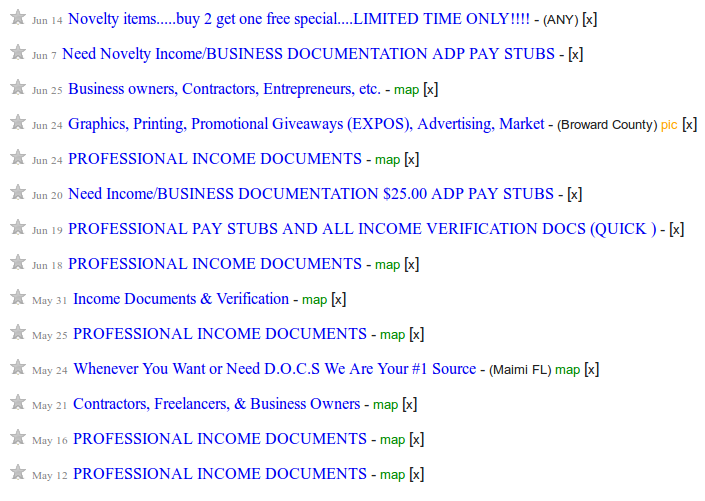
Some fraud-minded merchants buy “novelty” bank statements online for as little as $5 and fill them out electronically, said David Goldin, president and CEO of Capify, a New York-based funder formerly called AmeriMerchant, and president of the SBFA, which in the past was called the North American Merchant Advance Association.
To make matters worse, dishonest brokers sometimes coach merchants on how to create the forgeries or modify legitimate records, Goldin maintained. Funders have gone so far as to hire private investigators to scrutinize brokers, he said.
But savvy funders can avoid bogus bank statements, according to Nicholas Giuliano, a partner at Giuliano, McDonnell & Perrone, a New York law firm that handles collections. Funders can protect themselves by remaining skeptical of bank records supplied by applicants. “If the merchant cash advance company is not getting them directly from the source, they can be fooled,” Giuliano said of obtaining the documents from banks.
Another attorney at the firm, Christopher Murray, noted that many funders insist upon getting the merchant’s user name and password to log on to bank accounts to check for risk. That way, they can see for themselves what’s happening with the merchant.

Besides banking records, funders should beware of other types of false information the can prove difficult to ferret out and even more difficult to prove, Murray said. For example, a merchant who’s nine or ten months behind in the rent could convince a landlord to lie about the situation, he noted. The landlord might be willing to go along with the scam in the hope of recouping some of the back rent from a merchant newly flush with cash.
Merchants can also reduce their payments on cash advances by providing customers with incentives to pay with cash instead of cards or by routing transactions through point of sale terminals that aren’t integrated onto the platform that splits the revenue, said Jamie Polon, a partner at the Great Neck, N.Y.-based law firm of Mavrides, Moyal, Packman & Sadkin, LLP and manager of its Creditors’ Rights Group. A site inspection can sometimes detect the extra terminals used to reduce the funder’s share of revenue, he suggested.
In a ruse they call “the evil twin” around the law offices of Giuliano, McDonnell & Perrone, merchants simply deny applying for the funding or receiving it, Giuliano said. “Suddenly, the transaction goes bad, and they deny they had anything to do with it,” he said. “It was someone who stole the merchant’s identity somehow and then falsified records.”
In other cases, merchants direct their banks not to continue paying an obligation to a funder, or they change to a different bank that’s not aware of the loan or advance, according to Murray. They can also switch to a transaction processor that’s not aware of the revenue split with the funder. Such behavior earns the sobriquet “predatory merchant,” and they’re a real problem for the industry, he said.
Occasionally, merchants decide to stop paying off their loans or advances on the advice of a credit consulting company that markets itself as capable of consolidating debt and lowering payments, Giuliano said. “That’s a growing issue,” agreed Murray. “A lot of these guys are coming from the consumer side of the industry.”
The debt consolidator may even bully creditors to settle for substantially less than the merchant has agreed to pay, Murray continued. Remember that in most cases the merchants hiring those companies to negotiate tend to be in less financial trouble than merchants that file for bankruptcy protection, he advised.
“More often than not, they simply don’t want to pay,” he said of some of the merchants coached by “the credit consultants.” They pay themselves a hundred thousand a year, and everyone else be damned. You continue to see them drive Humvees.”

Merchants sometimes take out a cash advance and immediately use the money to hire a bankruptcy attorney, who tries to lower the amount paid back, Murray continued. However, such cases are becoming rare because bankruptcy judges have almost no tolerance for the practice and because underwriting continues to improve, he noted.
Still, it’s not unheard of for a merchant to sell a business and then apply for working capital, Murray said. In such cases, funders who perform an online search find the applicant’s name still associated with the enterprise he or she formerly owned. Moreover, no one may have filed papers indicating the sale of the business. “That’s a bit more common than one would like,” he said.
In other cases the applicant didn’t even own a business in the first place. “They’re not just fudging numbers – they’re fudging contact information,” said Polon. “It’s a pure bait and switch. There wasn’t even a company. It’s a scheme and it’s stealing money.”
Whatever transgressions the merchants or pseudo-merchants commit, they seldom come up on criminal charges. “It is extremely, extremely rare that you will find a law enforcement agency that cares that a merchant cash advance company or alternative lender has been defrauded,” Murray said. It happens only if a merchant cheats a number of funders and clients, he asserted. “Recently, a guy made it his business to collect fraudulent auto loans,” he continued. “That’s a guy who is doing some time.”
However, funders can take miscreants to court in civil actions. “We’re generally successful in obtaining judgments,” said Giuliano. “Then my question is ‘how do you enforce it?’ You have to find the assets.” About 80 percent of merchants fail to appear in court, Murray added. Funders may have to deal with two sets of attorneys – one to litigate the case and another to enforce the judgment. Even merchants who aren’t appearing in court to meet the charges usually find the wherewithal to hire counsel, he said.
Funders sometimes recover the full amount through litigation but sometimes accept a partial settlement. “Compromise is not uncommon,” noted Giuliano. Settling for less makes more sense when the merchant is struggling financially but hasn’t been malicious, said Murray.
To avoid court, attorneys try to persuade merchants to pay up, said Polon. “My job is to get people on the phone and try to facilitate a resolution,” he said of his work in “pre-litigation efforts,” which also included demand letters advising debtors an attorney was handling the case.
 But it’s even better not to become involved with fraudsters in the first place. That’s why more than 400 funding companies are using commercially available software that detects and reduces incidence of falsified bank records, said a representative of Microbilt, a 37-year-old Kennesaw, Ga.-based consumer reporting agency that has supplied a fraud-detection product for nearly four years.
“Our system logs into their bank account and draws down the various data points, and we run them through 175 algorithms,” he said. “It’s really a tool to automate the process of transferring information from the bank to the lender,” he explained.
The tools note gross income, customer expenditures, loans outstanding, checks returned for non-sufficient funds and other factors. Funders use the portions of the data that apply to their risk models, noted Sean M. Albert, MicroBilt’s senior vice president and chief marketing officer.
Funders pay 25 cents to $1.25 each time they use MicroBilt’s service, with the rate based on how often they use it, Albert said. “They only pay for hits,” he said, noting that they don’t charge if information’s not available. Funders can integrate with the MicroBilt server or use the service online. The company checks to make sure that potential customers actually work in the alternative funding business.
MicroBilt is testing a product that gathers information from a merchant’s credit card processing statement to analyze ability to repay excessive chargebacks reflected in the statements could spell trouble, and seasonality in receipts should show up, he noted.
Additional help in avoiding problem merchants comes from the Small Business Finance Association, which maintains a list of more than 10,000 badly behaving funding applicants, said the SBFA’s David Goldin. The nearly 20 companies that belong to the trade group supply the names.
SBFA members, who pay $3,000 monthly to belong, have access to the list. According to Goldin, the dues make sense because preventing a single case of fraud can offset them for some time, he maintained. Besides, associations in other industries charge as much as $10,000 a month, he added.
Another database of possibly dubious merchants, maintained by DataMerch LLC, became available to funders in July, according to Scott Williams, who started the enterprise with Cody Burgess. It became integrated with the AltFinanceDaily news feed by early October, causing the number of participating funders to double to a total of about 40, he said. The service is free now, but will carry a fee in the future.
It’s not a blacklist of merchants that should never receive funding again, Williams emphasized. Businesses can return to solvency when circumstances can change, he noted. That’s why it’s wise to regard the database as an underwriting tool. In addition, merchants can in some cases add their side of the story to the listings.
Funding companies directly affected by wayward merchants can contribute names to the list, Williams said. About 2,500 merchants made the list within a few months of its inception, he noted. “We’re super happy with our numbers,” he said of the database’s growth.
Many merchants find themselves in the database because of hard times. Of those who land on the list because of fraud, perhaps 75 percent actually own businesses and about 25 percent are con artists applying for funding for shell companies, Williams said.
So far, only direct funders – not brokers or ISOs – can get access to the database, he continued, noting that DataMerch could rethink the restriction in the future. “We don’t want hearsay from a broker who might not know the full scope of the story,” he said.
DataMerch might grant brokers and ISOs the right to read the list to avoid wasting time pitching deals to substandard merchants, but the company does not intend to enable members of those groups to add merchants to the database, Williams said.
Williams sees a need for the new database because smaller companies can’t afford belonging to the SBFA. The association also tracks deals about to become final, which could prevent double-funding but makes some users uncomfortable because they don’t want to disclose their good merchants, Williams said.
 Although dishonesty’s sometimes a factor, merchants often go into default just because of lean times, Jamie Polon, the attorney, cautioned. A restaurant could close, for example, because of construction or an equipment breakdown. “Were they not serving dinner anymore, or was there something much deeper going on?” he said. Fraud may play a role in 10 percent to 20 percent of the collections cases his law firm sees, he noted. More than 95 percent blame their troubles on a downturn in business, and the rest claim they didn’t understand the contract, he said.
To understand the downturn, it’s important to amass as much information about the merchant as possible, said Mark LeFevre, president and CEO of Kearns, Brinen & Monaghan, a Dover, Del.-based collections agency that works with funders. That information sheds light on a merchant’s ability to repay and could help determine what terms the merchant can meet, he said.
Timeliness matters because the sooner a creditor takes action to collect, the greater the chance of recouping all or most of the obligation, LeFevre maintained. When distress signals arise – such as closing an ACH account or a spate of unreturned phone calls – it’s time to place the merchant with a collections expert, he advised.
LeFevre’s company also traces a troubled merchant’s dwindling assets to help the funder receive a fair share. Funders can sometimes recover all or most of what they pay a collection agency by imposing fees on the merchant, he noted.
Pinning the collection fees to merchants in default makes sense because that’s where the guilt often resides, observers said. It’s part of balancing the bad behavior equation, they agreed.
Shark Tank’s Barbara Corcoran Teams Up With OnDeck for Small Business Contest
November 29, 2015 Barbara Corcoran, co-founder of The Corcoran Group and famous Shark Tank investor, has teamed up with small business lender OnDeck to support entrepreneurs through a contest. Three winners will be chosen for a $10,000 prize and they’ll also get to meet Barbara Corcoran.
Contest applicants are asked to enter what they would spend the $10,000 on to grow their business. The deadline to enter is December 2nd, 2015.
The partnership is significant because it marks yet another time that a Shark has crossed paths with online business lenders. Just one year ago, Kevin O’Leary became a spokesperson for IOU Financial.
I'm thrilled to announce a new partnership between O'Leary Financial & @IOUCentralInc this morning! http://t.co/ECJl1K5ZUC #smallbusiness
— Kevin O'Leary (@kevinolearytv) October 2, 2014
Also around that time, Kevin Harrington, an original Shark Tank investor before Mark Cuban or Lori Greiner, co-founded his own small business lending marketplace, Ventury Capital. Straight out of the OnDeck or merchant cash advance playbook, Ventury’s FAQ says their system “deducts a fixed, daily payment directly from your business bank account each business day.”
Watch Kevin Harrington explain his company here:
Of course there was the time that a merchant cash advance company (Total Merchant Resources) actually went on Shark Tank and pitched the sharks…
It seems that the show and the real world have a lot in common.
Business Lending: Sell The Whole Solution
November 26, 2015 The year of 2015 went by rapidly, as it felt like yesterday that I was sitting back in my office chair, reading an article from the March/April 2015 edition of AltFinanceDaily Magazine, composed by Ed McKinley, a man with nearly 40 years of journalism experience.
McKinley began a discussion about a “year of the broker,” based on analysis, interviews, and criticism of the mass new entrants of brokers into our space within recent times. I have spent the better part of this year continuing this discussion both here on AltFinanceDaily and within our industry circle, with discussions that have been both conventional, out of the box, and even at times peculiar. Speaking of peculiar, this brings us to the opening of this discussion, in which I must quote RuPaul.
RuPaul once stated that, “life is about using the whole box of crayons.” In my opinion, if you can figure out the profession of sales, you can pretty much figure out most of everything there is to life. And if RuPaul is right in that life is about using the whole box of crayons, why do so many of the mass new entrants of brokers within our industry, believe they are going to properly sell a merchant without using the whole solution?
It’s common knowledge that every individual crayon provides its own distinctive color, which in and of itself creates its own distinctive value, as value in this case is based upon where the color fits on the page to provide its role in the total coloring scheme. But just like crayons, every part of our alternative financing solution provides a distinctive value that altogether creates the whole solution for the merchants we serve.
(Q) + (S) + (P) = THE WHOLE SOLUTION
The Whole Solution equation is based on three letters. “Q” stands for Quality, “S” stands for Support and “P” stands for “Pricing”. How many brokers within our industry focus only on offering the “Q” and “S” portion of this equation, without the “P” portion? How many brokers within our industry focus on offering the “Q” and “P” portion, without the “S” portion?
QUALITY
Quality is all about bringing to the merchant what they deem to be value, and in our space (alternative financing) that means capital when they need it. Thus, you should have a comprehensive resource network of alternative financing products from merchant cash advances, alternative business loans, equipment leasing products, factoring, purchase order financing, and more, with approval amounts that can solve the working capital needs of the merchant. This creates value.
SUPPORT
This is all about your professional competency, merchant servicing and merchant education.
- Professional competency is all about you and your team having knowledge of the industry, the various products, the competing products, the market trends, understanding your merchant’s industry, and understanding how the product could help (or hurt) the merchant in achieving their operational objectives.
- Merchant servicing is all about providing tools for your merchant to manage their account with you, such as online access to statements, balances, transactions, or at least providing such information in a monthly statement. It also includes having easy access to live support agents during business hours to properly handle merchant questions, payment issues, collection issues, as well as there being an option for payment modification if a situation warrants it.
- Merchant education is all about educating the merchant based on the big data analytic information that you have currently, and how they can use this to help their business in various areas such as how to qualify for more conventional financing, better marketing strategies, etc.
PRICING
In our industry, proper pricing is based on utilizing risk-based pricing, which is to price a merchant based on their paper grade. This can only be done after efficient pre-qualification of the merchant to understand where they stand.
Some merchants have low risk measurement, thus, they are A+ Paper and A Paper. Some merchants have moderate levels of risk, thus, they are B and C Paper. Then some merchants have higher levels of risk, thus, they are D and E Paper.
A+ Paper: Should be priced similar to a P2P lender’s pricing schedule, which includes longer terms up to 60 months. These terms and conditions mirror that of a conventional loan.
A Paper: Should be priced on 6 – 18 month payback cycles. The shorter ranges of 6 – 8 months having 1.09 – 1.20 pricing, 9 – 10 months having 1.22 – 1.24 pricing, 12 – 15 months having 1.25 – 1.32 pricing, and 18 months having 1.28 – 1.35 pricing.
B and C Paper: Should be priced on 6 – 12 month payback cycles. The shorter ranges of 6 – 8 months having 1.22 – 1.26 pricing, 9 – 10 months having 1.28 – 1.30 pricing, and 12 months having 1.35 – 1.45 pricing.
D Paper: Should be priced on 4 – 7 month payback cycles. 4 – 5 months having 1.28 – 1.35 pricing and 6 – 7 months having 1.40 – 1.45 pricing.
E Paper: Too high of risk to usually find a decent approval.
FINAL WORD
I usually debate other sales professionals (within our industry and outside of it) in regards to selling the whole solution.
Some believe that if you put majority of the focus on quality and support, then you can literally price your client however you prefer, including well above their marketplace pricing.
Some believe that if you just focus on providing the lowest price, then you can get away without having the best quality and support functions.
Both of these approaches are selling the partial solution, but the whole solution should always be the best solution as it provides the best in quality and support, while tying in a proper pricing model for the client based on their standing in the marketplace. This leads to client longevity, loyalty and stickiness. That’s why I believe the best approach is to sell the whole solution.
Building An Alternative Lending Sales Profile
November 24, 2015 Merriam-Webster dictionary defines the word, independent, in a number of different ways, but one of the definitions provided relates this word to the concept of freedom. Most of us operate in this industry on an independent basis, which gives us a significant level of freedom that revolves around not having a boss, freedom to set our own schedules, freedom from being down-sized, freedom from office politics, but more importantly:
- freedom to craft our own business plans
- freedom to target our own market segments
- freedom to decide what we will sell
- freedom to create our own products
- freedom to negotiate our own market pricing
- … and freedom to innovate
With such high levels of freedom, you have to wonder why a lot of brokers in our industry don’t exercise such liberties? Why do we sell the same products (cash advances and alternative business loans)? Why do we use the same marketing tactics (UCCs and aged leads)? Why do we market, promote and sell to the same merchants (UCCs)? Why do we use the same “pitch”? Why do we submit to the same funders?
If we are truly independent contractors, why do we all look, act and sound the same?
As we continue The Year Of The Broker, I wanted to begin a discussion on a concept that integrates your capability of independent expression. It’s the concept of constructing an alternative financing sales profile. It allows you to display your level of true independence by pre-qualifying your prospective clients and recommending solutions that are different from the pack of brokers recommending the same “me too” solutions, seeking to submit the merchant to the same “me too” funders.
ARE YOU A “BROKER” OR NOT?
Are you paid only when you broker (fund) a deal?
If so, the generation of a financing lead or application in and of itself, doesn’t produce value as it doesn’t create revenue. Revenue is only created when you successfully broker a deal, which is to match a merchant with alternative funding needs and with a particular terms/conditions comfort range, with products funded by lenders whose pricing lines up with the particular comfort level of your prospective client.
As a broker, you are much more than a salesperson, you are more of a match-maker, an arbitrator, and an consultant. You can’t consult someone if you don’t know their current situation for one, and two, you can’t consult someone unless you have the resources to prescribe appropriate solutions.
See yourself more as a doctor than a salesperson, where as a salesperson has one or two products that he’s looking to “push” on a prospect using various tactics such as cost cutting and overcoming objections, a doctor isn’t trying to “push” anything out of the gate without firstly diagnosing the client through a series of questions. After said questions have been inquired and answers provided, the doctor creates a “profile” of said client and through his wealth of medication, he prescribes a couple of solutions to assist the client.
To help increase your chances of brokering (funding) your deals, you want to increase your level of pre-qualification and increase your level of product offerings, both of which will allow you to create firstly an alternative financing sales profile of your client, and then secondly allow you to go into your wealth of alternative financing products to prescribe an array of products.
EFFICIENT PRE-QUALIFICATION
Going forward, make sure to do serious pre-qualification to create an estimated risk profile as well as an estimated sales profile. You want to know all of the following: their credit, time in business, annual sales, cash flow situation, level of profitability, type of assets, outstanding commercial debt, any current tax or judgment liens, recent bankruptcies, and current status of commercial mortgage or commercial lease agreements.
From this information you are able to create an Alternative Financing Sales Profile along with an occupying Risk Profile for each product you will soon be recommending, to know which lender within that product category is best to serve your client.
YOUR WEALTH OF ALTERNATIVE FINANCING RESOURCES
So for example, say we have a restaurant owner that’s in need of $250k in working capital for expansion. You shoot him over the pre-qualification survey and receive the following: 700 FICO, 5 years in business, $1 million sales, zero NSFs/Overdrafts for 6 months, $10k average bank balances over the last 6 months, company has been profitable for the last 3 years, no tax liens, no judgment liens, no bankruptcies, current on commercial lease payment, outstanding debt that includes $25k on a credit card with $50k outstanding on a bank loan. The merchant’s commercial assets includes business equipment, free and clear, with appraised value of $150k.
As an alternative financing broker, you should have access to more than just merchant cash advances and alternative business loans, you should also have access to: merchant processing, equipment leasing, asset based lines of credit, inventory loans, SBA loans, business credit cards, factoring, purchase order financing, commercial mortgages and real estate hard money loans.
So based on the answers to the pre-qualification survey completed by the restaurant owner, in conjunction with his total financing needs, you might be prescribing an SBA loan, a merchant cash advance, and a sale-leaseback.
- You would seek to get him an SBA loan first and let’s just say he only gets approved for $50,000. So you guys complete the process to fund the SBA loan.
- Next, you would look at doing either a merchant cash advance for let’s say another $100,000 using split funding. You notice that his current processing rates are a little higher than market average pricing for Restaurants and show him a savings analysis with your interchange plus pricing structure with a 10BP mark-up that should be saving him $400 a year which is $1,200 over three years. So in the process of this you also convert his merchant processing over to one of your processing platforms that can handle split funding. Now you have raised $150,000 of the $250,000 funding goal that the merchant has in mind.
- Finally, you would look at doing a sale-leaseback on his pre-owned equipment that’s appraised for $150,000. With a 70% LTV, this comes to $105,000 in funding. Now you have successfully funded the merchant over $250,000 and in the process closed three different alternative funding products as well as converted over his merchant processing at the same time.
In an upcoming article, I will continue this discussion on pre-qualification by going into information on how this level of efficiency includes the creation of Risk Profiles that allow you to limit your submissions to your funders/lenders as to not clog up their underwriting pipelines with unnecessary submissions. It allows you to focus on submitting 10 applications and funding 5, instead of submitting 50 applications and funding 5.
Mr. Funder: Help ME, Help YOU (Rants On Funders and Lenders)
November 13, 2015 As we continue the Year of The Broker, I thought that it was time for a part two to my original rant article that blew off some steam on one of the most crucial elements in our industry, the merchants themselves. For this round, how about we take a look at another crucial element to our industry, the ones who create the platforms, raise the equity capital, create the products, fund the deals and pay the commissions. Of course, I’m talking about the Funders and Lenders.
Help ME, Help YOU
Mr. Funder, please Help ME, Help YOU. We all know the situation of why I, as an independent broker, are working with you and it’s because I’m a part of your Mom and Pop Network. The Mom and Pop Network is just a group of random brokers who will resell for free (we cover our own expenses), so your goal is to recruit hundreds to thousands of us to collectively produce tens of millions in annual funding volume for your organization.
But some of the things that you do Mr. Funder make it difficult for me to help YOU build your Mom and Pop Network, which in terms helps ME build my portfolio and commission stream. So allow me to list out some pet peeves that hopefully you, going forward, can fix.
#1.) New Deal Requirements To Keep Renewal Portfolio
Mr. Funder, you received free marketing and acquired new clients on behalf of my efforts in marketing, selling and closing. You had no cost associated with the acquisition of said client other than the percentage points paid to me in commission, but that was only after the fact that I bought you a quality client (that didn’t default within 30-45 days), there was no risk assumed by you in spending money on marketing with a chance of not recouping profit.
So why in the hell do you put provisions in place to try and cut me OFF from said renewal portfolio? Do you realize that my entire business plan is based on building up a renewal portfolio and “sitting back”? That’s why I’m in Merchant Services related sales, it’s all about the Renewal Portfolio. Mr. Funder, please remove your insane new deal requirements and stop trying to push good brokers out of their Renewal Portfolio.
#2.) Having An Incompetent Process
From the customer service and billing support “little girls” who are flat out rude, to the payment collections team who messes up fixed payment withdrawals, to the underwriters who throw out inaccurate approval numbers, to having an underwriting process that takes 48-72 hours for you to update me on a file, to the excessively long closing process that drags on and on into 10 business days (two weeks) which is way more than the promoted “3 day” closing period, Mr. Funder, can you please take a little more time to fix your process?
#3.) Allowing My Merchants To Stack
So you make sure provisions are in place that I, the Broker, do not stack the merchant and you make this clear in the Broker Agreement that I would be “cut off” from renewals if such action occurs.
But yet, in your Funding Agreement for the Merchant, you have absolutely NO provision, sanction, penalty, or anything in place to punish the Merchant for going out and stacking other than the fact that he might not be approved with you for a renewal (like the Merchant would care, after all, 10 companies are calling him a day offering him money).
This means that the Broker up the street can stack my Merchant with a 2nd position, you will decline them during renewal as a result of such stack, and the other Broker will offer another approval to then 100% steal the client over to their organization going forward. You Mr. Funder get paid off, the merchant gets more money, the other Broker gains a new client……the only one that gets screwed in this situation is ME!
Mr. Funder, please add an Amendment to your Funding Agreements for Merchants that will put fines in place if they stack, similar to how Merchant Processors put ETFs in place to stop merchants from switching their merchant accounts every month to save “$10”. This will STOP the stacking craze when a merchant realizes they will have to pay $7,000 per STACK.
#4.) Still Filing UCCs On Good Accounts
So Mr. Funder, it’s common knowledge that the mass new entrants of brokers into the industry are all pounding away on UCC records, causing said merchants to receive 15 – 20 calls a week for “funding”. So knowing this Mr. Funder, why in the hell do you keep filing UCCs on good accounts?
If an account goes bad, you already have paperwork signed with said Merchant stating that a UCC “will be or could be” filed, can’t you just come back and file the UCCs only on the accounts that went to collections? Why file them on the good paying accounts so the Merchant is harassed all week long?
#5.) Over 30 Day Commission Clawbacks
No more than a 30 day clawback period should be in place. Once we start getting into 45, 60 and 90 day clawback periods, this means that you are inefficiently underwriting the merchant.
#6.) Excessive Stacking and Back-Dooring
Let’s start with back-dooring, once again, you receive free marketing from me and I’m only paid when I bring you a quality deal that funds. So why in the hell are you trying to steal my deals? Aren’t you already getting a good “deal” from me with all of the free marketing I’m doing for you? Mr. Funder, can you please stop back-dooring files?
In relation to Stacking, there’s absolutely no justification you can make for a 3rd, 4th, 5th, and 6th position stack. You can make a case for a 2nd position, even though it might still technically violate the 1st position lender’s Agreement, a 2nd position could work on a case-by-case basis.
There’s absolutely no justification for a 3rd plus position, all you are doing is taking way too much of the merchant’s monthly gross to where he might end up paying 40% (or more) of his monthly gross to Cash Advance companies. This makes absolutely no sense Mr. Funder, so can you please STOP doing this?
Final Word
Mr. Funder, please Help ME, Help YOU. My position as an independent broker in a highly competitive industry is hard enough. I have to cover my own insurance costs and I’m alone in this world in terms of developing my own profitable business plan to not just eat, but cover my other living expenses, pay for taxes (on time) and fund retirement.
Please stop making it harder for independent brokers with the above inefficiencies, keep your process as efficient as possible so that it can increase the probability of more of your independent brokers having career sustainability.