
Merchant Cash Advance Industry is Waiting for its Big Moment
August 25, 2011Originally Posted 7/28/2011
According to an article in ISO&AGENT Magazine, the Merchant Cash Advance (MCA) industry has had significant success but “the companies that fund them acknowledge the cash-advance market is still waiting for its big moment.” This echoes our earlier opinion that a lack of collective marketing is keeping this financial tool from reaching its true potential.
How is it that in an ultra tight credit market that small businesses have not heard of MCA? With lax credit score standards, fast turnaround, minimal documentation, and a flexible method of repayment, it’s absurd that the industry has not reached so many that are looking to borrow. ISO & AGENT points to a negative image crisis and fingers the costs involved as a possible culprit.
The costs are a non-crisis. MCAs would be less expensive if they required collateral, perfect credit scores, fixed terms, ten years in business, and a 3 month underwriting process. If a small business meets those requirements and does not have a time sensitive opportunity they are looking to capitalize on, they should be going to their local bank. But most small business owners either do not meet that criteria or need the funds for a project they have going on today. Hence the product has to be more expensive for it to make sense for the firms providing the funds.
ISO&AGENT claims the industry has been compared to payday loans, an untrue characterization. In fact, that comparison has so rarely been made, that we can pinpoint the exact place they got that from. Inc.com published a very unflattering article on April 1, 2008 titled ‘Thanks, But No Thanks‘, in which they explain MCAs as “the business equivalent of a payday loan.” That was three and half a years ago! The article was not only biased and unfair, but was also written at a time when everything related to Wall Street, banks, or lending was being demonized as the nation sat on the verge of the Great Recession and economic collapse.
Still one can’t help but notice that buried deep within their criticism, is the answer to why MCAs are a tad bit more expensive:
The fact that collateral isn’t necessary is another important part of the MCA providers’ pitch. Entrepreneurs sometimes risk losing their homes if they can’t repay a bank loan, but they have no legal obligation to repay merchant cash advances if their companies fail, as long as they strictly follow the terms of the contract. They can’t encourage customers to pay in cash, for example, and they cannot switch credit card processors (typically, the MCA provider gets paid directly by the processor, rather than by the merchant). “If Diane’s Bistro goes out of business because Lauren’s Bar & Grill opens up across the street, we have absolutely no recourse to Diane, none whatsoever — as long as she follows the clearly defined covenants in our contracts,” says Glenn Goldman, AdvanceMe’s CEO.
And if you had any more reason to suspect MCAs are not as bad they tried to make it out to be, Inc.com published that article on April Fools Day. Case closed.
But there is indeed an image crisis and it’s that many businesses haven’t been exposed to the concept of MCA and thus cannot consider the pros and cons at all.
For instance: Most people can make the case for or against consumer payday loans. They’ve already got loads of information from the media, newspapers, banks, and lawmakers on which to base their argument. It’s become a well known household accepted form of financing. Whether or not payday loans can help the consumer is a separate debate.
That’s the difference. MCA is rarely spoken about by newspapers, banks, or lawmakers. Its presence in the media is limited and as a result we’re referring to stories published over three years ago. We have many friends employed as small business loan officers across the country and the only reason they’re aware of how MCAs work is because we told them. It’s embarrassing. And for an industry that funded over $500 Million last year alone, it really makes no sense.  We blamed antiquated marketing techniques: cold calling, junk mail, useless internet marketing, and spamming. The industry has gotten lazy and has a propensity to market their financing to small businesses that have already secured a MCA. This comes with bold promises of lower rates and other gimmicks. This inner competitiveness leads to both smaller margins and lower conversion rates. It does nothing to grow the industry as a whole.
That’s complemented by carpet bombing the public with an approach their customers learned to ignore a long time ago. Cold calls and junk mail. Really? Yes, really. There will always be a sliver of effectiveness from these methods and the firms that employ them will defend their success to the death. These methods may score some deals and perhaps even work well enough to grow a MCA firm, but it will not lead to the industry’s ‘big moment.’ Same goes for internet spam, poorly constructed articles that serve no purpose other than to boost some company’s SEO, and useless blogs kept by both respectable firms and no-name websites set up to harvest leads. Sure that’s the way of things on the internet these days but there isn’t anything beyond that. There are no mainstream media articles about MCA, forums for business owners where it is actively discussed, nor any public endorsements by anyone of high political or business stature.
Sounds like we have an image crisis on our hands. The Merchant Cash Advance Resource (the site you’re on right now) has been in existence for 1 year. In that time, we’ve made significant additions to the information that can be accessed here. We constantly receive emails from business owners and MCA brokers alike with the hope that we can provide them with an unbiased answer. And guess what? We do just that. By having no commercial affiliation, we give the best advice we can. The e-mail volume has gotten so heavy that our volunteer editors have trouble answering them all. But we try anyway.
And along the way we’ve managed to get some formal offers to convert this resource into a commercial site to generate sales leads. A six figure buyout offer here and there coupled with some lengthy, legalese filled non-disclosure agreements. We say ‘no’ every time. The Merchant Cash Advance Resource is designed to provide information, opinions, critiques, data, guides, and an independent ‘thumbs up’ to an industry that’s destined to do great things for small business.
Why do we spend the time, money, and effort to provide this service? We’re looking at the big picture of MCA. Big picture… Big moment…
And we’re on our way.
AltFinanceDaily
../../
Who Are You Really Dealing With?
August 23, 2011
A long time ago, I did what every man has to do at some point in their lives (hopefully only once), plan my own wedding. Once the reception hall was booked, I assumed the job was 90% complete. My wife proved that theory wrong and before I knew it, we found ourselves in a wedding vendor tornado. Which photographer was best?…which florist…which DJ…caterer, limo company, hotels, theme, invitations, and honeymoon? But finding the best was only the beginning. Not everyone was available for our special day, nor was everyone in our price range. Even worse, some of our top choices had reputations for being late or not showing up at all.
It was tough to determine who was genuine and dependable. Some of our phone calls would go unreturned for days and others would hide large fees in their contract that they hoped we wouldn’t find. As a consumer, it was an experience I’ll never forget. I was thankful to have most sales presentations face to face and can only imagine how much more difficult it would’ve been to choose over the phone.
And that’s just it… a very large percentage of financial transactions are conducted over the phone and internet. For the Merchant Cash Advance industry, it’s upwards of 90%. Rate shopping can be done at light speed but the warning signs of a bad vendor are harder to spot. Anyone can tell you what you want to hear, but consumers should use the internet to fill in the blanks.
Researching the company helps but it certainly can’t hurt to check up on your salesman too. Believe it or not, bad people can work for good companies. Inexperienced people can too. The Merchant Cash Advance Resource is offering some advice for business owners. Go on Google, Bing, or Yahoo and search any or all of the following:
- The company’s name
- The company’s name (followed by) reviews
- The 1-800 #
- Your salesman’s direct phone #
- Your salesman’s name
- Your saleman’s name (followed by) the company’s name
- Your salesman’s e-mail address
Some additional sites are:
- The Better Business Bureau (www.BBB.org)
- LinkedIn (www.LinkedIn.com) Find the professional profile of your salesman and view their experience
Need help interpreting the data? Here are some signs this vendor may not be for you:
=========================================================

=========================================================
The salesman that tells you how much experience they have in the business comes up with this:
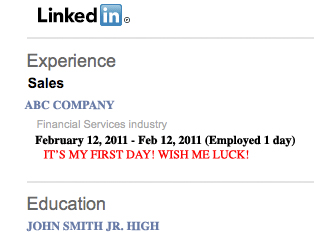
=========================================================
Don’t take any of this the wrong way. The Merchant Cash Advance business has been around for a long time. Most firms perform background checks on their employees and provide them with the proper training. Regardless, any transaction that requires the handling of social security information and bank statements should warrant a little due diligence. This advice applies to banks, insurance companies, stock brokers, and investment funds.
My wedding vendors were fantastic and the time spent chasing the best overall deal (reliability, experience, reputation, price) rather than choosing on price alone was worth it. I hope business owners use the same approach when obtaining working capital.
-The Merchant Cash Advance Resource
By: One of our individual contributors
The Interchange Debate: A Political Mess and a Waste of Time
August 23, 2011
The Huffington Post published a lengthy article today, titled “Swiped: Banks, Merchants And Why Washington Doesn’t Work For You.” While it reiterated the talking points for both sides of the Durbin Amendment debate, it made the case for neither. Rather it highlighted the dirty business of Washington politics. Millions of dollars are being spent on an unrelenting battle, which frankly will result in no winner.
Debit interchange reform was enacted in Australia in 2004 after an exhausting four year debate. The outcome? No savings were passed on to consumers and debit card use declined nationally. We broke down the findings in a previous article: Interchange Regulation and Reduction, Proof it Will Fail.

We will not make our case here again, but instead would like to point out the refreshing perspective by the Huffington Post:
“As swipe fees dominate the Congressional agenda, a handful of other intra-corporate contests consume most of what remains on the Congressional calendar: a squabble over a jet engine, industry tussling over health-care spoils and the never-ending fight over the corporate tax code.
The endless meetings and evenings devoted to arbitrating duels between big businesses destroy time and energy that could otherwise be spent on higher priorities. In America today, over 13 million people are out of work and millions more are underemployed. One out of every seven is living on food stamps. One out of every five American children lives in poverty. Yet the most consuming issue in Washington — according to members of Congress, Hill staffers, lobbyists and Treasury officials — is determining how to slice up the $16 billion debit-card swipe fee pie for corporations.”
We don’t remember debit card fees causing the Great Recession. We do remember the corrupt mortgage brokers, the exotic derivative securities, the overly leveraged investment banks, and the deficit spending at all levels of government. Repeal the Durbin Amendment or support the Debit Interchange Fee Study Act so we can undo the damage already caused and move on to more important matters.
– AltFinanceDaily
Small Business Failure Rates a Data Point for MCA
May 24, 2011
If you’re a Merchant Cash Advance (MCA) firm, you probably already know which regions pose a higher risk of default. CNN recently analyzed a report by Dunn and Bradstreet on states with the highest and lowest business failure rates:
- California (69% higher than the national average)
- Nevada (65% higher than the national average)
- New Hampshire (38% higher than the national average)
- Tennessee (36% higher than the national average)
- Colorado (33% higher than the national average)
- North Dakota (67% lower than the national average)
- Vermont (47% lower than the national average)
- Iowa (40% lower than the national average)
- Wyoming (40% lower than the national average)
- Kansas (39% lower than the national average)
 Small business failure rates rose overall by 40% from 2007 to 2010. That’s an incredible increase but not surprising given the time period. So what does the data mean for an industry focused on banking the unbankable businesses?
Personal credit scores have been weighted more heavily in MCA underwriting over the last year or so. Once celebrated as credit-blind financing, most funding providers today have minimum score requirements. This began with arbitrary benchmarks such as 500 or 550 but is now resembling a banker’s analysis. “Your client has a 620 FICO but it’s a weak 620 so we’ll pass” is one such phrase that MCA brokers are just beginning to encounter, leaving them stunned and wondering how this product’s high cost seemingly only targets those with excellent credit. This situation has created A Fork in The Merchant Cash Advance Road.
Small business failure doesn’t happen overnight. It begins with a few missed payments. At that point there is either a recovery or a continuation of falling behind. Low credit scores occur in North Dakota and California but a business in North Dakota with 520 FICO is probably more sustainable than one in California with the same score. Therefore those in the lowest failure states should be extended leniency on credit requirements. Afterall, the goal of the MCA industry is to fund sustainable businesses, not those with the best credit report. The two don’t always go hand in hand.
This outlook isn’t new and would probably serve well in a data points based underwiting system. The CEO of Canadian based AdvanceIt was previously cited on this topic, though his firm futher narrows their data points to the city level. Any data that might impact the outcome deserves to be considered, no matter how broad.
The MCA product is most often a purchase of future sales, which does not require conscious payments on the seller’s (business’s) part. A percentage of sales are recovered automatically so the top priority should be to ensure those sales don’t stop.
If you’re a business owner in Iowa (3rd lowest failure rate) with bad credit, don’t get discouraged. You’re still a viable candidate for a traditional MCA. You just need to find the right firm for you. Ask your sales representative what requirements there are and stay away from those that respond with an arbitrary credit score. The smartest firms use data points and data says you’re not that likely to fail…
– The Merchant Cash Advance Resource
The Direct Funder Model is Sooo 2009
December 1, 2010Originally posted on Dec. 1, 2010
We touched on this in a previous post and think it’s important to expand on it. The Merchant Cash Advance industry has evolved over the last several years. The clear line between Broker and Funder is becoming incredibly blurred.
Many Direct Funding companies are now offering brokers the opportunity to contribute their own funds towards an advance and share in the profits(And the risk!). On the same token, many big name brokers seem to have filed a handful of UCCs as a secured party, an indication that they have funded accounts all by themselves.
Some industry vets have taken things to another level and are calling on multiple parties to share in a single advance. For example: A broker contacts several other brokers/funders and requests if they want to all chip in. One firm usually takes the lead and services the account to reap a management fee. This collaborative group financing acts like a mini hedge fund but we believe this signals an evolutionary move towards the Peer 2 Peer(P2P) Lending model. In essence a P2B model that looks like this:

This is an an altered picture of the Prosper.com P2P Lending Site.
Prosper boasts of having funded $210,000,000 since their inception. The Merchant Cash Advance industry has put out more than that in just the previous 6 months. So the concept is similar and it fits the mold. Merchants submit documents and an application to a P2B Network. The Network posts the business profile, processing history, personal credit score, reference information, and publicize it on the site. Anyone can then peruse businesses and choose which to contribute funds towards. Once the total advance amount that the P2B Network recommends has been raised, the P2B Network converts the processing, transfers funds to the merchant, and maintains the account for a fee.
While we don’t anticipate the entire industry to convert to this model, nor do we predict if it will actually work, this will inevitably become a segment of the market. The Merchant Cash Advance industry received much criticism back in 2007 and 2008 but the tone has changed dramatically. The phrase “banks aren’t lending” is so worn out that people should be fined for saying it. Self regulating industry practices, the recent mass exodus of devilish sales brokerages, and the banking problem, have not only brought the Merchant Cash Advance industry legitimacy but also made it one of the preferred and most credible funding options available to small business.
A P2B network could do all of the underwriting, complete with a final say on approvals or they could present a business as is and allow everyone in America to be their own underwriter and make the determination themselves. How tempting would be it to invest $100 to a business in your community and buy a percentage of their future credit card sales? We like the concept and the industry is halfway there. Who’s going to start this first?
– An Opinion by the Merchant Cash Advance Resource
../../merchantcashadvanceresource.htm
============
UPDATE 12/23: P2P MARKETPLACE FOR MERCHANT CASH ADVANCE FOUND ALREADY TO EXIST, READ HERE
Am I Talking to a Broker? Does it Matter?
August 1, 2010Many merchant cash advance applicants have found the relationship structure of the companies involved confusing. Others who thought they understood it, later found out they were wrong. There are likely to be at least 3 parties involved in the process. Below is a breakdown of each and their role:
Cash Advance Provider: This is the company taking liability on the advance. They are the entity purchasing your future receivables at a discount. They also handle the decision making on approvals. It is very likely that they do not have an outbound marketing campaign or customer service department. They may rely on Brokers to bring in clients and service the accounts. The Cash Advance Provider pays a commissioned percentage of the advanced amount to the Broker for their services.
Cash Advance Broker: This is the reseller of the cash advance. Their business purpose is to acquire clients and submit their applications to the Cash Advance Provider for approval. They generally will also provide customer service. The Cash Advance Provider pays a commission to the Broker for every client of theirs that is funded. Brokers do not have to charge their clients for their “service” as the Cash Advance Provider is already paying them.
Credit Card Processor: In most cases, repayment of your advance depends on the Processor diverting a percentage of credit card transactions to the Advance Provider.
In order to do so, the Processor has to have contractual agreements with the Advance Provider. That is why in most cases, businesses are required to convert their processing to a new company. There is no Advance Provider that is compatible with all processors.
The Credit Card Processor performs it’s own risk analysis on the business as well. They want to ensure that your transactions are legitimate, secure, and consistent with the stated business model. Approval of an advance conditionally relies upon approval with the Processor.
This being known, some Advance Providers rely solely on Brokers to acquire clients and thus there is no way to apply directly with the Provider directly. For cost purposes this shouldn’t matter. The cost of the advance itself is the same whether a Broker is involved or not. However, SOME brokers charge additional fees for their service to the client themselves. They may try to convince you that it is the Cash Advance Provider’s fee, a set up fee, a reprogramming fee, a legal fee, etc. These are just disguised names for the Broker’s fee.
In some cases the Cash Advance Provider may charge up to $200 to file a UCC1 on the client’s business once the contract has been executed. Any amount higher than that is most likely not a necessary fee to be passed onto the client.
Clients should ask upfront with their account representative if any additional fees will be charged upon execution of the contract. Some will charge, some won’t. Whom the client decides to apply with is their choice.
1 Application Turned into Multiple Credit Pulls
July 30, 2010 Many merchant cash advance applicants have filled out a single form only to later find out their credit was pulled multiple times. This is common amongst brokers. Many brokers will take the application and then submit it to multiple Cash Advance Providers for review. They do this to increase the applicant’s chance of approval and ultimately come out with the best deal.
There is a flip side to this strategy that every applicant should be aware of. Credit inquiries affect FICO score. Though multiple pulls in a very short span of time won’t be as damaging as if they were spread out (Credit Agencies realize that people shop for credit and thus your score isn’t lowered as much), the actual record of the inquiry will remain on the report for 2 years.
If there are upwards of 4 pulls or more, this can have negative implications. Many Cash Advance Providers view inquiries from competitors as a bad sign and there are instances where applicants will be declined simply because they’ve “over shopped.“
If an applicant was credit worthy to begin with and they were planning on obtaining a mortgage or auto loan in the near future, this needs to be seriously considered. That mortgage or car loan may no longer be available because of too many credit inquiries.
Advice: Anyone applying for a merchant cash advance should discuss with their account representative before hand to find out exactly how many times their credit will be pulled and what entities will be pulling it. Authorizing an entity to pull credit does not grant anyone unlimited usage for an indefinite amount of time.
If any applicant feels their credit was pulled more times than was authorized or by unauthorized entities, they should contact the entity responsible. The entity is required by law to prove they had authorization to pull credit. If they made the inquiry in error, they are required to send you a letter stating just that. This letter can then be used to have the inquiry removed when contesting with the Credit Agency.
If the entity does not respond within 30 days, they can be in violation of the Fair Credit Reporting Act.