
Money2020 Kicks Off – With part of last year’s prophecy fulfilled
October 23, 2016
The industry’s biggest conference by attendance kicks off today at The Venetian in Las Vegas. With more than 10,000 attendees and 3,000 speakers, topics range from payments to financial services innovation.
During last year’s conference, alternative lenders appeared to be waiting for a shakeout. Has that happened?
It’s starting to. Since then, online lender Vouch Financial shut down and CircleBack Lending announced that they are no longer issuing loans. Lending Club’s founder resigned in a scandal, the pure marketplace lending model died and no other alternative lenders managed to IPO in 2016. Even a handful of merchant cash advance firms have quietly exited the market.
Valuations are down as well, perhaps more in line with reality. Robert Greifeld, the CEO of Nasdaq, warned attendees about the validity of private market valuations of fintech companies at Money2020 last year. “A unicorn valuation in private markets could be from just two people,” he said. “whereas public markets could be 200,000 people.” And the public markets have been tough. Lending Club’s stock has fallen by 67% since then while OnDeck’s has dropped by 52%.
And yet much of alternative lending is still standing and still raising capital. Over the summer, Fundry secured a new $75 million credit line, Bizfi secured a $20 million investment from Metropolitan Equity Partners, Pearl Capital secured $20 million from Arena Investors, and Legend Funding secured a $3 million debt facility from Ango Worldwide.
We’ll see what happens this week at The Venetian.
Some Alternative Funders See Pot As Next Big Market Opportunity
October 17, 2016
For some funders, marijuana is not just about sewing their wild oats. Rather, they see the business potential of being early to what’s expected to be a highly profitable and long-lasting party.
Indeed, for the right type of funder, doling out money to marijuana-related businesses is a promising market—certainly in the short term because these companies are so capital-starved. Because marijuana is still classified by the feds as an illegal drug, many related businesses can’t even get a bank account much less access to bank loans or more traditional funding. Many alternative funders are also unwilling to lend to marijuana-related businesses, which has left a significant void that’s beginning to be filled by opportunistic private equity investors, venture capitalists and others.
Meanwhile, rapidly shifting public opinion and state-centered initiatives bode well for what many estimate is a multi-billion dollar market. Indeed, industry watchers say marijuana funding will eventually be an even stronger niche than lending to alcohol producers, tobacco companies or pharmaceuticals because of all the ancillary business opportunities related to medical marijuana use.
 “I think it’s probably the biggest opportunity we’ve seen since the Internet,” says Steve Gormley, managing partner and chief executive at Seventh Point LLC, a Norwalk, Connecticut-based private equity firm that invests in the cannabis industry. “Consumption continues to grow and demand is there,” he notes.
Despite shifting public opinion, legalized marijuana use is still quite controversial. So, all things considered, it takes a particularly thick-skinned funding company—one that has no moral objectives to marijuana and is also willing to accept a significant amount of legal, business and reputational risk—to throw its hat in the ring.
One of the biggest challenges keeping banks and many mainstream funders at bay is that cannabis remains illegal under law. Despite numerous attempts by proponents to scrap marijuana’s outlaw status, the DEA recently dealt out a significant blow by opting to maintain the status quo. This means that for the foreseeable future marijuana remains a Schedule I drug, on par with LSD and heroin, and as a result many lenders will choose to remain on the sidelines for now.
It remains promising, however, that over the past several years, the federal government has taken a more laissez-faire approach, giving individual states the authority to decide how they will deal with legalizing marijuana use. Forty-two states, the District of Columbia, and the U.S. territories of Puerto Rico and Guam have adopted laws recognizing marijuana’s medical value, according to the Marijuana Policy Project, an advocacy group. Four states—Alaska, Washington, Oregon, and Colorado—as well as the District of Columbia have gone even further. They allow the recreational use of marijuana for adults, with certain restrictions. Meanwhile, marijuana initiatives are on the November ballot in numerous states.
As these changes have percolated, forward-thinking alternative funders have been dipping their toes in the market—getting an early start on a market that’s hungrily looking for growth capital. “The last couple years there have been fewer investors than capital needed, but we believe that tide is changing,” says Morgan Paxhia, managing director and chief investor of Poseidon Asset Management LLC in San Francisco, an investment management company founded in 2013 to invest exclusively in the cannabis industry.
Paxhia says he’s starting to see more venture capitalists, lease-finance companies and private equity investors willing to provide liquidity to marijuana-based companies that are seeking to grow. The short-term cash advance marketplace, however, is not there yet. The challenge is finding funders willing to do the business with them.
“The people that are building these businesses have to always be worried about their cash. It’s not a given that they’ll get new additional investment,” Paxhia says. “Most people are quick to brush it aside. They won’t give it a minute to take a serious look at it and understand that it is already a multi-billion dollar market growing at 30 percent annualized for the next several years,”
A QUIETLY GROWING INDUSTRY
There are a number of private investors and venture capitalists who have spent the last several years researching and ramping up to invest in what they see as a goldmine of business opportunities. Many of these companies aren’t shy about publicly expressing their support for change.
“We see this as an opportunity of a lifetime to witness a societal change and we want to be a part of it,” says Paxhia who together with his sister runs a $10 million investment fund.
At the same time, there are also some alternative funders who dabble in this space and won’t discuss it publicly—partly because of the perceived stigma and partly out of concern that their financial backers won’t approve. To cover themselves, some are only willing to deal with companies that have hard assets. Often times the rates they offer are much higher than businesses in other industries with comparable financials would pay.
Andrew Vanam, founder of Rx Capital Funding LLC, an ISO in Norwalk, Connecticut, who focuses on the healthcare and medical industry, has helped a handful of few marijuana-related businesses get funding in the past few years and would love to help facilitate more deals. But he says it’s extremely difficult to find lenders that are willing to fund cannabis-related businesses as well as offer reasonable rates. Many of the files he generates in the cannabis space have incredible financials, positive cash flow, and month-on-month growth. However, lenders still treat these businesses as high-risk and offer rates so high it’s not even worth bringing back to a client. Instead, “they are taking hard money loans from private investors that put these cash advance offers to shame,” he says.
 ASSESSING THE RISKS
Certainly there are risks to funding marijuana businesses. In Colorado—one of the first states to legalize the recreational use of marijuana—values are getting lofty, and people are overpaying for properties that house marijuana-related businesses, notes Glen Weinberg, a partner in Fairview Commercial Lending, a hard-money lender with offices in Atlanta and Evergreen, Colorado.
Weinberg has financed between 75 and 100 commercial real estate loans where marijuana businesses were involved, but says recently he’s shied away. “I’m not comfortable with the valuations at a lot of these marijuana properties,” he says.
Even investors who are bullish on the space urge caution. “If you’re in a [nationwide] market that is growing at about 64 percent per year, that rising tide floats all boats, but there’s a lot of risk, so you have to be careful,” says Chet Billingsley, chief executive of Mentor Capital Inc., a public operating company in Ramona, California, which acquires and provides liquidity for medical and social use cannabis companies.
Billingsley says he has learned some hard lessons through his dealings with about nine marijuana-related companies. For example, he recently won a court judgment against a company that Mentor had supplied with millions of dollars in cash and stock. The company later balked at the terms of the deal and tried to renege, but Mentor ultimately prevailed in court. Still, Billingsley says Mentor went through many unnecessary hassles and racked up $300k in legal costs over the course of its two-and-a-half-year legal battle.
Many business owners in the marijuana space started out during a period when it w as completely illegal. Often these companies march to the beat of their own drum; to protect themselves, lenders need to do more than offer a standard funding contract and hope for the best, Billingsley says.
“The contract has to be solid and it has to be explained in detail to the marijuana operator who is often not sophisticated with regard to contracts.” If you leave things open to interpretation, you’re likely to end up in court, where anything can happen, he cautions.
Companies that fund cannabis businesses say they have very extensive vetting processes—so much so that they turn away a good portion of requests. Jeffrey Howard, managing partner of Salveo Capital in Chicago, says about two-thirds of the companies that come across his desk don’t make it past the company’s initial criteria. “We see a ton of companies and business plans from companies seeking capital to raise money,” he says. “We are going to be very selective about who we invest in and how much.”
Gormley, of Seventh Point, leverages all the same resources he would if he were buying any retail or production manufacturing outfit. He does extremely invasive vetting of the individuals involved and uses private detectives to help.
It many cases it comes down to the business’s management team, according to Paxhia of Poseidon Asset Management. “All the businesses are very early-stage and most companies have a very short track record, so you have to place a greater emphasis on the people,” he says.
OPPORTUNITIES ABOUND
Despite the risks, funders that work in the marijuana space say they are filling an important need by providing capital to marijuana-related businesses. For Gormley of Seventh Point, it’s a calculated risk in an area he’s been following for quite some time. “How often do you get to be part of history, and how often do you get to participate in a burgeoning market?” he says.
Industry participants stress the many funding opportunities aside from companies that cultivate and distribute the plant. Indeed, there are many ancillary businesses that provide products and services geared towards patients and cannabis users without having anything to do with the actual plant.
Howard of Salveo Capital, says his company is gearing up to provide private equity and venture capital to several marijuana-related businesses through its Salveo Fund I and will only make select investments into companies that “touch the plant.” The goal is to eventually have $25 million of committed capital to invest in multiple early-stage companies that offer ancillary products and services to the marijuana industry. “We think there’s more exciting opportunities than ‘touch the plant’ investments,” he says.
Crowdfunding platforms are another avenue for companies in the marijuana space. This type of funding hasn’t yet been utilized to its full potential, industry watchers say.
Eaze Solutions, a San Francisco-based provider of technology that optimizes medical marijuana delivery, is one example of a company that turned to crowdfunding. It raised part of a $1.5 million infusion to fund its expansion via the crowdfunding site AngelList in 2014. Loto Labs, in Redwood City, California, is another example. It raised more than $220k via Indiegogo to fund production of its Evoke vaporizer. There’s also CannaFundr, an online investment marketplace for companies in the cannabis industry to gain access to capital.
 Seth Yakatan, co-founder of Katan Associates in Hermosa Beach, California, suggests that crowdfunding will become more of an option for certain types of cannabis based companies, specifically those that aren’t as closely tied to the actual production of the plant. “Until federal regulations change, it’s going to be hard to raise money for an entity where you are actively engaged in the cultivation, distribution or sales of a product that’s federally illegal,” says Yakatan, whose company invests in and advises cannabis-related companies that have a biotech or pharmaceutical orientation.
Because laws on legalized marijuana are still in limbo, industry watchers say the market is still many years away from being mainstream. “Public perception will be similar to alcohol in 10 years from now,” predicts Weinberg of Fairview Commercial Lending, adding that he expects banks to enter the funding arena in five to 10 years.
In the meantime, alternative funders who can stomach risk continue to pave the path for others. Howard of Salveo Capital expects private equity investors, venture capitalists and other alternative players to continue playing a big role in getting the nascent industry off the ground.
“I strongly believe that in the interim there’s a significant advantage for players like us to be funding and to be in on the ground floor of this industry before it changes,” Howard says.
Indeed, many alternative funders believe the potential upside significantly outweighs possible negative consequences. “The perceived risk at this point is far greater than the actual risk,” says Paxhia of Poseidon Asset Management.
Total Merchant Resources Obtains California Lending License
October 17, 2016Piscataway, N.J. – October 17th 2016 – Total Merchant Resources, a Piscataway based business funder and a veteran in the merchant cash advance space, has obtained their California Lending License to capitalize on providing businesses with working capital in the Nation’s most populous state. This new designation allows TMR to quickly and easily extend money to small and medium sized business throughout the Golden State.
“We are thrilled to have access to this very important market. In addition, TMR is now perfectly positioned to do business in California as we await the imminent and necessary regulation of the industry,” said TMR Co-Founder and CEO Jason Reddish.
Reddish and co-founder and CFO Val Pinkhasov, who were recently featured on CNBC’s ‘Shark Tank’, were among the very first business lenders to enter this space. They are a respected name in the industry and thanks to their major prime time TV appearance, have brought attention to this underutilized model for businesses to obtain working capital.
For more information contact Gary Lane, Director of Business Development at (212) 220-9872.
Commercial Finance Coalition Tells MCA Industry Story on Capitol Hill
September 23, 2016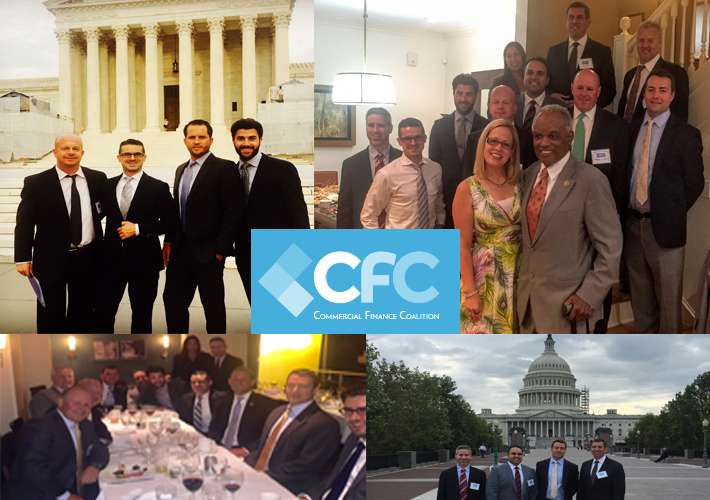
Earlier this week, executives and representatives from the merchant cash advance industry met with dozens of policymakers on Capitol Hill. The Fly-In was hosted by the Commercial Finance Coalition, whose members make up a sizable chunk of the industry’s overall transaction volume. It was their second such event this year.

The opportunity allowed industry representatives to get face time with Republicans and Democrats from both the House and the Senate. One message of great importance was in communicating the challenges that small businesses face in trying to access less than $250,000 in working capital. Another was in distinguishing purchase transactions from loans.
“Our members are engaged and committed to educating and advocating the interests of the merchant cash advance industry in Washington DC and state capitals around the country,” said Isaac Stern, President of the CFC and Fundry. “I would strongly encourage my industry colleagues and competitors to get involved in the organization and help us grow the CFC.”
While banks have been accused of being too big to fail, the CFC noted that many businesses have become too small to survive as a consequence of banks moving upstream. Regulations have made it too burdensome and expensive for a bank to underwrite a $25,000 loan, plus they may not be able to stomach the risk or be properly incentivized to approve or decline a loan in the first place. The CFC’s members do not securitize their transactions or sell them off, lending credence to the position that their livelihood depends on small businesses succeeding and performing.
“In less than 9 months the CFC has become the gold standard of alternative small business finance trade groups in Washington,” said Dan Gans, Executive Director of the CFC. “In a short time we have been able to conduct over 50 meetings with key policymakers and assemble a world class regulatory and lobbying team. I would encourage anyone involved in the merchant cash advance or alternative small business finance space to join the CFC and help us advocate for the thousands of small businesses across the country who benefit from the access to needed capital provided by the industry.”
The CFC has not been the only coalition from the broad genre of fintech to host a Fly-In, making it all the more imperative for the MCA industry to educate policymakers on the specifics of what they do and how they do it. For instance, a lot of the regulatory discussion as of late has focused on the partnerships between online lenders and chartered banks, the legitimacy of those partnerships and the sustainability of the algorithms being employed to make quick decisions. While there are several MCA-like products that rely on that model, there is also an entirely different methodology that relies on helping small businesses by purchasing their future receivables. The CFC is one major coalition communicating that distinction.
The CFC is also currently accepting new members to join their cause and participate in future events.


Annual Percentage Rates Fail Business Owners, Again
September 16, 2016 A survey of small businesses once again revealed that Total Cost of Capital (TCC) was a better metric than Annual Percentage Rate (APR) when choosing a small business loan. This study, conducted by Edelman Intelligence on behalf of the Electronic Transactions Association (ETA), found that a majority of respondents stated that they would look to minimize TCC, rather than APR, when considering loan options in the face of a short-term ROI opportunity.
The ETA explained this in the report as follows:
Generally, when consumers take out a loan, they are not making an income-generating investment that would increase the funds available to pay the loan back. Therefore, in most situations, the more “affordable” loan for a consumer is one with a longer term and lower monthly payments, even if it results in paying more over the long term. Consumers, therefore, look at APR, which describes the interest and all fees that are a condition of the loan as an annual rate paid by a borrower each year on the outstanding principal during the loan term. APR takes into account differences in interest rates and fixed finance charges that may otherwise confuse a consumer borrower and is most useful in comparing similarly long-term loans, such as 30-year mortgages or multi-year auto loans. Likewise, APR is useful for comparing revolving lines of consumer credit, like credit cards, where the amount borrowed each month changes. APR allows consumers to compare the rate at which an outstanding balance would increase under different credit cards.
While APR describes the cost of the loan as an annualized percentage, TCC represents the sum of all interest and fees paid to the lender. As the Cleveland Federal Reserve recently noted, TCC enables a small business to determine the “affordability” of a product – a key driver for most small business borrowers. Unlike consumer loans, commercial loans are normally used to generate revenue by helping a business purchase equipment or inventory or hire additional employees. Thus, “affordability” for small business borrowers means assessing the cash flow impact of the loan and comparing the TCC of the loan and the return they expect to earn from investing the loan proceeds. To reduce TCC, many small business borrowers prefer short-term financing they can quickly pay back with the return on their investment (ROI).
The ETA’s full report can be VIEWED HERE.
The findings are consistent with other studies:
Fed study on small business borrowing
A debate with anecdotal evidence, demonstrating people’s inability to calculate an APR
Consumers also struggle to make sense of APR, according to a 2008 Fed study
Funding The Great White North
September 13, 2016
As of last year, 98 percent of Canada’s employers were small businesses compared to 0.3 percent (2,933) large companies. Given this and what we know about Canada’s banking oligarchy, dominated by five large banks, it was inevitable that American alternative lenders would go looking for greener pastures in Canada.
When OnDeck set foot in the country two years ago, it accelerated the alternative lending movement by offering loans up to $150,000 CAD. But OnDeck wasn’t the first to discover the Canadian market. Merchant cash advance companies such as Principis Capital and AmeriMerchant (today Capify) have been there since 2010. Principis actually draws close to 15 percent of its business volume from Canada. But the credit that’s due to OnDeck is for expanding the horizons of small businesses who have been conditioned to think that lending begins and ends with banks. The crop of Canadian alternative lenders who do not otherwise have the resources for similar blitzkreig marketing are pleased with the industry’s promotion in general.
“We are happy that some of the bigger US players are coming up here and they are spending millions of dollars on advertising,” said Bruce Marshall, vice president of British Columbia-based Company Capital. “These companies raise awareness of the industry to a higher level and with us being a smaller company, we can ride on their coattails,” he said.
Company Capital has been operating as a balance sheet lender for five years and has provided term loans, working capital loans, merchant cash advances and ‘cash lines’ which are similar to lines of credit. For lenders such as Company Capital which makes loans in the range of $30K – $50K, the presence of bigger players like OnDeck saves them from consumer education-oriented marketing campaigns. “We cannot compete with the advertising of big companies but it works in our favor of creating awareness and becoming more mainstream,” Marshall noted.
And this not only helps the Canadian companies but also smaller US companies that feel comfortable entering a market with a leader. OnDeck’s presence nudged Chad Otar, founder and managing partner of New York-based commercial finance brokerage Excel Capital Management into considering Canada as a viable market. “We saw OnDeck go there and thought that there is some kind of money we can make,” he said.
 But for OnDeck, Canada might just as well be another large US state. Most American companies including OnDeck, Principis Capital and Excel Capital run their Canadian operations remotely, treating it much like an extension to their US business with similar products.
“Our range of business is virtually the same in Canada as in the US. We don’t need to have an operation center there,” said Jane Prokop, CEO of Principis Capital. The company approaches Canada just like the US with accounts and customer service being handled in a similar fashion. “It’s a very manageable extension of the US market,” Prokop said. “It’s a smaller market so someone who enters Canada cannot expect the same kinds of volume as in the US.”
It also certainly helps to be spread across the same time zones and in such close proximity where a majority of the country also speaks the same language. If it was that easy though, shouldn’t we have seen more companies doing this?
“The fundamentals of the Canadian market are different. Our banks are established and trusted and in general do quite a good job, so the opportunity for market expansion is different than in the US,” said Jeff Mitelman, CEO of Thinking Capital, one of the country’s first alternative lenders.
Prior to Thinking Capital, Mitelman founded and ran Cardex, Canada’s first ISO which offered lending products with payment services. And that competitive edge helped him recently to partner with payment solution company Everlink to expand its customer base and offer loans online. The company previously secured credit facilities worth $125 million from two of the biggest banks in the country, The Canadian Imperial Bank of Commerce and Nova Scotia.
Picking up the same strategy, some American companies decided to bank on these big banks (pun intended) for their success. For instance with Kabbage, it made sense to license its automated platform to Nova Scotia Bank and to rely on them to deploy capital while Kabbage provides the technology and customer experience. “We saw that Canada is ripe for technology but the differences in regulation among other things made us go the partner route,” said Peter Steger, head of business development at Kabbage.
The advantages of having an incumbent customer base, the brand equity and the supply of capital usually outweighs the costs and inconveniences of maneuvering in an unfamiliar business environment that only a few firms have the bandwidth for, some companies contended.
Secondly, there is a lack of reliable and robust data necessary for making lending decisions. Since only a handful of large financial institutions dominate the landscape, the data reported is limited to a small number of players and the outputs from credit bureaus may not be sufficient for making a credit decision. “The availability and access to government and financial data is scarce in Canada compared to other markets,” said Jeff Mitelman. “Most of the data relationships that fintech companies rely on, need to be developed on a one-to-one basis and is often proprietary information.”
Having the data presented in the right format can save a lot of underwriting time. Companies in Canada find the government and financial data available to be scanty and in less than ideal form. David Gens, CEO of Vancouver-based Merchant Advance Capital noted that Canadian merchants are slower to adopt technology which adds to the woes of online lenders. “Believe it or not, some Canadian merchants still use fax,” he said.
Even as the country plays catch up, Canadian lenders consider the market to be large enough for many players. “At this time, education is more important than competition,” said Mitelman.
 Canada’s geographical dispersion and regional differences however are peculiar. The four provinces of Quebec, Alberta, Ontario and British Columbia make up 86 percent of the population and the greater part of the economic activity. And Quebec is often avoided, in part because of the bilingual mandate that requires businesses to advertise and produce materials in French. OnDeck and Company Capital both do not operate there, for example.
The cultural differences can also determine how customer relationships are handled, and being a part of that culture has given Canadian companies an upper hand. “It does definitely help to have a home advantage in terms of understanding the local peculiarities,” said David Gens. “Marketing to Canadian merchants is also different — being aggressive might not work very well here and they like to know they are dealing with someone nearby.”
For financial brokers such as Otar, Canadian usury laws can appear restrictive. As per Canadian interest rate rules, Under Section 347 of the Criminal Code (Canada), interest rates exceeding 60 percent per annum are termed “criminal rates of interest” and “interest” in the Criminal Code is broadly defined as a broad range of fees, fines and expenses which includes legal expenses.
“US lenders have had to change their way of doing business. Since, APR is less here, if your product is a loan contract, you will be restricted and you will have to service low risk for low rates,” said David Gens.
Even so, the business emerging out of Canada may now be supplemental for American lenders and the potential for growth beneficial to diversification.
Why The Quiet Summer Was a Good Thing for ‘Marketplace Lending’
September 11, 2016 A lackluster April turned into an explosive May. And then… well it got kind of quiet there for a bit as loan origination volumes for some lenders dropped.
A lot of theories have been challenged, a lot of absolutes shaken. Like given the choice between a short term loan at a high interest rate and a long term loan at a low interest rate, which one would a small business choose? A lot of lenders raised money on the belief that businesses would choose the latter, bolstered by a compelling argument that it is “better” for their well-being. But businesses are not neatly packaged entities with uniform interests, strategies and situations. It’s not uncommon for small businesses to choose both options. Simultaneously. Two loans. To serve different purposes.
And so what then? I believe to some extent the concept of algorithms with thousands of data points, yelp reviews and the rest of it are being challenged by basic scenarios such as what happens to performance models if the customer takes on more debt after the initial loan?
Why do many consumer borrowers that claim to be consolidating their debt end up more in debt? Maybe the lenders themselves expected this but it conflicts with the message that was being told to the outside world for a long time about what made these products so special, that borrowers were consolidating their high interest debt to lower rate loans that was all made possible thanks to the low cost required to operate an online lender fueled by revolutionary new algorithms.
Even the underlying low cost premise to operate is being challenged. Why are low cost lenders often wildly unprofitable if their secret sauce is supposedly the low cost of being a nonbank online lender?
The problem is that some stories sound great on paper but don’t work out exactly as planned in the real world.
Even the concept of peer-to-peer lending and to some degree the marketplace has transformed or been phased out. Marketplace lending as the term is survived by today is typically Wall Street institutions providing capital to nonbank lenders. There is no real marketplace, at least not for the little guy anymore.
All of these discoveries and evolutions are a good thing. Too many experiments being conducted in the market at the same time created chaos. Failures, slowdowns, and adjustments are a positive step toward a sustainable future. How could a lender reasonably rely on its performance models when every day some new company was opening up and pulverizing the market with billions of dollars of marketing and loans based on some untested unprofitable system?
It’s no wonder that like twenty trade groups formed this year alone. Regulators and legislators looking out into the world of fintech probably saw and still on some levels see a tornado of disruptive confusion.
“Are you guys one of those crowdfunding marketplace bitcoin cash advance peer-to-peer lending companies I’ve been reading about? We need to regulate you.”
They need help to sort through it all and fast.
The FDIC, for example, humorously defined marketplace lending as basically every kind of lending there is, from auto loans to merchant cash advance to medical patient financing to real estate lending. The industry became everything and as everything it’s essentially nothing.
And so the quiet summer months, though not totally dead, were much needed. Hopefully everybody has gotten a chance to breathe and can now continue the work they set out to do and truly provide sustainable value to the economic system.
Bring on Fall!
IT’S A BROKER’S WORLD
August 31, 2016
From east to west, small businesses are getting funded. But how they’re found and who they work with depends on where they are. In the US, where brokers tend to have a love/hate relationship with the funding companies they work with, they are no doubt a driving force in the market. In other countries, they might not even exist, are just starting to bloom or they add balance to a mature market. Is the world built for brokers? AltFinanceDaily traveled far and wide to find the answers.
Down under in Australia where American-based merchant cash advance and lending companies have expanded, the ISO (which stands for Independent Sales Office and is synonymous with broker) model has not really followed. David Goldin, CEO of Capify, an international company headquartered in New York, told AltFinanceDaily that there’s very few ISOs in Australia.
 He believes that’s because there’s next to no payment processing ISO market there, a foundation that was a major precursor in the US towards the development of ISOs reselling merchant cash advances and business loans.
Luke Schmille, President of CapRock Services, echoed same. The Dallas-based company founded Sprout Funding in Australia earlier this summer as part of a joint venture with Sydney-based family office Huntwick Holdings. “Direct marketing is the primary method [of acquiring deal flow],” he said. “The credit card processing space is controlled by several large banks, so you don’t see ISO efforts in the acquiring space either.”
Big bank dominance was only one reason why another country’s emerging alternative small business funding market developed slowly. In Hong Kong, non-bank alternatives like merchant cash advances faced legal uncertainty for a long time. For example, Global Merchant Funding (GMF), once the only merchant cash advance company in the Chinese special administrative region, had been relentlessly pursued for years by the Secretary for Justice for conducting business as a money lender without a license. GMF fought it. And won.
In May of this year, the legality of merchant cash advances ultimately prevailed after the highest court ruled the agreements were not loans. Emboldened, several companies have stepped up their marketing of the product. But whether they’re doing daily debit loans or split-processing merchant cash advances (both of which exist there), marketing tends to be directed at merchants, not a middle market of brokers.
 Gabriel Chung of Hong Kong-based Advanced Express Capital said that there are a handful of large brokers typically comprised of former bankers, but the rest of the broker market is highly fragmented, mostly made up of individual freelancers.
Adrian Cook, the Founder and CEO of Hong Kong-based Asia Capital Advance, agreed that marketing is usually aimed at merchants directly but that it’s changing. “Since the market is still very new and MCA is only beginning to gain popularity, brokers on the market are only starting to recognize MCA,” he said. “There is a lot of room for the brokerage market to grow.”
In the UK, where Capify also operates, CEO David Goldin explained that the UK doesn’t have a lot of credit card processing ISOs so there wasn’t a major migration from that business to MCA like there was in the US. But that doesn’t mean there is no middleman market at all.
 Paul Mildenstein, executive director of London-based Liberis, said that brokers are an important channel, but not as dominant as they are in the US. “Our brokers are usually members of the NACFB, an organisation in the UK that actively supports and provides operating principles to the furtherance of the commercial finance broker community,” he wrote. The National Association of Commercial Finance Brokers claims to have 1600 members, one among them is Liberis.
“Many clients want the support of an experienced professional who can discuss the financial options available to them in their specific circumstances,” said Liberis’ CEO, Rob Straathof. “Given relatively low awareness of the Business Cash Advance product in the UK, this means that brokers have a key role to play in educating potential customers on when this is the right option for them,” he added.
Straathof stressed a robust criteria for the brokers they work with and explained that brokers are their eyes and ears in the market. “The relationships we have with them are not transactional, but transformational for our business,” he said.
The NACFB was also praised by Alexander Littner, Managing Director of Chelmsford, Essex-based Boost Capital. The company, which is actually a subsidiary of Coral Springs, FL-based BFS Capital in the US, sees a balance between their use of brokers and their efforts to acquire customers directly.
“As the alternative finance market is still relatively new here in the UK these brokers are important for this independent advice, and to help educate the market and establish trust,” Littner said. “At Boost Capital we work very closely with brokers across the UK, they are a critical part of our growth and fundamental to our ongoing success.”
In the US, brokers play such a dominant role in customer acquisition that some MCA funding companies rely on them to source the entirety of their business. Back in February, Jordan Feinstein of NY-based Nulook Capital told AltFinanceDaily, “We decided that the best way to grow is to build relationships to avoid the overhead, compliance, training and manpower that a sales team would require.” Nulook markets its broker-only approach as a strength.
Others take a more blended approach, like Justin Bakes, CEO of Forward Financing, for example. “While our priority is to self originate, it is essential to create and maintain partnerships in this business,” he said earlier this year.
Notably, no such guiding authority like the UK’s NACFB exists for brokers in the US so it’s not easy to track exactly how many there are or how they operate, but their role in the industry cannot be understated. AltFinanceDaily actually labeled 2015 The Year Of The Broker, when it published an article in its March/April 2015 issue that tried to capture the essence of the industry at the time. Tom McGovern, who was then a VP at Cypress Associates LLC, said of brokers, “They’re like the missionaries of the industry going out to untapped areas of the market.”
But preaching the gospel of alternative funding exists at different stages across the world. And Goldin, whose company Capify operates in four countries including the US, thinks that many middlemen here at home may not ultimately survive. In an interview, he predicted that the stronger ones over time will be acquired by funding companies and that direct marketing will only increase. “I think more and more companies are going to start building their own internal sales forces,” he said.
Other brokers are not convinced that acquisition costs will lead to the death of their businesses, especially if they’ve already found ways to reduce overhead costs. Several brokers have discreetly mentioned running operations from Costa Rica, Nicaragua or elsewhere as a way to keep things profitable. Still more, like Excel Capital Management based in Manhattan, have found that offering a suite of products allows them to monetize more customers. Chad Otar, a managing partner for Excel, said that they recently brokered a $4.9 million SBA loan. MCA is just one of their options these days. “As long as there’s small businesses, there’s always going to be opportunity,” he said.
 In the US, the brokers have certainly seized it, but that’s because most funding companies offer big bucks and quick payment to those that are capable of sourcing customers. In other countries, compensation for services rendered might be the responsibility of the broker to arrange with the merchant since it may not be customary for funding providers to pay commissions. That would mean more work and more risk for the broker.
Ironically, some brokers in the US will tap into both sides, earning a commission from the funder and charging a fee to the merchant for services rendered. And if the broker has payment processing roots, they can go a step further and earn merchant account residuals as well.
Brokers can’t exist without funding companies willing to support their endeavors, of course. While their prevalence around the world varies, most of the funding companies AltFinanceDaily spoke to, appear eager to nurture the middleman’s role, so long as they act responsibly.
“Brokers in the UK are incredibly important as independent advisors to small businesses on the various sources of finance to suit their needs,” said Littner.
And as long as those customers, wherever they may be, are getting the value they want from a broker, that role, so long as it can continue to be done profitably, will likely have a place in the world for the foreseeable future.