
Ready to Trade ONDK and LC?
November 16, 2014 On November 10th, OnDeck Capital finally made their S-1 public. Immediate reactions from inside the industry were mixed. The bears criticized the years of losses while the bulls pointed out that the tide is turning. With a profitable 3rd quarter, OnDeck’s bet on the long game might finally be proving itself.
And without delving into their S-1 for now, the industry should be bracing itself for change. The mysterious world of daily funders (financial companies that deal in daily payments) is about to come under the scrutiny from another body, stock analysts.
Unlike journalists which have bruised the industry with sensational headlines and surface level criticism (high costs, light regulation), analysts will be tasked with truly understanding the fundamentals of nonbank business lending. Not to mention that everyday retail investors looking for an edge will want to learn more about the industry than what a single company’s quarterly financials will tell them.
Daytraders might make decisions based on melodramatic stories but those buying and holding for the long run will be conducting something that’s rarely taken place in this industry, research. Expect these questions to be asked and deeply considered:
- Who are OnDeck’s competitors? (and not just the top 3, but the hundreds that follow them)
- What are ISOs/brokers and how do they operate?
- How do they generate deal flow?
- What is Merchant Cash Advance and how is it similar or different to OnDeck?
- What is the real regulatory environment? (Because there are actually applicable regulations despite articles that say there aren’t any)
- Why does OnDeck collect payments daily?
- Why is OnDeck’s model so much different than Lending Club’s?
Look for the last bullet point to be explored greatly. If OnDeck and Lending Club are both innovative small business lenders broadly targeting the same market, why is OnDeck charging an average of 50% APR paid daily over 6 months and Lending Club charging as low as 5.9% APR paid monthly up to 5 years?
Their products couldn’t possibly be more different. And while Lending Club’s IPO path has curiously stalled, there is nothing to indicate that it will not proceed. That means we should expect comparisons between the two upcoming tickers LC and ONDK, a lot of them.
Details about commissions, closing fees, marketing practices, and transparency will be talked about in open forums by the general public. If it’s controversial, it will be debated. If it’s unique, it will be scrutinized. To an extent, OnDeck, Lending Club, and many of their competitors will cede control of their destiny to the general investing public.
There are folks in the industry giddy over the chance to buy and sell stock in both companies. They have years of experience on the front lines. But just as they’re gearing up to trade ONDK and LC, so too is everyone else.
Get ready for major change…







Merchant Cash Advance Risks and Myths
October 24, 2014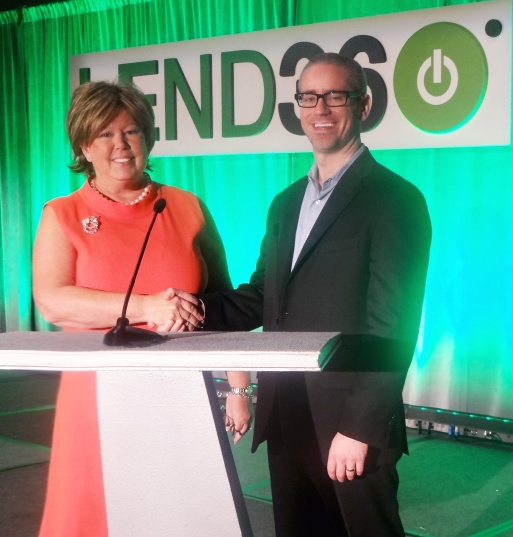 The Lend360 Conference in New Orleans last week had a different vibe from the five other conferences I’ve attended this year. For one, I was a partner in it through DailyFunder. And further, there was a huge focus on best practices, ethics, and regulations. Expert speakers and panelists aired it out to dispel myths and disclose risks.
Most telling about the future was a response from Victory Park Capital’s Brendan Carroll about whether or not he feared looming regulations could hurt the merchant cash advance and alternative business lending industry. As someone who has invested heavily in Kabbage and more recently in Square Capital, he expressed concern about regulations in general but clearly was not convinced they were on the immediate horizon for the industry.
Lisa McGreevy, president of the Online Lenders Alliance moderated the two-man panel which also consisted of John Hecht of Jefferies and she did a great job of digging out the true thoughts from one of the room’s most powerful investors. It’s unlikely a company like Victory Park Capital would invest hundreds of millions of dollars in an industry they believed faced imminent regulatory upheaval.
Merchant Cash Advance regulation is not on any regulator’s immediate agenda but they are doing their homework. At Lend360, it was revealed that several members of the North American Merchant Advance Association met with the Federal Reserve in Washington D.C. months ago for a Q&A. There’s communication occurring now on some levels. Even I’ve been contacted by the Federal Reserve to comment as a part of a broad research assessment.
Eventually I believe the CFPB will try to play a role in the industry through Section 1071 of the Dodd-Frank Act. We’re a long way from there though and it doesn’t mean they’ll be successful. Even internal operatives have expressed doubt on business-to-business jurisdiction.
In the meantime, it’s not all blue seas and sunny skies. Robert Cook, an attorney at Hudson Cook, LLP explained at the conference that the industry is already in many ways supervised by the FTC. And with the FTC, it’s not a question of how high the costs are, it’s about how transparent those costs are. If they’re high, fine, but do the customers understand them and are they marketed accordingly?
Terms like guaranteed, 99% approval rate, and lowest rates can be deemed deceptive if not true.
 Transparency, ethics, customer experience, that’s what people in the business need to be focused on right now. Stacking, while a polarizing topic, seems to be a matter of contract law. Everybody’s caught up in the stacking debate believing it’s the lightning rod that will attract regulation. If left unchecked, it might draw interest, but it’s the fundamentals that get overlooked that could draw the ire of an agency like the FTC.
If your marketing says “rates from 1.10 and up”, while actually contracting 99% of your customers with 1.49s, that’s something you’ll probably want to address now. Think about the net cost your customer is likely to be charged. If a 1.10 is a buy rate and there’s a 10 point upsell, a 10% closing fee, and 10% origination fee that makes the end cost closer to a 1.40, you probably don’t want to market the cost as 1.10.
Right now it all basically comes down to doing good business in a transparent manner. Costs may be high but explain those costs, make sure the customers understand them. Don’t be deceptive. There will always be critics of high costs, but rational people are being exposed to the sober reality that you can lose money even at a 50% interest rate.
As a word of advice for new ISOs and brokers, stay away from funding companies that don’t even have a paid email account. If a funder is too financially strapped to afford a web domain, they probably are going to cut corners in other places too. The story about working off a gmail or hotmail account in the interim while they try to get their website set up is indicative that they’re getting ahead of themselves. There are way too many solid funding companies to choose from for you to entertain doing business with hotFunding4ISOsNow@hotmail.com. Even middlemen are accountable in the grand scheme of best practices and the customer experience.
Fund intelligently…
– AltFinanceDaily
Also read:
4/11/14 Regulatory Paranoia and the Industry Civil War
8/13/14 Should Licensing and Accreditation come to Merchant Cash Advance?
Are We in a $300 Billion Market?
August 7, 2014 Earlier today on a large group conference call with Tom Green and Mozelle Romero of LendingClub, I learned a few more details about their business loan program. In the Q&A segment, one attendee came right out and asked if they believed their competition was merchant cash advance companies and online business lenders.
According to Green, it’s not so much other companies that they feel they are up against but more of the broad challenge of market awareness. Their struggle is about getting people to know that there are non-bank options available and to make people aware of their existence.
It’s the same challenge merchant cash advance (MCA) companies have been dealing with for more than a decade. Notably though, there are many in the MCA industry that feel the market is saturated and thus a lot of the industry’s growth has been fostered through a turf war for the same merchants. Stacking (the practice of funding merchants multiple advances or loans simultaneously) is partially spurred by a belief that there are no more untapped businesses left to fund. The acquisition costs of a brand new untouched business that is both interested and qualified is so high, that it is not a pursuit some funders and brokers can afford to take on.
 Market Size
At present, daily funders, which are a combination of both MCA companies and lenders that require daily payments, are funding somewhere between $3-$5 billion a year. On the call Green said he believed the potential market was far larger than that, though he discredited the $200 billion figure that some independent research had predicted. That was only because LendingClub believes the potential market is substantially higher, more like $300 billion.
$300 billion?! That’s about 100x larger than the current daily funder market combined and starkly contradicts any belief that there’s no merchants out there who haven’t already gotten funded.
LendingClub’s minimum gross sales requirement is $6,250 a month and they have an upper monthly gross threshold on applicants at $830,000 a month, though they’ve had businesses apply who do even more than that. Their sweet spot as Green put it, is the segment doing $16,000 to $416,000 gross per month.
I can’t help but notice that’s the same sweet spot that daily funders have. And we mustn’t forget, LendingClub’s target business owner has at least 660 FICO. If it’s a $300 billion market for good credit applicants, then it’s got to be even bigger for the ultra FICO-lenient companies in MCA.
What’s a business?
LendingClub only needs someone with at least 20% ownership to both apply for and guarantee the loan, an unheard of stipulation in the rest of alternative business lending. One cardinal rule in MCA has been that there needs to be at least 51% or 80% ownership signing the contract. That’s had a lot to do with the fact that most MCA agreements are not personally guaranteed and the signatory is required to have absolute authority to sell the business’s future proceeds.
Summer of Fraud
 In 2013 the MCA industry experienced what many insiders dubbed the summer of fraud. Spurred by advances in technology, small businesses were applying for financing en masse while armed with pristinely produced fraudulent bank statements. Fake documents overwhelmed the industry so hard that today it is commonplace for underwriters to verify their legitimacy with the banks. This is done manually or with the help of tools such as Decision Logic or Yodlee.
Knowing this firsthand, I asked LendingClub if they also take the care to verify bank statements. In the majority of cases they do not. They rely greatly on an algorithm that detects fraudulent answers on the application but the statements themselves are not scrutinized except in very high risk situations. Considering they’re wildly less expensive than MCAs, I find it odd that they are exposed to this type of risk. Fraudulent documents are the norm and in these underwriting conditions, I would expect them to charge as much or more than MCA companies, not less.
At the same time it’s important to mention that at present, business loans on their platform are only funded by institutional investors. Retail investors can only invest in consumer loans. LendingClub has been very transparent about excluding retail investors here for the very purpose of shielding them from unevaluated and unforeseen risk. My guess is that as time goes on, they will do more to validate the bank statements which is the bread and butter of assessing the risk and health of a business.
$300 billion
In a FICO flexible environment, it’s possible the potential for daily funders is at least $300 billion. If true, that would mean that for the 16 years that MCA players have been around, they barely reached even 1% of their target audience. I’ve been saying it since I’ve started this blog 4 years ago, every business owner I’ve spoken to has never heard of a merchant cash advance… which means saturation is a myth.
Tom Green was right, the real competition is public awareness. 99% of the potential market is untapped. If you’re fighting with 5 other companies over the same merchant, you gotta:
You gotta keep on looking now
Keep on looking now
You’re looking for love
In all the wrong places
Six Signs Alternative Lending is Rigged
August 3, 2014There’s a lot of players at the alternative lending table but there are two that have won a string of lucky hands to put them on top. Neither were the first to draw cards, nor do either of them offer something that everybody else does not. These two lenders have something in common of course, special favor with the Internet gods. Is the game rigged?
OnDeck Capital is the most celebrated alternative business lender of our time. Their daily repayment loans and fast approval times are a hit with customers. In fact, as told in their recent securitization prospectus, OnDeck has been eroding its reliance on brokers and third parties to accommodate growth through their direct channel. Direct has been good for OnDeck, very good.
LendingClub on the other hand is the big dog in consumer lending, having funded more than $5 billion since inception. Every month they shatter the previous record for volume of loans funded and they’re expected to go public within the next year. LendingClub continues to pound their distant rival Prosper in monthly loan production. Are they just better at marketing?
Curiously I can’t help but notice they have something in common, they’re both owned by Google. Google Ventures led OnDeck Capital’s series D round and Google Ventures’ Karim Faris sits on OnDeck’s board of directors. Similarly, Google owns a minority stake in LendingClub.
While neither is outright owned or controlled, It’d be surprising if Google didn’t do something to foster the success of their investments. What could a billion dollar Internet giant possibly do to give them a little push?
Stop backlinking and SEO. The game is rigged

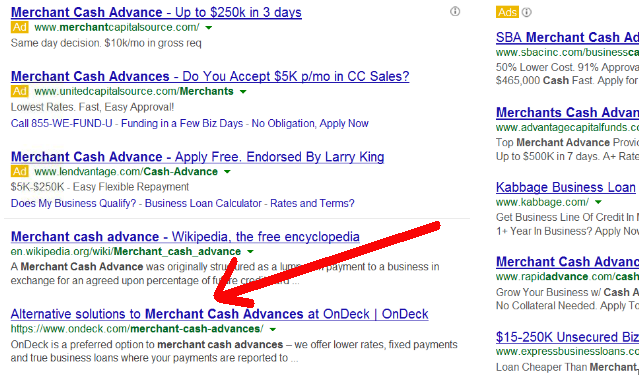


If you reproduce a search for the same keywords, you should know that results vary depending on what kind of device you’re using (mobile vs. desktop), what zip code you’re in, what time of the day it is, whether or not you’re logged into Gmail/Google+/Youtube, and whether you’ve searched for related topics before. I performed my searches with a fresh desktop browser on a Sunday evening in NYC with all cookies, cache, and Google account sessions wiped clean.
 You might not get exactly what I get and I realize that obfuscates the conspiracy I’m trying to establish here. If you do witness peculiar keyword domination though, keep an open mind that there might be more going on than good SEO and strong natural backlinking brought on by mainstream media publicity. Plenty of big businesses that dominate offline fail to rank well in the top ten results online.
Search engines say that if you’re popular, you’ll rank well. But there are plenty of cases where ranking well has made businesses popular.
Maybe, just maybe the game is rigged…
Alternative Lending Advances: Go Ahead and Eat My Lunch
June 28, 2014Yesterday it was reported that the well-known peer-to-peer loan platform LendingClub had dubbed Morgan Stanley and Goldman Sachs to work on their IPO later this year. Going public would advance the legitimacy of the wider alternative lending industry and solidify its place in the mainstream.
The Wall Street Journal states, “As the most visible company in the growing space, Lending Club’s IPO will likely be watched carefully by a number of other firms such as OnDeck Capital Inc.”
Many folks have asked me if I syndicate and technically I do, just not in merchant cash advances. For one, that opportunity is largely reserved to brokers and institutional investors, neither of which currently describes me.
Instead I dabble in LendingClub-issued personal loans and I adhere to one major ground rule, I don’t lend to business owners.
While that rule might seem to stand in stark contrast to what I preach (support for alternative business lending), there is a reason I won’t do it on LendingClub’s platform:
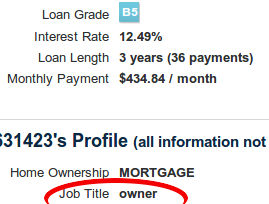 1. The rates LendingClub charges to business owners are too low (about 6-26% APR)
2. The terms are too long relative to the risk (3 or 5 year terms)
Earlier this year the Federal Reserve conducted a study that found “[p2p] loans for small business purposes were more than two-and-a-half times more likely to perform poorly.” They also acknowledged that “lending to small businesses is generally considered to be riskier and more costly because small firms have higher failure rates and are more vulnerable to downturns in the economy.”
Therein lies my dilemma, the risk that loans to business owners at those rates will result in a net loss. As a lender, I happen to be in the unique position of trying not to lose money. I know such thinking is greedy, antiquated, and close-minded but I welcome those with opposing philosophies to eat my lunch.
In a recent Bloomberg article, writer Pat Clark put the high interest business lending community on notice by touting Opportunity Fund’s 15% APR EasyPay business loans. Of course by booking an average of only 5 loans a month, their model is not built to scale. Compare that to for-profit alternative lender CAN Capital, whom has funded more than 55,000 small businesses since inception.
Opportunity Fund’s VP of Small Business Lending Marco Lucioni is quoted in the article as follows, “If you have taken out a merchant cash advance, I guarantee you that our refinance program will save you money and could even cut your payments in half.”
Their revolutionary system works for one reason, they are not a for-profit business. Opportunity Fund is a California-based charity. Less than two years ago Lucioni admitted to another Bloomberg writer, “EasyPay is a real loan, with a fixed simple interest rate that works out to be about 12 percent on an annual basis. At that rate, the nonprofit is not covering its costs.” He continued, “Opportunity Fund subsidizes the loans to keep them cheap.”
I have a difficult time with tidbits like “not covering costs” and “nonprofit organization”. As an individual lender on a platform like LendingClub I am forced to make a significantly less informed decision than the one Opportunity Fund is afforded. LendingClub only tells me simple things like credit history of the business owner, how much debt they have, and how much their monthly salary is. In short, I am not privy to the 2,000 data points that OnDeck Capital has at their disposal, a lender that charges significantly more than the California-based nonprofit.
If Opportunity Fund is substantially more informed and admittedly losing money at an annualized rate of 12%, why should I as an individual retail investor expect better results at the same or lower rate?
And just how short is Opportunity Fund coming up on covering their costs? Is it a lot or a little? It might not be outlandish to suppose that the break-even point lies in the 20% or 30% interest range… or even higher.
Above all, Opportunity Fund’s EasyPay loan program began in 2010, meaning there is no data on their performance in a recessionary economy.
This supports the case that in purely prosperous times, the odds of turning a profit on a 3-year loan to a small business owner at 12% or less is at best unfavorable. And when realizing that terms of 3 years and longer increasingly expose lenders to an economic downturn and higher loss ratios, I can only reach one conclusion; I cannot lend to small business owners at low rates over long terms and expect my investment to be safe.
To put this into additional perspective, prior to 2009, merchant cash advance companies believed they hedged the risk of economic uncertainty by limiting the amount of time their capital was outstanding to 6-9 months. They were wrong. The impact of a major recession was swift and devastating. The loss rate climbed so fast that many merchant cash advance companies declared bankruptcy.
For a time, the lesson learned was that 6-9 months of exposure was too long, not that it was too short. Indeed, 2010 and 2011 birthed an entirely new breed of merchant cash advance products, programs where capital exposure was limited to only 2-4 months. These products still exist today and are widely considered to be the profit center in the alternative business lending industry.
With the Great Recession far behind us, many new entrants to business lending have written off the long term risks. Suspiciously, default risk today has shifted from balance sheet lenders to peers, the crowd, and charitable donors.
LendingClub for example has no exposure to defaults as they are nothing more than a platform for investors and individuals like myself to lend to consumers.
Opportunity Fund is a subsidized nonprofit.
As you continue down the list of alternative business lenders, you’ll notice the trend is the same. Lower rates with longer terms offered by companies bereft of default risk. Curious, isn’t it?
Small business owners, journalists, and loan brokers tasked with securing the best terms for their clients are cheering this trend on. Who can blame them? It’s easy to get caught up in the excitement of technology-driven innovation and lower rates in a new world devoid of traditional banks. It’s absolutely a good thing for business owners. But today’s platform lenders dangle interest earning opportunities that beat savings account rates a hundred times over and sing a song that longer terms are in investors’ own interest. Are you willing to bear the risk they urge you to take?

I participate in LendingClub’s platform loans. To date, I’ve contributed to more than 800 of them. But I refuse to believe that a long term business loan at 6% is somehow a good investment when a competitor is:
1. charging double while still losing money in a stable economy
2. has access to more underwriting data than me
3. a nonprofit
If OnDeck Capital has spent years of mathematical research to get short term business loan rates down to 54% APR on average, why should the average John Doe retail investor reasonably expect to do well on vastly longer term loans with substantially reduced rates?
As the alternative lending industry advances, they don’t want peers, the crowd, and donors to ask themselves that question.
It’s a “pay no mind to the man behind the curtain” scenario. That guy’s just somebody that had to bear the liability of his own underwriting decisions. They fixed that issue by making it your problem. Fund faster, earn less, ignore history, and extend terms over longer periods of time. What could possibly happen?
Eight years ago I got my start in the merchant cash advance industry as none other than an underwriter. I know a bad deal when I see one. They’re not as obvious to everyone else.
I’ve said it a million times and I’ll say it again, business lending is fraught with risk. Eat my lunch and you won’t live past dinner.

The Deal
May 25, 2014When times are tough, small businesses take chances. Last year, a family run business in Cohasset, MA made a snap decision and agreed to a $75,000 loan with infinity percent interest, literally. The principal was completely repaid in just 74 days but as per the contract, they still had to make fixed interest payments for as long as the business was open.
It wasn’t necessarily a good deal. Heck, some might think it was a really bad deal, but they got the cash when they needed it. The perpetual fixed payments kicked in after the principal was repaid because the lender structured them as royalty fees. A normal merchant cash advance will take a percentage of a merchant’s sales up until a predetermined amount has been satisfied, but this deal required a percentage forever. Is Wall Street running amok yet again? Shouldn’t people be monitoring stuff like this?
As it would turn out, about 6.5 million people were witness to this transaction. More than half of those people, most of whom are hard-working American families, cheered the business owner on. That’s because this deal had nothing to do with Wall Street and did not involve a commercial loan broker.
The business is named Wicked Good Cupcakes and it’s a deal they made on Shark Tank, a hit TV show on ABC. Kevin O’Leary loaned them $75,000 and took a percentage of every sale until he was repaid just 2.5 months later. Since then he is taking a permanent royalty of 45 cents per cupcake sold.
As quoted in the Boston Business Journal
“The royalty deal has worked great for us,” said Tracey Noonan, the CEO of the company.
Many people told her immediately following the deal that she was stupid. But today, Wicked Good Cupcakes is doing better than ever.
O’Leary, whom the business owners called an “angel in disguise” has referred to the deal as one of the most phenomenal ever made on the show. Wicked Good Cupcakes is actually on pace to do $3 million in revenue in 2014.
While it’s true that part of their success is due to the appearance on the show, nowhere does it say that entrepreneurs have to agree to take a deal if offered one. That means the owners could have walked away from O’Leary’s offer and still experienced the same post-show hysteria of celebrity. But they needed the money… and there was an offer on the table. It wasn’t the best deal, but it was A deal.
And that’s the nature of business. Everything is about circumstances. You could be flush with cash or in a pinch, growing fast or playing defense. All the while opportunities and obstacles approach from every turn.
 Unlike consumers who are afforded protections from making decisions that might not be in their best interest, small businesses are free to pursue whatever strategy they want. The best part about capitalism is that you’re the master of your own destiny.
The terms O’Leary offered to Wicked Good Cupcakes were not unique. Just recently in the 12th episode of Season 5, he offered a $100,000 loan to Tipsy Elves that once repaid, would still require payments in perpetuity in the form of a royalty fee for every sale. That’s an equivalent APR of infinity. In the end, they turned it down and went with Robert Herjavec’s equity offer instead.
Many viewers have taken to twitter to share their doubts about the viability of the Tipsy Elves business model, which is selling ugly Christmas sweaters. That healthy dose of skepticism is something alternative lenders are no strangers to, and as such they tend to price their deals accordingly.
Even deal making that is done on TV in front of millions of witnesses can go sour. Just ask Marcus Lemonis, the star of the TV show The Profit, who recently made a deal with a business in my own backyard, A. Stein Meat Products in Brooklyn, NY. After learning the business was on the brink of insolvency, Lemonis offered them a cash lifeline in exchange for buying their Brooklyn Burger brand at a bargain price of $190,000. In any other circumstances, that deal might not have happened.
Lemonis expeditiously wired them the cash, but never got what he paid for in return. Mora and Buxbaum, the owners, claim the funds were a loan but they have never made a payment. Defaults like these happen every day, especially in alternative business lending.
Hated to do it but here's the update on stein meats and Brooklyn burger. I tried not to but was ignored for 90 days. http://t.co/4oyYOiXK68
— Marcus Lemonis (@marcuslemonis) May 16, 2014
The entrepreneur applies for a business loan, the loan gets made, and the borrower quickly defaults. The result is that the price goes up for the next guy. That’s the risk part that lenders always talk about, the odds that they’re not going to get paid back. If every business repaid their loans, the average cost of financing in alternative business lending would probably be about 6% a year, around what an A rated personal loan costs on LendingClub, instead of the high double digit or triple digit rates that exist now.
Even Kevin O’Leary isn’t taking any chances, hence he protects himself by charging infinity percent interest, and America thanks him every Friday night for blessing entrepreneurs with an opportunity. It’s not the best deal, but it’s A deal.
Small business owners are sophisticated enough to make tough decisions all on their own. That’s the reason we can put them in the public eye, in front of more than 6 million people who either cheer for their success or literally cry out for their demise. These entrepreneurs don’t go on Rainbow & Unicorn Tank, they go on Shark Tank. Sometimes the entrepreneurs walk away with a partner, sometimes they get a loan with infinity percent interest. In the end, it’s their choice, a choice that 36,000 small businesses hoped they would have in 2012. That’s how many applied to be on the show that year.
Business is business and a deal’s a deal. The ball’s always in your court…
Quotes from Kevin O’Leary
Business is war. I go out there, I want to kill the competitors. I want to make their lives miserable. I want to steal their market share. I want them to fear me and I want everyone on my team thinking we’re going to win.
Here’s how I think of my money – as soldiers – I send them out to war everyday. I want them to take prisoners and come home, so there’s more of them.
You may lose your wife, you may lose your dog, your mother may hate you. None of those things matter. What matters is that you achieve success and become free. Then you can do whatever you like.
I’m not a tough guy. I’m just delivering the truth and only the truth and if you can’t deal with it, too bad.
Nobody forces you to work at Wal-Mart. Start your own business! Sell something to Wal-Mart!
Don’t cry about money, it never cries for you.
The only reason to do business is to make money; that’s the only reason for doing business.
Money has no grey areas. You either make it or you lose it.
Working 24 hours a day isn’t enough anymore. You have to be willing to sacrifice everything to be successful, including your personal life, your family life, maybe more. If people think it’s any less, they’re wrong, and they will fail.
I have met many entrepreneurs who have the passion and even the work ethic to succeed – but who are so obsessed with an idea that they don’t see its obvious flaws. Think about that. If you can’t even acknowledge your failures, how can you cut the rope and move on?
I don’t mind rude people. I want people that I can make money with, so if their executional abilities are good, and they’re arrogant and rude, I don’t care.
Can you handle it?
Securitization Begins in Alternative Business Lending
May 1, 2014 It’s official, alternative business loans can now be pooled up and sold off to investors. On Wednesday, OnDeck Capital announced a $175 million transaction made possible by issuing fixed rate notes backed by their loans.
Their Class A notes were rated BBB by DBRS while the Class B notes received a BB.
According to DBRS, BBB grade are of “Adequate credit quality. The capacity for the payment of financial obligations is considered acceptable. May be vulnerable to future events.”
BB grade are “Speculative, non-investment grade quality. The capacity for the payment of financial obligations is uncertain. Vulnerable to future events.”
While it’s popular to refer to alternative business lending as highly speculative and fraught with risk, it’s notable that a highly respected ratings agency would not officially bestow OnDeck’s loans with a label to match that. A single B would’ve signified a highly speculative investment and CCC, CC, and C would signal danger. But OnDeck’s Class A notes are up to snuff as investment-grade level material.
OnDeck has been dogged by critics over the last few years, most of whom are their competitors. The argument goes that their practice of undercutting the rest of the industry on rates is doomed to fail. Those theories are bolstered by the very public knowledge that they have yet to turn a profit. Back in March, CEO Noah Breslow was quoted in the Wall Street Journal as saying they were “imminently profitable“, an optimistic yet openly ambiguous indicator of where they stand. Since they are not a publicly traded company, they are not required to disclose their financial statements.
While DBRS serves to validate OnDeck’s policies and approach, word that they had achieved “investment-grade” status did little to pacify their critics. Yet, for a company that places a remarkably heavier focus on credit modeling and technology infrastructure than the majority of their peers, there is always the possibility that OnDeck is actually as smart as they want everyone to believe. Four months ago it was reported that “fifty-six of their 225 employees have backgrounds in math, statistics, computer science, or engineering.” Contrast that with some of the small and mid-sized players that are largely focused on ISO recruitment and sales.
While I haven’t seen a prospectus in its entirely, I’ve learned there are quite a few ground rules in place for these notes. For one, these loan pools have to be diversified. That means no secretly packaging up all the loans in a risky zip code in Nevada and selling them off as a BBB rated note. There are concentration limits in place to reduce risk. Below are the maximum thresholds allowed in a pool based on their location:
Obligor Located in California 20.0%
Obligor Located in Florida 15.0%
Obligor Located in New York 15.0%
Obligor Located in Texas 15.0%
Obligor Located in Any Other State 10.0%
 If a concentration limit is exceeded, the issuer is required to maintain additional credit enhancement. I’m not surprised at all that California, Florida, New York, and Texas are singled out. In addition to being among the most populous in the country, they are the heaviest users of alternative business loans and merchant cash advances. There’s also the theory that Floridians are statistically the least likely to repay a loan, as openly discussed in The Joy of Redlining, a controversial assessment borne out of the peer-to-peer lending crowd.
There are other concentration limits to adhere to such as the OnDeck Score range (not FICO score range), size of the outstanding principal, industry type, and repayment time frame.
Notably, recognition and acceptance of the proprietary OnDeck Score in concentration limits is a major achievement for them. Breslow previously referred to the OnDeck Score as “the Main Street equivalent of FICO” in American Banker.
Additionally, OnDeck’s reliance on ISOs/brokers for originations is shrinking. In 2013, their direct marketing channel accounted for 43% of their deal flow, compared to only 12% back in 2010. This is a step in the right direction for them financially as broker commissions are on the rise. Increasing the direct marketing percentage will serve as a hedge against increasing third party origination costs.
So what’s next?
For now, OnDeck Capital can enjoy the liquidity gained through securitization and focus on more important things like growth and profitability. Profits are a must in the current IPO environment. Payment company Square had their IPO hopes dashed when word of their losses were leaked to the Wall Street Journal. That came as a shock to the general public. Meanwhile everybody already has an idea of where OnDeck stands, sort of. They’re either brilliant or doomed to fail. I’d say an independent assessment that they’re capable of issuing investment grade notes, increases their odds of brilliance.
Whatever your feelings, they have set a powerful precedent for secuitization. As these notes were reportedly oversubscribed, investors will be looking to their competitors for a taste. OnDeck just whet the appetite. Additional securitization in this industry could be right around the corner. One might say it’s… imminent.