Heron Raises $16M Series A to Bring the AI Revolution from Silicon Valley to American Businesses
July 15, 2025Backed by Insight Partners, Heron automates document-heavy workflows in insurance, lending, and finance — bringing reliable AI to businesses and allowing humans to focus on complex tasks
Heron, a startup using AI to automate workflows in business lending, equipment finance, and insurance, has raised $16 million in Series A funding led by global software investor Insight Partners, with participation from existing investors Y-Combinator, BoxGroup and Flex Capital. The Series A will support Heron’s next phase of expansion, helping the company scale its AI-driven solutions to more segments.
While many AI startups target developers or other technologists, Heron is at the frontier of deploying AI into real-life business operations in traditional industries like lending, banking, and insurance. Heron’s mission is to free up humans to focus on judgment-based work and complex edge cases while software handles the repetitive, monotonous work. Heron focuses on serving companies without large engineering departments, enabling more businesses to reap the rewards of the rapid advances in AI.
Heron’s system can automate time-consuming manual workflows end-to-end, completing tasks automatically or flagging edge cases for human review. That reliability has led many customers to fully offload entire processes to Heron — freeing up their teams to focus on critical work.
For example, SMB lenders employ teams of underwriting analysts that spend hours on repetitive intake work — scanning email inboxes for submissions, downloading and renaming files, checking packet completeness, manually entering data into CRMs, and running basic eligibility checks. Using Heron, these hours of work can be accomplished in seconds, and with higher accuracy, full auditability, and no manual overhead.
This focus on reliability and solving problems end-to-end has attracted more than 150+ customers to Heron, including insurance carriers and FDIC-insured banks, and enabled the company to process over 350,000 documents per week. One lender cut submission-to-decision time by 60%, while an insurer used Heron to automate over 80% of its inbound submission triage.
“Anyone who tells you they use AI to automate work with 100% accuracy is probably lying to you. Instead of chasing accuracy, we focus on clearly understanding where our software is successful and where humans still need to review. This allows customers to use Heron in situations where millions of dollars are at stake and reap the rewards of the AI revolution in a reliable fashion that drives business outcomes,” said Johannes Jaeckle, co-founder and CEO of Heron
Founded in 2020 by Dom Kwok, Jamie Parker, and Johannes Jaeckle, Heron launched out of Y-Combinator’s Summer 2020 batch, initially building products for financial services companies with earlier generations of AI in the pre-ChatGPT era. The company eventually landed on a core insight: traditional industries weren’t waiting for flashy new tools — they were drowning in unstructured data, and paying millions of dollars a year to deal with it. In 2023, as LLMs matured, Heron pivoted to focus on AI document workflow automation. With minimal outside capital, the team tripled annualized revenue in 2024 and has continued to expand its presence in insurance and specialty finance this year.
“Heron’s AI models with vertical specific context automate the end-to-end data processing workflow, enabling automation and driving competitive differentiation in industries where speed to decisioning is of the essence,” said Philine Huizing, Managing Director at Insight Partners. “Heron’s founding team—Johannes, Jamie, and Dom—are an experienced trio that has proven their ability to adapt and execute. We’re thrilled to partner with them and the entire Heron team as they continue to scale up.”
The new capital will be used to scale Heron’s presence in insurance, equipment finance and SMB lending, while expanding into adjacent verticals that have shown demand for Heron’s solution. The company plans to grow its engineering and go-to-market teams in New York and London, and continues to invest in internal AI Tooling to enable a small team to serve more and more customers.
“We’ve proven we can win in one segment,” said Jaeckle. “Now we’re going workflow by workflow, industry by industry — giving people hours back in their day by eliminating time-intensive manual work.”
About Heron
Heron automates document-based workflows across industries like lending, insurance, and equipment finance. By turning unstructured documents into structured, actionable data, Heron helps companies process information faster, more accurately, and with less manual effort. Heron is based in New York and London, with the team bringing a wealth of experience from top-tier tech companies including Facebook, Spotify, N26, Revolut and Taptap Send.
Learn more at herondata.io
About Insight Partners
Insight Partners is a global software investor partnering with high-growth technology, software, and Internet startup and ScaleUp companies that are driving transformative change in their industries. As of December 31, 2024, the firm has over $90B in regulatory assets under management. Insight Partners has invested in more than 800 companies worldwide and has seen over 55 portfolio companies achieve an IPO. Headquartered in New York City, Insight has offices in London, Tel Aviv, and the Bay Area. Insight’s mission is to find, fund, and work successfully with visionary executives, providing them with tailored, hands-on software expertise along their growth journey, from their first investment to IPO. For more information on Insight and all its investments, visit insightpartners.com or follow us on X @insightpartners.
Trump: We got rid of the CFPB
February 10, 2025 The one week closure of the CFPB may last longer than previously suggested. The President on Monday talked about the CFPB’s existence in the past tense. While speaking rather candidly on his feelings about Senator Warren, he said of the recent orders freezing the CFPB’s operations: “We did the right thing. [The CFPB] was a very important thing to get rid of.”
When a reporter requesting clarification asked him: “Your goal is to get it totally eliminated?” Trump responded by saying “Yeah because we’re trying to get rid of waste, fraud, and abuse.”
Just days earlier Acting Director Russell Vought ordered the agency’s offices be closed for a week and that all employees refrain from work of any kind.
Small business lenders and MCA funders were scheduled to begin collecting data in accordance with the CFPB’s 888-page rule book starting this July.
NMEF Sets Unprecedented Milestones, Breaking All-Time Monthly, Quarterly, and Annual Origination Records
January 6, 2025JANUARY 6, 2025, NORWALK, CT – North Mill Equipment Finance LLC (“NMEF”), a leading independent commercial equipment lender and lessor headquartered in Norwalk, Connecticut, announced unprecedented performance milestones in originations for December, the fourth quarter, and the full year. Originations soared to an all-time high of $105.9 MM in the month of December, reflecting a remarkable 132% increase over December of last year. The fourth quarter closed with an extraordinary $252 MM in originations, while the full year reached a record-setting $654 MM, representing 21% growth compared to prior benchmarks.
David Lee, Chairman and CEO of NMEF, commented on the company’s historic success: “The fourth quarter was transformational for NMEF, with originations surpassing our previous quarterly record by an impressive 68%. This growth was driven in large part by the rapid expansion of our mid-ticket business, showing 178% growth year over year. Our evolution from a small-ticket subprime lender to a small and mid-ticket lender focused on near-prime opportunities reflects the success of our strategy and commitment to meeting the diverse needs of our partners. Furthermore, NMEF’s corporate-only product increased 11 points as a percentage of originations, underscoring our focus on mid-ticket portfolio enhancement.”
Mark Bonanno, President and Chief Revenue Officer of NMEF, attributed this exceptional performance to the company’s innovative culture and its robust network of partnerships. “This milestone is a testament to the incredible relationships we’ve built and nurtured over the years. Our ability to think creatively and work collaboratively with both new and long-standing partners has been instrumental in driving these results. We’re deeply grateful to our partner and referral network for their trust and collaboration, which enables us to continually push the boundaries of what’s possible in equipment finance.”
“We’re excited by the progress we’ve made this year. Through initiatives like integrating Taycor, expanding our credit appetite to include larger ticket sizes, and developing a true FMV program, our efforts to develop North Mill into a scalable platform for growth are beginning to show results. These advancements position us to support larger, more sophisticated transactions and deliver sustained growth in 2025 and beyond.” said Tom Lyle, COO of NMEF.
About North Mill Equipment Finance
NMEF originates and services small to mid-ticket equipment leases and loans, ranging from $15,000 and up to $5,000,000 for investment grade opportunities, and accepts A – C credit qualities and finances transactions for many asset categories including construction, transportation, vocational, medical, manufacturing, technology, franchise, renovation, janitorial and material handling equipment. NMEF is majority owned by an affiliate of InterVest Capital Partners. The company’s headquarters are in Norwalk, CT, with regional offices in Irvine, CA, Murray, UT and Voorhees NJ. For more information, visit www.nmef.com. Taycor Financial operates as an independent division of NMEF, with a focus on developing direct and vendor origination programs. For more information, visit www.taycor.com. One of NMEF’s controlled affiliates, BriteCap Financial LLC, is a leading non-bank lender providing small businesses with fast, convenient financing alternatives such as working capital loans from its main office in Las Vegas, NV. For more information, visit www.britecap.com.
###
Top Stories of 2024 vs 2014
December 30, 2024A lot happened in 2024, but rather than just rehash it all out, let’s revisit the world of 10 years ago. In 2014, both OnDeck and LendingClub went public, Bitcoin landed in the mainstream, Square started funding, securitizations in the industry commenced, and the world was still not totally sold on the concept of MCA. Oh how things changed!

Applicant Didn’t Complete their Business Loan Application? They Might’ve Gotten Stuck
September 26, 2024 “Early discovery showed us in the market that over 85% of [small business] loan application packets were straight up abandoned,” said Jay Long, COO and co-founder of Parlay.
In an era where fintechs have sought to increase the speed and accuracy of the underwriting process, Parlay, an AI-native SaaS company, noticed that one major lingering challenge for small business lenders starts well before today’s tech stacks even come into play. For example, an applicant might not be sure what they’re supposed to be submitting to the lender in the first place and thus the process may never even make it to the fintech underwriting stage. This bottleneck comes at a cost for both a lender who fails to move a loan application forward and for a borrower who gets stuck and isn’t able to get what they wanted.
“A lot of small businesses when you request a bunch of stuff in an email or you just say ‘give me these things,’ they may not have the financial background, that financial education to know how to answer those questions,” said Alexandra McLeod, CEO and co-founder of Parlay. “And so what we’ve done is we’ve built a series of really intuitive, user-friendly, plain-English workflows that are easy and rapid to get through but also systematic.”
Parlay’s Loan Intelligence System (LIS) was drawn from interviews with hundreds of small businesses and also by observing how they did with existing workflows.
“We’re asking them yes-no questions, and based on how they answer, then the questions arrange themselves in a specific way,” said McLeod. “But also, we have tool tips in the platform, so if somebody doesn’t know what a term is or if they need help building something—like a debt schedule is something they have to provide, and people don’t know how to generate those, then we have these builders in the workflows to help them with that.”

At present, Parlay is focused on SBA 7(a) loans with their most common customer being a community bank or credit union. The company’s focus on the intake process has also enabled their technology to do even more, and that is to nurture applicants that are not eligible for approval to eventually become eligible through personalized actionable recommendations.
According to Parlay, their LIS easily integrates with existing Loan Origination Systems and it improves profitability without increasing overall business risk.
For McLeod, who has a prior background with financial inclusion initiatives and startups, she’s seen firsthand that there are financial institutions eager to provide capital to the underserved but that the economics to do it with legacy systems at scale have just made it too cost prohibitive. “The other side of the problem is the small business needs more hand holding,” said McLeod, “and the lender can’t provide it. And so this is a perfect application of technology where you can offer a scalable alternative where you can handhold the small business, you can provide a lot more insight to the lender as to the needs of those small businesses and you can generate that outcome of more booked loans because more people can actually get through the process.”
Notably, Parlay is a recent graduate of the Center for Accelerating Financial Equity (CAFE) Fintech Accelerator Program, which supports fintechs advancing health & wellness of underserved populations. CAFE is headquartered in the Fintech Innovation Hub building on University of Delaware’s STAR Campus, a building AltFinanceDaily covered in 2022.
A Broker Diversifies With Suite of Value-Adds
August 8, 2024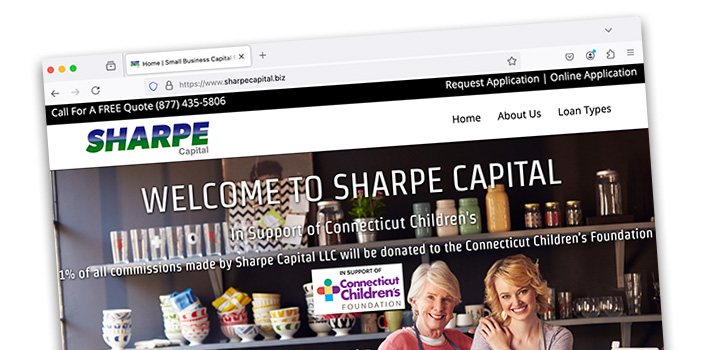 Like many broker shops these days, Connecticut-based Sharpe Capital is offering more than just a revenue-based financing product. Owned by CEO Brendan Lynch who has been funding deals and boarding credit card processing accounts for more than 15 years, the company is now looking much deeper into business owners’ needs through a whole new set of diagnostic questions like whether or not they have a written will, access to a lawyer, possession of a firearm, or ownership in real estate.
The latter on that list, real estate, is becoming more familiar in the small business finance community. Sharpe Capital, for example, added mortgages to its product set about 18 months ago.
“When we talk to anybody on the phone and they start asking questions, ‘oh, what kind of programs do you have? What are the rates?’ now we’ll always say, ‘well, the cheapest way and the most affordable way to get money is, even though rates are higher on mortgages and that stuff right now than they were in the past few years, it’s still the cheapest way.'” Lynch said. “And then what we’ll try to do is explain that it’s going to take a while. ‘How much do you need to get through the next two months while we work this up for you,’ right? Try to get the long term funding going for them and the short term solution all in one.”
More recently, however, the company has added a bundle of services that include things like identity theft protection, legal consultations, will writing, and more. In one example, Lynch said that a merchant disclosed that an IRS audit had slowed down their ability to continue the application process with them and he realized they actually had a solution for that.
“One of the things [this partnered service] covers here is audit services,” Lynch said. “They’ll give you up to 25 hours and walk you through an audit from the IRS. So it was easy. I was like, ‘hey, yeah, let me help you out right now. We signed him up right away.'”
Lynch says that for now, since it’s all still new for them, these value-adds are typically being proposed after the customer onboards for funding but that he’s open to switching it around.
“We’re definitely trying to figure out a way to approach it as the frontend as well,” he said. “The way these leads are being bought and sold so fast and rapidly, you’re fighting with 50-60 different brokers on every deal, you know? … So, we’re really just trying to find something that separates us.”
Lynch argued that in a market where a lot of brokers are essentially offering the same thing, just being personally remembered later on when it comes time for funding again can make all the difference and that being the guy who helped them draft a will for sixty bucks will probably stay fresh in their mind.
“It definitely stands out,” Lynch said. “It definitely opens up conversations where you’re going to get a little more personal with them and build a closer relationship because you’re going to start asking, ‘Are you married?’ Yeah, I know maybe that’s part of people’s sales pitch, but a lot of times we’re just so focused on getting you an offer fast and getting you funded fast, you kind of don’t have time to get into all that, so that afterwards getting to really build the relationship seems to really be working.”
New Lender Designed to Support Underserved SMEs
July 23, 2024A new specialist lender has today been launched in response to evolving SME funding needs.
Rapital is set to transform the financial landscape to support both brokers and SME businesses facing difficulty in securing funding from existing lenders and banks.
Rapital will focus on offering a direct route for clients with challenging credit situations, such as poor credit, existing loans, CCJs and defaults with loans ranging between £5,000 and £250,000. With a focus on offering fast funding, Rapital aims to make decisions in as little as three hours so SMEs can access the cash boost they need quickly.
 Access to funding is an evergreen issue for the UK’s vital SME community, with many struggling to get approval from traditional lenders. Indeed, according to the National Association of Commercial Finance Brokers’ (NACFB) annual lender and broker survey, 32% of new clients successfully funded by its members last year had been previously denied funding elsewhere – a 3% increase from 2022. Rapital has been launched to help close the gap and enable SMEs who might have been denied financing from traditional lenders to get the cash boost they need to succeed.
Rapital’s ambition is to help turn a “no” into a “yes” for SMEs needing rapid and flexible financing solutions. The service promises an easy, transparent process and same-day funding, empowering businesses to thrive and grow. In these challenging operating conditions, it is vital that smaller businesses have access to rapid and flexible capital. Rapital will offer a much-needed financial lifeline to the business profiles and industries that are often rejected by banks and other SME lenders.
About Rapital
Rapital’s mission is to empower businesses of all sizes, credit backgrounds and industries by providing brokers and SMEs with funding solutions tailored to meet the real-world challenges they encounter.
For media inquiries, please contact:
Rapital Media Team
Email: info@rapital.co.uk
Phone: 0161 884 0767
Website: rapital.co.uk
Coming Soon: Domain Names as Loan Collateral
April 25, 2024 It’s called a DeFi Cash Advance, a collateralized loan with 1-30 day terms. It’s just one of many products created by Teller, a peer-to-peer lending platform that relies on smart contracts to facilitate the transactions. The key word is “collateralized” because the blockchain-tethered asset doesn’t necessarily have to be crypto-native per se anymore. Virtually any business owner with a website can offer up its online domain name as collateral for a loan thanks to rapidly developing blockchain technology.
“Essentially what Teller is at the core is basically like an OTC desk as a way to think about it because Teller doesn’t do any lending,” said Kieran Daniels, Growth at Teller.
Instead it’s done by peers which have historically used the platform to lend against very esoteric crypto assets that traditional commercial finance folks would probably roll their eyes at. But all that’s poised to change ever since a Silicon Valley-based startup called Namefi recently found a way to bridge regular old internet domain names to the ethereum blockchain. Namefi’s tech can turn any .com or similar internet domain into a real life NFT without any disruption to the underlying website it hosts. And once ownership of the domain name is governed by whomever owns the NFT, then voilà, it can be offered up as collateral for a loan on the blockchain.
The advantage of doing something this way is the efficiency in which it transforms a widely recognized digital asset, a domain name, into a liquid piece of collateral for a loan. For example, a loan can be made instantly just with a smart contract, it can be transferred to escrow (while still working the whole time) instantly, and also transferred to the lender in the instance of a default without any headache or hassle. The hard part, if one could even consider it hard, is that in order for the domain name to turn into an NFT, it has to be transferred from the owner’s current domain name registrar to the one operated by Namefi. This can be accomplished in less than an hour. It’s the exact same process as if one were to transfer a domain name from say Godaddy to Namecheap. Namefi does all the techy stuff that turns it into an NFT and the user can still manage their regular DNS settings via Namefi.
As mentioned previously, Teller is accustomed to other assets on its platform, things like “meme coins” and digital artwork, some of which use a technological token standard called ERC-721. That’s kind of where I ironically enter the story because I noticed that Namefi relied on the same standard when turning domain names into NFTs. And so without informing either Namefi or Teller of what I was up to, I turned a domain name that I owned into an NFT via Namefi and then used the Teller platform to set up and execute a loan transaction, resulting in a self-aggrandizing press release this past January about how smart I was for possibly doing the first domain name loan over ethereum in the world.
It was noticed. The outcome is that Namefi and Teller have been talking to each other since. On February 28, the two took to social media to announce a partnership.
Namefi is partnering with Teller (@useteller) to bring DeFi to your internet domains! Now lending with Namefi domains as collateral is made easy through this partnership.
As a result of the partnership, customers will be able to:
1. List DNS names gaslessly for liquidity: List… pic.twitter.com/nHJpkUKeXj
— Namefi.io 🍊 (@namefi_io) February 28, 2024
“We’re fully leaning into it,” said Daniels to AltFinanceDaily, “we did a spaces [on X] with Namefi.”
“I think we’re just really bridging that gap for a lot of people right now and actually making that connection to say that ‘hey, NFTs aren’t just JPEGs, they aren’t just digital identity, they can have other forms of utility,'” said Alexander Walker, Ambassador at Namefi. “And there’s millions of people out there with domain names already.”
And that’s sort of the point. Everyone already understands domain names as a digital asset. The tech has just finally caught up to do that much more with them.
The typical challenge of any upstart peer-to-peer lending platform, however, is liquidity. As some readers may recall in the very early years of LendingClub and Prosper, hopeful borrowers would languish on those platforms while they waited for individual retail investors to pool together enough money to actually fund the full value of the loans. Teller has already come up with a solution for other assets it understands well, standing liquidity pools funded by peers or investors that will automatically lend against assets it recognizes. There would be a similar goal with certain categories of domain names.
“When you go to Teller, you’ll see Pokemon on ENS or 999s or certain collections of NFTs,” said Daniels of Teller. “So those are the more popular NFTs and so what Teller has done is created standing offers for those. So again, Teller isn’t the LP, but LPs can come in and add to that pool. And anyone with one of those categories can instantly get a loan or instantly borrow against that.”
 Enter .coms into the fray.
“The bigger vision is right now when you go to Teller you see Tokens, NFTs, and ENS,” Daniels said. “We want to change that to Tokens, NFTs, and Domains. […] Once we integrate that and once we get set up, then we can really lean into it and grow it from there.”
The market is still mostly unaware that this technology is here. Early interest seems to be coming from domain name investors in particular, those that think about the standalone speculative or resale value of a domain name independent of any active business use. Valuations on that basis might be too small or risky for a commercial lender to get excited about. The real opportunity then perhaps is domain names that are actively in use where the corresponding website is driving revenue for a business or even generating it on site. In the digital era, it’d be reasonable to say that many businesses depend on their web traffic to generate hundreds of thousands or millions of dollars a year in annual sales. A domain name that is being used to make that all happen is theoretically worth much more than an unused clever sounding domain name. It’s also the sort of collateral that could be monetized by a lender familiar with the market of its borrower.
With 360 million domain names registered worldwide as of Q3 2023, there’s a large market at stake.
“Domains don’t have that liquidity as of yet,” said Walker of Namefi. “But we’re currently building out that infrastructure. And that’s what makes me really excited.”