Fintech Lenders Did Better Job Meeting Intentions of the CARES Act, Study Finds
February 18, 2021 Fintech lenders doling out PPP not only reached smaller businesses on average but played an essential role in extending PPP loans to Black-and Hispanic-owned businesses, according to a study conducted by professors at the NYU Stern School of Business.
“Fintech lenders originated much smaller loans than other lenders, suggesting they served smaller firms on average,” researchers found. “Overall, we find that, relative to other lenders, [Minority Development Institutions] nonprofits, and fintech lenders make a substantially larger share of their loans to minority borrowers, particularly Black- and Hispanic-owned businesses.”
The team of economists looked over 3.4 million PPP transactions to determine what category of lenders had the highest minority share among their loans. Ryan Metcalf, Head of Public Policy for Funding Circle, member of the Innovative Lending Platform Association (ILPA), shared the full study on LinkedIn, pointing out that six ILPA members had contributed to saving jobs.
“(Funding Circle US, BlueVine, Kabbage, Inc, OnDeck, Fundbox, Lendio) provided more than 476,000 #PPP loans totaling $16.5 billion with an average loan size of ~$30,000, median loan size of $15,000, and helped save more than 2 million jobs,” Metcalf wrote. “And that was just in 2020.”
The study found that fintech lenders did a better job meeting the intention of the CARES act. While most lenders were giving out larger loans to large firms, fintech better reached actual small businesses with smaller loans on average.
“Section 1102 of the CARES Act explicitly specified that the program should prioritize ‘small business concerns owned and controlled by socially and economically disadvantaged individuals,'” they wrote. “However, the SBA did not issue specific guidance for distributing the loans, leaving private financial institutions administering the loans to independently determine which businesses to serve first or at all.”
Instead, as has become clear, many funds went to larger firms and seemed to miss minority communities. The team compared the mean and median loan amounts for different Lenders, finding the smallest in both types were fintech loans.
Researchers put first and last names through a mathematical model to predict race because that data was not available from the majority. Then predictions were compared to the sample borrowers that self-reported race. The algorithm was 78% accurate in guessing black names, 84% in guessing Hispanic, 95% for Asian, and 99% accurate for white names.
Become Releases a New Shopify App – Beprofit, to Expand Its Offerings to the E-Commerce Market
November 25, 2020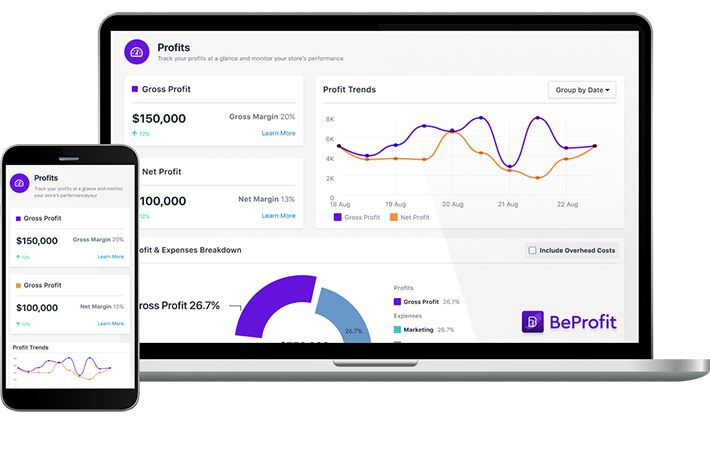 Tel Aviv, Israel – November 25, 2020 – Become, the leading online platform for small and medium businesses to find and optimize their funding solutions, announced today it has released a new Shopify app offering ‘BeProfit’.
With the expansion of the ecommerce landscape in light of the coronavirus, Become noticed the need for a single intuitive dashboard that ecommerce sellers can use to track and manage their profit and expenses. With BeProfit, Shopify sellers across the globe can now trace their profits in real time and discover what areas of their business they can optimize to increase their bottom line.
“Creating BeProfit has been a big part of our ‘pivot strategy’ during COVID-19. Building a Shopify app is a totally new and exciting realm for Become,” said Eden Amirav, CEO and Co-founder of Become. “Although offbeat, BeProfit falls in line with our underlying mission – to create a better world of funding for businesses and essentially help business owners become more. Being more profitable is not only something all businesses aspire to achieve but it is also something that will make a business become more fundable down the line.”
With many e-commerce sellers struggling to calculate, map and understand their profits, BeProfit calculates and organizes everything for them in a process that takes a matter of minutes. The app enables sellers to know exactly how much they’re making and spending, and more importantly on what. The dashboard integrates with a number of external sources, such as shipping service providers, external marketing platforms, and payment processors. This results in both visual and dynamic financial reports that update in real-time.
Noam Sinansky, CEO and Co-founder of Spire Jewelry – one of BeProfit’s first users said it’s “the first app that really manages to put in order all the financial information of my store! The app helped me get rid of complicated excel files, it just displays the information in a convenient, simple, and accurate way.”
To learn more about BeProfit, visit apps.shopify.com/beprofit-profit-tracker
About Become
Become, is the leading online platform for SMBs to find and optimize their funding solutions. The company uses its proprietary technology to nurture each business throughout the funding cycle. Become is rapidly growing with near 200,000 loyal business owners registered through its platform. The company has built an ecosystem of more than 50 leading lenders and partners and has facilitated over $285 million in tailored business loans to date.
Become’s latest service is a Shopify App “BeProfit”, organizes complex data into an intuitive and interactive dashboard. Shopify sellers can easily track their profit and expenses to see which areas of their business needs improving in order to become more profitable.
Become is backed by Benson Oak Ventures, Magenta Venture, Viola Credit, RIO Ventures Holdings, Entrée Capital and iAngels. The company has offices in San Francisco and Tel Aviv. For more information, visit: become.co.
Media Contact
Amit Shalgi
shalgi@become.co
+972547331141
Joe Camberato Named CEO of National Business Capital & Services
November 9, 2020 November 9, 2020, Bohemia, NY – National Business Capital & Services, the nation’s leading FinTech lending marketplace which streamlines the application and approval process for small business owners, today named Joe Camberato CEO. He succeeds James Webster, who has exited the company to pursue new endeavors.
The announcement comes as the COVID-19 crisis has crippled small businesses across America. Not only are business owners challenged with the overwhelming stress of meeting near-term financing demands simply to survive, but they are also tasked with re-imagining how to best position their businesses for growth in the post pandemic ‘new normal’.
“Through booming and challenging times, National’s priority has always been to serve as the go-to source for small businesses to find competitive financing options, revenue-generating services and consultative support to help them at every step of their growth journey,” said Camberato.
“When it comes to small business loan approvals, banks are highly conservative, tending to lend an umbrella when the sun is shining. With COVID-19, the sun is not shining. We recognize how crucial it is to provide access to competitive financing options to help businesses survive, but they also desperately need help to rebuild and grow.”
In a recent survey of small to mid-sized businesses by CBIZ, over half (51%) of respondents reported a significant decrease in sales due to the pandemic. Smaller businesses have been disproportionately impacted, with nearly half of businesses with 1-4 employees reporting a significant or severe impact, and 37% of businesses with 20-49 employees noting a significant or severe impact.
 In taking reins as CEO, Camberato is steadfastly committed to National’s vision to Innovate the Way Entrepreneurs Grow by offering essential resources beyond just financing. His plans include enhanced business growth consulting and coaching offerings, which he anticipates will be a dire post-pandemic need, but is currently a significant gap across the competitive landscape.
Michael Gerber, a mega bestseller who was named “The World’s #1 Small Business Guru” by Inc. Magazine, commended National’s efforts toward empowering small business owners by providing streamlined access to capital, among other game-changing resources.
“I’ve admired Joe since the day we met. He shares my mission to transform the state of small business and has unmatched knowledge of small business lending practices. His personal success building a scalable business, and passion for helping entrepreneurs and small business owners invest their efforts in the right areas to create sustainable, growth-oriented companies have been invaluable as we work together to co-author our new book,” says Gerber.
Gerber is currently collaborating with Camberato to write “The E-Myth Money Book”, which will educate small business owners about the various avenues they can take to obtain and successfully utilize small business financing while growing their businesses.
As one of National’s original founders and previous President, Camberato spearheaded significant technological innovations, implemented process enhancements, and helped build an amazing company culture on his mission to simplify the previously laborious business financing process for small business owners, securing over $1 billion in financing in the process.
Now, business owners can apply in one simple place and securely connect their bank accounts to receive tailored financing options in minutes, with funding following in as little as a few hours.
Beyond streamlined technology and processes, Camberato credits National’s success to its award-winning team and applauds their role in helping business owners get back to business amid the pandemic.
“By taking the time to understand business owner challenges or opportunities, our amazing team has established the National brand as a trusted source of capital and counsel. I couldn’t be prouder of my team’s dedication to helping small business owners, but also for their significant role in helping our clients overcome the COVID-19 crisis and get back to business. They rally behind our mission to be the trusted resource business owners turn to for financing, revenue-generating services, and business coaching and will play a pivotal role as we add new offerings to help businesses not only survive but thrive and grow.”
Camberato regularly shares his insights about FinTech lending, access to capital and small business growth strategies through his seat on the Forbes Finance Council and his YouTube channel, GrowByJoe. He is also an active member of the Young Presidents Organization (YPO) and is actively involved in giving back, locally and nationally.
ABOUT NATIONAL BUSINESS CAPITAL & SERVICES
National Business Capital & Services is the #1 FinTech marketplace offering small business loans and services. Harnessing the power of smart technology and even smarter people, we’ve streamlined the approval process to secure over $1 billion in financing for small business owners to date.
Our expert Business Financing Advisors work within our 75+ Lender Marketplace in real time to give you easy access to the best low-interest SBA loans, short and long-term loans and business lines of credit, as well as a full suite of revenue-driving business services. We strengthen local communities one small business loan at a time. For every deal we fund, we donate 10 meals to Feeding America!
CONTACT:
Matt Carrigan
press@National.biz | www.National.biz
National Business Capital & Services
1 Corporate Dr, Suite 202, Bohemia NY 11716
Toll Free: (877) 482-3008 | Fax: (631) 446-6016
SOURCE National Business Capital & Services
An Update on Section 1071 of Dodd-Frank
October 23, 2020 After more than a decade, Section 1071 of The Wall Street Reform and Consumer Protection Act (AKA Dodd-Frank) is finally moving along. The law expanded the Equal Credit Opportunity Act to require that the Consumer Financial Protection Bureau collect demographic data from small business finance companies. For ten years, a whole lot of nothing happened to roll it out, so you’ll be forgiven if it seems like the latest updates are a bit vapid.
But then the CFPB got sued for its failure to carry out its duties and it resulted in a settlement that requires the agency to hit certain milestones by certain timelines. Section 1071 is all about collecting loan applicant data in commercial finance to measure if there are disparities in the ability to access credit, particularly for female-owned and minority owned businesses. It necessitates a mechanism to comply, which will
ultimately cost time and money.
But in the meantime, the milestones to even get to the point where data collection is being carried out, are roughly as follows:
1. Convene a panel of small business lenders
2. Have that panel issue a report
3. Propose what the rules on collection will be
4. Collect feedback on the proposal
5. Formulate a final rule
6. Issue a rule
7. Set a time for when that rule will go into effect
We spoke with one alternative finance company that has been engaged in the process.
“I am representing, and Greenbox Capital is essentially representing, the industry,” CEO Jordan Fein told AltFinanceDaily in regards to his role as a Small Entity Representative to the CFPB’s panel of small business lenders. “There are some banks, there’s Funding Circle, but other than that, it’s Greenbox Capital serving in the industry.” Fein said that panelists give their opinion and engage in discussion on how companies will be impacted. He also said that he was very happy to participate in the process.
“It’s an honor to be selected to the industry panel providing feedback on section 1071 of the DoddFrank Act ensuring fair lending laws to women- and minority-owned businesses,” said Fein. “Over 2 million businesses across the U.S. are either women or minority owned and it’s vital they can secure funding as easily as non-minority owned businesses.”
The panel must complete a report within 60 days of convening. With several more milestones to go, a final rule is unlikely to go into effect prior to 2022. But until then, know that Section 1071’s implementation will probably happen during your lifetime.
Greenbox Capital on Official Panel to Aid Section 1071’s Rollout
October 21, 2020 This week, Greenbox Capital, the Miami-based alternative finance company known for its MCA and SMB financing, announced they are serving as a Small Entity Representative (SER) to the Consumer Financial Protection Bureau (CFPB) as the organization proceeds with the rollout of Section 1071 of the Dodd-Frank Act.
“I am representing, and Greenbox Capital is essentially representing, the industry,” CEO Jordan Fein said. “There are some banks, there’s Funding Circle, but other than that, it’s Greenbox Capital serving in the industry.”
Fein, who founded Greenbox in 2012 and has since facilitated MCAs and business loans across America, Puerto Rico, and Canada, wrote in a press release that it was an honor to be selected to provide feedback on Section 1071.
“Over 2 million businesses across the U.S. are either women or minority-owned,” Fein wrote. “It is vital they can secure funding as easily as non-minority-owned businesses.”

Congress passed the Dodd-Frank Act in 2010 in response to the Great Recession. To further protect consumers, the CFPB was born. Section 1071, an amendment to the 1974 Equal Credit Opportunity Act, mandates financial institutions report demographic information to the CFPB. But much was left undefined about how to go about doing that and who would technically be subject to it.
Ultimately, the intent behind the law was to measure potential disparities among factors like the race and gender of applicants. Ten years later, the rollout is finally moving along.
As part of this, the CFPB created a board of firms representing the affected industry, on which Greenbox sits, to ensure the law works with the industry, not against it. The first panel was on October 15, in compliance with the 1996 Small Business Regulatory Enforcement Fairness Act (SBREFA.)
“They’re going through the SBREFA process, which is a structured process where they have a panel of industry representatives, and they share what they’re planning to do,” Fein said. “They run it by companies like us and we give our opinion and talk about how we think companies will be impacted.”
According to an invitation letter the firms received, they will have until November 9 to respond.
Fein said Greenbox would ensure any suggestions it made would positively impact the industry. Especially during a pandemic, Fein said it is essential to create regulation with firms in mind.
Keeping Up With Kabbage
October 17, 2020 On Friday, American Express announced that it had completed its acquisition of Kabbage.
“Kabbage, An American Express Company will continue to provide quick and easy cash flow management solutions for small businesses, now backed by the trust, service, and security of a American Express,” American Express wrote on social media. “We’re excited to welcome Kabbage’s talented colleagues to American Express. Together we will combine our over 60 years of experience backing small businesses with Kabbage’s innovative technology to support our customers through this challenging time, and help them get back on their feet and thrive.”
Meanwhile, below is a copy of a Q&A AltFinanceDaily had with Kabbage co-founder Kathryn Petralia that appeared in our magazine’s July/August issue.
Q: How specifically do you think the pandemic will change the way SMEs bank?
 A: The pandemic will first change with whom they bank, and that choice will change the way they bank. For perspective, one hundred percent of Kabbage customers have a bank account, but very few of them can get a loan from their bank. We launched Kabbage Checking earlier this year to serve the smallest of businesses without sacrificing the features they expect and offering other products banks don’t. We’re focused on making cash flow tools accessible to the businesses traditionally underserved and overlooked, and the pandemic has been a catalyst for businesses to find new solutions.
Q: How might the dynamic of banking change after the crisis?
A: It was well-reported that businesses without an existing credit relationship with their bank were turned away from applying for PPP loans. We’ve heard directly from many of our PPP customers that this will compel them to change banks, and the demand for Kabbage Checking has reflected that sentiment since its launch. In the short term, businesses of all sizes and ages will seek out and sign up for new, tech-forward banking partners. In the long term, that shift will change customers’ expectations of what banks should offer. For example, prior to the PPP, Kabbage had issued well over a billion dollars to customers during non-banking hours. On-demand, 24/7 access to funding and cash flow insights, or faster settlements and money transfers will soon become commonplace, and large retail banks will need to adapt if they want to capture or reclaim these customers.
Q: How are these changes likely to impact alternative lenders and funders?
A: For starters, single-product lending companies will realize they must diversify their offerings in order to compete in the new financial-services marketplace. I would expect to see lenders launch new products to more resemble a bank. Conversely, traditional banks will need to begin adopting automated ways to serve customers with a tech-forward experience. Especially in the new normal where customers may be apprehensive about in-person banking meetings, they must adapt online to acquire and serve customers.
Q: What’s still needed to help Main Street recover?
A: The PPP was only the first phase; we’re not out of the woods yet. Businesses now need to restart and eventually grow. The crisis made business owners realize they need tighter controls over their cash flow, as many found themselves on the back foot and ill-equipped to withstand a long-term crisis such as the one through which we are all muddling.
They’ll need cash-flow tools to be more prudent and appropriately plan for similar events. Having said that, it’s not only on the shoulders of small businesses or tech solutions. They need customer demand, and local economies need to begin to reopen safely so consumers feel comfortable returning to normal commerce. That will take the support of cities and states encouraging consumers to shop local so small businesses have greater incentive to recall their employees and get back to work.
Q: How can alternative lenders and funders best play a role in this recovery?
A: Much of what we’re already doing is exactly what our economy needs. For the most part, fintech companies serve the customers banks won’t or can’t. That reality is unfortunately unchanged today. That’s why during the pandemic Kabbage made every effort possible to provide products that helped SMBs through this crisis. With respect to PPP, we helped nearly 300,000 small businesses access over $7 billion, helping preserve an estimated 945,000 jobs. Our payments product saw a near 4X spike in adoption as businesses sought contactless payment options. We built www.helpsmallbsuiness.com in three days to allow any small business to generate needed revenue by selling online gift certificates. We also launched Kabbage Checking, giving small businesses a new banking option, and Kabbage Insights remains available and free to access for any small business.
Q: What changes do you expect to see in the alternative lending and funding industry as a result of the pandemic?
A: Everyone will expand their services. Whether it’s larger companies expanding their solutions through acquisitions, or start-ups investing beyond their primary product, everyone will aim to enhance their offerings to give customers more data-driven products that help them rebuild.
Q: Kabbage just agreed to be purchased by American Express. Should we expect to see more consolidation in the alternative lending/funding space? If so, over what time frame and why do you expect this to happen?
A: I would not be surprised if we saw more deals announced before the end of the year.
Q: Tell us a little about why Kabbage decided to sell and why the timing was right?
A: For us, it has always been about finding the right company with the right mission and intentions. We just happened to be in the middle of a crisis when the conversations started, despite having the financial capacity to support operations for multiple years. American Express shares our vision to be an essential partner to small businesses, and we couldn’t be more excited at the opportunity to continue the important work of providing solutions and innovative capabilities that address a range of small business cash flow needs alongside AmEx.
The Roosevelt Hotel is Closing Permanently Due to Pandemic Losses
October 13, 2020 After nearly a century of quintessential Manhatten hospitality, the Roosevelt Hotel is closing by the end of the month, sources say. A relic of classic New York that survived the Great Depression, WWII, and Broker Fair 2019, the hotel is officially shutting down for good after suffering pandemic related losses, a spokesperson said.
“Due to the current, unprecedented environment and the continued uncertain impact from COVID-19, the owners of The Roosevelt Hotel have made the difficult decision to close the hotel, and the associates were notified this week,” the Spokesperson told CNN reporters Friday. “The iconic hotel, along with most of New York City, has experienced very low demand, and as a result, the hotel will cease operations before the end of the year. There are currently no plans for the building beyond the scheduled closing.”
The hotel will be added to the growing list of staple New York City businesses that have closed as a result of COVID. The Roosevelt was named and built to honor the United States’ 26th president and it opened its doors on September 22, 1924. Constructed during Prohibition, the building began the modern trend of featuring designer store windows on the street front.
 Appearing as a backdrop for dozens of Hollywood blockbusters like Boiler Room, Malcolm X, and The Irishman, the hotel was iconic. The New Year’s Eve tradition of singing “Auld Lang Syne” was born at the Roosevelt in 1929 when Guy Lombardo and his orchestra broadcast the song live over the radio.
The building was purchased by the limited investment branch of Pakistan International Airlines (PIA) in 1999.
In July, government officials and PIA executives debated the hotel’s future, some hoping rumors that President Trump would purchase the property were true. The initial plan was to sell or renovate the city block to create office space, thought to be far more lucrative than the hotel business in 2019. Work-from-home orders threw a wrench into the cogs, and the hotel kept losing money: no one wanted the traditional New York experience during a pandemic.
 Posting a loss during this year has become expected of the hospitality industry. According to the Bureau of Labor Statistics, hospitality lost 7.5 million jobs due to shutdowns and travel restrictions in April. CNN reported that only half as many jobs had been added back. In September, NYC hotels were below 40% occupancy.
The decision to ultimately close The Roosevelt might also come from trouble in PIA’s airline business. After the crash of PIA flight 8303 that killed 97 people in Havelian, Pakistan, European and US regulators banned flights from PIA for six months. After the crash, nearly one-third of airplane licenses in Pakistan were found to be fraudulent or forged, further straining the organization’s ability to recover.
Though this may have contributed to The Roosevelt’s closure, the pandemic sealed the deal. According to a study by the American Hotel & Lodging Association, New York has 2,336 hotels statewide that have lost 43,014 jobs this year.
 Without further congressional aid, 1,565 hotels might close: the AHLA found that 74% of overall US hotels say more layoffs are coming if the industry doesn’t get additional federal assistance. But successful talks for more aid in the House and Senate are increasingly unlikely due to this election year’s heightened partisanship.
NYC is losing yet another historical business, as the way of life and all things we have come to expect from the big apple struggle to survive. As a destination venue, The Roosevelt was also dear to AltFinanceDaily. It was the home of Broker Fair 2019, where Sean Murray spoke in the same ballroom that Michel Douglas (as Gorden Gekko) made the famous “Greed is Good” speech as part of the 1987 film Wall Street. Murray made a similar speech but rewrote it to fit the industry that had gathered. “Funding small business, for lack of a better phrase, is good,” he said on stage to an audience of 700 people.
Unfortunately, it was The Roosevelt that ultimately needed funding and didn’t get it.
Avant CEO: Colorado Decision Framework for Bank Fintech Partnerships
October 13, 2020 After three years of litigation, in August, the Colorado “true lender” case settled with an agreement between the fintech lenders, bank partners, and the state regulators. Along with lending restrictions above a 36% APR, the fintech lenders will have to maintain a state lending license and comply with other regulatory practices.
The decision has been called unfair regulation and a bad precedent for other similar regulatory disputes across the country.
But James Paris, the CEO of Avant, sees the decision as a victory for fintech lenders. Paris said the decision was an excellent framework for fintech/bank partnerships across the nation and a sign that regulators are finally taking the benefits of alternative finance seriously.
“For us, the case also involved being able to continue to provide these good credit products to deserving customers who maybe weren’t being served as well through some of the legacy providers,” Paris said.
Paris called back to the Madden vs. Midland Funding case in the US Court of Appeals Second Circuit decided in 2015. That case called into question if loans made in fintech bank partnerships in the state of New York were valid at the time of origination. Regulators charged that though national banks can create loans higher than state regulations allow, fintech partners buying those loans to take advantage of higher rates were skirting state regulations.
“The ruling was essentially that the loan would not continue to be valid,” Paris said. “Because the individual state in question, which was New York’s local usury law, would apply because it was no longer a national bank that held that loan after it had been sold.”
The decision called into question loans made in the fintech space. Paris said that the Colorado true lender Case was not about whether the banks were even making loans. Instead, fintech lenders were called the true originators and therefore didn’t have a license that allowed them to make loans at higher rates than the state allowed.
Paris said the decision showed confidence that fintech bank partnerships were not exporting rates, and that by limiting lending to under 36%, regulators were protecting bank fintech partnerships and consumers.
“All of the lending Avant does is under 36%, and that’s been the case for years,” Paris said. “In the space where we do play, from 9% to just under 35%, through our partnership with WebBank, we are confident in running a portfolio extremely focused on regulatory compliance.”
Colorado went from not allowing partnerships at all, to working with fintech companies to developing a set of terms that allowed partnerships to function, Paris said. He added that Avant’s products have always been to customers below nonprime credit, from 550 to 680 Fico scores, serviced by up to 36% APRs.
Paris said he does not know about customers outside of this range, or how they are affected by limiting APR to 36%, but he cited a study done by economist Dr. Michael Turner. Turner is the CEO and founder of the Policy and Economic Research Council (PERC), a non-profit research center.
The study compared lending after the Madden case in New York with how customers can be served after the Colorado true lender case. In the credit market Avant serves, Turner found that customers are better off with access to regulated fintech loans, as opposed to not having access at all.
The study looked at the average borrower credit score, APR, and loan size of Avant and WebBank borrowers, and found that if WebBank loans through Avant were prohibited, borrowers would be forced to access other means of credit, through much higher rates.
“Should WebBank loans be prohibited in Colorado, then we can reasonably expect that some non-trivial portion of the WebBank loan borrower population, as well as prospective future borrowers, will be forced to meet their credit needs with higher cost products,” Turner wrote. “This outcome is financially detrimental for this borrower population, most of whom have no access to more affordable mainstream alternatives.”
Given this data, Paris is happy to comply with the regulation. Without the framework Colorado has provided, Paris said borrowers would be worse off. Paris hopes that this decision will precede other state frameworks because what fintech bank partnerships need the most are consistent regulatory practices.
“I’m hopeful that to the extent there are ongoing concerns around bank models across other states, that this type of safe harbor model that Colorado helped develop is something that others could look to as a precedent or a model. Because I think the more that we can have consistency across the relevant jurisdictions, the better.”