
Lendio Improves Access to Capital, Continuing Marketplace Trend
September 22, 2016 Small business loan marketplace Lendio partnered with Detroit-based working capital financing company Supplier Success to improve capital access to businesses owned by minority and women owners.
“By joining forces with Supplier Success, we’re able to expand our capabilities to provide minority business owners easier access to financing,” said Brock Blake, CEO and co-founder of Utah-based, Lendio.
Supplier Success is the latest addition to the string of partners the company already works with. In August, the company announced that it had facilitated over $250 million in funding transactions and of that, $55 million was originated in Q2 alone. Partnerships with GoDaddy and Staples originated $14 million and $4 million respectively.
Loan marketplaces have been quick to board the partnership wagon, forging customer-share deals to expand their reach. Recently, Conshohocken, Pennsylvania-based small business lender CapitalFront partnered with Lenders One, a marketplace for mortgage brokers to offer unsecured business loans on the Lenders One platform.
Lenders One is a mortgage banking cooperative with 250 members including credit unions and community banks. Under the customer-sharing partnership, CapitalFront will offer funding to self-employed residential mortgage customers.
“Roughly 20% of mortgage borrowers are self-employed business owners,” said Brian Simon, CEO of CapitalFront in a statement. “The relationship between CapitalFront and Lenders One allows the cooperatives members to differentiate their services and strengthen their relationships with their customers by offering borrowers access to capital for their business needs.”
Funding The Great White North
September 13, 2016
As of last year, 98 percent of Canada’s employers were small businesses compared to 0.3 percent (2,933) large companies. Given this and what we know about Canada’s banking oligarchy, dominated by five large banks, it was inevitable that American alternative lenders would go looking for greener pastures in Canada.
When OnDeck set foot in the country two years ago, it accelerated the alternative lending movement by offering loans up to $150,000 CAD. But OnDeck wasn’t the first to discover the Canadian market. Merchant cash advance companies such as Principis Capital and AmeriMerchant (today Capify) have been there since 2010. Principis actually draws close to 15 percent of its business volume from Canada. But the credit that’s due to OnDeck is for expanding the horizons of small businesses who have been conditioned to think that lending begins and ends with banks. The crop of Canadian alternative lenders who do not otherwise have the resources for similar blitzkreig marketing are pleased with the industry’s promotion in general.
“We are happy that some of the bigger US players are coming up here and they are spending millions of dollars on advertising,” said Bruce Marshall, vice president of British Columbia-based Company Capital. “These companies raise awareness of the industry to a higher level and with us being a smaller company, we can ride on their coattails,” he said.
Company Capital has been operating as a balance sheet lender for five years and has provided term loans, working capital loans, merchant cash advances and ‘cash lines’ which are similar to lines of credit. For lenders such as Company Capital which makes loans in the range of $30K – $50K, the presence of bigger players like OnDeck saves them from consumer education-oriented marketing campaigns. “We cannot compete with the advertising of big companies but it works in our favor of creating awareness and becoming more mainstream,” Marshall noted.
And this not only helps the Canadian companies but also smaller US companies that feel comfortable entering a market with a leader. OnDeck’s presence nudged Chad Otar, founder and managing partner of New York-based commercial finance brokerage Excel Capital Management into considering Canada as a viable market. “We saw OnDeck go there and thought that there is some kind of money we can make,” he said.
 But for OnDeck, Canada might just as well be another large US state. Most American companies including OnDeck, Principis Capital and Excel Capital run their Canadian operations remotely, treating it much like an extension to their US business with similar products.
“Our range of business is virtually the same in Canada as in the US. We don’t need to have an operation center there,” said Jane Prokop, CEO of Principis Capital. The company approaches Canada just like the US with accounts and customer service being handled in a similar fashion. “It’s a very manageable extension of the US market,” Prokop said. “It’s a smaller market so someone who enters Canada cannot expect the same kinds of volume as in the US.”
It also certainly helps to be spread across the same time zones and in such close proximity where a majority of the country also speaks the same language. If it was that easy though, shouldn’t we have seen more companies doing this?
“The fundamentals of the Canadian market are different. Our banks are established and trusted and in general do quite a good job, so the opportunity for market expansion is different than in the US,” said Jeff Mitelman, CEO of Thinking Capital, one of the country’s first alternative lenders.
Prior to Thinking Capital, Mitelman founded and ran Cardex, Canada’s first ISO which offered lending products with payment services. And that competitive edge helped him recently to partner with payment solution company Everlink to expand its customer base and offer loans online. The company previously secured credit facilities worth $125 million from two of the biggest banks in the country, The Canadian Imperial Bank of Commerce and Nova Scotia.
Picking up the same strategy, some American companies decided to bank on these big banks (pun intended) for their success. For instance with Kabbage, it made sense to license its automated platform to Nova Scotia Bank and to rely on them to deploy capital while Kabbage provides the technology and customer experience. “We saw that Canada is ripe for technology but the differences in regulation among other things made us go the partner route,” said Peter Steger, head of business development at Kabbage.
The advantages of having an incumbent customer base, the brand equity and the supply of capital usually outweighs the costs and inconveniences of maneuvering in an unfamiliar business environment that only a few firms have the bandwidth for, some companies contended.
Secondly, there is a lack of reliable and robust data necessary for making lending decisions. Since only a handful of large financial institutions dominate the landscape, the data reported is limited to a small number of players and the outputs from credit bureaus may not be sufficient for making a credit decision. “The availability and access to government and financial data is scarce in Canada compared to other markets,” said Jeff Mitelman. “Most of the data relationships that fintech companies rely on, need to be developed on a one-to-one basis and is often proprietary information.”
Having the data presented in the right format can save a lot of underwriting time. Companies in Canada find the government and financial data available to be scanty and in less than ideal form. David Gens, CEO of Vancouver-based Merchant Advance Capital noted that Canadian merchants are slower to adopt technology which adds to the woes of online lenders. “Believe it or not, some Canadian merchants still use fax,” he said.
Even as the country plays catch up, Canadian lenders consider the market to be large enough for many players. “At this time, education is more important than competition,” said Mitelman.
 Canada’s geographical dispersion and regional differences however are peculiar. The four provinces of Quebec, Alberta, Ontario and British Columbia make up 86 percent of the population and the greater part of the economic activity. And Quebec is often avoided, in part because of the bilingual mandate that requires businesses to advertise and produce materials in French. OnDeck and Company Capital both do not operate there, for example.
The cultural differences can also determine how customer relationships are handled, and being a part of that culture has given Canadian companies an upper hand. “It does definitely help to have a home advantage in terms of understanding the local peculiarities,” said David Gens. “Marketing to Canadian merchants is also different — being aggressive might not work very well here and they like to know they are dealing with someone nearby.”
For financial brokers such as Otar, Canadian usury laws can appear restrictive. As per Canadian interest rate rules, Under Section 347 of the Criminal Code (Canada), interest rates exceeding 60 percent per annum are termed “criminal rates of interest” and “interest” in the Criminal Code is broadly defined as a broad range of fees, fines and expenses which includes legal expenses.
“US lenders have had to change their way of doing business. Since, APR is less here, if your product is a loan contract, you will be restricted and you will have to service low risk for low rates,” said David Gens.
Even so, the business emerging out of Canada may now be supplemental for American lenders and the potential for growth beneficial to diversification.
Upcoming Industry Conference Schedule
September 2, 2016It’s not too late to sign up for this year’s remaining industry conferences. AltFinanceDaily will be at all three of the following events:
Marketplace Lending and Investing Conference
Who should go?: Investors, lenders, platforms, etc.
When is it?: September 27 – 28
Where is it?: New York City
How do I sign up? Register here
Bonus: Use promo code DB to get $250 off the ticket price
Commercial Loan Broker Conference
Who should go?: Business loan brokers, MCA brokers, equipment finance companies, lenders, MCA funders, investors, etc.
When is it?: October 4 – 6
Where is it?: Las Vegas
How do I sign up?: Register here
Lend360
Who should go?: Consumer Lenders, Business loan brokers, MCA brokers, MCA funders, investors, etc.
When is it?: October 5 – 7
Where is it?: Chicago
How do I sign up?: Register here
Bonus: Use promo code AltFinanceDaily15 for 15% off the registration price
LendIt Europe
Who should go?: Everyone
When is it?: October 10 – 11
Where is it?: London
How do I sign up?: Register here
Bonus: Use promo code AltFinanceDailyVIP for 15% off the registration price
Money2020
Who should go?: Everyone
When is it?: October 23 – 26
Where is it?: Las Vegas
How do I sign up?: Register here
IT’S A BROKER’S WORLD
August 31, 2016
From east to west, small businesses are getting funded. But how they’re found and who they work with depends on where they are. In the US, where brokers tend to have a love/hate relationship with the funding companies they work with, they are no doubt a driving force in the market. In other countries, they might not even exist, are just starting to bloom or they add balance to a mature market. Is the world built for brokers? AltFinanceDaily traveled far and wide to find the answers.
Down under in Australia where American-based merchant cash advance and lending companies have expanded, the ISO (which stands for Independent Sales Office and is synonymous with broker) model has not really followed. David Goldin, CEO of Capify, an international company headquartered in New York, told AltFinanceDaily that there’s very few ISOs in Australia.
 He believes that’s because there’s next to no payment processing ISO market there, a foundation that was a major precursor in the US towards the development of ISOs reselling merchant cash advances and business loans.
Luke Schmille, President of CapRock Services, echoed same. The Dallas-based company founded Sprout Funding in Australia earlier this summer as part of a joint venture with Sydney-based family office Huntwick Holdings. “Direct marketing is the primary method [of acquiring deal flow],” he said. “The credit card processing space is controlled by several large banks, so you don’t see ISO efforts in the acquiring space either.”
Big bank dominance was only one reason why another country’s emerging alternative small business funding market developed slowly. In Hong Kong, non-bank alternatives like merchant cash advances faced legal uncertainty for a long time. For example, Global Merchant Funding (GMF), once the only merchant cash advance company in the Chinese special administrative region, had been relentlessly pursued for years by the Secretary for Justice for conducting business as a money lender without a license. GMF fought it. And won.
In May of this year, the legality of merchant cash advances ultimately prevailed after the highest court ruled the agreements were not loans. Emboldened, several companies have stepped up their marketing of the product. But whether they’re doing daily debit loans or split-processing merchant cash advances (both of which exist there), marketing tends to be directed at merchants, not a middle market of brokers.
 Gabriel Chung of Hong Kong-based Advanced Express Capital said that there are a handful of large brokers typically comprised of former bankers, but the rest of the broker market is highly fragmented, mostly made up of individual freelancers.
Adrian Cook, the Founder and CEO of Hong Kong-based Asia Capital Advance, agreed that marketing is usually aimed at merchants directly but that it’s changing. “Since the market is still very new and MCA is only beginning to gain popularity, brokers on the market are only starting to recognize MCA,” he said. “There is a lot of room for the brokerage market to grow.”
In the UK, where Capify also operates, CEO David Goldin explained that the UK doesn’t have a lot of credit card processing ISOs so there wasn’t a major migration from that business to MCA like there was in the US. But that doesn’t mean there is no middleman market at all.
 Paul Mildenstein, executive director of London-based Liberis, said that brokers are an important channel, but not as dominant as they are in the US. “Our brokers are usually members of the NACFB, an organisation in the UK that actively supports and provides operating principles to the furtherance of the commercial finance broker community,” he wrote. The National Association of Commercial Finance Brokers claims to have 1600 members, one among them is Liberis.
“Many clients want the support of an experienced professional who can discuss the financial options available to them in their specific circumstances,” said Liberis’ CEO, Rob Straathof. “Given relatively low awareness of the Business Cash Advance product in the UK, this means that brokers have a key role to play in educating potential customers on when this is the right option for them,” he added.
Straathof stressed a robust criteria for the brokers they work with and explained that brokers are their eyes and ears in the market. “The relationships we have with them are not transactional, but transformational for our business,” he said.
The NACFB was also praised by Alexander Littner, Managing Director of Chelmsford, Essex-based Boost Capital. The company, which is actually a subsidiary of Coral Springs, FL-based BFS Capital in the US, sees a balance between their use of brokers and their efforts to acquire customers directly.
“As the alternative finance market is still relatively new here in the UK these brokers are important for this independent advice, and to help educate the market and establish trust,” Littner said. “At Boost Capital we work very closely with brokers across the UK, they are a critical part of our growth and fundamental to our ongoing success.”
In the US, brokers play such a dominant role in customer acquisition that some MCA funding companies rely on them to source the entirety of their business. Back in February, Jordan Feinstein of NY-based Nulook Capital told AltFinanceDaily, “We decided that the best way to grow is to build relationships to avoid the overhead, compliance, training and manpower that a sales team would require.” Nulook markets its broker-only approach as a strength.
Others take a more blended approach, like Justin Bakes, CEO of Forward Financing, for example. “While our priority is to self originate, it is essential to create and maintain partnerships in this business,” he said earlier this year.
Notably, no such guiding authority like the UK’s NACFB exists for brokers in the US so it’s not easy to track exactly how many there are or how they operate, but their role in the industry cannot be understated. AltFinanceDaily actually labeled 2015 The Year Of The Broker, when it published an article in its March/April 2015 issue that tried to capture the essence of the industry at the time. Tom McGovern, who was then a VP at Cypress Associates LLC, said of brokers, “They’re like the missionaries of the industry going out to untapped areas of the market.”
But preaching the gospel of alternative funding exists at different stages across the world. And Goldin, whose company Capify operates in four countries including the US, thinks that many middlemen here at home may not ultimately survive. In an interview, he predicted that the stronger ones over time will be acquired by funding companies and that direct marketing will only increase. “I think more and more companies are going to start building their own internal sales forces,” he said.
Other brokers are not convinced that acquisition costs will lead to the death of their businesses, especially if they’ve already found ways to reduce overhead costs. Several brokers have discreetly mentioned running operations from Costa Rica, Nicaragua or elsewhere as a way to keep things profitable. Still more, like Excel Capital Management based in Manhattan, have found that offering a suite of products allows them to monetize more customers. Chad Otar, a managing partner for Excel, said that they recently brokered a $4.9 million SBA loan. MCA is just one of their options these days. “As long as there’s small businesses, there’s always going to be opportunity,” he said.
 In the US, the brokers have certainly seized it, but that’s because most funding companies offer big bucks and quick payment to those that are capable of sourcing customers. In other countries, compensation for services rendered might be the responsibility of the broker to arrange with the merchant since it may not be customary for funding providers to pay commissions. That would mean more work and more risk for the broker.
Ironically, some brokers in the US will tap into both sides, earning a commission from the funder and charging a fee to the merchant for services rendered. And if the broker has payment processing roots, they can go a step further and earn merchant account residuals as well.
Brokers can’t exist without funding companies willing to support their endeavors, of course. While their prevalence around the world varies, most of the funding companies AltFinanceDaily spoke to, appear eager to nurture the middleman’s role, so long as they act responsibly.
“Brokers in the UK are incredibly important as independent advisors to small businesses on the various sources of finance to suit their needs,” said Littner.
And as long as those customers, wherever they may be, are getting the value they want from a broker, that role, so long as it can continue to be done profitably, will likely have a place in the world for the foreseeable future.
Can an ISO “Excel” in 2016?
August 26, 2016
Don’t let anyone tell you that it’s too hard for a commercial finance broker to make a buck in exchange for honest work these days. One ISO in lower Manhattan is seeing more opportunity than ever before. Chad Otar, a managing partner of Excel Capital Management, sat down with AltFinanceDaily to make his case for a bright future.
“As long as there’s small businesses, there’s always going to be opportunity,” Otar said. “Business owners are always going to need money.” Ironically, his own company that he cofounded in 2013 with hometown friend Nathan Abadi, was formed without any outside debt. Bootstrapped even to this day and even as they’re expanding, they’ve seen firsthand what other businesses around the country have to go through to get ahead.
“We’ve always believed in the products that we’ve sold,” said Otar, who brokers merchant cash advances, business loans, SBA loans, factoring products and more. They want every deal to help their clients whether it’s big or small, explaining further that even he himself has to feel comfortable with what the merchant wants. When asked about size, Otar said the largest SBA loan they got done was for $4.9 million.
But when questioned if more merchants were moving towards factoring and other traditional products, he explained that some merchants just don’t want to deal with the hassle of something that might be overly invasive or a process that might take a long time. They just want to get funded quickly, he said. And that’s where they come in.
Otar and Abadi’s optimism is not just anecdotal. The two partners, who previously renewed one year leases for their small office on Maiden Lane, saw enough runway to recently sign a five year lease for a 2,700 sq ft. office on Greenwich Street, staying within the bounds of the city’s financial district. Between full time employees and contractors, they currently house about fifteen people in their new office.
 Though the partners live in Brooklyn, they, like many other companies in the industry, believe a Manhattan headquarters makes the most sense. “Everything is here,” Otar said. It’s easier to recruit new hires, he explained. And they indeed have immediate hiring plans now that they’ve got the space for it, both in sales and operationally.
This new up-and-coming generation of business owners is very comfortable with the Internet and technology, Otar added, speeding up the process and allowing they and the funding partners they work with to do more deals together. One example offered was a small business owner who gave a guided tour of his establishment to an underwriter using FaceTime on his phone. Normally, the process would’ve been delayed by a few days because of the time it takes to hire a third party to perform a site inspection.
Some funding partners offer DocuSign so that merchants don’t even have to spend time printing and signing documents anymore, he said, qualifying that however by adding that while some merchants love it, others hate it and feel more comfortable doing things the old fashioned way. He acknowledged that was likely due to the generational gap that still exists.
When asked if the setbacks and gloom that had begun to envelop the consumer lending side of fintech, was also affecting the commercial side, Otar said he didn’t see it. Funders are still very aggressive with approvals and terms, he said. While paperwork required for approval is declining overall, he described one obstacle that he hadn’t really dealt with in previous years, UCC filings that are accidentally left active even when the agreements are satisfied in full.
Underwriters doing due diligence might interpret active UCCs to mean that outstanding obligations still exist. Absent a formal termination of the UCC, an underwriter may request that merchants provide documents from the secured party to support that a termination should’ve been filed. This in itself is not a burdensome task but Otar said he has seen merchants who have used alternative financing products continuously over the last eight years or so, who are then challenged to produce satisfaction letters from dozens of companies, some of whom the merchant may only vaguely remember.
But he is not discouraged when new challenges come up. “We’ve been constantly learning,” he said. And when asked what their secret to success has been up until this point, “It’s hard work and dedication,” he responded.
Have You “AltFinanceDaily” Yet?
August 5, 2016If you’re not already subscribed, you can make sure that you receive the July/August 2016 edition in print by subscribing here.
Among the featured stories and content are:
- The role of MCA/business-loan brokers around the world contrasted with the U.S.
- The continued growth of alternative commercial finance
- How to grow an MCA or business loan brokerage
- Uber’s new finance program
- And much more!
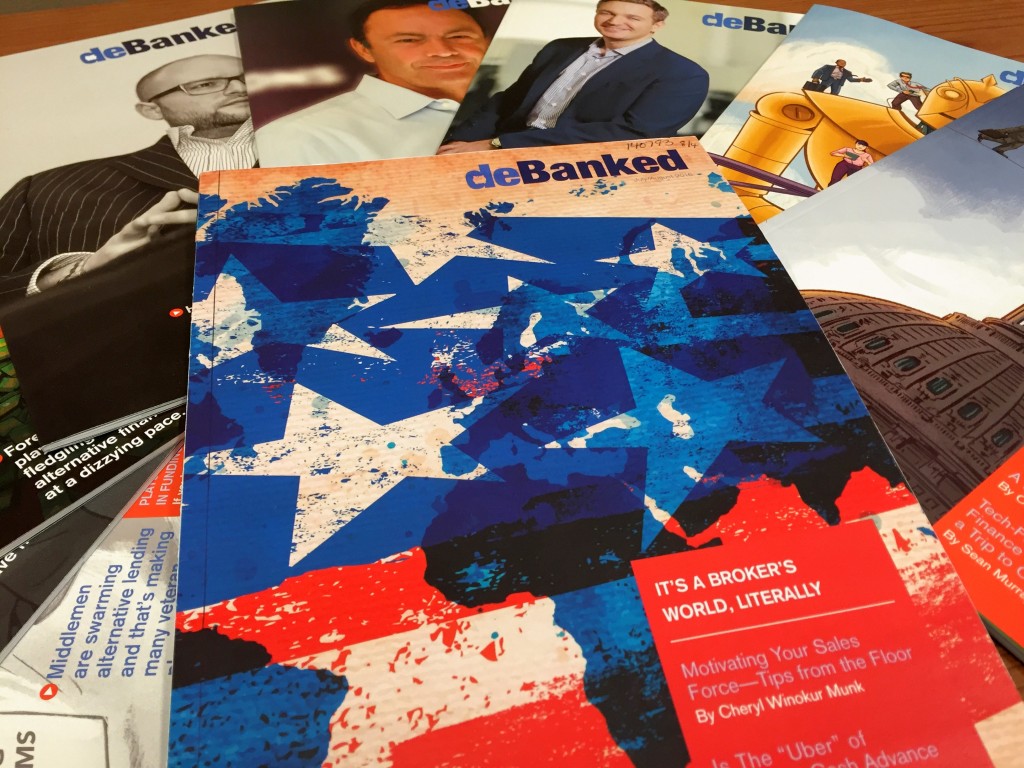
Are you involved in funding businesses outside the bank? It sounds like you’ve de-banked! We hope you enjoy this issue. The digital version will be online later this month.
California Finance Lenders Law Licensing Compliance for Merchant Cash Advance Financiers
August 2, 2016 Since the Richard B. Clark v. AdvanceMe Inc. class action case settlement was brought to the awareness of the Merchant Cash Advance (“MCA”) industry, many MCAs applied and obtained a California Finance Lenders Law License from the Department of Business Oversight. (“DBO”)
After your company obtains a California Finance Lenders Law license, it will then need to comply with the California Finance Lenders Law. (“CFLL”)
CFLL does not contain specific financial code sections and regulations to regulate MCAs. However, CFLL regulates consumer and commercial loans. So, MCAs licensed under the CFLL will need to comply with the code sections and regulations that apply to commercial loans, assuming that MCAs provide advances that are each “bona fide” $5,000 or more in principal amount and for commercial purposes.
The MCA contract you use when making advances in other states is likely not in compliance with CFLL. CFLL regulation includes without limitation, (either directly or by incorporation of other California and federal laws) the rates and charges, marketing and advertising, disclosures, contractual provisions, electronic transactions, collections, credit applications, default and repossession, brokers and finders, and general operations of main and branch offices.
The CFLL license application requires the MCA company’s principal (corporate officer or LLC manager) to acknowledge on behalf of the MCA company, that it read the contents of and is familiar with the CFLL, and that it agrees to comply with the CFLL.
Lack of compliance can be brought to the attention of DBO’s enforcement officials as a result of either, a customer or competitor complaint, a DBO audit, through the Annual Report that must be filed by CFLL licensees by March 15 of each year, or by other means.
It is important to not only obtain the CFLL license, but to also comply with the CFLL to keep the license. DBO publishes online enforcement actions, such as Desist and Refrain Orders and Accusations. A CFLL licensee has a right to request an administrative hearing to defend itself and present its case. Unfortunately, although the legality of this practice by DBO is questionable, DBO publishes online none-final (and also final) administrative enforcement actions such as Desist and Refrain Orders (“D&Rs”) and Accusations. (publishing of final administrative orders is specifically authorized by the Financial Code but not none-final orders) Potential customers and competitors who review none-final D&Rs, are under the mistaken belief that the D&R is a final order, and may therefore refuse to conduct business with the licensee.
MCAs who are either CFLL licensees or potential licensees should familiarize themselves with CFLL law to avoid administrative enforcement actions, court actions, loss of business, and other adverse repercussions.
National Funding Deploys $1.5B, Beefs up Automated Underwriting
July 26, 2016California-based small business lender National Funding said that it has deployed $1.5 billion in capital, funding small businesses with short-term working capital loans.
The 17-year-old company funded $152 million in loans in the half of 2016, up 45 percent from the same period last year. The company’s customers include general contractors, medical services and trucking companies that average about $1 million in sales annually.
While 80 percent of the loans are for working capital, the company has seen demand for equipment leasing slowly resurge after the financial crisis. “After 2008, the market turned negative in LA and we had to shrink our company,” said CEO Dave Gilbert.
The company is also preparing for a technology overhaul, trying to get access to data pools to automate underwriting. “We need to be tech driven,” he said. “As deals get smaller, we need to automate them to make it affordable.”
National Funding generates 25 percent of its loan volume through brokers. “Given everything that’s happening in the industry, a lot of lenders will be forced to become balance sheet lenders,” he said.
The company hired Geoff Howard from Intuit to lead its technology efforts and aims to automate underwriting for 40 percent of its deals, doubling up from its present rate of 20 percent.
The average size of its loans is $50,000 and the company also plans to launch its first long-term loan product later this year.