
CAN Capital Woes Continue – Layoffs Commence
December 16, 2016More information is slowly starting to come out about the recent C-level removals at CAN Capital. In the meantime, the company announced major layoffs just before the holidays. American Banker says the number is 136 employees laid off just at CAN’s Kennesaw, GA office.
Multiple brokers that have done business with CAN in the past have told AltFinanceDaily that CAN is not actually servicing renewals for existing customers or that they’re only doing them on a highly selective basis, despite what the company said two weeks ago.
The company’s chief executive officer, chief financial officer and chief risk officer were all put “on a leave of absence” in late November after discovering that “some assets were not performing as expected and that there was a need for process improvements in collections.” All of their names have been removed from the leadership page on the company’s website.
While the collective expectation has been that CAN would resume funding new business again in January, the wave of layoffs do not inspire confidence. No executive replacements have been named and CAN’s chief legal officer still remains in place as the company’s “acting chief executive.” It’s a bizarre sequence of events that seems to indicate there will not be a return to normalcy any time soon.
A True Rapid Advance For Mark Cerminaro
December 16, 2016 In the 1999 film “Any Given Sunday,” Al Pacino plays a pro football coach whose obsession with winning has torn apart his family. He’s also plagued by a meddlesome team owner, challenged by an offensive coordinator who’s after his job, and vexed by a talented but narcissistic backup quarterback. But none of that stops the coach from reaching deep inside to deliver a stirring halftime pep talk to his dispirited losing team. Assuring his players that life and football are both games of inches, he beseeches them to look into the eyes of the men around them. “You’re going to see a guy who will go that inch with you,” he declares. “Either we heal now as a team or we will die as individuals.” The players rally and explode onto the field.
It’s a scenario the sales staff can’t get enough of at RapidAdvance, a Bethesda, Md.-based alternative small-business finance company with more than 200 employees. Mark Cerminaro has screened a clip of the scene countless times in a company conference room to fire up his crew. Salespeople emerged from those meetings eager to make that extra phone call, provide the telling detail on an application or do whatever else it would take to taste the victory of making the sale. For Cerminaro, the movie and the sales meetings embodied his penchant for winning ethically through teamwork, dogged persistence and great customer experience. That credo has helped propel him to top management at RapidAdvance and has earned him accolades from once-skeptical financial services peers.
Cerminaro’s story begins in his hometown of Highland Park, N.J., where he experienced a small-town vibe but enjoyed easy access to New York City, Philadelphia and the Jersey Shore. He graduated in a class of 85 students from the local public high school, playing varsity football, basketball and baseball. Summers, he worked construction, did landscaping, delivered flowers and umpired Little League. “It was a great place to grow up,” he says.
 In high school, Cerminaro sometimes went along for the ride when his sister, who was five years older, was choosing a college. On a visit to Georgetown University in Washington, D.C., Cerminaro stood in the student center and gazed out at the campus. “I’m going to come here and play football,” he told himself.
He made good on that vow when his high school football team made a reputation for itself, and Georgetown was among the schools that recruited him. Besides, it made sense to go there because he was interested in studying politics and going to law school. Growing up with a father who was chairman of the local Democratic Party, Cerminaro had his eye on eventually becoming governor of New Jersey.
Playing for the NFL on the way to the governor’s mansion seemed like a good idea, too. But Cerminaro, a quarterback, blew out his throwing arm two years into his collegiate football career. His dreams of making the pros died, but that left more time for academics. He plunged into a series of four rigorous internships, three of them in politics. He served two in the Clinton White House and one on Capitol Hill with Sen. Robert Torricelli, D-N.J. He fondly recalls talking to President Bill Clinton for five minutes before a state dinner. Then two hours later, after spending time with heads of state, the President called out, “There’s Mark, my fellow Hoya.” Cerminaro will never forget it.

In the end, however, the fourth internship won out. Although Cerminaro hadn’t studied business or finance too much, he landed an internship in the local Washington, D.C., office of Morgan Stanley. If nothing else, it would help him manage his investments some day, he reasoned. However, he soon approached the operations manager and some senior brokers and offered to take on duties they didn’t want to fulfill. He had decided to learn about operations, and taking on extra work without additional compensation was in line with his new habit of figuring out what steps would take him where he wanted to go in life.
Cerminaro earned his managerial license with Morgan Stanley and accepted a job as associate branch manager in the Washington, D.C., office, managing and training new financial advisors. He considered the position great exposure to sales, management, operations and compliance – “elements that have paid dividends in the growth of my career,” he notes.
 Early in Cerminaro’s tenure at Morgan Stanley, the company sent him for training with about 300 other new employees at 2 World Trade Center in Manhattan. The date was Sept. 10, 2001. When the trainees reported to the office the next day, they were in a 64th-floor conference room when they heard an explosion and saw shreds of paper floating past the windows. They didn’t realize yet that a terrorist-controlled jetliner had hit next door at 1 World Trade Center.
As they evacuated down a stairwell, the trainees heard and felt the concussion of the second plane that hit their building. “I’m 22 years old and I may be about to die,” Cerminaro remembers thinking. “Make sure my family knows I love them,” he prayed. He made it out and was greeted with smoke, debris, the flashing lights of emergency vehicles and panic in the streets. He walked to a restaurant some family friends operated in Little Italy and borrowed a working phone to call his family in New Jersey and let them know he was OK.
Returning to the D.C. office of Morgan Stanley, Cerminaro got back to work. He loved the entrepreneurial spirit at the company, but as the years passed he realized he was unlikely to amass enough power in the giant firm to dictate how it would operate, grow and change. So he was interested when someone he knew at Morgan Stanley told him about RapidAdvance, then a two-year-old company with about 20 employees. “I saw the opportunity to be part of building a company – that’s what drew me to RapidAdvance,” he recalls.
In 2007, Cerminaro interviewed with Jeremy Brown, who was RapidAdvance’s CEO at the time and has since advanced to chairman. “It was apparent that Mark had a well thought-out, well-articulated plan for sales,” Brown says of his first impression. “He had a presence about him, a command that said this guy a real leader – somebody who could make a long term component of the company.”
Cerminaro joined RapidAdvance as national sales director and began building a sales structure and team based on some of the elements of Morgan Stanley’s sales model. Developing KPIs, or key performance indicators, helped him measure progress. “You had to roll up your sleeves and get involved in every aspect of things,” he said of working for a startup in a fledgling industry. The company’s outbound call center came up with sales leads, and he cut and pasted them from an Excel spread sheet and divvied them up among the five or six account executives.
 Cerminaro wanted to teach that handful of salespeople to function as business advisors and help them become the single point of contact for clients. His salespeople guided small-business owners through the application process and stayed in contact with them after the sale. He emphasized doing right by customers, teammates and the company as a whole. It was a vision that inspired the team.
“Mark was a great mentor and provided me a lot of guidance and tutelage over the years,” says Devin Delany, who started as an account executive at RapidAdvance and has moved up to director of sales. “His real mission was to create a sense of family and he executed on that to the fullest extent, creating a close knit team of upward of 40 folks who really care about one another.”
That sales “family” used dialogue marketing to refocus attention on prospects who had fallen out of the sales cycle. In those days they used a product-driven sales pitch based on merchant cash advances. Third-party partners included credit card processors and credit card ISOs. Brokers came onto the scene later.
Soon after Cerminaro arrived at RapidAdvance, the financial crisis struck. The company managed to navigate the troubled times and emerged with improved underwriting skills, a better understanding of leading indicators and a truer grasp of how its portfolio performs. Something else happened, too.
 As traditional lines of credit dried up during the recession, small businesses that didn’t accept credit cards began to search for working capital. In response, Cerminaro, Brown and Joseph Looney, RapidAdvance’s chief operations officer and general counsel, sat down and outlined a plan to offer small-business loans as well as MCAs. “That effort really redefined who RapidAdvance was,” Cerminaro says of the new loans. “We went from a single-product company to now being more of a solutions-based company,” he maintains. “We were able to shift from selling a product to doing needs-based analysis with our clients and focusing on what was the right solution for them.”
Cerminaro found it exciting to develop the loan program and oversee sales, but he was looking for more. He turned part of his attention to business development and even expanded his purview to include marketing. The company was thinking along the same lines. In 2010, RapidAdvance promoted him to senior vice president, sales and marketing. “As the company has grown we have had different needs, and we leaned on Mark and his skill set every time we made a change,” Brown says. “Every time we made a change he has stepped up and done what’s asked of him.”
Producing one of the industry’s first national television ad campaigns highlighted Cerminaro’s period as senior vice president. “We were the pioneers in being able to market through that medium,” he says. “It was absolutely scary at the same time. It was a massive investment for us and we had no idea whether it would pan out.” The sales staff were waiting in anticipation when the phones began ringing after the public saw the commercial. “The original spot we put together still tests well and drives a lot of traffic,” he notes. Viewers find a tune featured in the ad sticks in their minds and can’t help humming it – sometimes when they’d prefer they didn’t, he adds.
Then came another promotion. In 2013, just before Detroit-based Rockbridge Growth Equity LLC acquired RapidAdvance, Cerminaro was named chief revenue officer and became responsible for all revenue-generating activities and all of the company’s front end efforts. The company had grown significantly over the years, but the merger increased financial backing and thus accelerated growth, he says. For him, that meant pursuing a new type of partner company – asset-based lenders and factoring companies. It wouldn’t be easy. “The traditional lending market had a lot of misconceptions about our industry,” Cerminaro admits. “A lot of people in that business were very critical.”

But Cerminaro made the rounds of trade shows and visited conference rooms until he succeeded in winning the hearts of bankers, according to Will Tumulty, RapidAdvance’s CEO. “Mark and his team have developed partnerships in the commercial lending space,” Tumulty says. “There are a number of companies that have historically viewed working-capital funding as a competitor. We don’t see ourselves competing with those companies. Mark and his team have worked with those companies to get merchants what they need.”
As a testament to Cerminaro’s success in that quest, the Commercial Finance Association named him to its 2016 list of “40 under 40” achievers. He was the only person from alternative small-business funding to make that venerable list of prominent young lending executives. He helped spur his company on to other awards, too. The RapidAdvance Bethesda office was chosen for The Washington Post Top Workplaces 2016 list, and the RapidAdvance Detroit office made the list of 101 firms recognized as Metro Detroit’s 2016 Best and Brightest Companies to Work For.
Meanwhile, Cerminaro was successfully courting mega retailers, says Brown. When the possibility of becoming a partner with Office Depot arose, Brown felt hopeful but remained skeptical because of the long lead time required to convince so many executives in such a large corporation. “But mark was dogged,” he says. “It took him probably a year to land and close the deal and negotiate the agreement and sign the account. He went to countless meetings down in Florida. He participated in endless conference calls, but mark got the deal done. It’s a relationship we’re proud of, and he is singularly responsible for closing that deal.”
In those encounters with Office Depot execs, Cerminaro displayed savvy and professionalism, Brown says. They’re traits that will continue to pay off not only for RapidAdvance but for the entire industry, maintains RapidAdvance’s Looney. “He’s out there with lots of big banks and other potential partners,” says Looney. “He’s a good face for the industry.”
For Cerminaro, it’s satisfying to see RapidAdvance become all he dreamed it could be. But that still comes in second for him and differentiates him from the coach played by Al Pacino. Cerminaro’s the kind of guy who asked his father to be his best man and now has a wife and two sons of his own. “Your family and your loved ones are by far more important than anything else in your life,” he says.
AI Sales Assistant Penetrating Alternative Finance Raises $34 Million in Series B Round
December 15, 2016 Wondering how your competition always seems to be so on top of their game? They might be using an artificially intelligent sales assistant. Such technology was reported on last month when AltFinanceDaily learned that it had penetrated the alternative business financing industry through at least one company named AI Assist. AI Assist is powered by Conversica, a Foster City, CA-based technology firm that announced it had raised $34 million in a Series B round on Wednesday led by Providence Strategic Growth Capital Partners L.L.C. More than 1,000 companies across technology, automotive, higher education, finance, insurance, real estate and hospitality are using Conversica.
“Conversica’s AI technology has helped IBM be smarter about engaging our prospective customers and maximizing their value as they move through our sales funnel,” Kevin Pollack, head of IBM’s Global Email Marketing Practice, is quoted as saying in a press release. “Not only have we freed up resources within the marketing team and gained immediate value in the form of qualified sales opportunities, we are also seeing how AI can help transform our entire business moving forward.”
For Roman Vinfield, who launched a merchant cash advance ISO in 2015, it changed his life. “I hadn’t heard anything like an artificial-intelligence sales assistant,” said Vinfield. “The results we got within a month of using it were unbelievable.” Within the first month, Vinfield made $35,000 in revenues by spending just $4,000 and he eventually reduced his staff of 24 to 4 people. He’s since launched AI Assist, the exclusive reseller of Conversica to the alternative finance industry.
“We’ve gone way beyond the theoretical,” Conversica CEO Alex Terry told Fortune. A demo given by Vinfield of AI Assist, demonstrated that its artificial intelligence can communicate with merchants over emails in a way that is indistinguishable from a human. According to Fortune, Terry said the sales assistant software has proven so effective for some customers that recruiters have even mistaken the software for a human and tried to make a hire. Other contacts have sent in thank-you notes and flowers, he added.
Conversica has raised more than $56 million since inception. Providence, who led the Series B round, also owns stakes in Hulu and the Yankees Entertainment & Sports Network (YES Network). Conversica’s technology is only available to this industry via AI Assist.
As OnDeck’s Stock Hits Record Low, Is There a Renewed Confidence in the Broker Channel?
November 6, 2016 OnDeck traded below $4 on Friday, a new all-time low that came in the wake of the company’s earnings announcement just the day before. Apparently, the company’s record-breaking $613 million in quarterly originations was not the assurance that investors were looking for.
Their report showed that more of the company’s loans are staying on their balance sheet and notably, there’s been an increase in the percentage of loans sourced from brokers. 27% of the dollars originated in Q3 came from brokers versus only 24.5% during the same period last year. Meanwhile, the raw number of loans originated by brokers is up from 18.6% to 20.2% in Q3 year-over-year. These are still substantially lower than previous years. For instance, brokers originated 41.4% of dollars in 2014, 56.54% in 2013 and 75.1% in 2012.
OnDeck refers to brokers as “funding advisors” in their reports, with company CEO Noah Breslow noting that this channel has grown 40% year-over-year, almost twice as fast as their direct and strategic channels. Analysts took note and Brian Fitzgerald from Jefferies asked why this was occurring on the morning call. Breslow responded by saying that it wasn’t due to any intentional reallocation of resources among the channels.
“So at any given quarter you may see a push/pull on the relative growth rates of the channel but I would say that we’re not sort of allocating resources or dollars between channels and the channels really are competing for resources internally. So I think the dynamic in funding advisors frankly, is a positive. We took that channel down last year, we did a pretty aggressive recertification. So we’re working with a lot fewer partners than we did a while back and on the flip side, those partners are higher quality and we’re seeing better originations now from them; and we’ve really optimized our conversion rates with a number of those partners. So we feel we feel pretty good about that.”
Also discussed on the call was OnDeck’s partnership with Barbara Corcoran, in which it was said that the company is sending out direct mail using her name and likeness to promote the company. Her TV commercials have already been making the rounds.
And just as signing on Shark Tank stars as partners probably doesn’t come cheap, Breslow suggested that the industry competition had really been narrowed down to the players who had already made hundreds of millions of dollars in loans.
“I think it’s fair to say that the very early stage start-ups or the subscale players are increasingly having a little bit more trouble competing, so we are seeing the preponderance of some of the marketing activity coming from folks who are a little bit larger in scale. And my sense is that continues and that’s going to consistent with the overall trends that people have seen. So the folks who are buying marketing at this point are folks who have loaned hundreds of millions of dollars as opposed to tens of millions of dollars, and I think the VC environment for these types of companies remains pretty challenging.”
Merchant Cash Advance Misinformation Abounds – What’s A Broker To Think?
October 10, 2016
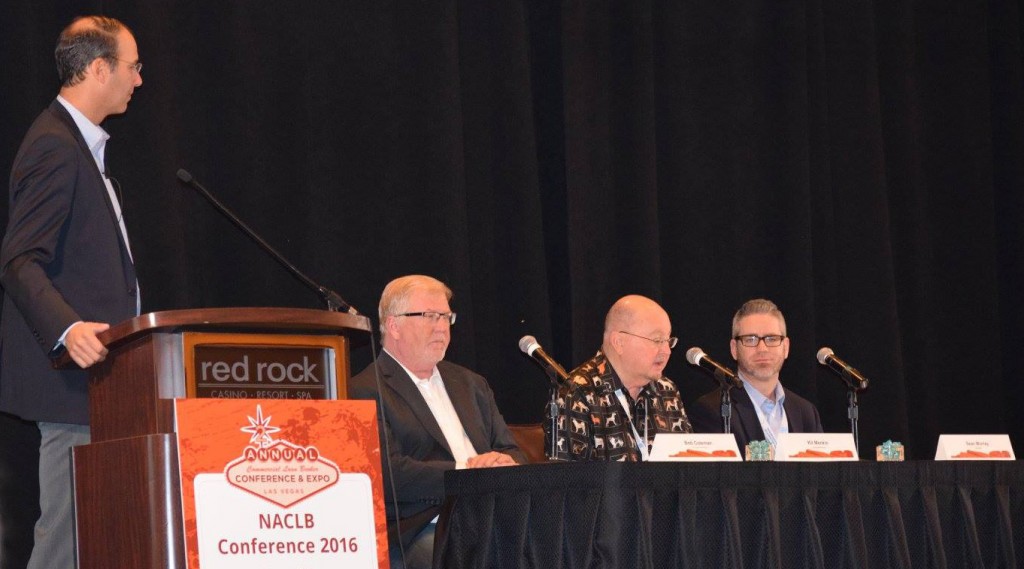
Last week, at least two panelists at the major commercial loan broker conference critiqued merchant cash advances, even going so far as to assign an arbitrary cost to them. Craig McGrain, President of factoring company Durham Funding, said they cost about 75%. Bob Coleman, owner of The Coleman Report, an SBA loan journal, said that merchant cash advance contracts should stipulate that prices are basically equivalent to 100% APR. Neither accurately describes a merchant cash advance if for no other reason than because a merchant cash advance is merely a methodology or a mechanism, not a price. The term itself is derived from the process of making a merchant an advance on their future projected sales. With hundreds of companies employing that concept, some are able to do it at a low cost and others at a high cost.
And it’s obviously the high cost ones to which their disdain was directed. But even then, when MCAs are properly structured as a purchase of future sales, there is no calculable APR because there is no assigned time frame, predetermined payments, or interest rate. This doesn’t mean an MCA product can’t be expensive, because surely they can be, but assigning randomly high percentages to scare people only compounds the misinformation that has persisted for years.
On a panel I participated in with Bob Coleman, Coleman said that these purchases were really just loans. The New York Supreme Court, however, repeatedly disagrees with him. In Platinum Rapid Funding Group Ltd v. VIP Limousine Services, Inc. and Charles Cotton, the court affirmed a purchase of future receivables for an upfront payment, adding that the request for the Court to convert the Agreement to a loan and assign an interest rate to it would require unwarranted speculation, and would contradict the explicit terms of the sale of future receivables in accordance with the Merchant Agreement.
In Merchant Cash & Capital, LLC v G&E Asian Am. Enter., Inc., the court reached the same conclusion.
With regard to McGrain of Durham Funding, he said that 70%-80% of companies that apply for his company’s factoring services have already used an MCA. This kind of competitive pressure is probably a leading reason why a factor would mischaracterize MCAs. In fact, the factoring industry has felt so threatened by MCAs, that two years ago the International Factoring Association voted to ban all MCA companies from their organization.
This isn’t to suggest that factoring is an inferior product and that MCA is the newer better thing. On the contrary, factoring is an excellent loan alternative and to McGrain’s credit he said that he believed the free market would work everything out. To facilitate that, more MCA brokers need to be educated on factoring and SBA lending. And in return commercial finance brokers need to understand the true nuts and bolts of MCA. That process gets sullied when misinformation abounds. Merchants will get the best help when the brokers fully understand all of the market’s options.
My panel with SBA lending expert Bob Coleman and equipment leasing veteran Kit Menkin at the NACLB conference last week highlighted some differences of opinions across these closely related industries but also demonstrated areas in which we all agree. Small businesses have different needs and it’s up to the brokers to prescribe the most appropriate solution. Whether it’s short-term or long-term, cheap or expensive, proactive or reactive, there’s capital out there. Hopefully the kind of cooperative engagement the NACLB conference provided this year will continue to be fostered for years to come.
Mind The TCPA And Get AltFinanceDaily All Over Again
October 4, 2016
AltFinanceDaily’s September/October 2016 issue is set to go in the mail very soon. And in this issue, we wade chest-deep into a trend that has many brokers and funders worrying behind closed doors. In the last year there has been a surge of TCPA lawsuits, whether for robo-dialing, Do-Not-Call-List violations or something else. Are industry players being irresponsible or is there something else amiss? AltFinanceDaily went looking for the answers and you might be surprised by some of the things we found.
If you’re wondering what TCPA lawsuits even are or how they might affect you, this story will hopefully teach you about the risks of marketing over the phone. Smile Dial… and Trial? You’ll want to read this.
If you’re already subscribed to receive the magazine, you’ll be getting your copy soon. If not, you should SUBSCRIBE NOW FREE
Time To Get Back On Track! The Commercial Loan Broker Conference and Lend360 Kick Off This Week
October 2, 2016
If you’re one of those people who book things at the last minute, well then there’s technically still time to register for the NACLB’s Commercial Loan Broker Conference and Lend360. As each are taking place over roughly the same few days this week, you should expect a great experience regardless of which one you choose to go to. You could also split your staff up and attend both!
I’ll personally be at the Commercial Loan Broker Conference at the Red Rock Casino in Las Vegas and am scheduled to participate in an industry reporter’s panel there early Thursday morning.
At last year’s Lend360, Congressman David Scott (D-GA) famously blessed the online lenders after urging them to educate policymakers about what they do.
The industry hopes to see you at one or both of these shows:
Commercial Loan Broker Conference
Who should go?: Business loan brokers, MCA brokers, equipment finance companies, lenders, MCA funders, investors, etc.
When is it?: October 4 – 6
Where is it?: Las Vegas
How do I sign up?: Register here
Lend360
Who should go?: Consumer Lenders, Business loan brokers, MCA brokers, MCA funders, investors, etc.
When is it?: October 5 – 7
Where is it?: Chicago
How do I sign up?: Register here
Bonus: Use promo code AltFinanceDaily15 for 15% off the registration price
Entire Industries Still Unbankable Despite Big Data Boom
September 28, 2016
The use of data and technology for assessing risk shows promise for new borrowers, safer bets and fewer delinquencies. Big data has been credited for overhauling traditional lending models and ushering in a new crop of lenders that do not shy away from risky businesses and low credit scores. But has it been successful in narrowing the list of industries previously ineligible to even be considered? And perhaps there’s a bigger story, that some lenders still maintain a list of industries they cannot or will not lend to despite the boom in data. AltFinanceDaily checked the temperature on restricted lending practices today with three lenders and here’s what we found.
Jersey City-based World Business Lenders whose average loan size is $150,000 does not lend to startups. According to chief revenue officer, Alex Gemici, startups usually don’t have revenues to justify payments. “Startups fail the ‘ability to pay’ test,” he said.
The restricted industries for WBL are the usual-suspects that fall in the federal legality grey areas like Marijuana related businesses and adult entertainment websites and weapon manufacturers that the company takes a moral stance against. Gemici said that the company has never lent to these industries and will evaluate the policy only if the need arises.
Apart from these WBL also classifies certain establishments as ‘high risk,’ either prone to defaults or without a steady cash flow like car dealers, childcare services, gas stations, real estate speculators, stock brokers, insurance brokers etc. which the company lends to with increased scrutiny and tighter checks.
 Often, the risk appetite of a company depends on how long it has been in business and its funding track record. For instance, San Diego-based National Funding is 17 years old but is gun shy when it comes to lending to auto dealerships, thanks to sustained losses. “We don’t lend to auto dealerships because they already have enough MCA plans out there,” said CEO Dave Gilbert. “It’s too risky to be in that environment without being tied to actual assets, we have had too many losses.”
Government agencies, membership organizations (usually, non profit), insurance brokers, online dating services, weapon manufacturers, credit repair services, gambling and ticket sales websites are also industries the company does not lend to.
However, construction companies, oil companies, transportation and industries with high subsidies like solar businesses are what National Funding considers high risk and will finance cautiously, by tightening the credit window, advancing smaller amounts, demanding higher FICO scores and increasing scrutiny on cash flows.
Irrespective of whether a company automates underwriting, few contest the need for rich and varied data for calculating risk and approving a loan. Kennesaw, Georgia-based IOU Financial, which recently started lending in Canada, has a proprietary ‘Risk Logic’ score for underwriting which includes credit data, financial and non-financial accounts, public records, transactional data and a business owner’s personal credit information.
Despite this, it restricts lending to businesses with seasonal cash flow like tax prep services, industries that invoice out for larger orders including manufacturing, and marijuana dispensaries. IOU also does not lend to industries where it has faced high delinquencies in the past, like oil refinery service related industries and supply chain service providers that are subject to fluctuations in commodity prices.
And if OnDeck, the touted leader in deploying big data for underwriting prohibits 60 industries in five different categories including blood and organ banks, payroll companies and its own kind — non-bank financial companies, has big data really changed underwriting?