Is Your Firm Ready for Machine Learning?
October 15, 2018Artificial intelligence such as machine learning has the potential to dramatically shift the alternative lending and funding landscape. But humans still have a lot to learn about this budding field.

Across the industry, firms are at different points in terms of machine learning adoption. Some firms have begun to implement machine learning within underwriting in an attempt to curb fraud, get more complex insights into risk, make sounder funding decisions and achieve lower loss rates. Others are still in the R&D and planning stage, quietly laying the groundwork for future implementation across multiple areas of their business, including fraud prevention, underwriting, lead generation and collections.
“It’s entirely critical to the success of our business,” says Paul Gu, co-founder and head of product at Upstart, a consumer lending platform that uses machine learning extensively in its operations. “Done right, it completely changes the possibilities in terms of how accurate underwriting and verification are,” he says.
While there’s no absolute right way to implement machine learning within a lender’s or funder’s business, there are many data-related, regulatory and business-specific factors to consider. Because things can go very wrong from a business or regulatory perspective—or both—if machine learning is not implemented properly, firms need to be especially careful. Here are a few pointers that can help lead to a successful machine learning implementation:

Using machine learning, funders can predict better the likelihood of default versus a rule-based model that looks at factors such as the size of the business, the size of the loan and how old the business is, for example, says Eden Amirav, co-founder and chief executive of Lending Express, a firm that relies heavily on AI to match borrowers and funders.
Machine learning takes hundreds and hundreds of parameters into account which you would never look at with a rule-based model and searches for connections. “You can find much more complex insights using these multiple data points. It’s not something a person can do,” Amirav says.
He contends that machine learning will optimize the number of small businesses that will have access to funding because it allows funders to be more precise in their risk analyses. This will open doors for some merchants who were previously turned down based on less precise models, he predicts. To help in this effort, Lending Express recently launched a new dashboard that uses AI-driven technology to help convert business loan candidates that have been previously turned down into viable applicants. The new LendingScore™ algorithm gives businesses detailed information about how they can improve different funding factors to help them unlock new funding opportunities, Amirav says.
Lenders and funders always have to be thinking about what’s next when it comes to artificial intelligence, even if they aren’t quite ready to implement it. While using machine learning for underwriting is currently the primary focus for many firms, there are many other possible use cases for the alternative lenders and funders, according to industry participants.
Lead generation and renewals are two areas that are ripe for machine learning technology, according to Paul Sitruk, chief risk officer and chief technology officer at 6th Avenue Capital, a small business funder. He predicts that it is only a matter of time before firms are using machine learning in these areas and others. “It can be applied to several areas within our existing processes,” he says.
Collection is another area where machine learning could make the process more efficient for firms. Machines can work out, based on real-life patterns, which types of customers might benefit from call reminders and which will be a waste of time for lenders, says Sandeep Bhandari, chief strategy and chief risk officer at Affirm, which uses advanced analytics to make credit decisions.
“There are different business problems that can be solved through machine learning. Lenders sometimes get too fixated on just the approve/decline problem,” he says.

“Most underwriters don’t have enough data to effectively incorporate AI, deep learning, or machine learning tools,” says Taariq Lewis, chief executive of Aquila, a small business funder. He notes that effective research comes from the use of very large datasets that won’t fit in an excel spreadsheet for testing various hypotheses.
Problems, however, can occur when there’s too much complexity in the models and the results become too hard to understand in actionable business terms. For example, firms may use models that analyze seasonal lender performance without understanding the input assumptions, like weather impact, on certain geographies. This may lead to final results that do not make sense or are unexpected, he says.
“There’s a lot of noise in the data. There are spurious correlations. They make meaningful conclusions hard to get and hard to use,” he says.
The more precise firms can be with the data, the more predictive a machine learning model can be, says Bhandari of Affirm. So, for example, instead of looking at credit utilization ratios generally, the model might be more predictive if it includes the utilization rate over recent months in conjunction with debt balance. It’s critical to include as targeted and complete data as possible. “That’s where some of our competitive advantages come in,” Bhandari says.
Underwriters also have to pay particularly close attention that overfitting doesn’t occur. This happens when machines can perfectly predict data in your data set, but they don’t necessarily reflect real world patterns, says Gu of Upstart.
Keeping close tabs on the computer-driven models over time is also important. The model isn’t going to perform the same all along because the competitive environment changes, as do consumer preferences and behaviors. “You have to monitor what’s going well and what’s not going well all the time,” Bhandari says.
Certainly, as AI is integrated into financial services, state and federal regulators that oversee financial services are taking more of an interest. As such, firms dabbling with new technology have to be very careful that any models they are using don’t run afoul of federal Fair Lending Laws or state regulations.
“If you don’t address it early and you have a model that’s treating customers unfairly or differently, it could result in serious consequences,” says Tim Wieher, chief compliance officer and general counsel of CAN Capital, which is in the early stages of determining how to use AI within its business.
 “AI will be transformative for the financial services industry,” he predicts, but says that doing it right takes significant advance planning. For instance, Wieher says it’s very important for firms to involve legal and compliance teams early in the process to review potential models, understand how the technology will impact the lending or funding process and identify the challenges and mitigate the risk.
To be sure, regulation around AI is still a very gray area since the technology is so new and it’s constantly evolving. Banking regulators in particular have been looking closely at the issues pertaining to AI such as its possible applications, short-comings, challenges and supervision. Because the waters are so untested, there can be validity in asking for regulatory and compliance advice before moving ahead full steam, some industry watchers say.
Upstart, for example, which uses AI extensively to price credit and automate the borrowing process, wanted buy-in from the Consumer Financial Protection Bureau to help ease the concern of its backers as well as to satisfy its own concerns about the legality of its efforts. So the firm submitted a no-action request to CFPB. The CFPB responded by issuing a no-action letter to Upstart in September 2017, allowing the company to use its model. In return, Upstart shares certain information with the CFPB regarding the loan applications it receives, how it decides which loans to approve, and how it will mitigate risk to consumers, as well as information on how its model expands access to credit for traditionally underserved populations.
The No-Action Letter is in force for three years and Upstart can seek to renew it if it chooses.

Theoretically firms could have a computer underwriting model constantly updating itself without having a human oversee what the model is doing—but it’s a bad idea, industry participants say. “I believe there are companies doing that, and it’s a risky thing to do,” says Scott M. Pearson, a partner with the law firm Ballard Spahr LLP in Los Angeles.
During review of the models—and before implementing them—people should carefully review the models and the output to make sure there’s nothing that causes intrinsic bias, says Kathryn Petralia, co-founder and president of Kabbage, which is one of the front-runners in using machine learning models to understand and predict business performance.
“If you’re not watching the machine, you don’t know how the machine is complying with regulatory requirements,” she says.
Kabbage has teams of data scientists regularly developing models that the company then reviews internally before deploying. The company is also in frequent contact with regulators about its processes. Petralia says it’s very important that firms be able to explain to regulators how their models work. “Machines aren’t very good at explaining things,” she quips.
As a best practice, Pearson of Ballard Spahr says lenders and funders shouldn’t use any machine learning model until it’s been signed off on by compliance. “That strikes a pretty good balance between getting the benefits of AI and making sure it doesn’t create a compliance problem for you,” he says.
While AI has many benefits, industry participants say alternative lenders and funders need to be mindful of how it can be applied practically and effectively within their particular business model.
Craig Focardi, senior analyst with consulting firm Celent in San Francisco, contends that the classic FICO score continues to be the gold standard for credit decisions in the U.S. He warns firms not to get overly distracted trying to find the next best thing.
“Many fintech lenders have immature risk management and operations functions. They’re better off improving those than dabbling in alternative scoring,” he says, noting that data modeling is an entirely separate core competency.
Indeed, Lewis of Aquila cautions underwriters not to view AI as a silver bullet. “AI is just one tool out of many in the lenders’ toolbox, and our industry should use it and respect its limitations,” he says.
New Jersey Moves to Regulate Small Business Loan Disclosures and Brokers
October 15, 2018 A committee within the New Jersey State Senate convened today at 1:30pm to discuss S2262, a new small business loan disclosure bill. Similar to SB1235 in California, this bill would require all of the following on small business loan contracts less than $100,000:
The APR(This was removed during the committee hearing)- The annualized interest rate
- The finance charge
- The maximum credit limit available
- The payment schedule
- A list of all broker fees and a description of the broker’s relationship with the lender and any conflicts of interest the broker may have
- These terms must be presented before a business accepts a loan
In addition, any change to the terms that would significantly affect the responsibilities or obligations of the small business concern under the loan must be noticed 45 days in advance.
During the hearing, the bill was amended to define merchant cash advances as small business loans. Kate Fisher of Hudson Cook, LLP who represented the Commercial Finance Coalition (CFC) during the hearing, strongly opposed that amendment. The CFC is a trade association representing small business lending and MCA companies.
Also testifying against it was PJ Hoffman of the Electronic Transactions Association. Other Trade groups are gearing up to oppose the bill as well, AltFinanceDaily has learned.
The bill was voted through the committee and will continue to move forward.
Kate Fisher’s testimony has been transcribed below:
Senator Pou and committee members: Thank you for the opportunity to present testimony today regarding business loan disclosures.
My name is Kate Fisher and I am here today on behalf of the Commercial Finance Coalition, a group of responsible finance companies that provide capital to small and medium-sized businesses through innovative methods. I also am an attorney who helps providers of commercial financing comply with state and federal law.
The Commercial Finance Coalition supports efforts to make business financing more transparent.
The problem is the proposed amendment would define a merchant cash advance as a loan. A merchant cash advance is not a loan.
We all know how a loan works – the lender advances money and the borrower promises to pay it back.
A merchant cash advance is a factoring transaction, in which a business sells a percentage of its future receivables at a discount.
Take for example, a pizza shop. The pizza oven breaks and the owner needs cash to replace it.
In a loan, the pizza shop borrows the money and promises to pay the money back to the lender with interest.
In a merchant cash advance, the pizza shop sells its future receivables to a merchant cash advance company. In exchange for the money to buy that pizza oven, the merchant cash advance company will take 10% of each dollar the pizza shop makes.
If the pizza shop’s sales go down, it will pay less. If the pizza shop’s sales go up, it will pay more. And if the pizza shop is damaged by a hurricane and has to close for repairs, it will pay nothing until it can reopen its doors.
This uncertainty of repayment is why a merchant cash advance is not a loan – the pizza shop in our example, only pays if it sells pizza. Courts have overwhelmingly agreed that a merchant cash advance is not a loan. To quote a recent court decision:
“Receivables purchasing is an accepted form of business transaction, and is not a loan.”
Because a merchant cash advance is not a loan, and there is no fixed payment term, requiring an APR or annual interest rate disclosure would be misleading. For a small business looking for financing, these types of disclosures would only add confusion.
I’m very optimistic that New Jersey can lead the way in providing businesses with disclosures that are helpful – and not misleading.
Thank you.
The Broker: How Kunal Bhasin and His Team of Closers Make Deals in NYC
September 25, 2018 Kunal Bhasin, President, 1 West Finance
His title:
President and owner of 1 West Finance in New York City. He founded it in May of 2017 in New York City. The company is a team of seven.
His background:
I was at World Business Lenders for 6 years. That’s where I learned this business and figured out how things worked. Then I left WBL and started 1 West Finance. At WBL, I worked in business development…And I think I was in a good space there to get experience to start my own shop.
His morning:
I get up around 7:00, usually will take my kids to school. I’ll have one cup of coffee, then pick up a cup of coffee for my train ride. On the train, I answer any overnight emails and follow up on whatever outstanding deals I’m working on. So usually I’ll be pinging funders to say “What’s going on with this? What’s going on with that? What’s next, what’s next, what’s next?” Then I buy another coffee when I get to Penn Station. I get to the office by 9:15 / 9:30.
Two times a week at a minimum, will bring in all the guys into the conference room. We will go through the pipeline…Who needs my help? Or who needs the sales manager’s help on a certain deal?…Things tend to move really well after that meeting.
 Biggest challenge:
Because of the nature of our relationships, we get a lot of clients that haven’t done this type of financing before. And there’s always some level of sticker shock that the client experiences when you tell them, “I’m going to give you $100,000 and you’re going to pay me $130,000 or $135,000.” And they’re like “Oh my goodness. How is that possible?” “And by the way,” we say, “I’m going to take the payments daily or weekly.”
For clients who haven’t experienced this before, getting over this initial sticker shock is a challenge.
How do you respond to this shock?
I usually say “Hey, listen, we are not a bank.” I say “we fund clients everyday and clients fall into two buckets.” Either they have already gone to the banks and have been told “No.” Or, they can get the money from the bank but they just don’t have the time, because the bank is going to take 40 days or 60 days. And they need the money today or tomorrow.
So I say “If you think you have the 60 days and you can go to the bank, you should go to the bank. Don’t take this money. But if the bank says ‘No’ or you can’t wait, then I’m the next stop.”
Some of his favorite funders:
OnDeck – “by far, my favorite”
Green Peak Capital
InAdvance
Wall Funding
Average monthly volume funded:
$2.7 million.
Largest deal:
$1 million. We made $50,000. That was this year.
 The Team
His funding process:
A deal first goes to two processors [we have]. They make sure everything is there. No pages missing. They’ll make a decision – is this a good deal for OnDeck or is this a better deal for InAdvance or Fundworks? They’ll actually make the submission, update the CRM, and once the approvals come back, if it meets what the client needs, then the deal goes round robin around the sales team…We try to keep it very fair. And all my guys can close. They’ve all been in business for at least 5 years.
His weekends:
I’m a husband and the father of three and a half year-old identical twin boys. I work a lot and my kids are generally asleep before I get home. So weekends are dedicated to my wife and kids. I try to put the phone away and spend some quality time with them.
War on Debt Settlement Continues: 16 Defendants Sued in RICO Case
September 6, 2018
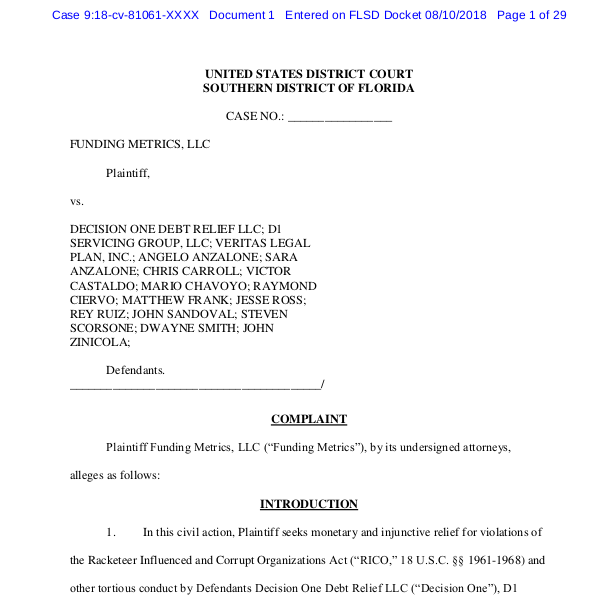
Fourteen individuals and two companies (including Decision One Debt Relief) were sued by Funding Metrics in Federal court last month for allegedly “conducting a nationwide illegal debt restructuring scheme through numerous acts of mail and wire fraud.”
The suit, which stems from the defendants’ interference with Funding Metrics’ merchant cash advance customers, makes six claims, among them financial damages resulting from state and federal crimes. Per the complaint:
“Defendant Decision One (along with its affiliate/alter ego D1 Servicing) fraudulently presents itself as being able to renegotiate and restructure merchant agreements with Plaintiff and other funding companies. It has established a deceptive business practice of making misleading and often outright false representations to merchants under contract with Plaintiff promising that, with its help, these merchants will save money on those contracts by defaulting on them. Decision One tells merchants that they can safely stop paying cash advance funding companies like Plaintiff; that it will go to work for them promptly; that it can reduce their debt by 60-80% or more; and that they will be provided with a Veritas insurance plan to cover legal expenses arising from their defaults, once cash advance companies exercise their rights under agreements with their merchants, as they inevitably will. Based on these misrepresentations, the merchants default on their contracts with their funders – that is, at Decision One’s direction, they stop paying their funders and instead pay Decision One – although Decision One does not even expect to achieve results for the merchants. The result is a fraud on the merchants and tortious interference with the contracts Plaintiff have with them.”
The suit is just the latest bomb dropped on the exploding debt settlement industry. AltFinanceDaily began covering the controversy surrounding debt settlement in late 2016 after the owner and employees of an upstate New York debt settlement company were arrested for charging merchants to restructure their merchant cash advances and then not actually performing any services. The owner, Sergiy Bezrukov, was charged with money laundering, bank fraud, mail fraud, wire fraud and conspiracy to defraud. Bezrukov has been locked away in jail for almost two years awaiting trial. He is facing a maximum of 30 years. Two of his employees pled guilty, Vanessa Cardona to bank fraud and Dustin Walker to conspiracy to commit bank fraud.
Since then, nearly a dozen major lawsuits have been filed by merchant cash advance companies against other debt settlement companies that are alleged to be carrying out similar schemes. One of those sued companies, NJ-based Corporate Bailout LLC, was featured on the cover of the New York Post last summer for being “the craziest office in America.” Corporate Bailout was sued by both Yellowstone Capital and Everest Business Funding which later resulted in a very public settlement agreement that forced Corporate Bailout to fork over $500,000 to the two MCA companies.
Decision One Debt Relief, sued now by Funding Metrics, was also originally a co-defendant alongside MCA Helpline in a lawsuit filed by Everest Business Funding earlier this year. In February, after determining the two were not related, Everest dropped the claims against Decision One only. The suit against MCA Helpline is still pending.
Around that same time, a representative for Decision One revealed to AltFinanceDaily that the company was on track to be doing more than $100 million a year in business.
Bezrukov, by contrast, who currently resides in a Niagara County New York jail, is accused of having only obtained $1.2 million throughout his entire debt settlement venture’s existence. Although Decision One is not being charged criminally, the private civil suit alleges damages caused by a violation of criminal statutes including RICO.
The Funding Metrics suit against Decision One was filed in the Southern District of Florida under ID# 9:18-cv-81061.
The California Business Loan & MCA Disclosure Bill Has Passed
August 30, 2018The bill has passed. With the governor’s signature, all business loan contracts and merchant cash advance contracts in California will soon require a uniform set of formal disclosures including an annualized rate of the total cost. The precise formula for that rate will be determined by the state’s regulatory agency, the Department of Business Oversight.
Update: The bill’s death in committee was challenged by the bill’s author, Senator Steve Glazer, and ultimately allowed to come up for a vote after he complained to the senate majority leader that a committee’s decision is merely a recommendation, not a deciding factor on the bill itself. At 2:10 AM EST, it passed.
Update: The bill has died in the Senate Banking Committee. Daniel Weintraub, who serves as chief of staff to the bill’s author, tweeted after midnight eastern time that the bill was not moving forward.
Thanks to all who supported small business and #SB1235. Unfortunately the Senate Banking Committee killed the bill tonight. We fell one vote short of the four we needed to send the bill to the Senate floor. https://t.co/30ztdW2LbD
— Daniel Weintraub (@DMWeintraub) September 1, 2018
Update: The bill passed the Assembly unopposed and is slated for a late night vote by the Senate Banking Committee.
Update 8/31/18: Today is the last day for the legislature to pass this bill. We will keep you updated
California’s bill to mandate certain disclosures on business loan and merchant cash advance contracts is looking a little bit worse. The Annualized Cost of Capital method (Explained here) that some folks in the industry were accepting of, has been scrapped in favor of whatever formula a state regulator decides to pick. That means if the Commissioner of Business Oversight decides on an APR disclosure, which many industry trade groups believed they had already successfully lobbied against, all loans and non-loans alike would have to report an APR, a mathematical impossibility for a product like merchant cash advance. At present, however, all that is known is that the Commissioner’s choice must be an annualized metric.
According to Bloomberg, the amended version of the bill needs to get approval in both the Assembly and the Senate by Friday before the legislative session ends.
Trade associations that have weighed in on this bill include the Electronic Transactions Association, Commercial Finance Coalition, Small Business Finance Association, and the Innovative Lending Platform Association.
You can view all of our previous coverage about the bill here.
The Google Battle for Lending & SMB Finance Keywords Revisited
August 29, 2018When it comes to Google’s organic search for major keywords, companies like Nerdwallet and Fundera still dominate. A few players, however, have gained or lost significant ground since last year.
The Small Business Administration relinquished its place on the first page for words like “business loan” and “business line of credit” while PayPal and Credit Karma have begun to make major appearances as their activity in these markets increases.
Take a look:
| Keywords | Fundera | Fundera | PayPal | PayPal | Credit Karma | Credit Karma | Kabbage | Kabbage | OnDeck | OnDeck |
| Date | 9/14/17 | 8/29/18 | 9/14/17 | 8/29/18 | 9/14/17 | 8/29/18 | 9/14/17 | 8/29/18 | 9/14/17 | 8/29/18 |
| business loan | 1 | 1 | 2 | 3 | 4 | 5 | ||||
| merchant cash advance | 3 | 2 | 2 | 4 | ||||||
| working capital | 8 | 9 | ||||||||
| commercial loan | 3 | 1 | 5 | |||||||
| small business loans | 2 | 1 | 3 | 5 | 4 | |||||
| business line of credit | 2 | 2 | 5 | 3 | 3 | |||||
| fast business loan | 4 | 5 | 1 | 4 | ||||||
| business loan with bad credit | 7 | 5 |
| Keywords | Lending Club | Lending Club | Nerdwallet | Nerdwallet | National Funding | National Funding | Traditional Banks | Traditional Banks | SBA.gov | SBA.gov |
| Date | 9/14/17 | 8/29/18 | 9/14/17 | 8/29/18 | 9/14/17 | 8/29/18 | 9/14/17 | 8/29/18 | 9/14/17 | 8/29/18 |
| business loan | 9 | 6 | 3 | 7,8 | 5 | 4,7 | 6 | |||
| merchant cash advance | 4 | 1 | 8 | 9 | ||||||
| working capital | 4 | |||||||||
| commercial loan | 2,7 | 3,8,9,10 | ||||||||
| small business loans | 9 | 3 | 7,8 | 5 | 7 | 1 | 2 | |||
| business line of credit | 11 | 1,4 | 1 | 6,7,8,9,10 | 4,6,7,9,10 | 5 | ||||
| fast business loan | 2 | 3 | 5,6 | 8 | ||||||
| business loan with bad credit | 1,4 | 1 | 2 | 2 | 3 |
As mentioned in previous posts, this is not a scientific analysis. Keywords are measured using a wiped browser on my own computer.
The value of a Page-1 ranking too, is not as valuable as it once was, due to the heavy placement of paid ads above the search results. Ads, however, are not a factor for the keyword “merchant cash advance” since Google banned all advertising for that search term last Fall. Originally it was theorized that the ban was accidental, but ten months later it is still in place.
No such ban exists on Bing.
Read my previous analyses on the industry’s search war over the years:
September 2017 The Google Battle for Lending and SMB Finance Keywords
December 2015 Google Serves Low Blow to Merchant Cash Advance Seekers
March 2015 Google Culls Online Lenders – Pay or Else?
October 2014 Merchant Cash Advance SEO War Still Raging
August 2014 Six Signs Alternative Lending is Rigged: Do Lending Club and OnDeck have a helping hand?
October 2013 Google Penguin 2.1 takes swing at the MCA industry
August 2013 Your merchant cash advance press release may be hurting you
December 2012 Is Google your only web strategy?
July 2012 The other 93% [of leads]
April 2012 The SEO war continues
February 2012 The SEO War for Merchant Cash Advance: The first story on this topic
MCA Companies Have Won a “Sh*t Ton” of Cases, Judge Declares
August 27, 2018 A judge in Buffalo, New York has finally had enough with merchants trying to claim that merchant cash advances are loans.
At issue were defendants who sought to overturn a confession of judgment filed by SOS Capital. The Honorable Catherine Nugent Panepinto, who presided over the case, didn’t like that one bit, but what was more offensive to her was the manner in which the defendants tried to overturn it.
With a shit ton of case law already weighing against the defendants for filing an improper motion, Judge Nugent Panepinto went a step further by reminding the defendants that there is no merit to the argument that the subject merchant agreement was a loan.
The defendants, who seemed completely doomed to pay SOS Capital’s attorney fees, were saved only by the charm of their affable Long Island attorney.
This case was decided in Erie County, NY under Index #803512/2018.
Grooming The Best Sales Reps
August 22, 2018The best sales reps have a lot in common – they’re smart, honest, likable, well-organized, thick-skinned and hungry for success. They navigate the difficult early days of their careers in the alternative small-business funding community by persevering despite long hours, countless outbound telephone calls and meager commissions.

“Persistency is really, really the key – putting in the time,” says Evan Marmott, CEO of Montreal-based CanaCap and CEO of New York-based CapCall LLC. “It’s not always easy, but you’ve got to stay late, make the phone calls, send the emails and do the follow-ups. It’s a numbers game.”
Being relentless counts not only when pursuing merchants but also when matching merchants with funders, Marmott emphasizes. “If they can’t get an approval one place, they’re going to shop it out until they get approval someplace else so they can monetize everything that comes in,” he says.
“It’s all mindset and work ethic,” in sales, according to Joe Camberato, president at Bohemia, N.Y.-based National Business Capital. His company works to create a culture that supports the right mindset by working with a firm called “Delivering Happiness.” Together, they forge to a set of core values based on integrity, innovation, teamwork, empathy, and respect for fellow employees, clients and clients’ businesses.
National Business Capital employees learn to live those ideals by working and playing together on the company volleyball team, through work with local and national charities, and at company mixers and staff picnics, Camberato maintains. “We adapt and change, and we’re committed to helping small businesses grow,” he says of the company culture, “and we have fun while doing all that.”
Likeability helps build relationships with customers, says Justin Thompson, vice president of sales for San Diego-based National Funding. “People will do business with people they like and trust,” says Thompson. “It’s really about establishing a relationship first and then establishing quality discovery.” From there, presentation and execution become paramount, he says.

Methodology can make the difference between success and failure in sales, observes Justin Bakes, co-founder and CEO of Boston-based Forward Financing LLC. “Have a defined process and stick to it,” he advises. A well-organized approach inspires trust among clients, establishes and maintains a great reputation; and fosters understanding of the customers’ needs, wants and business operations that help the rep choose the right financing option and appropriate funder. Using technology to wrangle multiple leads and high volume counts for a lot, too, he says.
It’s all part of the consultative approach to sales, says Jared Weitz, CEO of Great Neck, N.Y.-based United Capital Source. Long ago, sales reps may have succeeded by mimicking carnival barkers, sideshow pitchman and arm-twisting medicine-show peddlers. Thankfully, those days have ended – if they ever really existed. Most of today’s successful salespeople earn clients’ respect by becoming knowledgeable, trusted business consultants, says Weitz.
THE CONSULTATIVE SALE
“Someone calls, and there are two ways of handling a deal, right?” Weitz asks rhetorically. Using one method, a salesperson can say, “We’ll fund you this much at this rate today – are we good?” he says. The other way calls for understanding the client’s business – how long has it been open, does it make more cash deposits or credit card deposits, would it be best-served by an advance, a loan, an equipment lease or a line of credit, how much can it afford in monthly payments?

Establishing how the merchant intends to use the funding plays a crucial role in the consultative sale, Marmott agrees. Objections can arise when a merchant learns that receiving $100,000 this week will require paying back $150,000 in four or five months, he notes. So it’s essential to demonstrate that using the money productively will more than pay for the deal. A trucking company can realize more income if it deploys two more trucks, or a restaurant can increase revenue by placing another bar outside for the summer, he says by way of example.
“A lot of salespeople ask a business owner what they need the money for,” observes Thompson. “The merchant says, ‘Inventory,’ and the rep stops right there. I train my reps at National Funding to go two or three clicks deeper.” Examples abound. When does the merchant need the inventory? From whom do they order it? How long does it take to ship? How long does it take to turn it over? What are the shipping terms?
The consultative approach can require salespeople to pose a lot of open-ended questions that can’t be answered yes or no, according to Thompson. Ideally, the conversation should adhere to the 80-20 rule, with the client talking 80 percent of the time and the sales rep speaking 20 percent, he asserts, adding that “a lot of times it’s reversed in this industry.”
Sometimes, however, salespeople should set aside the time-consuming consultative approach and instead find funding for a merchant as soon as possible. That’s true when the business owner can make an opportune purchase of inventory or when it’s time to acquire a competitor quickly. More often, however, it pays to take the time to understand the merchant’s needs and search out the best type of funding for that particular case, top sales people maintain.

Much of the alternative small-business finance industry has caught on to the importance of the consultative approach to sales as the array of available alternative financial products has grown beyond the industry’s initial offerings of merchant cash advances, according to Weitz. The days of scripted pitches and preplanned rebuttals to objections have ended, he says. Today, management trains reps for success.
THE RIGHT TRAINING
Are top salespeople born that way? “Some people hit the ground running, but sales can be taught – that’s for sure,” Weitz says. “The tougher thing to teach is integrity.” Much of the training process focuses on learning the products to enable a rep to make a consultative sale and shoulder financial responsibility, he maintains.
Believing that some people are born to sell provides a crutch to avoid learning what really works, according to Bakes. Training can teach a smart, motivated person how to succeed, he maintains. They don’t have to be born that way.
However, some people do seem born to exert influence, which can translate into sales prowess, says Thompson. Still, those born with a strong work-ethic can overcome other deficiencies, he notes. The work ethic drives them to “come in every day,” he notes. “They’re organized and disciplined. They follow the National Funding philosophy, and they make a ton of money.”

National Funding trains salespeople to view their craft as being defined by two broad elements – art and science, Thompson continues. The science proves easier to master and includes asking the right questions to learn about the customer and the deal. The hard part, the art of the sale, consists of getting to know the business owner, building a relationship and demonstrating expertise. In one example, that’s based on learning how many trucks are in the fleet, whether they’re long-haul or short haul and whether they use dumpsters versus box trailers, he says.
Beyond those important basics, training should be ongoing because selling techniques change slightly as new products and systems emerge, according to Weitz. “One of the things I like about being a broker is the ability to pivot and add another arrow to your quiver,” he says.
Salespeople at United Capital Source talk sales among themselves almost nonstop, which amounts to daily sales training, Weitz observes. That can take the form of describing a challenge and explaining how to overcome it, he notes. A particularly good idea merits an email to the group to share the new piece of wisdom. It’s a matter of constantly refining the approach.
Training can help sales reps understand the businesses their clients run, according to Marmott. Knowing the margins in a restaurant, for example, can help the salesperson explain that the increase in revenue from an expansion will quickly pay the cost of capital, he notes.
Training should teach new employees how business works because common elements arise in enterprises ranging from dog grooming to asphalt paving, Thompson notes. There’s inventory, marketing, employee expense, payroll taxes, insurance and 401k’s in almost any business. “We teach all that to the reps,” he says. Then after conversations with thousands of merchants, reps have a solid foundation in the workings of businesses.
 National Business Capital’s formal two-week classroom training usually lasts three hours a day, focusing on systems, guidelines, product, general business principles and the company’s processes, says Camberato. Teachers include the sales management team, company culture leaders and the managers of IT and Tech, Marketing, Processing, and Human Resources.
New hires spend much of their time working with mentors for the first six months and a team leader who works with them indefinitely, Camberto continues. The company sometimes hires in groups and sometimes hires individually, he notes.
National Funding provides three eight-hour days of regimented classroom training on the fundamentals to each of the four groups of 12 to 17 hired each year, says Thompson. The classes cover processes, sales strategy, marketing and the lender matrix. Next comes three months of working with a sales manager dedicated to working with the class. After a total of nine to 12 months, management knows which reps will succeed.
Some shops operate on the opener-closer model, with less experienced salespeople qualifying the merchant by asking questions like how long they’re been in business and how much revenue they bring in monthly, Marmott says. If the merchant qualifies, the newer salesperson who’s working as an opener then hands off the call to an experienced closer to complete the deal. Good openers become closers, but opening isn’t easy because it requires lots of calls, he notes.
National Funding doesn’t use the opener-closer approach because the company believes reps should Participate “from cradle to grave,” Thompson says. “They hunt the business down, build the relationship and handle the transaction from A to Z.” East Coast shops often focus on cold calling and use the opener-closer model, while West Coast shops tend to invest more in marketing and reject the opener-closer method, he noted.
But where do these top salespeople come from?
THE RIGHT BACKGROUND
Prospective sales reps who have just finished college should have a grounding in communications or business, Weitz believes. Experience in sales and a familiarity with dealing with merchants helps prepare reps, he notes. Job history doesn’t have to be in the finance industry. Someone who’s sold business services in a Verizon store or worked for a payroll company, for instance, has been dealing with small-business owners and may succeed more quickly than those without that background.
Sales experience in other industries counts, Bakes agrees, especially in businesses that require dealing with a large number of leads. “Organization and process is just as important as being born with the traits of a salesperson,” he opines.
Life experience that breeds a positive attitude can prove vital, says Marmott. That’s especially important in the beginning when a new rep might take home a paltry $300 in the first month. Later, when the rep has a $50,000 month, he or she will see that their optimism wasn’t misplaced, he declares.
GUYS WHO ARE HUNGRY”
“The biggest thing I look for is guys who are hungry,” Marmott maintains. I don’t need somebody with a doctorate or a master’s degree or even a degree,” he says. “I need somebody who is going to put the work in.” Of a roomful of 25 new reps, two or three will succeed and stay on the job, he calculates. “You get to eat what you kill. If you’re not killing anything, you don’t get to eat.”
“We look for potential candidates who come from backgrounds of rejection,” says Thompson. Their previous sales experience has taught them not to take the answer “no” personally. “It’s part of the business and you continue to move on.”
Although most regard the financial services industry as a white-collar pursuit, “it has blue collar written all over it,” Thompson says, referring to the work ethic required for success. But it’s not just the volume of work. Sixty good phone calls generate more business than 300 mediocre calls, he emphasizes.
GETTING UP TO SPEED
Succeeding at sales requires taking the time to form relationships, understand guidelines, become familiar with lenders and acquire a working knowledge of how clients’ businesses operate, Camberato says. How long does it take? “It’s a solid year,” he contends while conceding that most who succeed operate at a fairly high level before then.
Others disagree about what constitutes being up to speed and how much time’s necessary to achieve it. “I’ve seen it take 30 days, and I’ve seen it up to 120 days,” says Weitz. “The hope is that it’s within 60.”
A salesperson should start feeling better after 30 days and should start feeling good after 60 days, Marmott says. Management can usually identify the strong and the week reps within two to three weeks, he says. “You get the lazy ones that drop out, the guys who aren’t making any money, the ones who aren’t putting the effort in,” he says. “The first two weeks are the toughest because you’re learning the product and how to sell it.”
“It depends on the person,” Bakes says of the time needed to begin selling successfully. “It takes time. It is not something that will just happen overnight.” About six months should suffice to become confident as a closer, he estimates.
Even when sales reps hit their stride, some outsell others, Marmott notes, citing the 80-20 rule that 80 percent of the business comes from 20 percent of the salesforce. Outbound sales to merchants who may feel beleaguered by offers of funding requires more effort than when a merchant makes an inbound call to seek funding, he adds.
And even the best salespeople need great marketing and tech support from the their companies, sources agree.
INVESTING IN SALES
A shop just starting out might have a marketing budget as low as $2,500 a month, which won’t do much more than pay for direct mail pieces that might prompt a few potential clients to pick up the phone, Weitz says. With a little more money to spend, a shop can begin buying leads, he notes. “Don’t break the bank before you understand what formula works for you,” he advises.
“The key to sales is marketing,” says Marmott. “You can be the best sales guy but if you don’t have anything qualified to call or follow up with, it’s a waste of time.” Social media doesn’t work as well for business-to-business contact as it does for business-to-consumer marketing, he says. Pay per click and key words have become more expensive and isn’t as cost-effective as it once was, especially for smaller shops, he contends. Mailers can work but require heavy volume and repetition, he says, adding that could mean at least 25,000 pieces and at least three mailings.
Besides allocating marketing dollars, companies can invest in sales by paying new sales staffers a salary instead of forcing them to rely on commissions to eke out subsistence during the tough early days. National Business Capital pays a salary at first and later switches reps to commissions and draw, Camberato says. “An energetic person interested in sales can plug into our platform, get trained and do very well,” he continues. “We believe in you, as long as you believe in us.”
National Funding provides recruits with a salary and commissions so that they have enough income to get by and still reap rewards when they help close a deal, Thompson says.
Investment in technology can help salespeople set priorities, eliminate some of the drudge work in the sale process, measure the sales staff member’s success or lack of success, and provide a consistent experience for customers, notes Bakes. “Because of the way our technology is set up we can hold people accountable,” he adds.
Every salesperson and every shop should organize the workflow by using a lead-management system or customer relationship management tool (CRM) – such as Zoho or Salesforce –instead of operating with just a spreadsheet, Weitz says.
Brokers can invest in sales through syndication, which means putting up some of the funds involved in a deal. Forward Financing favors syndication in some cases because it aligns the salesperson and the funder, thus demonstrating the sales rep’s belief in the validity of the deal and ensuring a willingness to continue servicing that customer, Bakes says.
Some shops offer monthly bonuses for outstanding sales results, but Weitz believes awarding incentives weekly makes more sense. With a monthly cycle, some reps tend to slack off for the first week or so because they believe they can make up for lost time later. With weekly rewards, there’s not much room for downtime, he notes.
Whatever form investment takes, it can help build a sterling reputation and a free-flowing “pipeline.”
THE RIGHT REPUTATION
“Reputation is huge,” especially for repeat business and referrals, Marmott says. Once a merchant has received funding, a blizzard of sales call can follow. Treating customers right by maintaining ethical standards and helping them during hard times can guard against defection to a competitor touing low prices, he says.
Reputation requires differentiation, which usually occurs online, by email or over the phone, notes Bakes. Factors that enhance reputation include referrals by satisfied customers and real-world testimonials from actual customers and good ratings on social media sites, he says.
While it’s still uncertain what role social media plays in the industry’s reputation-building efforts, it appears that text messages elicit quick responses if the client has agreed to communicate with the company via that format, Bakes says. He notes that unwanted text messages won’t work. Email messages provide more information than text messages but seem less likely to prompt response, he says.
THE RIGHT GOAL
So, where does the effort to succeed at sales lead? It’s the foundation for building “the pipeline” – the name given to the flow of renewals, referrals and leads that makes every day not just busy, but busy in a productive and profitable way. As a rep’s pipeline takes shape, the cost of acquiring new business also goes down, Marmott says. “It just grows from there,” he says of the successful salesperson’s endeavors at building a pipeline of business. It’s what successful salespeople seek.