Fundera Passes $500M in Loans Funded to 8,500+ Small Businesses
November 1, 2017(New York, NY–Nov 1, 2017) – Fundera, the trusted advisor and online marketplace for small business financing, today announced that it has surpassed the $500 million mark in loans funded to over 8,500 small businesses on its platform.
Fundera’s platform allows small business owners to apply to a curated network of 25-30 lenders in the industry with one easy common application. Small business owners come to Fundera for all of their financing needs, from credit cards to SBA loans and everything in between.
“It’s about more than just saving time and money for the small business owner,” said Jared Hecht, CEO and cofounder of Fundera. “At Fundera we’re truly able to become a partner in these businesses’ financial decisions. Our goal is to use our resources and technology to educate small business owners on their credit eligibility, improve their creditworthiness over time, and help them graduate into better and better financing products.”
Fundera replaces small business loan brokers with software and algorithms, making the process faster and easier to navigate. The average loan size on Fundera’s platform is about $60,000, and although no single industry accounts for more than 10% of Fundera’s customer base, the most popular industries include ecommerce and retail.
Since launching in 2014, Fundera has raised over $20M in equity financing.
View From The C-Suite: Alternative Funding Execs Talk Shop, The Landscape, And The Future
October 30, 2017 Alternative funders have had a roller coaster 2017 with highs and lows that will likely be remembered as a high-stakes time for the industry, one in which the rubber met the road for many and the market landscape shifted for everyone from funders, to merchants to brokers.
Three C-Suite executives in the alternative funding space — Christine Chang, CEO of 6th Avenue Capital, Heather Francis, CEO of Elevate Funding and Torrie Inouye, National Funding president — spoke with AltFinanceDaily, offering their take on some of the industry shakeups, direction of the alt lending space and upcoming developments at their respective companies.
All three execs are embracing what appears to be shaping up as a bigger and better 2018 with plans on the horizon for new products, relationships and deals but also where there could be further shakeout as the shift in the industry landscape takes hold.
Industry Landscape
6th Avenue Capital, provides short-term funding to merchants that Chang describes as “high touch, high tech and fast.” The company is building an SEC RIA compliant infrastructure as Chang believes that MCA regulation will take place over the next several years. Chang said she is sympathetic to the banks and the onerous rules that they must follow, and whatever form the industry regulation eventually takes on, the company will be ready for.

A recent story in The Wall Street Journal points to community banks comprised of those with less than $10 billion in assets historically funding local merchants in what’s dubbed character-based lending. As the name suggests, the underwriting standard for the loans was tied to the character of the business owner, which the lender knew based on personal relationships in their own communities.
The financial crisis gave rise to greater regulation, driving a spike in that model and the rest is history. Small banks were forced to direct their resources toward risk management and compliance instead of adding more personnel to service loans. The WSJ quotes a small business lender that bears repeating: “When they created too big to fail, they also created too small to succeed.”
When that door closed, however, another one opened, creating the opportunity for alt lenders to service a niche that was getting left out in the cold.
“The alternative funding industry is here to stay. That’s good news for MCA and fintech in general. There’s a need for fast funding and there will continue to be a trend toward that,” said Chang.
Banks, meanwhile, have started coming to the fintech table to compete for deals. “We’re in the process of speaking to a number of banks, some quite large and some regional, that have expressed an interest. We think this is a great opportunity for them. The idea is that we’d help them to serve a population of clients that they would not otherwise be able to serve,” said Chang.
6th Avenue has had discussions about white labeling and customizing the platform for institutions. “We would run everything for them,” said Chang.
In addition to possible new banking relationships, 6th Avenue Capital, backed by a private family and institutional investors, will expand the business model to include more investors on its platform. “We are in discussions with a number of significant international investors. It’s in the works. We’re building an institutional infrastructure, so it was always contemplated,” she said.
Elevate Funding, whose is 100% referral-based and whose product suite is comprised of a trio of MCA solutions, is coming up on its three-year anniversary in December.
“When I created Elevate, I did it with the purpose of providing a product to high-risk merchants. That’s who we deal with. We’re not dealing with credit scores. There is a level of risk to who we work with. Elevate was created to provide a product that is going to fit their needs and also provide a product that doesn’t treat them like they’re high risk. That’s who we are,” said Francis.
Gainesville, FL-based Elevate recently hired Michael Gaura to spearhead a new MCA product that the company is rolling out in 2018. Francis held the details of the new funding product close to the vest, but she did offer her views on the direction of the MCA and alternative lending space.
“I see difficulty in the coming years, especially in 2018, for qualified lead flow. You have a lot of big banks that are getting into this industry. And that’s a lot of marketing dollars that you’re competing against.”
She points to JPMorgan Chase, American Express, Square and PayPal, saying they are “huge marketing dollar companies” with tremendous access to customers on their respective platforms.
“There’s going to be a shakeout of what can you reach, who can you reach, can you get them the first time? How do you engage them to where they only want to work with you and they’re not submitting 20 applications for every website they come across?”, Francis said.
San Diego, Calif.-based National Funding is a balance sheet lender whose primary product is loans, not MCAs. The broker factor has changed significantly for the lender in a very positive way this year. “We’re really seeing sizeable growth in our broker channel in 2017 and have designed a strong and consistent process for our broker clients” Inouye said. The leads have been driven by a variety of factors, not the least of which comes down to CAN Capital and Bizfi’s loss being National Funding’s gain.

“That’s a factor we can’t ignore. The broker community has rewarded us for being consistent and building those relationships and being a partner to them,” Inouye said. “We definitely saw an uptick in business when they left the space. I can say we’ve continually experienced sizeable growth in our broker channel year over year but 2017 was beyond what we had expected. It surpassed other years.”
Incidentally, National Funding was one of the earliest alt funders on the scene along with CAN Capital in the 1990s. CAN’s fate started unraveling about this time a year ago.
“It’s not positive when you see that happen in the industry. However, we are really focused on what we’re doing and the decisions we’re making internally. I think that’s why we’ve consistently had profitable growth over the years. We’ve stayed true to our underwriting principles and the market seems to have rewarded us. We were consistent and not erratic. Brokers know they can rely on us and feel confident that we would quickly fund their deal once we issued an approval,” said Inouye.
The Broker Effect
Elevate, a balance sheet funder, relies on outside brokers and referrals for deals. “I don’t find it a disadvantage for us not having an internal sales team. A lot of companies in this space have the ability for a chief marketing officer who focuses entirely on leads. Elevate isn’t there yet. Will we be there in five years? Maybe. Marketing can change by that time,” Francis said.
6th Avenue Capital welcomes relationships with brokers as well. “We have an in-house business development team that works with brokers. 6th Avenue Capital is also considering direct sales in niche strategies in its future,” said Chang.
6th Avenue Capital has a starter program in which there are no guarantees but considers businesses that have been in existence for less than a year and businesses with credit scores of 500 or more. Plus, they’re willing to do consolidations up to two advances.
In addition, 6th Avenue Capital is open to offering financing to brokers. “It’s really good in that there is an alignment of interests and allows brokers to participate in the deals they put forth. If they think the merchant is credit worthy and a terrific opportunity, they participate. Everyone has skin in the game and interests are aligned,” Chang said.
Technology
While technology is at the core of fintech, all three of the companies take a hybrid approach when it comes to credit underwriting comprised of a tech platform and the human touch, which perhaps keeps character-based lending alive in some form.
With respect to fintech, “6th Avenue Capital’s philosophy is that technology is a tool to supplement human underwriting. We use technology to detect fraud, manage workload processes and manage risk. We do not use technology to make our final decisions,” said Chang.
Specifically, 6th Avenue Capital benefits from research, artificial intelligence and predictive technology of its sister company Nexlend Capital. 6th Avenue Capital has customized Nexlend’s consumer lending algorithmic intellectual property, which uses machine learning and credit analysis with high speed execution to make better and faster decisions.
Elevate also takes a dual-approach to its underwriting process. “I believe in a hybrid method. You have to have someone looking at it, to have eyes on the paper at some point in the process. This doesn’t mean a computer system can’t help to weed out what might not meet the criteria, but I do believe there needs to be a person reviewing the files,” Francis said.
National Funding was started as an equipment leasing company. “We apply some principles we learned as a leasing company and take into account all of the attributes that go into that business in addition to FICO and cash flow,” Inouye said.
Automation is an area of technology that they continue to look to for innovation and process efficiencies. “We do serve our customers online, but we also provide a human contact as well. We deliver a loan experience that builds trust and confidence with customers. We try to deliver on what our customers want in the most efficient way,” said National Funding’s Inouye.
National Funding continues to look at construction deals and accepts them as a niche in their portfolio, which Inouye said differentiates the company. “It allows us to be more flexible and comfortable with certain industries that other lenders might stay away from.”
Corporate Culture
2017 has been a roller coaster year for fintech including alt funders. While there have been plenty of bright spots, there was also some fallout that left veteran players scrambling to salvage either their reputation, status as a funder or both.
SoFi has been at the center of controversies that resulted in the Mike Cagney leaving his chairman post with plans to step down as CEO. Most recently, the lender has removed its application for a bank charter, according to reports.
We asked Elevate’s Francis about it. “SoFi is a very big company. They’re to the level where the CEO has people to answer to. They have a checks and balances system they need to go through,” said Francis. “It worked, and they removed him.”
Francis maintains an open-door policy with her employees, and she says all you can do is focus on your house and keep your house in order. “My door is always open. That’s our office policy. They use that quite frequently; it’s a catch 22,” she said with a laugh.
Fintech and Diversity
Something else that all three executives have in common is that they are all women in top roles in fintech, an industry that isn’t known for its diversity.
6th Avenue’s Chang’s career includes working at a large institutional bank for six years. Out of 200 professionals, only four of them in her group were women. “At the end of the day, performance is the best differentiator. If you perform well, it presents unique opportunities. At 6th Avenue Capital, diversity is embraced. Our underlying merchants aren’t just one gender or color. Diversity helps us understand the needs of small businesses better, so we can provide fast and customized funding quickly,” she said.
Q&A With Noah Breslow On Replacing ACH For Realtime Funding and More
October 25, 2017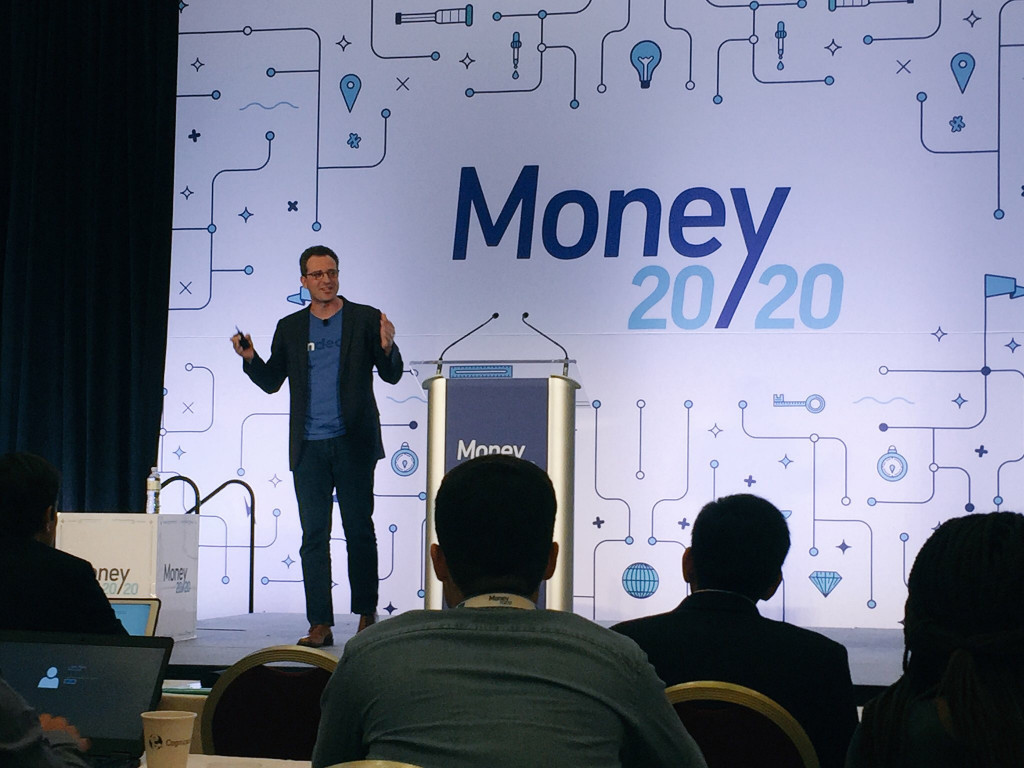 An announcement by OnDeck, Ingo Money and Visa this week at Money2020 may be more consequential than it appeared. That’s because the partnership enables OnDeck to actually fund a merchant’s bank account (not their debit card) on days, nights, weekends, and holidays. Such a feature is not possible in the realm of ACH where funding typically takes place on the next business day and only if the transaction is submitted before a predetermined cutoff time. AltFinanceDaily got to learn more about how this works in an interview with OnDeck CEO Noah Breslow on Tuesday as well as the opportunity to pick his brain about a few other things. Below is a curated excerpt of the interview that has been edited for brevity.
AltFinanceDaily: For this real time funding you announced, do you have to have a Visa debit card?
Breslow: You do not, but you have to have a debit card. 70% of small business owners have debit cards. And this will work with Visa or Mastercard.
AltFinanceDaily: So you’re not actually funding a merchant’s debit card, you’re funding their bank account but using the Visa network as the mechanism?
Breslow: It’s the rails, it’s the way to get the money into a small business owner’s checking account. My prediction is that every funder in the industry is going to be doing this in a couple of years. It’s going to be faster and small businesses will start to expect it. Now instead of waiting 2 days to get the money into someone’s account, it can be done on nights, weekends, holidays, 365 days a year.
AltFinanceDaily: So you can fund a merchant’s bank account on the weekend?
Breslow: Yes, it’s real time. And to be clear we partnered with Ingo Money, Visa has the rails. Ingo is our interface point, they do the PCI compliance and the rest. We looked at a bunch of different players in the market and Ingo was unique in that they had covered small business checking accounts. Some of this stuff is happening in consumer already. We’re the first lender to use these rails for either consumer or small business in the US.
AltFinanceDaily: Has this already gone into effect?
Breslow: No, it’s coming out in a couple months. Early 2018.
AltFinanceDaily: Does this system work with every bank already?
Breslow: It doesn’t work with every bank yet. It works with most of them, all of the major ones.
AltFinanceDaily: Speaking of payments… Square. PayPal. They’re both payments companies first that went into lending. Is there a potential reverse play for OnDeck to go into payments?
Breslow: Right now our product expansion stuff is very focused on additional lending products. I still feel like we haven’t lived up to our full potential there. There’s a couple other product categories that we’ve looked at and thought about. Equipment finance is one, invoice factoring, small business credit cards. And so we look to be the best small business lender in the world with the best set of products. And then we can partner with a lot of the payments companies. But right now, no we’re not going to sell merchant processing. Never say never, but not in the near future.
AltFinanceDaily: Any news on the Chase front?
Breslow: We re-upped our agreement with them in early August. The customer experience is amazing, our platform is scaling, and we’re making progress. I can’t tell you a lot of other details about it.
AltFinanceDaily: I’ve heard from folks in the industry about merchants who are being debited by Chase either daily or weekly. Is that you?
Breslow: That would be our platform. Chase’s product is more or less like the OnDeck product but cheaper obviously. It’s a daily or weekly collected loan. It goes up to 24 months for $200,000.
AltFinanceDaily: I want to ask you about brokers, or as you call them “funding advisors.” Do you anticipate reliance on them increasing or decreasing?
Breslow: Stable. I don’t anticipate it moving up or down. We really like the funding advisors that we have and we’re continuing to grow with them. We’re also adding some new ones.
AltFinanceDaily: What makes a good broker? What can they do to do things right?
Breslow: The value equation between the merchant, the lender and yourself has to be in balance. They should also be efficient and know the credit box of the lender they’re working with. They should invest in their employees, train them, and they should become more sophisticated about their online marketing and CRMs, which we’ve been seeing.
AltFinanceDaily: Everyone’s talking about blockchain at this conference. Is there a way that blockchain fits into online lending and possibly OnDeck?
Breslow: I love the technology, I’m very intrigued by it. But we’re not actively using it and it’s not like I have a secret blockchain project in the works.
AltFinanceDaily: Is there a universe in which OnDeck considers making an acquisition of a company?
Breslow: So we’re not totally opposed to that. They’re might be an opportunity for a complementary product or a complementary team. I think you’re going to see a lot of consolidation in the industry in the next 3-5 years.
Insurtech, the Alt Lending of 2017
October 17, 2017 A new asset class is emerging and it’s taking top talent away from the alternative lending space. Insurance technology, or insurtech, is a nascent market segment that presents a similar market opportunity that fintech did back in the day, sources say. And while there are parallels between the two niches, the market landscapes are unique in many ways, too.
Former OnDeck exec Paul Rosen recently decamped to insurtech startup CoverWallet where he’s been named COO. CoverWallet is an online marketplace for small- and medium-sized business insurance policies. Rosen left the alt lending space at a pivotal time for the industry and his former employer, both of which have experienced realignments to their approach in 2017.
So why would Rosen, the former chief sales officer at OnDeck, depart a proven market opportunity in alt lending for newer waters in a less mature segment in the insurance industry? In short, he’s not the only one.
Earlier this year, James Hobson, former COO of OnDeck, left to take the helm at insurance startup Attune. According to LinkedIn, OnDeck’s former SVP of operations Martha Dreiling made the same jump, joining Attune as head of analytics and corporate operations. Josh Wishnick, another OnDeck alum, is now spearheading business development at PolicyGenius.
One might question whether the trend is specific to OnDeck, given that the newly minted insurtech execs are originating from that company. The interest in insurtech, however, extends beyond the C-Suite and into the investor base, which is indicative of a broader trend unfolding.
OnDeck spokesperson Jim Larkin told AltFinanceDaily: “OnDeck was among the early pioneers of online lending going back to 2007. Since then, we have seen numerous other fintech initiatives take off. Insurtech is the latest. Several former OnDeck employees are providing their expertise to this new space and I’m confident they will help their new organizations to thrive in the same manner OnDeck has over the last decade. Growing talent and seeing some of them graduate and contribute to the vitality of FinTech ventures across the world is one of the things that we are most proud of here at OnDeck.”
Meanwhile CoverWallet in recent days announced a Series B-$18.5 million cash raise led by Foundation, a new investor in the startup that similarly backed Lending Club and OnDeck. This trend speaks to the comfort level among both alt lending industry execs and institutional investors for the emerging insurtech market.
“So, it’s interesting. A lot of the people that helped to grow and shape the fintech industry have now moved on to this industry. Insurtech today feels a lot like fintech did in 2011,” Rosen told AltFinanceDaily.
 Industry Landscape
Insurtech stands to disrupt the insurance industry much the same way that alternative lenders did in that arena. The nascent market opportunity is also unique, with nuances that set insurtech apart not only from alternative lending but from the broader insurance industry as well.
“SMB insurance is very different from personal insurance. You can go online with Geico and switch insurance providers in 15 minutes. SMB insurance isn’t built that way right now,” said Rosen.
For instance, most SMBs go to brick-and-mortar insurance agencies to get whatever policies they need. But the process to getting a loan is slow and paper-work driven. They might have to fill out a 42-page application to get a $600 business owner policy.
The differences are even more pronounced between insurtech and alt lending, especially when it comes to compliance. “With this business, there are heavier regulations than there are in SMB lending. All our sales people must be licensed. There’s a heavier compliance component to it,” said Rosen.
As of today, CoverWallet markets to its customers directly. “If you look at the fintech industry, we’re kind of like an ISO. At this point we’re a distribution company going directly after our customers,” said Rosen, adding that they have put brokers using their technology on the back burner for now.
CoverWallet does some of the underwriting themselves. “We’re where insurance and technology meet,” he said. If a SMB went to a typical brick and mortar broker, they might fill out a 42-page application with 80 questions. Considering that CoverWallet is online, the product is extremely simple and intuitive so the SMB owner doesn’t have to answer tons of questions. “You go through the process a lot quicker. And a lot of the underwriting is done on the sales end by our sales team,” said Rosen.
CoverWallet acts like a marketplace in that they will go through the carrier that best meets the need of the SMB. “It’s very similar to a broker. We’re out there doing online marketing. We don’t do a lot of direct mail. A customer comes in and we examine the customer and based off the industry, location and some other things we determine where the best fit for that customer is. We send them to the carrier that’s the best fit based off carrier appetite,” he said.
That Was Then, This Is Now
So, what is it about insurtech that has some top-tier talent in the alt lending space running for the exit? Rosen pointed to a trio of parallels between insurtech today and alternative lending then (back in 2011), which perhaps is what’s compelling alt lending veterans to make a career change.
When Rosen joined OnDeck in 2011, one of the things they discussed was a $100 billion market opportunity in unmet demand in the small- and medium-sized business lending market. Six years later and the industry is probably lending $10 billion to $15 billion now, which suggests there’s still a lot of headway in the alt lending space today.
Meanwhile, Rosen points out that of the $100 billion in small- and medium-sized business insurance premiums that are written today in the United States, “virtually none of them are done online.” And that, he says, is the No. 1 reason why insurtech feels a lot like fintech did in 2011.
“If insurtech can get to $15 billion to $20 billion in premiums, that will be a huge opportunity for the right companies. We think we have a shot at it,” Rosen said, adding that it’s not a zero-sum game.
Secondly, insurtech is highly fragmented similar to how the online lending industry was before. “There aren’t a lot of brokers or distributors with a significant amount of market power, especially in the SMB market. When we started OnDeck, there wasn’t any one company from a lending SMB perspective with a whole lot of market power,” recalled Rosen.
Lastly, Rosen points to industry disruption. “The way SMBs were purchasing loans in 2010 was very similar to how they were purchasing loans 20 years prior. There was not a whole lot of innovation or disruption. Then OnDeck, BizFi, Lending Club, BFS Capital and CAN Capital came on the scene and started disrupting the space. On the SMB side, there has been no technology disruption till this point. Now a handful of companies like CoverWallet are looking to change that,” said Rosen.
More Fallout?
Rosen has been fielding inquiries from others in the alt lending space. “There’s definitely interest in the insurtech space from fintech team members,” he said. Meanwhile, even though he has left, Rosen remains “bullish” both on the alt lending space and his former employer, OnDeck. I have kept most of my equity at OnDeck,” he said.
Lead Generators Facing Rougher Road
October 13, 2017 Lead generators for alternative funders are facing stronger headwinds these days. The business has gotten tougher for a whole host of reasons. A pullback in alternative lending necessitates fewer leads. On top of that, funders, ISOs and brokers have gotten pickier about the types of leads they’ll accept. What’s more, stricter application of the Telephone Consumer Protection Act (TCPA) is hampering lead generators’ ability to solicit business owners. As a result, some lead generators have faded away, while others have been developing additional business lines or are broadening their reach to other areas within financial services to buoy earnings.
“I don’t see any growth in the space for the next six months, or maybe a year,” says Michael O’Hare, chief executive of Blindbid, a lead generation company in Colorado Springs, Colorado. “It’s really unclear right now what’s going to happen, but we’ll see.”
The alternative funding industry has been in somewhat of a funk since spring 2016 when Lending Club grabbed headlines with a scandal that spooked the industry and also took out several senior managers, including the company’s then-CEO.
It was the first time in the industry’s relatively short history that people realized “it wasn’t all puppy dogs and ice cream,” says Justin Benton, a partner at Lenders Marketing in Santa Monica, Calif., a lead generator in the alternative funding space.
Since that time, there’s been a lot of movement in the market, including companies that are consolidating or exiting the business, pumping the brakes or making shifts in product lines, Benton says. These developments have all had a big impact on the sheer number of clients that are looking for leads, he says.
Late last year, for instance, CAN Capital Inc. stopped funding for several months, though it’s back in business as of early July. This summer, Bizfi, one of the stalwarts of the alternative financing space, began giving pink slips to staff and in August the company sold the servicing rights to its $250 million loan portfolio to rival Credibly.
There aren’t as many start-up ISOs or companies entering the alternative funding space—meaning more leads for existing funders—which, of course, is a boon for them.
“There are still roughly 75,000 business owners every week who meet the criteria for an [MCA]. Now instead of there being 5,000 options in the space, there are 2,000, so those 2,000 are gobbling it all up,” Benton says.
 At the same time, however, TCPA regulations have gotten more stringent, making it dangerous to solicit businesses, says O’Hare of Blindbid. “Any phone call you make, you can get sued,” he says.
Large funding companies generally take TCPA very seriously—especially if they’ve gotten hit with violations, O’Hare says. Smaller funders and brokers, however, aren’t always as familiar with the restrictions; they think it’s only an issue if you’re calling consumers, as opposed to calling businesses, but that’s not the case. “A lot of businesses today are using their cell phone as a main business line and also for personal use. If you call a cell phone that’s on the DNC [Do Not Call Registry], you can potentially get sued.”
Last year, he had a situation where a plaintiff pretended to be an interested business. When he passed along the referral, the plaintiff’s attorney claimed TCPA violations and ultimately sued the funder. The funder balked, and it created numerous issues for his company.
His company now tries to educate funders about how to protect themselves from TCPA litigation. He sends out emails to funders with information about TCPA and provides contact information of attorneys who are well-versed in TCPA rules. He also provides funders with risk mitigation tactics and shares his list of known TCPA litigators so funders won’t accidentally call them. He also provides direction to clients that receive a demand letter or complaint on how to respond and offers a list of TCPA defense attorneys, if they need.
“We’ve become almost extreme in how we try to avoid problems related to TCPA,” O’Hare says.
To be sure, some of the changes lead generators are experiencing are indicative of a maturing industry.
A few years ago, lead generators could be less selective who they approached initially because the concept of alternative funding was so new to merchants, says Bob Squiers, chief executive of Meridian Leads, a lead generator in Deerfield Beach, Fla. Now, however, the cat is out of the bag, and, with business owners getting multiple calls a day, it’s harder to get their attention, he says.
“They know, they’ve heard, they’ve been pitched. There’s not too many unturned business owners. It’s about getting them at the right time.”
As a result, lead generation today requires more data to discern the good leads from the bad. Instead of going after half a million restaurants, lead generators are targeting the 20 percent that data suggests are the most viable funding candidates. “It’s more of a sniper approach than a shotgun approach,” Squiers says.
 Rob Buchanan, senior sales executive at Infogroup in Papillion, Nebraska, who focuses on lead-generation for the fintech space, notes that within the past 18 months or so, clients have been going after “low-hanging fruit” when it comes to leads. They are looking for leads where business owners are actively looking for financing as opposed to relying primarily on UCC data. They are still using UCC data, but to a lesser extent than they were in the past, he says.
Not only do clients want very targeted and specific types of companies—but they are changing their minds more frequently about the types of businesses they’re looking for, says Matthew Martin, managing director and principal at Silver Bullet Marketing, a lead-generating and marketing company in Danbury, Conn. They might ask for businesses of a particular size or credit quality—they are even seeking to exclude businesses within certain zip codes. They are also more amenable to leads from industries they deemed too risky a few years ago.
“I have clients that are constantly changing the parameters of what they want,” Martin says.
The problem is that once you start narrowing the leads of possible merchants that can be funded, lead costs go up and many funders don’t want to pay for that, says O’Hare of Blindbid. “The glory days when everything was wide open and you could generate leads really cheaply are pretty much gone.”
Meanwhile, as some lead generators have faded into the sunset, others are forging ahead in search of new opportunities.
Benton of Lenders Marketing, for instance, says his company has started to focus its efforts in other areas of lending, including SBA, new business, mortgage, commercial, residential, auto and student loans.
Digital marketing is another area experiencing increased demand. Business owners that need money tend to use Google to find funding companies. Infogroup’s digital marketing leads these businesses directly to funders, ISOs and brokers, Buchanan says.
“More and more funders, brokers and ISOs are leaning toward doing digital marketing,” he says.
Kabbage’s Petralia Talks Big Tech, Fintech and Lending
October 2, 2017 Kabbage co-founder and head of operations Kathryn Petralia was in New York last week for The Economist’s Finance Disrupted 2017 conference where she was a panelist on in an Oxford-style debate about whether tech giants Alibaba, Amazon, Apple, Facebook and Google pose a greater challenge to traditional banks than the fintech startup community. Her position is that no, they do not, and there appears to be room for both.
“Fintech can be anywhere. Alternative lenders, whatever you want to call them, I think they’re disrupting the space but not by trying to put people out of business. In our case we make loans to small businesses, but these are folks that are having a hard time borrowing from banks. So, we’re not taking business from banks. We’re drawing the circle a little bit bigger around access to capital.”
It’s only been a few weeks since the blockbuster announcement that SoftBank is investing $250 million into Kabbage, which thrust the small business lender into the spotlight for a few reasons, not the least of which was the more than $1 billion valuation that has been speculated for Kabbage.
This valuation, of course, is in stark contrast to that of OnDeck, which also lends to small businesses. As Petralia points out, however, OnDeck is a very different company than Kabbage and in fact not a very good comparable at all. For instance, Kabbage has never turned to brokers to find customers, and their application process has been fully automated since day one. She highlighted other differences too.
 “All of our bank partnerships are technology integrations where our technology sits in their systems. They use our technology to deliver the customer experience. And I think what SoftBank saw in us was that potential. Whatever the valuation was I can assure you it was a result of a lot of due diligence on the part of SoftBank,” she said.
SoftBank may now be sitting on Kabbage’s technology but they’re also sitting on a vast treasure trove of customer data that Kabbage may gain access to in the future.
“Certainly, that’s something we’re interested in and that’s something they talked with us about. They have a lot of access to a lot of businesses in global markets certainly in Asia including Japan and India, so I think we’ll see more relationships forming from that alliance over time,” said Petralia.
And the SoftBank deal seems to support Kabbage’s ambitious expansion plans. “We always thought we would be in almost all of the global markets five years from now. SoftBank is a continuation of our strategy for growth.”
As Kabbage pursues its aggressive growth strategy, it’s hard to ignore some of the headwinds other industry players have experienced.
“I don’t think anyone’s immune to macroeconomic changes and changes to access to the debt markets. Our focus is on technology automation from the beginning, and I think that gives us an advantage in the way we manage our customer base. Debt investors can see it, the ratings agencies can see it. One problem with a lot of the lenders is that they’re not able to access the debt markets because there’s not enough history or their portfolios haven’t performed the way they need,” said Petralia, adding that Kabbage has had the benefit of time on its side.
Kabbage’s vision is to “dynamically deliver products that small businesses need to run their businesses and to stay connected to the data that drives the underwriting process for lines of credit,” Petralia says, adding: “This could be growth capital and it could be other products and services that work around small businesses, whether it’s data processing or insurance or payments, any of those things. We want to deliver big business tools to the little guys.”
In terms of customer interest rates, everybody would rather have a lower rate Petralia says, but customers in their ROI equation know they will be able to generate more revenue to offset that. And Kabbage doesn’t require small businesses put up any collateral, which is what a bank would require them to do.
Kabbage’s Culture
Meanwhile in addition to industry headwinds some funders have experienced company-specific issues that had more to do with internal culture than any macroeconomic influence.
“From our perspective, culture is incredibly important. We were No. 16 for Glassdoor reviews for mid-sized businesses and that’s because employees really enjoy working here. If I had to characterize our culture with one term I’d say connected – our employees are connected to one another and to our customers. There is transparency and trust and a culture of caring deeply about one another. That’s really important to us,” said Petralia.
As for future growth avenues for Kabbage, there’s a lot of stuff in the works none of which she was at liberty to discuss.
AltFinanceDaily to Attend FundKite ISO Event at Met Life Stadium Nov. 2nd
September 29, 2017 It’s unlikely the New York Jets will be dreaming of the Super Bowl come November 2nd when they play the Buffalo Bills, but MCA company FundKite is hosting a VIP event for select ISOs/brokers at Met Life Stadium in East Rutherford, NJ that day.
According to FundKite, sales reps that hit certain funding targets will be invited to join the actual football players on the field for the pre-game warmup. The company is also offering attendees 50-yard line seats and complimentary food and beverages.
The catch is that reps have to fund more than $150,000 or $300,000 with FundKite before October 26th. Reps outside the Tri-State area will be flown in, courtesy of the company.
AltFinanceDaily’s Sean Murray will be in attendance.
For more information, contact FundKite at isorelations@fundkite.com
ISOs Alleged to Be Partners in Debt Settlement “Scam” in Explosive Lawsuit
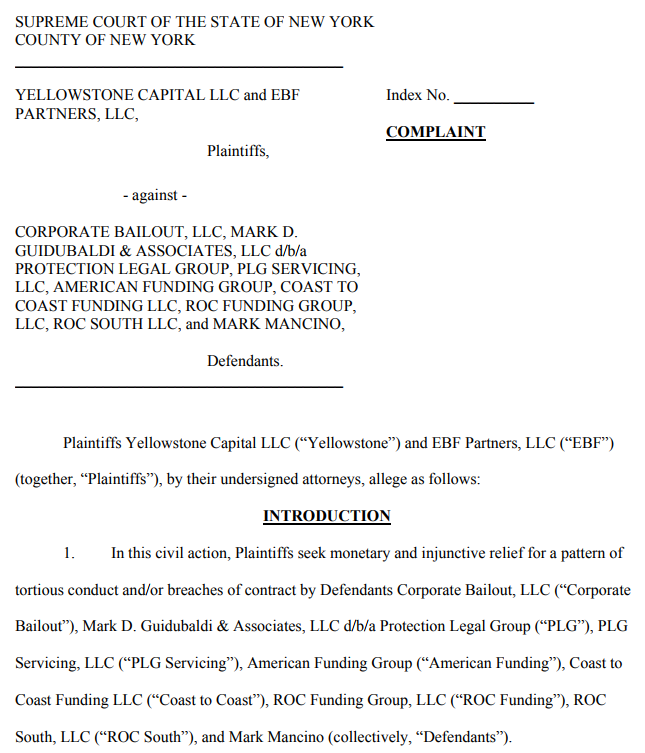
September 28, 2017 ISOs and brokers referring deals to debt settlement companies should pay attention to a lawsuit that was filed in the New York Supreme Court on Wednesday. In it, plaintiffs Yellowstone Capital and EBF Partners (“Everest Business Funding”) allege that certain ISOs are culpable partners in a scam that nefarious debt settlement companies are perpetrating on small businesses.
The debt settlement companies “mislead the merchants as to the services they will perform and the cost to the merchant, and they also conceal their relationships with the ISO Defendants and the fact that they or their affiliates are introducing these same merchants to merchant cash advance providers like Plaintiffs only to later induce those merchants to breach their agreements with their cash advance providers,” the complaint states.
Among the named defendants are:
- Corporate Bailout, LLC
- Mark D. Guidubaldi & Associates, LLC dba Protection Legal Group
- PLG Servicing LLC
- American Funding Group
- Coast to Coast Funding, LLC
- ROC South, LLC
- Mark Mancino
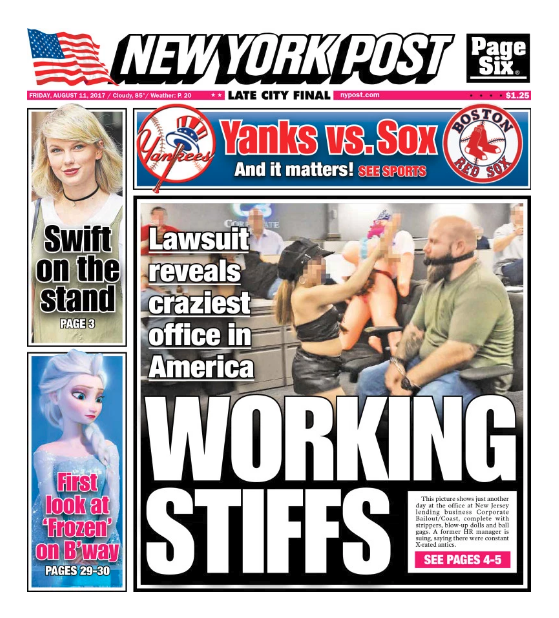
Several defendants are already best known for running an office “so sexually aggressive, morally repulsive, and unlawfully hostile that it is rivaled only by the businesses portrayed in the films ‘Boiler Room’ and ‘The Wolf of Wall Street,’” according to a salacious story that graced the back cover of the New York Post last month.
One paragraph of the complaint summarizes the allegedly collaborative scheme like this:
American Funding, Coast to Coast, […] (the “ISO Defendants”) are independent sales organizations (“ISOs”), companies that ostensibly support the merchant cash advance industry by brokering merchant agreements for companies like Plaintiffs. The ISO Defendants are anything but the proverbial “honest brokers.” As alleged below, they have partnered with companies that purport to offer debt relief services to merchants who have agreements with merchant cash advance companies like Plaintiffs. In practice, for these companies, “debt relief” is a code word for deceiving merchants to breach their existing agreements with Plaintiffs and to instead pay fees to these debt relief entities. In short, they scam merchants into believing that they can save them money when, in fact, they leave these merchants in financial shambles, while causing Plaintiffs to suffer millions of dollars in losses and future los[t] profits.
“’DEBT RELIEF’ IS A CODE WORD FOR DECEIVING MERCHANTS TO BREACH THEIR EXISTING AGREEMENTS”
Central to the plaintiffs’ claim is that they have ISO agreements with the defendants and that the defendants’ conduct is a breach of those agreements. The three causes of action alleged are tortious interference with contract, conversion, and breach of contract. Plaintiffs claim that 100 merchants with more than $3 million in outstanding balances are in breach of their contracts because of the defendants’ conduct.
The complaint was prepared and filed by attorneys at Proskauer, a 142-year old law firm founded in New York City.
Debt Relief Under Fire
The small business debt relief industry has been marred by scandal in recent years. In an unrelated criminal matter being handled in the Western District of New York, the owner of Corporate Restructure Inc. (no ties to Corporate Bailout) is currently residing in the Niagara County Jail awaiting trial on charges of conspiracy to commit mail fraud, wire fraud, bank fraud and money laundering for failing to deliver the debt relief services it charged for. In that case, United States vs. Sergiy Bezrukov, Bezrukov advertised that he could reduce a merchant’s short term debt by up to 75%. He is facing up to 30 years in prison. He was also previously a merchant cash advance ISO.
Two other MCA funding companies, Pearl Gamma Funding and Pearl Beta Funding, filed a lawsuit last November against another debt relief company that calls itself Creditors Relief. The complaint in that case also alleges tortious interference with contract and is still pending.
Meanwhile, a lawsuit filed in May by famous TCPA litigant Craig Cunningham against Corporate Bailout and Mark D Guidubaldi & Associates LLC went unanswered, according to court records. Cunningham, who alleged violations of telemarketing laws, filed for a default judgment against Corporate Bailout on September 12th.
Taking Advantage
Both Yellowstone Capital and Everest would not comment on the lawsuit they filed, citing pending litigation. Sources close to them, however, contend that both companies take matters that involve merchants being taken advantage of very seriously.
“When our own ISOs work directly in concert with companies that induce merchants to breach our contracts, that’s a problem,” said one source who did not wish to be named and was speaking generally about the recent introduction of debt relief service companies to the industry. “They’re taking advantage of businesses that can’t afford to be taken advantage of.”
An email sent by AltFinanceDaily to Mark Mancino early Thursday afternoon, an individually-named defendant alleged to be affiliated with the other defendants, has not yet received a response. This story may be updated if a reply is received.
A COPY OF THE COMPLAINT CAN BE VIEWED HERE.