
Silicon Valley’s One Punch Knockout
October 4, 2012“This morning I woke up, brushed my teeth, and hopped in my hovercraft to go to the office. As soon as I arrived, I began my routine of playing ping-pong against my co-workers while computers performed the automated tasks I had set for them. Then I went to the gym, came back, and learned that our web portal had generated 12,000 leads, closed 7,000 deals, and funded 5,000 merchants. It was an exhausting day…” — A Senior Account Executive from the year 2013.
 We’ve been offering insight on the 2012 invasion of Silicon Valley into the Merchant Cash Advance (MCA) industry. Excuse us, it’s called the “merchant financing industry” now. California technology companies are bringing money, yes, but most importantly, bringing their treasure trove of technologies to companies that were mostly satisfied with the status quo. But are America’s small businesses ready to do business Silicon Valley style or have MCA companies had it right all along, to operate in the way that small business is most comfortable with?
Two weeks ago, California enacted a law that will allow computerized driverless cars to drive on the road. Cars that drive themselves… this is business as usual in parts of California where everyday things such as gasoline, wires, and paper money don’t exist anymore. There, it is believed that clipping coupons from newspapers is something that the Pilgrims did on the Mayflower. There, applying for a small business loan should be as easy as using your brain waves to telepathically connect with a bank’s computer and having the funds instantly transferred to your bank account. There, is a sense that the rest of the country is just like them…. except it’s not.
If you’ve ever had the pleasure of being an MCA underwriter, you know why antiquated funding companies aren’t going to go quietly into the night. We got to speak with one veteran on condition of anonymity. His words:
We had a guy with good credit, processing $15,000 a month in credit card sales, looking for $20,000. He’d been in business for fourteen years and it seemed like a home run but it took seven weeks to close. He didn’t have a printer or a scanner and he had to drive twenty miles to the nearest Fedex/Kinkos every time he wanted to send us something. On his third trip, his ’94 Corolla broke down and we had to wait a few days until he could find a friend’s car to borrow to send the documents.
These situations do not occur every day, but it is evidence that automation will not singlehandedly knock everyone else out with one punch. There is a technology gap in America. Statisticians point out that 78% of Americans use the Internet, but there is a whole generation that doesn’t trust it with their most sensitive information or have the capabilities to use it to its fullest extent. Would a Silicon Valley takeover of the MCA industry alienate them and leave many of America’s small businesses once again without a shoulder to lean on?
Program or be Programmed
The title of this segment here is the title of a book written by Douglas Rushkoff. An article on CNN commented at length about it and its revelations about the digital age. Americans need to learn all the basics when they’re young. Your PHPs are just as important as your ABCs and 123s. CNN interestingly states:
It’s time Americans begin treating computer code the way we do the alphabet or arithmetic. Code is the stuff that makes computer programs work — the list of commands that tells a word processor, a website, a video game, or an airplane navigation system what to do. That’s all software is: lines of code, written by people.
—Just a couple of years ago, I was getting blank stares or worse when I would suggest to colleagues and audiences that they learn code, or else. “Program or be programmed,” became my mantra: If you are not a true user of digital technology, then you are likely being used by digital technology. My suggestion that people learn to program was meant more as a starting point in a bigger argument.
—According to Calacanis, each employee who understands how to code is valued at about $500,000 to $1 million toward the total acquisition price. One million dollars just to get someone who learns code.
Read those last two lines? Each employee that understands how to code is worth up to $1 million. Are they seriously teaching people in school that Microsoft Office proficiency is a leg up in the business world?
College graduates that know more than one language have an edge over people that don’t. But speaking Chinese, Spanish, or Arabic won’t get you as far as JavaScript. According to IT World, JavaScript is the most highly ranked programming language in the world as measured by its use and popularity. Learn French and you’ll really enjoy a vacation in Paris. Learn PHP, Python, or Ruby and you just might become the King of France.

Am I Already a Dinosaur?
No! Don’t let those 10 year olds with a software empire get you down. Anyone can learn and you need not spend $30,000 a year on college tuition to do it. Codecademy can help complete beginners learn code for free. Get real good at it and you may earn yourself a $50,000 salary increase.
One Punch
Silicon Valley with their exotic computer languages and cars that drive themselves may present a challenge to the MCA industry, but many firms will be able to hang on for a long, long time. Some people still pay by check at the grocery store and yes, many business owners would rather not use online banking, no matter how safe they’re told it is. But there will come a time when being bilingual means being able to write Java and Perl. Oh there will come a time when driving twenty miles to Kinkos in a car that one must drive themselves to fax a document that will never again exist on paper, will be an experience we confuse with the Pilgrims trip on the Mayflower.
Everyone should at least take some basic lessons on self-defense. Silicon Valley is coming out fighting. They might not knock you out, but it couldn’t hurt to have a white belt in JavaScript. Anything to keep you in the ring just a little bit longer.
< ?php echo "- Merchant Processing Resource"; ? > 😉
../../
Article condensed 10/8/12
The End of an Era
September 19, 2012It’s the end of an era. Sound ominous for a blog that reports on the Merchant Cash Advance (MCA) industry? It shouldn’t. In the last 10 years, MCA firms played in the minor leagues. No one was really paying attention to them and truthfully, a lot of critics didn’t think this business model would still be around. But today it still stands, funders are still funding, and this blog is practically struggling to keep up with the incredible amount of action that is taking place. Coincidentally, 2012 marks the end of the Mayan Calendar. Yes, it’s the end of an era.
MCA Goes From 0 to 60
There were a few big firms in the Mid-2000s (RapidAdvance, Merchant Cash and Capital, Strategic Funding Source, AdvanceMe, etc.) and they’ve all experienced modest success. It was “modest” in the sense that it is nothing compared to today’s standards. The level of play is changing. Wining and dining an Independent Sales Office (ISO) that could bring in $300,000 a month in deal flow used to be all the rage. 300k for one company was 300k less for a competitor. An extra point of commission here or a freebie approval there was enough to make you the big dog in town, at least for awhile. Despite all the supposed innovation and growth, the talent pool remained the same. Lead generators became agents, agents became ISOs, ISOs became syndication partners, syndication partners became funders, and funders became technology companies that were basically clearing houses for groups of funders. If the industry was Sally, Joe, and Tom in 2005, it was still Sally, Joe, and Tom in early 2011, just with new company names or titles. Then everything changed…
Money poured in:
Merchant Cash and Capital Announces $25 Million in new financing 10/4/11
Snap Advances raises $3 Million from TAB bank 11/21/11
Capital Access Network raises $30 Million 2/7/12
RapidAdvance Receives new financing facility through Wells Fargo 4/2/12
1st Merchant Funding | $5 Million re-discount line of credit from TAB bank 6/12
Strategic Funding Source secures $27 million 6/27/12
On Deck Capital raises $100 Million 8/23/12
Kabbage raises $30 Million 9/17/12
Industry insiders loosely redefined what a Merchant Cash Advance was:
Merchant Cash Advance Redefined Merchant Processing Resource 3/25/12
Big companies entered the market:
American Express Announces Their Own Merchant Cash Advance Program 9/22/11
PayPal Pilots Merchant Cash Advance Program in the U.K. 7/13/12
Some funders became licensed lenders in major states such as California:
A New Chapter Opens for Merchant Cash Advance The Green Sheet 6/25/12
Search the California licensed lender registry
New products formed:
FundersCloud creates platform to raise capital and find syndicate partners faster 8/29/12
A charity announces a new way to make subsidized business loans using the split-funding method 9/6/12
These barely scratch the surface of industry events. What used to be a competition to score the local neighborhood ISO has morphed into a race to be the first to partner up with Facebook, twitter, Groupon, and Square. Anyone not moving full speed ahead to integrate technology and social media will be gone in the next 24 months.
May 18, 2012 was the first time we noticed and commented on what was happening. In How The Facebook IPO Affects the Merchant Cash Advance Industry, venture capitalists and Silicon Valley had finally found MCA and there’s no hiding from them. Now it seems all of our far-fetched predictions are not only coming true, they’re happening moments after we predict them. In our last article we instructed everyone to keep their eyes on Kabbage. Six days later they announced they had raised $30 million in new financing and would be expanding overseas. For a company that makes wild claims about the correlation of facebook fans with account performance, all while humorously being named after a boring vegetable, they sure seem perfectly able to threaten the status quo. Nobody dared touch Ebay or Amazon businesses until they came around.
Price
On the cost basis front, the middle ground is eroding even further. We first discussed this phenomenon on April 25, 2011 in The Fork in the Merchant Cash Advance Road. In it, we explained that the combination of competition and defaults were placing downward pressure and upward pressure on price at the same time. Today, there is surging demand for “starter deals” at 1.49 factors that are payable over 3 months at the same time that more and more new lenders are offering 1 year loans at 10%. The low rate, 12-18 month term deals are nothing new. A few funders tried them in the past and most suffered irrecoverable consequences. This is history that the new players didn’t witness.
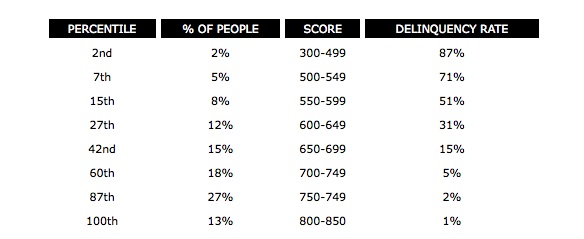
Some outsiders view the MCA industry as a bunch of Wall Street guys that got fat, happy, and disincentivized to lower costs. On the contrary, one only needs to take a single look at this chart to realize that undercutting the entire market isn’t so genius after all. How can a funder survive with extremely low margins when 15% – 71% of their target market is likely to experience problems repaying their loans? These aren’t our stats, these are FICO’s:
Veteran industry insiders know this and acknowledge that the coming tide of low rate financing is a bubble that has burst before. On the DailyFunder, a few folks have offered this insight:
The mca/unsecured loan biz is very risky. It’s all fun and games till deals start going south. My guess is they either adjust rates to match defaults or go out of business. I know first hand that this is not a get rich quick business. It may look like it is from the outside but once you are inside you see the world differently pretty quickly.
[these new low rate deals are] just like On Deck did. When they first came out, they offered 12 month 1.09’s. Then it dropped to 6 month 1.12’s, then 1.18’s. Now you see 1.25’s to 1.35’s offered by them
Governance
On the other side of the cost war is potential federal regulation. At least one D.C. consulting firm is prodding the leaders of the MCA industry to take a proactive approach on self-governance. According to Magnolia Strategic Partners, MCA is on the radar of regulators and members of congress, especially in light of the Dodd-Frank Wall Street Reform and Consumer Protection Act. The new MCA playing field has invited media attention, and not all of it is positive.
The North American Merchant Advance Association is the only organization for industry cooperation but their ability to dictate policies and standards is weak. They receive very little press and their website has been down for weeks. Many argue that they have been effective in minimizing defaults by sharing data on fraudsters. While this does stand to serve the community, it is but a footnote in their orignal intended purpose.
New Barriers to Entry
For the first time ever, potential resellers are facing barriers to entry. Becoming an ISO has long been as simple as owning a phone and purchasing a list of businesses that have used MCA financing before. Today, it’s not that easy. These lists have been sold literally hundreds of times over and called tens of thousands of times over. Pay-Per-Click marketing is dominated by the million and billion dollar firms with money to burn. If John Doe ISO wants to advertise on Google, he better be prepared to compete with the likes of American Express and Wells Fargo. Good luck! Putting skin in the game has also become more of a prerequisite for ISOs to succeed. Funders want to know if a sales agent would put his or her own money into a deal… and then actually commit them to doing just that. The odds are becoming stacked against the undercapitalized and it isn’t likely to change.
In 2009, the most prevalent pitch used by sales agents was to inform prospects that they themselves were “a direct lender” and that anyone else the prospect might be talking to was a broker. “Cut out the middleman and go direct with us,” they’d convincingly argue. This line became less effective when prospects heard this from all five agents they spoke to. Name dropping strategic partnerships will be the new way to build credibility. “We’re partnered with Facebook, twitter, Groupon, and Square,” a sales agent will soon be saying. “Can our competitors make the same claims? Go with us.”
 See You On the Other Side
2013 will kick off a single elimination tournament. Funders that didn’t realize 2012 was the end of an era will begin to fade. 2014 will eliminate the weaker firms that remain and by 2015, Merchant Cash Advance will no longer be a term that anyone uses. Big banks and billion dollar technology companies will go on to rebrand all that which the funding warriors of the last decade have worked so hard to establish. MCA will simply assimilate into other financial products. The metaphorical Sally, Joe, and Tom will probably still be in the business, but be working for companies like Capital One, Wells Fargo, and American Express. And as for us…well… we’re going to need something else to talk about. But we’ll keep you posted until that day. 🙂
– Merchant Processing Resource
../../
8 Advances Are Better Than 1
September 11, 2012Things just got interesting. Your merchant processing $20,000 a month got approved for $26,000 and it was hard fought. Bad credit and some other issues would normally have forced this deal to go the starter route, but not this time. This time you can reflect back on the past few weeks of sweet talking the underwriter and know that it’s starting to pay off. Maybe it was the fact that you obnoxiously concluded every e-mail to him or her with a <3 or 🙂 just to make them feel extra special even if it was in response to a deal of yours they moronically declined.
I understand why you had to decline my client with 720 credit. We’ll get the next one! <3 :-)
And now this time you’re chalking up a tally on the closer board for a deal that shouldn’t have gotten done…that is until your client claims to have received a contract for $50,000 from another source. “There’s no way that can be true,” you tell them while rolling your eyes in frustration. This always happens at the finish line. Someone comes in and shouts out wild figures just to steal their attention away for a minute. But what if there really was a company offering 250% of processing volume to merchants who teeter on the subprime/starter threshold?
Sure there are ACH funders out there who will step in and say “based on their gross sales we might be able to give this merchant 500% of their processing volume!” and the like, but very few people are doing this from a split processing perspective.
We’ve been speaking with Heather Francis at Merchant Cash Group (MCG) and they plan to formally announce the details of their Fast Funding Equity program in the next couple of weeks. Without going into all qualifying parameters merchants must meet to be eligible, we’ve learned that these advances will be disbursed in 8 fixed monthly installments rather than the entire lump sum upfront. And that’s the catch. Under this program the merchant might be contracted for $50,000 but only receive a deposit for $6,000 today. However, there would be no future “renewal agreements” to negotiate or sign. Additional funds would be sprinkled into the merchant’s bank account on a near constant basis of every 6 weeks.
MCG might not win the deal every time with this program but they’re going to give a lot of account reps a run for their money. We all know the pitch of verbally promising additional funds in 3-6 months from the date of the initial advance, which is based mainly on hope that the account will perform and that the funder won’t play games. Put that up against 7 renewals in writing and it’s fair to say we’ve got a good match on our hands. There are some other special incentives for MCG account reps on the Fast Funding Equity program that are being leaked on the DailyFunder Forum.
———————————
G-Day
 Today was G-Day in the Merchant Cash Advance arena. GoDaddy.com’s servers were taken down singlehandedly by a jerk (let’s be real here) in the hacker group known as Anonymous. But this time we couldn’t all point and laugh like when it happened to Sony, Yahoo, or LinkedIn. No, this time thousands of MCA agents, underwriters, and staffers wondered why they stopped receiving e-mails after 2pm EST. This time Internet leads stopped coming in, internal databases stopped responding, and websites stopped loading. This time we learned that almost everyone uses GoDaddy for something no matter how much they brag about their systems and technology.
We didn’t take a poll of which companies were affected (we couldn’t because our e-mail was down!), but we did participate in the mass hysteria with several other people that were affected. As this very website went down around 2pm today, we lost contact with our database and e-mail servers. One ISO reported that their website, e-mail, and even their VOIP phones were down (You can have GoDaddy phones?). Another reported that their system was so connected to their GoDaddy servers that they couldn’t even print, scan, or fax! If you’re not a fan of Mondays, today was certainly a good day to make up an excuse to leave early. With systems crashing nationwide, chances are your stapler may not have been stapling right and your boss would have had no choice but to send you home.
Strangely, we have run into the hacker group Anonymous before. Back when they hacked Sony in 2011, they sent a 5 page blistering explanation of why they did it to the U.S. Federal Government. They included a link to our site on page 4 to an area that is now deprecated. That area outlined the basics of PCI compliance. For a week, our analytics showed that most of our web traffic originated from the Department of Homeland Security, Department of Justice, and the FBI. Boy, that was fun. Read that report and see our citation below:
———————————
Who To Beat in 2012
“How’s your month going?” we asked. “Pretty slow, but that’s because it’s August,” said a lot of companies we spoke to. August is typically a slow month in the world of MCA. Account reps go on vacation, small business owners hit the beach, and America subconsciously puts everything on the back burner until after Labor Day. That was quite the opposite for 2 New York based MCA firms, United Capital Source and YellowStone Capital, both of whom reportedly broke single month funding records.
According to YellowStone Capital’s posts on LinkedIn, they funded $11,125,000 in August alone. With that, they gave a special thanks to RapidAdvance, GBR Funding, The Business Backer, Max Advance, On Deck Capital, Promac and Snap Advances.
———————————
Add This To Your Data Points!
Companies that actively work to gain Facebook fans and Twitter followers are 20% less likely to be delinquent on their Merchant Cash Advance. Seriously. Kabbage, a company we mention in blurbs every so often operates independently from the rest of the industry by targeting e-bay sellers, independent Amazon stores, and social media retailers. Some people feel that they are not a serious challenger to the status quo and that their tactics, methods, and headlines are merely shock value fodder for the rest of us to laugh at while we all rant and rave about ACH deals being the hottest thing since Square. The founder of twitter (Jack Dorsey) started Square and it has completely disrupted the payments market that quite frankly was used to disruptions until Dorsey turned everything upside down. We believe Kabbage is a company everyone should keep an eye on.
On another note, our favorite part of Kabbage’s recent press release is actually the level of interest banks are expressing in their business model.
While the firm said it is open to establishing alliances with credit unions, banks have expressed more interest in seeing how they can leverage the technology platform to serve its customers.
-Kabbage
Fresh off our rant about John Tozzi’s recent article in BusinessWeek that concluded Wells Fargo was essentially evil for being involved with MCA companies, we’ve become suddenly self-conscious of what journalists might think. Little do they know that America’s big banks have been joined at the hip with the MCA industry for a while now. Banks are still lending to small businesses, we’re just all doing it on their behalves. TRUTH!
– Merchant Processing Resource
../../
The Bubble That Wasn’t
August 17, 2012“The smaller the loan, the more likely a lender will deny it. The denial rate for applications for small loans (less than $100,000) was more than twice as high as it was for bigger loans.”
– CNNMoney 8/16/12
In early 2009, a very wise friend of mine gave me a bit of advice. As an ex-stock broker who made his fortune in the 80s, he’d seen his fair share of bubbles. And so he bestowed upon me his wisdom that the Merchant Cash Advance (MCA) industry’s days were numbered. “It’s got 6-8 months left of life in it and then it’ll go away. Everyone’s in freakout mode right now but things will go right back to the way they were and banks will push you right out of a job,” he lectured me. My expression didn’t change, for he wasn’t the first one to sing me this cautionary tale. He continued on, “You’re a nice guy so I suggest in the next few months, you go out and get into another line of work. You can always look at this experience as a wild ride but MCA is a fringe industry borne out of the financial crisis.” I thanked him for looking out for me and went home that night to mull over what he and a few others had been saying.
 No one wants to believe their thriving business is part of a bubble that will inevitably burst. But at the same time, no one wants to later on be perceived as that naive fool that couldn’t see an obvious end coming either. And while the career itself seemed honorable and sustainable (helping small businesses get financing), there were a lot of pivotal moments along the way that made me think for a second that at any day I could be told to pack up my stuff and go home because there was suddenly no more demand for MCA.
I am reminded of the time when a Craigslist Ad was answered by over 500 recently laid off mortgage brokers and underwriters. Some had literally been hired to underwrite mortgages, only to be told days later that their division was closing down. Similarly, there were hot shots from the payday loan industry who stopped by to learn what our business was all about. These people looked like they had been punched in the gut and told stories of major success followed by unforeseen ruin as states legislated them out of business overnight. And still others had the mentality that MCA was a get rich quick scheme and went on to run their own funding companies or brokerage offices into the ground within a matter of months. They cursed the MCA gods and the bubble they believed they were a victim of, ignoring the reality that they had poorly managed themselves into oblivion.
As the 6 to 8 month timeline for destruction expired and the light shone on those still standing, I realized I had made the right choice by sticking it out. MCA was not a progeny of the financial meltdown. Heck, the product itself had already been around since the late 1990s and had gained significant popularity around 2005 when other players began entering the market. It also had none of the trademark signs of a bubble. If financing businesses was a bubble, there would be no such thing as banks today. Business financing has been around for literally thousands of years. MCA firms just catered to the ones that banks ignored and by 2008 that included nearly every small business in the country. One could argue that the growth rate of MCA would eventually slow down, supporting the claim with the same wisdom I had heard nearly a year before, that everything would return to “normal.”
Today’s world is anything but the world of yesterday. The unemployment rate in July was 8.3% and according to a survey reported by CNN, “[Today], the option most often sought by businesses — opening a new credit line — face[s] the lowest approval rate at 13%” Banks never did return to their old ways, nor does it seem likely that they will any time soon. Those that doubted MCA’s longevity in 2009, including those who left the industry altogether back then in fear, did not foresee the many roads of evolution that would allow it to thrive.
Years ago, an MCA was easily defined as a purchase of future sales that would ideally be completed in 6 to 9 months. Virtually every provider offered identical terms and costs, which stymied competition and eventually created stereotypes that would come to haunt the image of MCA for quite some time. For a while, America had a hard time envisioning MCA as anything but a 1.38 factor rate that was available to those that fit a certain credit criteria and processed a minimum amount of credit card sales monthly. So imagine the shock some small business owners felt when approved by RapidAdvance, a veteran MCA firm, for a ::gasp:: small business loan. A loan?! could it be? Yes, MCA has been semantically broadened to include many forms of short term lending. And then there’s Florida based Merchant Cash Group that became famous with their Fast Funding program, a financing option for businesses that fell outside the box for traditional MCAs. Some companies don’t even require businesses to accept credit cards as a form of payment. “Credit card sales? Who cares how much they’re doing in credit card sales?!” Would you ever imagine an MCA rep making such a statement in 2009?
MCA is still widely considered to be tied to credit card processing and it doesn’t ever need to officially evolve away from that. Withholding a percentage of sales directly from a payment processor is what initially allowed the many business owners that were horrible at making monthly payments suddenly eligible to receive capital. But for all the changes that have been applied to the financing product itself, something has changed with the companies offering it as well.
Competitors used to be ultra secretive about their practices. An MCA firm could be underwriting an application that another MCA firm funded the day before. Sure, the merchant wasn’t supposed to hop around and do this with more than one company at a time, but the other firm wouldn’t even confirm if they funded them if you asked. One of the great failures of the past was the lack of cooperation amongst the players in the industry. An ‘every man for himself’ mentality hurt more than it helped in a business that was struggling to create its identity in the mainstream world of finance. The North American Merchant Advance Association (NAMAA) sought to correct that through data sharing and the promotion of common standards. Some of the major members have years of experience under their belt including Merchant Cash and Capital, Strategic Funding Source, RapidAdvance, and Merchant Cash Group. These firms have been around the block and back. “MCA bubble? What bubble?,” they’ll say with 100% confidence in their tone.
 So why a boring history lesson on MCA today? It’s only fitting on the day that CNN declared the bursting of the social media bubble, that I re-visit a decision I made 3 years ago. “I’m just looking out for you kid,” a mentor once told me. Bad advice for sure. This year, I am noticing many people that left MCA years ago are coming back. After so much time has passed, they are STILL getting in early on something that’s going to be huge, rather than coming back to ‘manage the decay’ (did I just take a swipe at Obama?!). VCs are having a field day trying to get in on it. Accel Partners recently forged an equity deal with Capital Access Network with the ultimate goal of what I’m guessing is to one day go public.
The only things bubbly in MCA these days are the excited account reps, underwriters, and support staff that are working to get America’s small businesses humming again. Some have taken to wearing their FUNDED pants 7 days a week. I know I have practically worn mine out.
I’m always struck now by the college grads that ask me if this business is sustainable. Their anxious parents are worried sick that their babies are going to be caught up in some bubble and be out of a job 6 to 8 months from now. To this I offer a few words of wisdom. “Providing small businesses with capital isn’t going away anytime soon. Sure, the product might evolve and the economy will change, but the fundamental demand for short term financing is here to stay. You seem like nice parents so I’d hate to see your kid get involved in some other industry at the end of its life cycle. He or She is getting in early on something big, something long lasting, something that has become a permanent staple of the American financial system.” Good advice for sure.
By: Sean Murray
Founder of Merchant Processing Resource (../../)
Began career in the MCA industry in August, 2006
P.S.
The FUNDED pants do exist and were created by Next Level Funding in early 2010.
Cool Stuff | ISO Extinction | Ignorant Media
April 27, 2012What’s new in the Merchant Cash Advance arena?
Cool Stuff
FundersCloud is making waves in the industry with their Peer2Peer/Crowdfunding platform. We’ve finally gotten a chance to speak to their team, do a walkthrough, and aim to release an independent review of their cloud next week. However, for the moment we would like to take this time to gloat that another one of our predictions is being proven right.
On December 1, 2010, we explained that the Direct Funder model was quickly becoming a thing of the past. (The Direct Funder Model is Sooo 2009). How many of your friends and colleagues have at some point considered leaving their current job to go and start a funding company? Tired and worn down agents are all prone at some point to say “screw this! I want to be the funder so the agents can send the deals to ME instead!” Now it makes increasingly less sense to start a funding company. Why would you do that when you can just syndicate on your own deals or on the deals of other funders? You can earn the same return they enjoy but without having to pay the nasty overhead. In some aspects, being the funder has disadvantages, unless they’re making a hefty amount on management fees.
 ISOs Facing Extinction
According to an article in ISO&Agent Magazine, it’s not practical to compete on just price anymore:
The internal threat lies in continuing to base the ISO business model solely on selling card services at the lowest price and failing to offer the latest payment technology, Helgeson cautioned the packed session room.
“They should be talking innovation,” Helgeson said of ISOs. “If they’re only talking rates, they’re already out of business”
Basically, if two merchant account representatives walk into the corner deli and one offers to lower the processing rates by 15 basis points and the other offers a state of the art POS cloud that can accept payments through the merchant’s smartphone, home computer, and in-store touch screen device, what’s going to happen? So many merchants have been tricked into higher rates under the guise that their rates would be lower that they’re beginning to tune out the low rate pitch already anyway. They want the technology now.
Could the same issue begin to plague the Merchant Cash Advance industry? In the last two years, new funders have popped up with the strategy to acquire marketshare by undercutting the competition. That works until the next guy undercuts the first guy, and the next guy undercuts the second guy. Pretty soon, we’ll have funders purposely operating in the red just to have a share of the market. Some are bleeding red ink already but not because they want to be. 🙁
They key is to give merchants added value with the financing program. This doesn’t mean trying to sell them insurance and warranties and trying to pass this off as some kind of value. Those are junk costs and extra fees for the funder, not value for the merchant. Anything you can contribute that would drive more customers to their business or make their business operate more efficiently is value.
Ways Merchant Cash Advance Companies Can Provide Additional Value to Their Clients:
- Provide them with POS software
- Provide them with SEO services to increase their exposure to customers in search engines
- Create a custom tailored marketing campaign for them to reach more customers
- Create and execute an e-mail marketing campaign for them that would be sent to either previous customers, potential customers, new customers, etc.
- Rent a few billboards and allow merchants to opt-in to have their business advertised on these billboards
- Copy Groupon
- Etc., etc., etc.
If you can’t come up with anymore ideas here on your own, you’ll probably be out of business by 2015. If the items you add to this list include ways to make yourself more money and not the merchant, you’ll probably be out of business by 2015.
Ignorant Media
In our own opinion, the petition set up to automatically e-mail the Huffington Post in response to their article about businesses having no choice but to pawn jewelry was a success. The Huffington Post may feel differently because they didn’t respond to us at all.
It figures that websites that receive millions of views daily really don’t bother to care about actual facts or information. They’re entertainment sites and for-hire PR mechanisms. Every time we see a friend’s company mentioned in the news, we shoot them an e-mail or call them up to offer them congratulations on getting noticed. They always respond with some version of, “Don’t congratulate me. I had to pay $30,000 to some PR company to try and buy placement.” Oh well… At least there’s the Merchant Processing Resource to fulfill all your Merchant Cash Advance information needs. 🙂
– AltFinanceDaily
../../
Merchant Cash Advance On Huffington Post / Just Call it a Coupon!
March 16, 2012An article was published by the Huffington Post today that explained the need for Merchant Cash Advance providers. Though some of it was described in an unflattering light, it conveyed some important messages.
- Real business owners explain that banks both big and small are not interested in lending to them
- One woman is quoted as saying: “If I ever write a book on how to open a restaurant, the first chapter is going to be ‘Banks Are Not Your Friends.'”
- A direct funding provider revealed that demand for merchant cash advances increased by 15 percent to 20 percent in 2011 and that 70% of businesses use more than 1 advance.
 Our favorite line and perhaps the most important thing you can take away from this article is the quote by the CEO of AmeriMerchant. “[Merchant Cash Advance] is less expensive than [offering] a Groupon for 50 percent off or putting inventory on sale for 30 percent off.” Isn’t it ironic that the Groupon/e-coupon/social coupon concept is today’s business as usual and is at the same time significantly more costly than what the media considers to be expensive financing?
LivingSocial has 60 million members worldwide and they operate much in the same way that Groupon does. Let’s discuss this. According to wikipedia, Groupon’s business model works as follows:
For example, an $80 massage could be purchased by the consumer for $40 through Groupon, and then Groupon and the retailer would split the $40. That is, the retailer gives a massage valued at $80 and gets approximately $20 from Groupon for it (under a 50%/50% split).
So the 50% discount to the consumer is actually a 75% loss of revenue for the business owner. This practice is publicly accepted as fair, practical, and a way to increase your sales. If that’s the case, should’t financing that costs $2,800 to receive $10,000 be considered a bargain? We think so. Expensive is in the eye of the beholder. The media has a funny way of convincing people that a 75% discount is a great deal but financing costs of 28% are astronomical. Not to say that 28% is cheap, but there is only one reason that low rate bank loans even existed in the first place. The SBA is willing to cover up to 90% of the defaults and charge it to the taxpayers. That’s an advantage the rest of the private sector doesn’t get.
We can’t help but think what would be if the Merchant Cash Advance concept was rebranded as a powerful social marketing tool to drive sales. What if a Merchant Cash Advance provider purchased $12,800 of a store’s future sales in exchange for $10,000 today and then mass marketed that business to local consumers through mailing lists, iphone apps, and website ads to drive customers to the store. That would allow the Merchant Cash Advance provider to recoup their purchase as fast as possible and at the same time create viral growth for the business. The technology already exists and businesses are already willing to accept 75% losses. Isn’t it time they all started getting a lot more bang for their buck?
It’s not expensive when it’s spun that way is it? Sayonara Groupon and LivingSocial! Merchant Cash Advance is the sleeping giant at your doorstep.
– AltFinanceDaily
../../
Are You Ready to Ride The Merchant Cash Advance Wave?
February 18, 2012Less than a year after we acknowledged the stunning absence of Merchant Cash Advance financing from the mainstream media, suddenly it’s the only thing being talked about. It took a few years but journalists are finally learning to complete the phrase of banks aren’t lending with, fortunately there are other options. The term Merchant Cash Advance is being thrown around so much that financial institutions that offer different funding programs entirely such as American Express are trying to attach their names to it. They are now trying to rebrand their product as Express Merchant Financing. This isn’t to be confused with a Dallas, TX based company called Express Working Capital which offers Merchant Cash Advances. You can understand why there is so much confusion. Merchant Cash Flow Loans too, which are micro loans based on gross sales are often identified as Merchant Cash Advances even though there is little common ground.
But let’s not fuss over small details because it’s not just the funding companies that are talking about it now, it’s the media.
No matter how well your website is designed or how good your sales people are, it’s important to recognize that small business owners think like normal consumers. According to a 2007 Nielsen Survey, 63% of people’s trust in a company forms from newspaper sources and 56% from television sources. Even though this type of financing has been around since the 1990s, the lack of news coverage has held the industry back. Despite the advancement of social networking and internet background searches, the majority of Americans still have that If it’s on TV, it must be true mentality. Why else would political candidates still be spending billions of dollars on TV commercials to get their message across?
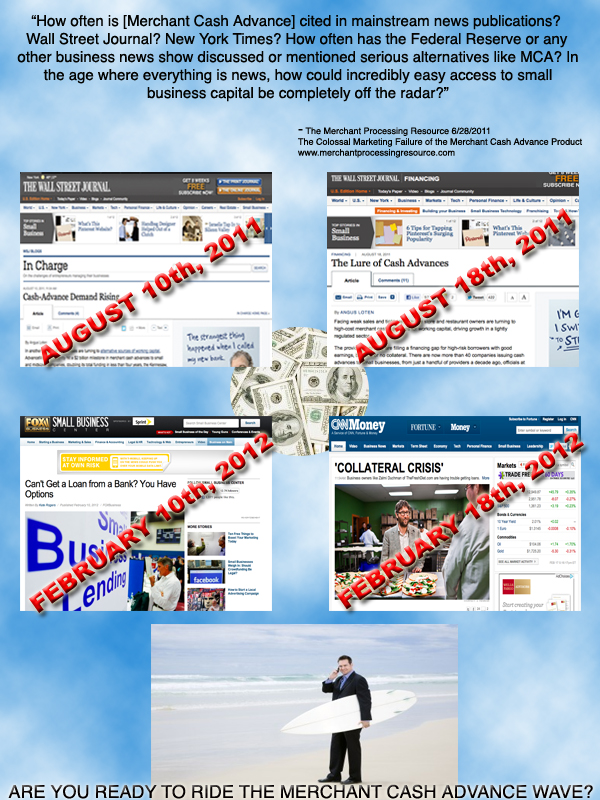
The broad use of Merchant Cash Advance terminology, the recent recognition by the mainstream media, and the march of average Americans into the reseller market is an omen. A wave is coming. Whether some deem the current industry’s size to be $600 million a year or $1 billion is irrelevant. Merchant Cash Advance and similar financing programs have the potential to be a $10 billion market annually, especially since the major banks are retreating from SBA loans.
We suspect that in 2012, particularly the latter half of it will be explosive unlike the entire industry has seen before. Too many small businesses have been waiting on the sidelines since 2008. If the trend of rising employment is correct and a real recovery is underway, then we’ve got all the ingredients for a perfect storm. Confident Business Owners + Fast, Easy Access to Capital = American Recovery.
Call these business loan alternatives whatever you want: Merchant Cash Advances, Merchant Cash Flow Loans, Express Merchant Financing, etc. Just make sure you have a surfboard. A giant wave is coming.
– AltFinanceDaily
../../
The SEO War for ‘Merchant Cash Advance’
February 12, 2012 Let’s admit it, we’re all at war. If you’ve uttered the terms Panda, PageRank, Backlinks, or Organic in the last few months, you know what we’re talking about. We didn’t choose this fight, Google forced it upon us. And so after a long day of phone calls and handshakes about affordable working capital, we return to our homes at night and search the web. Not for information of course, but to find out where our company website pops up when we Google the phrase: Merchant Cash Advance or other relevant terms. Today we ask, is the fighting worth it?
In 2007, back when the industry hadn’t put much thought into the Internet, the #1 search result for Merchant Cash Advance was the blog by David Goldin, the CEO of Amerimerchant. It made sense because it was a self proclaimed “online resource dedicated to the merchant cash advance industry.” There, small business owners and competitors could read about the trials and tribulations of an industry on the verge of explosive growth. It was interesting, it was informative, and best of all, he ranked first without trying.
Nowadays, it’s all commercial. Merchant Cash Advance companies with fat advertising budgets are spending thousands to rank for their favorite keywords, with Merchant Cash Advance still high on that list. The friendly information resource has been replaced by a website that not only crushed the competition in search positioning but seems to publicly brag about it too.

As we write this article, the top 10 Google search results for Merchant Cash Advance are:
1. Merchant Cash in Advance
2. YellowStone Capital
3. Entrust Cash Advance
4. Merchants Capital Access
5. Merchant Resources International
6. American Finance Solutions
7. Nations Advance
8. Bankcard Funding
9. Rapid Capital Funding
10. Paramount Merchant Funding
Do keep in mind that your results may differ slightly depending on your region. Google geographically targets searchers to bring them the most relevant matches.
How much is the #1 spot worth? The market priced it at $75,000 three months ago when MerchantCashinAdvance.com was sold in an online auction for that amount (saved in pdf). So which powerful Merchant Cash Advance company unloaded their precious website? None. The owner of the site was actually an SEO guru looking to make a quick buck. He studied the industry a bit and then within two months ranked a site at the top of Google.
75k might even be considered a steal, as we were actually approached to purchase that website ourselves in August 2011. The exchange was a bit contentious, with them being unwilling to accept less than $200,000 and us making an insulting offer of $100. Perhaps it was jealousy or perhaps it was because we didn’t realize how a Merchant Cash Advance website could be worth so much, but the discussion quickly degraded into name calling and we never spoke again.
How many small businesses are searching for Merchant Cash Advance anyway? According to Google, there are 14,800 searches for it a month. We assume that at least 75% of those are from the companies offering it. You probably Google the phrases several times a day yourself. Admit it!

The real money is in the long tail keywords, since merchants are more likely to personalize their search. Being first for merchant loan for bad credit might be more potent than Merchant Cash Advance. It’s tough to say since AltFinanceDaily doesn’t really rank for either of those. Then again, we’re an information destination, much like David Goldin’s Blog was/is.
We’re not SEO experts, but we do quite alright with Google ourselves. Without giving away all of them, this is our current placement for just the following keywords:
- Merchant Cash Advance directory: 1, 2
- Largest Merchant Cash Advance companies: 1
- Merchant Cash Advance UCC: 1, 2, 3
- Merchant Cash Advance statistics: 1
- Merchant Cash Advance stats: 1, 2
- Merchant Cash Advance default: 1, 2
- Merchant Cash Advance UCCs: 2, 3, 4, 5
- Merchant Cash Advance laws: 2
- Merchant Cash Advance forums: 2
- Merchant Cash Advance articles: 3
- Merchant Processing: 3
- Merchant Cash Advance Jobs: 8
- Sell your mom for cash: 1 (don’t ask)
MerchantCashinAdvance.com was no different and they claimed to be #1 for over 300 business lending related keywords. A spreadsheet of the analysis they put up during the auction can be found here.
With nothing more than an organic search presence, they claimed to have had the following results:
Month of July for 2011: Received 647 calls & 148 online business lending applications: Funded 81 deals, $26,000.00 profit.
Month of August for 2011: Received 731 calls & 234 online business lending applications: Funded 113 deals, $29,500.00 profit.
Month of September 2011: Received 1026 calls & 276 online business lending applications: Funded 147 deals, $41,750.00 profit.
If that’s the case, then $75,000 was a bargain. That no doubt led to the auction of a similar site just a month later. MerchantCashAdvances.org is currently ranking 51st for Merchant Cash Advance. They claimed to earn $12,500 annually in ad revenue and $200,000 in commissions. The starting bid was $10,000 and although there were many inquiries, it didn’t sell.
That doesn’t mean it wasn’t worth the price. Most Merchant Cash Advance companies are secretly or not-so-secretly investing thousands into SEO campaigns. Black hat SEO is rampant and even the most reputable companies have engaged in it at some point. The underwriting room is the one they show their clients. The sales floor is the one they show their new recruits. But ask where the internet marketing room is, and they’ll claim it doesn’t exist. But it does of course. They’re usually small quarters with no windows that are filled with computers armed with software like ScrapeBox, Article Marketing Robot (AMR), XRumer, and a list of working proxies.
Even the white hats are building backlinks manually and creating endless articles for use on their own company blogs or for services like BuildMyRank. One moderately sized Merchant Cash Advance company in New York City has just as many SEO employees as they do sales representatives. For some, this is just the beginning. It’s not unusual to spend $10,000 – $20,000 a month on pay-per-click campaigns.
The Internet has become a place where the person with the most to spend wins. Because of competition, a paid Google campaign for Merchant Cash Advance keywords can cost $20 per click! We did a phone call with Google and were told that less than 10% of clickthroughs convert into a sale or completed form. If only 1 out of every 10 visitors calls or inquires through the site, that amounts to $200 for a single lead. If only 1 out of every 5 of those leads turn into a closed deal, the acquisition cost is effectively $1,000. That number is awful especially considering commissions and factor rates have been rapidly declining over the last year. And merchants wonder why this financing is more expensive than a bank loan…
It also explains why the practice of closing costs and service fees have survived internal industry scrutiny. Some resellers would be operating in the red without them. Organic traffic is in essence free, that is if you don’t consider the salary or fees you pay your SEO team. Hopefully they don’t overdo it and place your site in the Google sandbox. Until then, the rewards outweigh the risks and every day the industry pushes the envelope a little further in the quest to rank on page 1.
If you can earn $200,000 a year from a website or sell one for $75,000 after two months of work, then there is plenty of room for growth. If the industry was saturated, it wouldn’t be that easy. If your mother is getting into the Merchant Cash Advance business, make sure she knows how to market her website. It’s a war out there.
– AltFinanceDaily
../../