
The FTC Wants To Police Small Business Finance
October 22, 2019 On May 23, the Federal Trade Commission launched an investigation into unfair or deceptive practices in the small business financing industry, including by merchant cash advance providers.
The agency is looking into, among other things, whether both financial technology companies and merchant cash advance firms are making misrepresentations in their marketing and advertising to small businesses, whether they employ brokers and lead-generators who make false and misleading claims, and whether they engage in legal chicanery and misconduct in structuring contracts and debt-servicing.
Evan Zullow, senior attorney at the FTC’s consumer protection division, told AltFinanceDaily that the FTC is, moreover, investigating whether fintechs and MCAs employ “problematic,” “egregious” and “abusive” tactics in collecting debts. He cited such bullying actions as “making false threats of the consequences of not paying a debt,” as well as pressuring debtors with warnings that they could face jail time, that authorities would be notified of their “criminal” behavior, contacting third-parties like employers, colleagues, or family members, and even issuing physical threats.
“Broadly,” Zullow said in a telephone interview, “our work and authority reaches the full life cycle of the financing arrangement.” He added: “We’re looking closely at the conduct (of firms) in this industry and, if there’s unlawful conduct, we’ll take law enforcement action.”
Zullow declined to identify any targets of the FTC inquiry. “I can’t comment on nonpublic investigative work,” he said.
 The FTC investigation is one of several regulatory, legislative and law enforcement actions facing the merchant cash advance industry, which was triggered by a Bloomberg exposé last winter alleging sharp practices by some MCA firms.
The Bloomberg series told of high-cost financings, of MCA firms’ draining debtors’ bank accounts, and of controversial collections practices in which debtors signed contracts that included “confessions of judgment.”
The FTC long ago outlawed the use of COJs in consumer loan contracts and several states have banned their use in commercial transactions. In September, Governor Andrew Cuomo signed legislation prohibiting the use of COJs in New York State courts for out-of-state residents. And there is a bipartisan bill pending in the U.S. Senate authored by Florida Republican Marco Rubio and Ohio Democrat Sherrod Brown to outlaw COJs nationwide.
Mark Dabertin, a senior attorney at Pepper Hamilton, described the FTC’s investigation of small business financing as a “significant development.” But he also said that the agency’s “expansive reading of the FTC Act arguably presents the bigger news.” Writing in a legal memorandum to clients, Dabertin added: “It opens the door to introducing federal consumer protection laws into all manner of business-to-business conduct.”
FTC attorney Zullow told AltFinanceDaily, “We don’t think it’s new or that we’re in uncharted waters.”
The FTC inquiry into alternative small business financing is not the only investigation into the MCA industry. Citing unnamed sources, The Washington Post reported in June that the Manhattan district attorney is pursuing a criminal investigation of “a group of cash advance executives” and that the New York State attorney general’s office is conducting a separate civil probe.
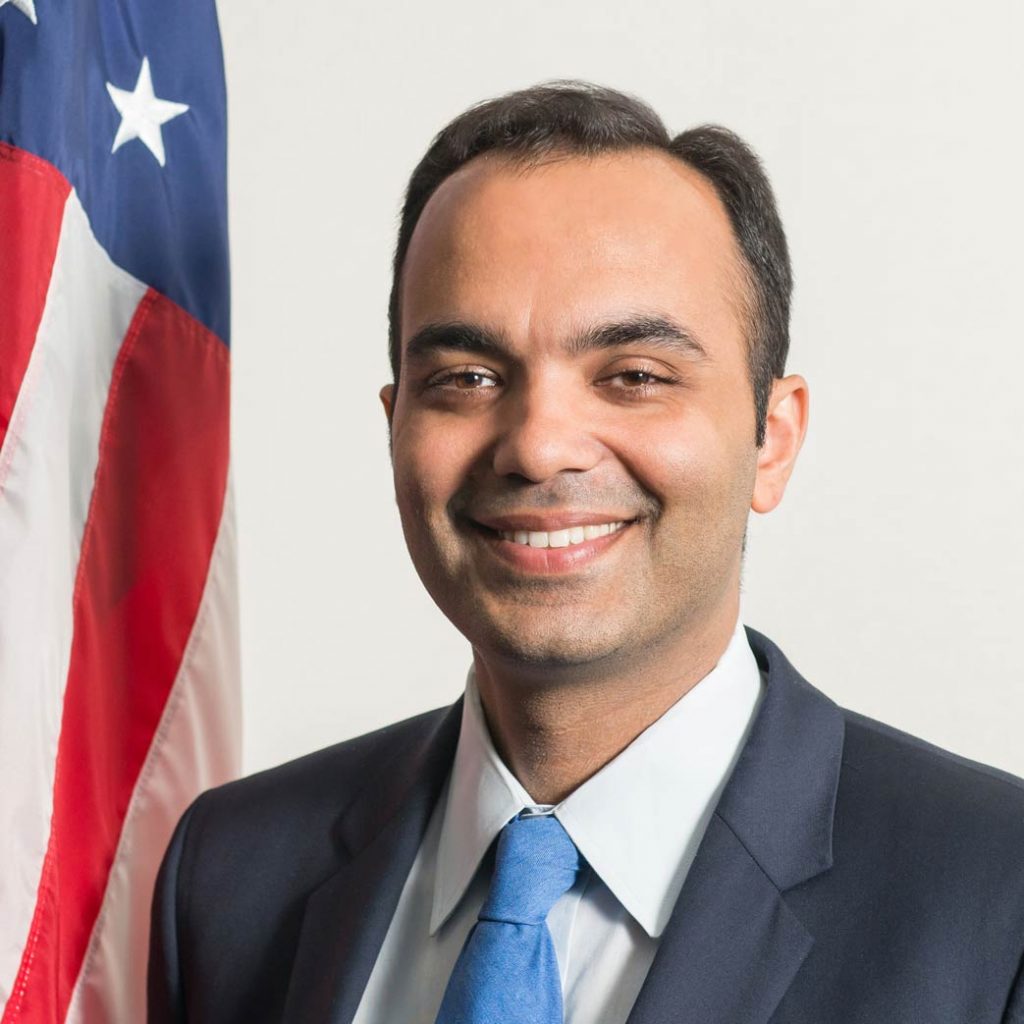
The FTC’s investigation follows hard on the heels of a May 8 forum on small business financing. Labeled “Strictly Business,” the proceedings commenced with a brief address by FTC Commissioner Rohit Chopra, who paid homage to the vital role that small business plays in the U.S. economy. “Hard work and the creativity of entrepreneurs and new small businesses helped us grow,” he said.
But he expressed concern that entrepreneurship and small business formation in the U.S. was in decline. According to census data analyzed by the Kaufmann Foundation and the Brookings Institution, the commissioner noted, the number of new companies as a share of U.S. businesses has declined by 44 percent from 1978 to 2012.
“It’s getting harder and harder for entrepreneurs to launch new businesses,” Chopra declared. “Since the 1980s, new business formation began its long steady decline. A decade ago births of new firms started to be eclipsed by deaths of firms.”
Chopra singled out one-sided, unjust contracts as a particularly concerning phenomenon. “One of the most powerful weapons wielded by firms over new businesses is the take-it-or-leave-it contract,” he said, adding: “Contracts are ways that we put promises on paper. When it comes to commerce, arm’s length dealing codified through contracts is a prerequisite for prosperity. “But when a market structure requires small businesses to be dependent on a small set of dominant firms — or firms that don’t engage in scrupulous business practices — these incumbents can impose contract terms that cement dominance, extract rents, and make it harder for new businesses to emerge and thrive.”
As the panel discussions unfolded, representatives of the financial technology industry (Kabbage, Square Capital and the Electronic Transactions Association) as well as executives in the merchant cash advance industry (Kapitus, Everest Business Financing, and United Capital Source) sought to emphasize the beneficial role that alternative commercial financiers were playing in fostering the growth of small businesses by filling a void left by banks.
The fintechs went first. In general, they stressed the speed and convenience of their loans and lines of credit, and the pioneering innovations in technology that allowed them to do deeper dives into companies seeking credit, and to tailor their products to the borrower’s needs. Panelists cited the “SMART Box” devised by Kabbage and OnDeck as examples of transparency. (Accompanying those companies’ loan offers, the SMART Box is modeled on the uniform terms contained in credit card offerings, which are mandated by the Truth in Lending Act. TILA does not pertain to commercial debt transactions.)
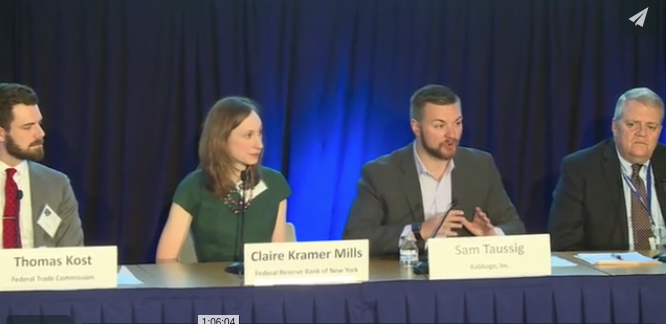 Sam Taussig, head of global policy at Kabbage, explained that his company typically provides loans to borrowers with five to seven employees — “truly Main Street American small businesses” — that are seeking out “project-based financing” or “working capital.”
“The average small business according to our research only has about 27 days of cash flow on hand,” Taussig told the fintech panel, FTC moderators and audience members. “So if you as a small business owner need to seize an opportunity to expand your revenue or (have) a one-off event — such as the freezer in your ice cream store breaks — it’s very difficult to access that capital quickly to get back to business or grow your business.”
Taussig contrasted the purpose of a commercial loan with consumer loans taken out to consolidate existing debt or purchase a consumer product that’s “a depreciating asset.” Fintechs, which typically supply lightning-quick loans to entrepreneurs to purchase equipment, meet payrolls, or build inventory, should be judged by a different standard.
A florist needs to purchase roses and carnations for Mother’s Day, an ice-cream store must replenish inventory over the summer, an Irish pub has to stock up on beer and add bartenders at St. Patrick’s Day.
The session was a snapshot of not just the fintech industry but of the state of small business. Lewis Goodwin, the head of banking services at Square Capital, noted that small businesses account for 48% of the U.S. workforce. Yet, he said, Square’s surveys show that 70% of them “are not able to get what they want” when they seek financing.
Square, he said, has made 700,000 loans for $4.5 billion in just the past few years, the platform’s average loan is between $6,000 and $7,000, and it never charges borrowers more than 15% of a business’s daily receipts. The No. 1 alternative for small businesses in need of capital is “friends and family,” Goodwin said, “and that’s a tough bank to go back to.”
 Panelist Gwendy Brown, vice-president of research and policy at the Opportunity Fund, a non-profit microfinance organization, provided the fintechs with their most rocky moment when she declared that small businesses turning up at her fund were typically paying an annual percentage rate of 94 percent for fintech loans. And while most small business owners were knowledgeable about their businesses — the florists “know flowers in and out,” for example — they are often bewildered by the “landscape” of financial product offerings.
“Sophistication as a business owner,” Brown said, “does not necessarily equate into sophistication in being able to assess finance options.”
Panelist Claire Kramer Mills, vice-president of the Federal Reserve Bank of New York, reported that the country’s banks have made a dramatic exit from small business lending over the past ten years. A graphic would show that bank loans of more than $1 million have risen dramatically over the past decade but, she said, “When you look at the small loans, they’ve remained relatively flat and are not back to pre-crisis levels.”
Mills also said that 50% of small businesses in the Federal Reserve’s surveys “tell us that they have a funding shortfall of some sort or another. It’s more stark when you look at women-owned business, black or African-American owned businesses, and Latino-owned businesses.”
On the merchant cash advance panel there was less opportunity to dazzle the regulators and audience members with accounts of state-of-the-art technology and the ability to aggregate mountains of data to make online loans in as few as seven minutes, as Kabbage’s Taussig noted the fintech is wont to do.
 Instead, industry panelists endeavored to explain to an audience — which included skeptical regulators, journalists, lawyers and critics — the precarious, high-risk nature of an MCA or factoring product, how it differs from a loan, and the upside to a merchant opting for a cash advance. (To their credit, one attendee told AltFinanceDaily, the audience also included members of the MCA industry interested in compliance with federal law.)
A merchant cash advance is “a purchase of future receipts,” Kate Fisher, an attorney at Hudson Cook in Baltimore, explained. “The business promises to deliver a percentage of its revenue only to the extent as that revenue is created. If sales go down,” she explained, “then the business has a contractual right to pay less. If sales go up, the business may have to pay more.”
As for the major difference between a loan and a merchant cash advance: the borrower promises to repay the lender for the loan, Fisher noted, but for a cash advance “there’s no absolute obligation to repay.”
Scott Crockett, chief executive at Everest Business Funding, related two anecdotes, both involving cash advances to seasonal businesses. In the first instance, a summer resort in Georgia relied on Everest’s cash advances to tide it over during the off-season.
When the resort owner didn’t call back after two seasonal advances, Crockett said, Everest wanted to know the reason. The answer? The resort had been sold to Marriott Corporation. Thanking Everest, Crockett said, the former resort-owners reported that without the MCA, he would likely have sold off a share of his business to a private equity fund or an investor.
By providing a cash advance Everest acted “more like a temporary equity partner,” Crockett remarked.
In the second instance, a restaurant in the Florida Keys that relied on a cash advance from Everest to get through the slow summer season was destroyed by Hurricane Irma. “Thank God no one was hurt,” Crockett said, “but the business owner didn’t owe us anything. We had purchased future revenues that never materialized.”
The outsized risk borne by the MCA industry is not confined entirely to the firm making the advance, asserted Jared Weitz, chief executive at United Capital Service, a consultancy and broker based in Great Neck, N.Y. It also extends to the broker. Weitz reported that a big difference between the MCA industry and other funding sources, such as a bank loan backed by the Small Business Administration, is that ”you are responsible to give that commission back if that merchant does not perform or goes into an actual default up to 90 days in.
“I think that’s important,” Weitz added, “because on (both) the broker side and on the funding side, we really are taking a ride with the merchant to make sure that the business succeeds.”
 FTC’s panel moderators prodded the MCA firms to describe a typical factor rate. Jesse Carlson, senior vice-president and general counsel at Kapitus, asserted that the factor rate can vary, but did not provide a rate.
“Our average financing is approximately $50,000, it’s approximately 11-12 months,” he said. “On a $50,000 funding we would be purchasing $65,000 of future revenue of that business.”
The FTC moderator asked how that financing arrangement compared with a “typical” annual percentage rate for a small business financing loan and whether businesses “understand the difference.”
Carlson replied: “There is no interest rate and there is no APR. There is no set repayment period, so there is no term.” He added: “We provide (the) total cost in a very clear disclosure on the first page of all of our contracts.”
Ami Kassar, founder and chief executive of Multifunding, a loan broker that does 70% of its work with the Small Business Administration, emerged as the panelist most critical of the MCA industry. If a small business owner takes an advance of $50,000, Kassar said, the advance is “often quoted as a factor rate of 20%. The merchant thinks about that as a 20% rate. But on a six-month payback, it’s closer to 60-65%.”
He asserted that small businesses would do better to borrow the same amount of money using an SBA loan, pay 8 1/4 percent and take 10 years to pay back. It would take more effort and the wait might be longer, but “the impact on their cash flow is dramatic” — $600 per month versus $600 a day, he said — “compared to some of these other solutions.”
Kassar warned about “enticing” offers from MCA firms on the Internet, particularly for a business owner in a bind. “If you jump on that train and take a short-term amortization, oftentimes the cash flow pressure that creates forces you into a cycle of short-term renewals. As your situation gets tougher and tougher, you get into situations of stacking and stacking.”
On a final panel on, among other matters, whether there is uniformity in the commercial funding business, panelists described a massive muddle of financial products.
Barbara Lipman: project manager in the division of community affairs with the Federal Reserve Board of Governors, said that the central bank rounded up small businesses to do some mystery shopping. The cohort — small businesses that employ fewer than 20 employees and had less than $2 million in revenues — pretended to shop for credit online.
As they sought out information about costs and terms and what the application process was like, she said, “They’re telling us that it’s very difficult to find even some basic information. Some of the lenders are very explicit about costs and fees. Others however require a visitor to go to the website to enter business and personal information before finding even the basics about the products.” That experience, Lipman said, was “problematic.”
She also said that, once they were identified as prospective borrowers on the Internet, the Fed’s shoppers were barraged with a ceaseless spate of online credit offers.
John Arensmeyer, chief executive at Small Business Majority, an advocacy organization, called for greater consistency and transparency in the marketplace. “We hear all the time, ‘Gee, why do we need to worry about this? These are business people,’” he said. “The reality is that unless a business is large enough to have a controller or head of accounting, they are no more sophisticated than the average consumer.
“Even about the question of whether a merchant cash advance is a loan or not,” Arensmeyer added. “To the average small business owner everything is a loan. These legal distinctions are meaningless. It’s pretty much the Wild West.”
 In the aftermath of the forum, the question now is: What is the FTC likely to do?
Zullow, the FTC attorney, referred AltFinanceDaily to several recent cases — including actions against Avant and SoFi — in which the agency sanctioned online lenders that engaged in unfair or deceptive practices, or misrepresented their products to consumers.
These included a $3.85 million settlement in April, 2019, with Avant, an online lending company. The FTC had charged that the fintech had made “unauthorized charges on consumers’ accounts” and “unlawfully required consumers to consent to automatic payments from their bank accounts,” the agency said in a statement.
In the settlement with SoFi, the FTC alleged that the online lender, “made prominent false statements about loan refinancing savings in television, print, and internet advertisements.” Under the final order, “SoFi is prohibited from misrepresenting to consumers how much money consumers will save,” according to an FTC press release.
But these are traditional actions against consumer lenders. A more relevant FTC action, says Pepper Hamilton attorney Dabertin, was the FTC’s “Operation Main Street,” a major enforcement action taken in July, 2018 when the agency joined forces with a dozen law enforcement partners to bring civil and criminal charges against 24 alleged scam artists charged with bilking U.S. small businesses for more than $290 million.
In the multi-pronged campaign, which Zullow also cited, the FTC collaborated with two U.S. attorneys’ offices, the attorneys general of eight states, the U.S. Postal Inspection Service, and the Better Business Bureau. According to the FTC, the strike force took action against six types of fraudulent schemes, including:
- Unordered merchandise scams in which the defendants charged consumers for toner, light bulbs, cleaner and other office supplies that they never ordered;
- Imposter scams in which the defendants use deceptive tactics, such as claiming an affiliation with a government or private entity, to trick consumers into paying for corporate materials, filings, registrations, or fees;
- Scams involving unsolicited faxes or robocalls offering business loans and vacation packages.
If there remains any question about whether the FTC believes itself constrained from acting on behalf of small businesses as well as consumers, consider the closing remarks at the May forum made by Andrew Smith, director of the agency’s bureau of consumer protection.
“(O)ur organic statute, the FTC Act, allows us to address unfair and deceptive practices even with respect to businesses,” Smith declared, “And I want to make clear that we believe strongly in the importance of small businesses to the economy, the importance of loans and financing to the economy.
Smith asserted that the agency could be casting a wide net. “The FTC Act gives us broad authority to stop deceptive and unfair practices by nonbank lenders, marketers, brokers, ISOs, servicers, lead generators and collectors.”
As fintechs and MCAs, in particular, await forthcoming actions by the commission, their membership should take pains to comport themselves ethically and responsibly, counsels Hudson Cook attorney Fisher. “I don’t think businesses should be nervous,” she says, “but they should be motivated to improve compliance with the law.”
She recommends that companies make certain that they have a robust vendor-management policy in place, and that they review contracts with ISOs. Companies should also ensure that they have the ability to audit ISOs and monitor any complaints. “Take them seriously and respond,” Fisher says.
Companies would also do well to review advertising on their websites to ascertain that claims are not deceptive, and see to it that customer service and collections are “done in a way that is fair and not deceptive,” she says, adding of the FTC investigation: “This is a wake-up call.”
Consultative Selling in Small Business Finance
October 16, 2019
 It’s nearly impossible to teach fiscal responsibility to most consumers, according to researchers at universities and nonprofit agencies. But alternative small-business funders and brokers often manage to steer clients toward financial prudence, and imparting pecuniary knowledge can become part of a consultative approach to selling.
Still, nobody says it’s easy to convince the public or merchants to handle cash, credit and debt wisely and responsibly. Consider the consumer research cited by Mariel Beasley, principal at the Center for Advanced Hindsight at Duke University and co-director of the Common Cents Lab, which works to improve the financial behavior of low- and moderate-income households.
“For the last 30 years in the U.S. there has been a huge emphasis on increasing financial education, financial literacy,” Beasley says. But it hasn’t really worked. “Content-based financial education classes only accounted for .1 percent variation in financial behavior,” she continues. “We like to joke that it’s not zero but it’s very, very close.” And that’s the average. Online and classroom financial education influences lower-income people even less.
The problem stems from trying to teach financial responsibility too late in life, says Noah Grayson, president and founder of Norwalk, Conn.-based South End Capital. He advocates introducing young people to finance at the same time they’re learning history, algebra and other standard subjects in school.
Yet Grayson and others contend that it’s never too late for motivated entrepreneurs to pick up the basics. Even novice small-business owners tend to possess a little more financial acumen than the average person, they say. That makes entrepreneurs easier to teach than the general public but still in need of coaching in the basics of handling money.
Take the example of a shopkeeper who grabs an offer of $50,000 with no idea how he’ll use the funds to grow the business or how he’ll pay the money back, suggests Cheryl Tibbs, general manager of One Stop Commercial Capital, Douglasville, Ga. “The easy access to credit blinds a lot of merchants,” she notes.
 Entrepreneurs often make bad decisions simply because they don’t have a background in business, according to Jared Weitz, CEO of New York based United Capital Source. “Many of the people who come to us are trying their hardest,” he observes.
Weitz offers the example of his own close relative who’s a veterinarian. That profession attracts some of the brainiest high-school valedictorians but doesn’t mean they know business. “He’s the best doctor ever and he’s not a great businessman because he doesn’t think about those things first. What he thinks about is helping people. That’s why he got into his profession.”
Entrepreneurs often devote themselves to a vision that isn’t businesses-oriented. “They start a business because they have a great idea or a great product, and that’s what excites them,” Grayson says. “They jump in with both feet and don’t think much about the business side.” The business side isn’t as much fun.
Merchants also attend to so many aspects of an enterprise—everything from sales, production and distribution to hiring, payroll and training—that they can’t afford to devote too much time to any single facet, notes Joe Fiorella, principal at Kansas City, Mo.-based Central Funding. Business owners respond to what’s most urgent, not necessarily what’s most important.
For whatever reason, some business owners spiral downward into financial ruin, bouncing checks, stacking merchant cash advances and continually seeking yet another merchant cash advance to bail them out of a precarious situation, says Jeremy Brown, chairman of Bethesda, Md.-based Rapid Advance.

Weitz advises sitting down with those clients and coming to an understanding of the situation. In some cases, enough cash might be coming in but the incoming autopayments aren’t timed to cover the outgoing autopayments, he says by way of example.
Informing clients of such problems makes a demonstrable difference. “We can see that it works because we have clients renewing with us,” says Weitz. “We’re able to swim them upstream to different products” as their finances gradually improve, he says.
The products in that stream begin with relatively higher-cost vehicles like merchant cash advances and proceed to other less-expensive instruments with better terms, says Brown. Those include term loans, Small Business Administration loans, equipment leasing, receivables factoring and, ultimately the goal for any well-capitalized small business—a relationship with the local bank.
Failing to consider those options and instead simply abetting stackers to make a quick buck can give the industry a “black eye,” and it benefits none of the parties involved, Tibbs observes. But merchants deserve as much blame as funders and brokers, she maintains.
Prospective clients who stack MCAs, don’t care about their credit rating and simply want to staunch their financial bleeding probably account for 35 percent to 40 percent of the applicants Tibbs encounters, she says.
Just the same, alt-funders continue to urge clients to hire accountants, consult attorneys, employ helpful software, shore up credit ratings, keep tabs on cash flow, calculate margins, improve distribution chains and outline plans for growth. It’s what helps the industry rise above the “get-money quick” image that it’s outgrowing, Weitz, says. Many funders and brokers consider providing financial advice an essential aspect of consultative selling. It’s an approach that begins with making sure applicants understand the debt they’re taking on, the terms of the payback and how their businesses will benefit from the influx of capital. It continues with a commitment to helping clients not just with funding but also with other types of business consultation.
“It’s not so much selling as building a rapport with clients—serving as a strategic advisor or financial resource for them, identifying their needs and directing them to the right loan product to meet those needs,” says Grayson. “They should feel they can call you about anything specific to their business, not just their loan requests.” He also cautions against providing information the client will not absorb or will find offensive.
Justin Bakes, CEO of Boston-based Forward Financing also advocates consultative selling. “It’s all about questions and getting information on what’s driving the business owner,” he says. “It’s a process.”
Consultative sales hinges on knowing the customer, agrees Jason Solomon, Forward Financing vice president of sales. “Businesses are never similar in the mind of the business owner,” he notes. “To effectively structure a program best-suited to the merchant’s long-time business needs and set a proper path forward to better and better financial products, you need to know who the business owner is and what his long term goals are.”
“It’s taking an approach of actually being a consultant as opposed to a $7 an hour order taker,” Tibbs says of consultative selling. “I like to teach new reps to think of it as if you were a doctor. Doctors ask questions to arrive at a final diagnosis. So if you’re asking your prospective customer questions about their business, about their cash flow, about their intentions of how they’re planning to get back on track.”
Learning about the clients’ business helps brokers recommend the least-expensive funding instrument, Tibbs says. “I really hate to see someone with a 700 credit score come in to get a merchant cash advance,” she maintains. The consultative approach requires knowing the funding products, knowing how to listen to the customer and combining those two elements to make an informed decision on which product to recommend, she notes.
 Consultative sales can greatly benefit clients, Weitz maintains. If a pizzeria proprietor asks for an expensive $50,000 cash advance to buy a new oven, a responsible broker may find the applicant qualifies for an equipment loan with single-digit interest and monthly payments over a five-year period that puts less pressure on daily cash flow.
It’s also about pointing out errors. Brokers and funders see common mistakes when they look at tax returns and financial records, says Brown. “The biggest issue is that small-business owners—because they work so hard— make a profit of X amount of money and then take that out of the business,” he notes. Instead, he advises reinvesting a portion of those funds so that they can build equity in the business and avoid the need to seek outside capital at high rates.
Another common error occurs when entrepreneurs take a short-term approach to their businesses instead of making longer-term plans, Brown says. That longer-term vision includes learning what it takes to improve their businesses enough to qualify for lower-cost financing.
Sometimes, small merchants also make the mistake of blending their personal finances and their business dealings. Some do it out of necessity because they’re launching an enterprise on their personal credit cards, and others act of ignorance. “They don’t necessarily know they’re doing something wrong,” Grayson observes. “There are tax ramifications.”
Some just don’t look at their businesses objectively. Take the example of a company that approached Central Funding for capital to buy inventory in Asia. Fiorella studied the numbers and then informed the merchant that it wasn’t a money problem—it was a margins problem. “You could sell three times what you’re wanting to buy, and you still won’t get to where you want to be,” he reports telling the potential customer.
Consultative selling also means establishing a long-term relationship. Forward Financing uses technology to keep in contact with clients regularly, not just when clients need capital, Bakes notes. That cultivates long-lasting relationships and shows the company cares. As the relationship matures it becomes easier to maintain because the customers want to talk to the company. “They’re running to pick up the phone.”
The conversations that don’t hinge on funding usually center on Forward Financing learning more about the customer’s business, says Solomon. That include the client’s needs and how they’ve used the capital they’ve received.
“We have our own internal cadence and guidelines for when we reach out and how often and what happens,” says Solomon. Customer relationship management technology provides triggers when it’s time for the sales team or the account-servicing team to contact clients by phone or email.
Do small-business owners take advice on their finances? Some need a steady infusion of capital at increasingly higher cost and simply won’t heed the best tips, says Solomon. “It’s certainly a mix,” he says. “Not everybody is going to listen.”
Paradoxically, the business owners most open to advice already have the best-run companies, says Fiorella. Those who are closed to counseling often need it the most, he declares.
Moreover, not everybody is taking the consultative approach. “New brokers are so excited to get a commission check they throw the consultative approach out the window,” Tibbs says.
Yet many alt-funders bring consultative experience from other professions into their work with providing funds to small business. Tibbs, for example, previously helped home buyers find the best mortgage.
Consultative selling came naturally to Central Funding because the company started as a business and analytics consultancy called Blue Sea Services and then transformed itself into an alternative funding firm, says Fiorella. Central Funding reviews clients’ financial statements and operations between rounds of funding, he notes.
Consultations with borrowers reach an especially deep level at PledgeCap, a Long Island-based asset-based lender, because clients who default have to forfeit the valuables they put up as collateral—anything from a yacht to a bulldozer—says Gene Ayzenberg, PledgeCap’s chief operating officer. Conversations cover the value of the assets and the risk of losing them as well as the reasons for seeking capital, he notes.
No matter how salespeople arrive at their belief in the consultative approach, they last much longer in the business than their competitors who are merely seeking a quick payoff, Tibbs says. Others contend that it’s clearly the best way to operate these days.
“The consultative approach is the only one that works,” says Weitz. “Today, everything is about the customer experience. People are making more-educated, better informed decisions.” What’s more, with the consultative approach clients just keep getting smarter, he adds.
The days of the hard sell have ended, Grayson agrees. Customers have access to information on the internet, and brokers and funders can prosper by helping customers, he says. “Our compensation doesn’t vary much depending upon which product we put a client in so we can dig deeper into what will fit the client without thinking about what the economic benefit will be to us.”
Even though the public has become familiar with alternative financing in general, most haven’t learned the nuances. That’s where consultative selling can help by outlining the differing products now available for businesses with nearly any type of credit-worthiness. “It’s for everybody,” Weitz says of today’s alternative small business funding, “not just a bank turn-down.”
Lending Valley Originates Over 100 Micro Deals in Debut
September 6, 2019 Brooklyn, NY – Lending Valley has originated 100 fundings to small businesses since the company’s debut in early June. The company was founded by small business finance veteran Chad Otar, the former CEO and co-founder of Excel Capital Management. Lending Valley focuses on micro funding deals of $1,500 to $10,000 with a variety of available payment structures. Otar is a Forbes Finance Council Member.
“We saw that the micro advances market needed another player and our goal is to help merchants’ businesses, not hurt them, and make it as easy as possible for them to obtain the capital and to be able to get them to the next step in their business venture,” Otar said. “Lending Valley is backed by years of industry knowledge and a diverse team that can provide the best support possible.”
About Lending Valley
Lending Valley was founded in New York City by Chad Otar. Otar is a member of the Forbes Finance Council. To learn more about Lending Valley, visit https://www.lendingvalley.com or call 866-888-3051.

Born To Borrow
August 26, 2019 Consumer debt has surpassed $4 trillion for the first time, and it’s continuing its ascent into the stratosphere. It’s getting big enough to trigger the next recession, and financial education isn’t changing the underlying consumer behavior.
Personal loan balances shot up $21 billion last year to close 2018 at a record high of $138 billion, according to a TransUnion Industry Insights Report. The average unsecured personal loan debt per borrower was $8,402 as of the end of last year, TransUnion says.
Much of the increase in consumer debt has emerged with the rise of fintechs— such as Personal Capital, Lending Club, Kabbage and Wealthfront—notes Rutger van Faassen, vice president of consumer lending at a U.S. office of London-based Informa Financial Intelligence, a company that advises financial institutions and operates offices in 43 countries.
In fact, Fintech loans now comprise 38% of all unsecured personal loan balances, a larger market share than any of the more traditional institutions, the TransUnion report notes. Banks’ market share has decreased from 40% in 2013 to 28% today, while credit unions’ share has declined from 31% to 21% during the same time period, TransUnion says.
 Fintechs are also gaining at the expense of the home- equity market, van Faassen maintains. “They’re eating away at some of the balance that maybe historically was in home-equity loans,” he says. While total debt is increasing, the amount that’s in home equity loans is actually shrinking, he notes.
What’s more, fintechs are changing the way Americans think about credit, van Faassen continues. Until recently, consumers experienced a two step process. First, they identified a need or desire, like a washer and dryer or home renovation. Realizing they didn’t have the cash to fund those dreams, they took the second step by approaching a financial institution for a loan.
If consumers chose a home equity line of credit to procure the cash, they had to wait for something like 40 days from the beginning of the application process to the time they got the money, van Faassen says. “You really had to be sure you wanted something,” or the process wasn’t worth the effort, he says.
Fintechs have removed a lot of the “pain” from that process, van Faassen says. With algorithms helping to assess the risk that an applicant can’t or won’t repay a debt and digitization easing access to financial records, fintechs can quickly evaluate and make a decision on an application. Tech also helps assess applicants with thin or nonexistent credit files, which broadens the clientele while also contributing to total consumer debt.
Meanwhile, mimicking an age old process in the car business, merchants are beginning to make credit available at the point of sale. Walmart, for example, recently signed a deal with Affirm, a Silicon Valley lender, to provide point-of-sale loans of three, six or 12 months to finance purchases ranging from $150 to $2,000. Shoppers apply for the loans by providing basic information on their mobile phones and don’t have to talk to anyone in person about their finances. Affirm’s CEO Max Levchin has called the underwriting process ‘basically instant.”
If that convenience comes at too high a cost, it doesn’t matter much because borrowers can later find another finance vehicle with better terms, van Faassen says. “So if I get the money at the point of sale, which might have been zero for six months and then it steps up to 20-plus percent, there is no problem with refinancing that debt,” he says.
But there’s a downside to the ease of borrowing, van Faassen cautions. It could trigger the next recession, even though unemployment remains low. Despite modest recent gains, wages have remained nearly stagnant for years. That means an increase in interest rates could lessen consumers’ ability to pay off their debts, he says.
 Meanwhile, at least some large mortgage lenders have begun running into problems, a situation that bears an eerie resemblance to the beginning of the Great Recession that struck near the end of 2007, notes a report in luckbox magazine, a publication for investors. Stearns Holding, the parent of Sterns Lending, the nation’s 20th largest mortgage lender, filed for bankruptcy protection just after the July 4 holiday, the luckbox article says.
Another worrisome sign with regard to the possibility of recession is emerging as institutional investors buy into the peer to peer lending market. Institutional investors bought batches of sliced and diced home mortgage securities that helped bring about the Great Depression.
Then there’s the nagging notion that the country and the world are becoming ripe for recession simply because no downturns have occurred for a while. Talk to that effect was circulating at the recent LendIt Conference, van Faassen observes. Fintech executives often come from the banking world and thus still find themselves haunted by the specter of the Great Recession. That’s why they’re already beginning to tighten underwriting for consumer credit van Faassen says.
One difference this time around lies in the fact that nothing about the increase in consumer debt appears to be hidden from public view, van Faassen says. Before, investors fell victim to the mistaken impression that risky mortgage-backed securities were rated AAA when they weren’t.
Plus, the increase in peer-to-peer lending could keep the economy going even if big financial institutions freeze the way they did during the Great Recession, van Faassen notes. “Hopefully, with the new structures that are out there, we can keep liquidity going,” he says. That raises key questions for the alternative small- business funding community. The industry came into being partly as a response to banks’ tightened lending policies during the Great Recession, so perhaps a downturn isn’t such a bad thing for the sector. But a downturn for the economy in general could cripple merchants’ ability to pay off debt.
But all bets are off during hard times. In the last recession the conventional wisdom that consumers make their mortgage payment before paying other bills was turned on its head. Instead of making the house payment—because foreclosure would take several months—people were choosing to make their car payments so they could get to work. Nobody really knows ahead of time what will happen in a recession, van Faassen notes.
After all, economics relies to at least some degree upon the often-irrational financial decisions of the general public. And science demonstrates that it’s no easy task to convince consumers to handle their cash, credit and debt responsibly, says Mariel Beasley, principal at the Center for Advanced Hindsight at Duke University and Co-Director of the Common Cents Lab (CCL), which works to improve the financial behavior of low- to moderate-income households.
“For the last 30 years in the U.S. there has been a huge emphasis on increasing financial education, financial literacy,” says Beasley. But it hasn’t really worked. “Content-based financial education classes only accounted for .1 percent variation in financial behavior,” she continues. “We like to joke that it’s not zero but it’s very, very close.” And that’s the average. Online and classroom financial education influenced lower-income people even less.
 Lots of other factors influence financial behavior, Beasley notes. How much a person saves, for example, depends upon how much they make, what their bank tells them and what practices they encountered at home as children, she says. The CCL has been finding out some other things, too.
In one example of its findings, it discovered that putting an amount for a minimum payment on a credit card decreases how much consumers pay. That happens because listing a minimum payment amount creates an anchor, and borrowers adjust their payment upward from there, Beasley says. If the card carrier doesn’t specify a minimum, consumers tend to adjust downward from the full amount they owe. “It turns out to be incredibly powerful,” she contends.
It’s the kind of problem that shows financial institutions haven’t devised many systems to reduce consumer debt by speeding up repayment, Beasley maintains. In this example, suggesting higher payments would prompt some consumers to pay off their debt more quickly.
In an exception to standard practice, a credit card company called Petal does exactly that by placing a slider on its website to help borrowers determine the amount of their payment, she notes.
Meanwhile, people tend to base financial decisions on the examples they see other people set, Beasley says. Problems arise with that tendency because they may see one neighbor spending money freely to dine in restaurants but don’t see any of the many neighbors eating at home to save money. They see a neighbor driving a new car but don’t know how much that neighbor is setting aside for retirement.
That’s why most people overestimate how much others spend to dine out in restaurants, Beasley says. When shown the error, most reduce their own spending in restaurants, she notes, but within two weeks their behavior returns to its original level, their newfound knowledge “drowned out by the noise in the world,” she says.
That’s not good for consumers or small businesses, but help is on the way, according to John Thompson, chief program officer of the Financial Health Network, a national nonprofit research and consulting firm that works with financial institutions and other companies to improve consumer financial health.
As part of that mission, the Network has formulated procedures to assess the financial health of individuals and small businesses, Thompson says. It’s too early to say whether the tool will help with loan underwriting, he notes, but financial wellness determines the ability to pay back debt, he notes.
The Network also publishes the U.S. Financial Health Pulse, which recently pronounced just 28% of Americans financially healthy, meaning that they have sufficient income, savings and planning to handle an unexpected expense and act on the decisions they make. About 55% are relegated to various stages of coping, and 17% find themselves in a vulnerable state.
So Americans aren’t feeling financially secure, and they’ve borrowed $4 trillion to reach that unenviable state. They’re borrowing more and learning virtually nothing useful about their financial errors. Thompson has a way of summing up the situation. “It’s crazy,” he says.
Apple Card Partnership Sees Goldman Sachs Lending to Subprime Borrowers
August 25, 2019 Apple Card launched this month, and with it have come some complaints over the unforeseen damage that wallets can do as well as an official guide from Apple on how to tend to and clean your new credit card. But aside from aesthetic and hygienic concerns, the card’s release to the wider public has raised eyebrows with news of subprime borrowers being approved.
Forged from a partnership between Apple and Goldman Sachs, a bank known for dealing with corporations and the rich, the move seems out of character for the 150-year-old institution.
Rolled out initially to Apple employees as a test, rumors began to circulate of early adopters expressing surprise at being approved despite having FICO scores in the middling 600s. Then, upon Apple Card’s wider release, Ed Oswald came forward and spoke to CNBC about receiving his card, along with a credit limit of $750 and an interest rate of 23.99%, despite having a credit score of around 620.
But this is not the bank’s first foray into FICO’s less than 700. Since its launch, Goldman’s Marcus has issued $4.75 billion in personal loans, 13% of these going to borrowers with a FICO of 660 and under.
This 13% and the partnership with Apple are indicative of David Solomon’s tenure as CEO of Goldman Sachs, who has sought to expand into consumer finance following years of declining trade revenues.
And while this contrasts the bank’s history, the push for more access to credit is aligned with Apple’s values. In fact, in the 1990s, when the tech company was in talks with Capital One over a potential card partnership, Steve Jobs “had an aversion” to rejecting any customers who wanted to sign up. Such yearning for openness and ease of access has reportedly scared off other banks. According to CNBC, Citigroup was in advanced talks with Apple prior to Goldman Sachs’s confirmation, but pulled out of the deal due to concerns over the profitability of the partnership. Similarly, JPMorgan Chase, Barclays, and Synchrony all allegedly bid on the deal.
But what does such access mean? Well opening up credit to those with a less-than-proven track record increases the risk of losses due to unpaid loans. The speed with which funds are made available, the application and approval process takes two minutes, means that Apple Card could rival payday loans and alternative finance for those customers looking for more modest funding. And as well, the commodification and attention paid to the appearance of the card by Apple has led to it being viewed as the latest gadget from the company rather than a tool to use when financially necessary, as pointed out by Macworld, raising questions over how credit cards should be marketed.
On the topic of access, Ian Kar, the author of the Fintech Today newsletter said that “Apple is only making one card, so they have to target everyone … It’s not like they’re Chase with multiple cards like Sapphire Reserve to target a higher demographic and other cards for lower segments.”
This singular approach to credit joins Apple’s growing collection of services. Likely being pushed to account for the falling sales of the iPhone, Apple Card is the latest in a line of launches that includes Apple News+, Apple TV+, Apple Pay, and Apple Arcade.
This year, iPhone sales saw a drop of 12%, making up 48% of total Apple sales. While Apple services rose by 13% from 2018 to become the second largest segment of the company’s sales portfolio, being 21%.
When discussing Apple Card and its role in the bank’s ecosystem in an internal Goldman Sachs memo, Solomon, hinting at further partnerships, said “Apple Card is big, but it’s also a beginning.”
For Sale: Three Loan Portfolios Held By Direct Lending Investments
August 19, 2019 The Court-appointed receiver of the now-defunct hedge fund, Direct Lending Investments (DLI), is gearing up to sell three loan portfolios with an aggregate par amount owed of $29.8 million. The portfolios comprise of business loans, consumer loans, and merchant cash advances.
An official notice of the proposed sale will be published in the Wall Street Journal and other publications. Bids on the portfolios are required to be submitted by August 29th. An auction may be conducted on September 5th.
Updates on the receivership process for DLI can be followed here.
The demise of Direct Lending Investments was sudden. The CEO resigned in March, shortly before the company was charged with a “long-running” fraud by the SEC. The company had apparently suffered a massive loss of investor capital due to a single failed investment. The investment was in VOIP Guardian Partners I LLC, a company that reloaned money to telecom businesses worldwide. VOIP filed for bankruptcy on March 11th.
Shopify Issued $93M in MCAs and Loans in Q2, Has Begun Offering Funding to Non-Shopify Payment Customers
August 4, 2019 Shopify, a publicly traded e-commerce platform, is quickly growing its merchant cash advance and loan originations through its Shopify Capital brand. The company issued $93M in Q2, up 36% year-over-year and an increase from the prior quarter of $5.2M. Shopify’s loan product is only available in Arizona, Idaho, Illinois, Indiana, Iowa, Kansas, Louisiana, Maine, North Carolina, South Carolina, Utah, Washington, Wisconsin, and Wyoming.
The company also recently began offering funding to merchants who don’t use Shopify Payments but still use the Shopify platform.
On the quarterly earnings call, Shopify CFO Amy Shapero said in doing so “we still have significant visibility into their operations, we see their orders, we see the engagement with the platform. And so, we are very comfortable moving in that direction.” The move provides an opportunity to expand their eligible market by 10%, she added.
Furthermore, Shopify’s deals are performing well, the company claims. Shapero said “we’ve actually managed our loss ratio in a very, very tight range. In fact, it’s lower than the top of the range where we think we could go with this, which says the power of our algorithms are working.”
Shopify Capital has originated more than $180M in 2019 so far, indicating they may be surpass many competitors in the rankings this year. The company originated $277.1M in 2018.
Clearbanc Raises $300M in a Series B
July 31, 2019
Toronto-based Clearbanc, a company founded on the idea of providing business owners with capital to purchase facebook and instagram ads in exchange for a percentage of their future sales, has raised $300M in a Series B. $50M of it is an equity investment led by Highland Capital. The other $250M will go into a fund that Clearbanc uses to fund small businesses, according to Fortune.
Clearbanc’s payment methodology is reminiscent of merchant cash advances and their factor rates range between 6% and 12.5%. Funding amounts range from $10,000 to $10M and the company is reportedly on track to fund $1 billion to small businesses.
Clearbanc President and co-founder Michele Romanow is a serial entrepreneur that is also a celebrity investor on the TV show series Dragon’s Den. She attributes the idea for Clearbanc to her experience on the show in which entrepreneurs were inappropriately seeking venture capital when it was really a specific type of working capital they needed, funds to advertise on facebook or instagram, for example.
The company was founded in 2015 in Toronto.