
Dear MCA and Business Loan Brokers, It’s Time
October 5, 2017 It’s been two years since the Year of the Broker was published. And it’s been many more than that since the last time I brokered a deal myself. Though I’ve only been writing about merchant cash advances (MCAs) and non-bank business loans for seven years here, my involvement in that industry started more than a decade ago. In all that time I’ve gone to countless trade shows, conferences, networking events, meetups and discussion sessions. To their credit, many of those provided excellent value across the spectrum of finance or payments, but none ever quite fully gripped an industry that is now pumping out approximately $15 billion to small businesses each year.
MCAs and online business loans are still overwhelmingly facilitated by salespeople, whether they’re employed by direct capital providers or independent sales organizations and brokers. Notably, a recent survey of industry CEOs suggested that in the last two years, the industry has come to rely even more on brokers for originations despite the belief that their reliance on them would decrease. An average of 64% of originations are currently coming from external sources/ISOs, the survey revealed.
Even salespeople at direct capital providers can find themselves playing the role of adviser or middleman when the solutions they offer in-house are not the right fit for a prospect. Small businesses need someone to help them navigate the massive universe of options and have that person be able to explain those options correctly. It only makes sense then that there would be an annual gathering of brokers, lenders, and MCA funders where all of those salespeople and their colleagues come together. Much to my disappointment (and I’m not alone in that) I’ve never found such an event.
I expect that will change in 2018. I truly believe dear friends that it’s time…
Update: Meet Broker Fair 2018
Funders and Lenders are Relying More on Brokers, Survey Finds
September 27, 2017Business lending and MCA CEOs are not finding it easy to reduce their dependence on brokers, the latest Bryant Park Capital/AltFinanceDaily survey results suggest. In a past survey conducted in Q4 2015, respondents indicated that an average of 46% of their business came from external sources/ISOs versus internal marketing. 44% of respondents also reported at the time that they expected the percentage of ISO business to decrease while 33% expected it would remain the same.
Nearly two years later, respondents to the latest survey reported that an average of 64% of their business now comes from ISOs/external sources, a significant increase. 62% of those surveyed said they expected that percentage to decrease.
OnDeck, who did not participate in the survey, reported last quarter that 21.1% of their loans were originated through ISOs, brokers and related parties, up from its lowest point in recent years. That accounted for 24.3% of the total dollars loaned for the period.
Loan Brokers Have it Easy in Alternative Lending
October 6, 2016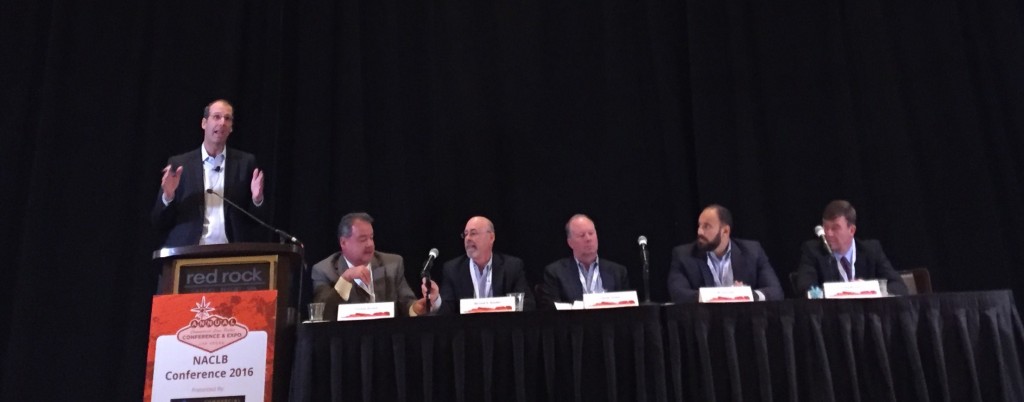 On a panel at the NACLB Conference in Las Vegas, Tom Zernick, the President of SBA Lending at First Home Bank explained that signing up a broker isn’t so simple. They have to conduct due diligence on them in advance, he said, because ultimately all their broker partners have to be reported to the SBA. Brokers can receive a 1% commission for completing a deal and also charge a separate fee to the merchant on their own but the merchant has to be aware of all of it and all the amounts reported to the SBA, he said.
And even that might not be enough on its own, according to the panel that Zernick was part of. Brokers should be keeping a log of the services performed to earn those fees and the hours spent on each task, like an attorney would.
Contrast that with alternative lending where brokers and fees are not reported to any agency.
One good thing about SBA lending these days though, according to Zernick, is that when he started in the business about 30 years ago, he joked it could take about a year to fund a loan but that today in reality it takes less than 30 days on average to fund.
Business Loan Brokers and MCA ISOs Call it Quits
May 17, 2016
Hard times reported just a month ago are already turning into farewells
Hard times for those facilitating small business financing solutions are starting to cause a visible exodus from the space. In their wake, industry vendors have told AltFinanceDaily of unexpected credit card charge disputes for leads long past purchased or for ISO software previously paid for.
One failed ISO who lasted just 14 months aired it all out on an industry forum. “I do have to say the entire journey was not fun or lucrative. I lost $250,000 of my own money [and] could not broker a deal to save my life,” he wrote. From what he could also tell during his experience, is that nobody else around him was really making any money either.
He’s not alone in feeling this way. Another user just two months earlier started a thread with this title, “Does anyone really make money in merchant cash advance?” In it, he wrote, “The merchant cash advance industry sucks. I’ve been in this business for now 1 year after 20 years of sales experience and what I find is that this industry is the craziest thing I have ever seen.”
Some sales reps or ISO owners are simply venting frustrations and continuing on but others are writing real goodbye letters. A few days ago for example, one long-time MCA industry consultant wrote on LinkedIn that he was “done with merchant cash advance” and that he had finally moved on to something that made him happy, which from the looks of it, is a career in playing Poker full time.
Gil Zapata of Lendinero wrote to AltFinanceDaily in an email about what’s happening out there. “Lead generation is expensive,” he said. “Most people think that obtaining a new client is just cold calling. Wrong. There is a cultivation process.”
And part of it may be a misunderstanding of what the sales process is like, he insinuates. “Many people who have tried entering this industry think it’s the mortgage business,” he said. “It’s not.”
On forums, users often attribute some of the issues to “low grade professionals,” salespeople who would clearly benefit from more training. They’re part of the reason why an official training course is in the works and should be available some time this year.
“Good agents are not easy to find. Recruiting, hiring, and training is costly,” said Zapata.
And even then with the right salespeople, he added that “a lot of the internet leads are dead deals or not the best leads. Forming partnerships is not easy if you are looking to generate massive deal flow.”
Bright Spot
Unlike some who are throwing in the towel, Zapata is not going anywhere. Neither is another sales rep who contacted AltFinanceDaily off the record. Just 16 months in to the business, he’s reportedly funding more than $500,000/month just from cold calls and claims that he is not stacking any deals. He admittedly says that he eats at his desk and never leaves. Being an equity trader in a prior life is what helped him succeed at this, he said.
“Some ex-stock brokers who can pound the phones can do very good,” Zapata said. “We only lose deals to hot shot brokers in N.Y. who were aggressive stock brokers or sold some sort of financial product out of Wall Street.”
 Indeed, just last week AltFinanceDaily learned that a sales rep from NYC that we had previously spoke with had just bought a red Lamborghini to celebrate his long and hard fought success. He’s not even 30-years-old yet and business is obviously going well.
More than a year ago, I wrote that it had become much too late to get into this business if all you had was a couple thousand bucks in startup funds. At Transact 16, one attendee told me they believed that the absolute minimum needed to stand a chance in setting up your own ISO shop at this point was $250,000, purely because marketing costs have skyrocketed.
Might it really take the cost of a new Lamborghini to start an ISO these days? If true, that would ironically mean that as a generation of disenchanted brokers make their way for the exits, they may be passed by an entirely new generation of brokers riding exotic Italian cars on their way in.
Even so, they should heed caution from those that have spent years in the trenches. “This industry is not as easy as it seems,” Zapata wrote. “Cost can eat you up alive.”
The Direct “Lender” Test – For ISOs/Brokers
May 16, 2016
ISOs/Brokers: Unsure if the company you’re speaking with is a direct lender? There’s a few ways to immediately spot a faker. Fakers are often confused between loan products and sales of future receivables, an issue that will likely open them up to all kinds of legal liabilities. For this reason alone, you don’t want to end up working with the wrong company. In some states brokering a deal to an unlicensed lender could have severe consequences.
First, if anyone tells you they are a direct lender, a popular phrase these days, ask them how it is they lend. Do they comply with lending laws on a state-by-state basis or do they have a bank charter relationship? If a bank charter, ask them what bank. Verify it. If they have a lending license in a single state or multiple states, verify it. You can look up licensed California lenders here for example.
If they don’t know what you are talking about when you ask about chartered banks or state licensing, you should end the conversation.
If they’re supposedly only in the business of purchasing future revenues or receivables but call themselves a direct “lender,” you should run away as fast as you can. If a company buying future receivables believes they are indeed a lender, they and anyone working with them could face all sorts of penalties, up to and possibly including criminal charges. No amount of commission is worth this.
If a company is only in the business of buying future receivables (what some would call a true or traditional merchant cash advance), a more proper title would be a direct “funder.”
Keep in mind that a lender reliant on a bank charter relationship technically would not qualify as being a “direct lender” either since the bank itself would be the lender.
The differences between loans and sales will be taught in the industry’s upcoming online certification course. I highly recommend that newcomers sign up for it.
Business Loan Brokers Encounter Hard Times
April 6, 2016 Feeling a little bearish about the business lending industry lately? If you’re a business loan broker, you’re not alone.
Marketing costs are going up while the response rates of marketing are generally going down. It’s a trend that’s lightly covered in the March/April issue of our magazine that has just been dropped in the mail. But there’s more to it. Several recent new broker shops have failed or are failing within just their first few months of operation. Employers have become more litigious with former employees, alleging violations of non-competes and/or non-solicit agreements, and at least one sales agent apparently went too far and was arrested in early February for backdooring deals.
The number of emails AltFinanceDaily has received about stolen commissions, rogue employees and general grievances has shot up in recent months, and on one industry forum, sales agents are now publicly voicing their frustrations. One thread that was aptly titled, Merchant cash advance crushed me, was posted by a discouraged broker. “I’ve been in this business for a year and I can say this is the hardest thing I’ve ever done from a business perspective,” he said. One user responded by saying, “fail rate is very high. Competition is crazy. If you can’t spend money on marketing, including a sizable outbound sales force, you are a dead duck.”
“The market has changed,” said Fundzio CEO Eddie Siegel to AltFinanceDaily in the previous issue. “The cost of capital has gotten a lot lower for the customer, and since there are more brokers in the marketplace they are willing to take a lesser amount just to get the deal to the finish line.”
“A lot of brokers are carpet bombing, they’re on the phone all day,” said Blindbid President Michael O’Hare. “I talked to one guy who said he makes 400 or 500 calls a day on a manual dial.”
In an environment of more calls, lower response rates and lower commissions, it’s no surprise that outrage over backdoored deals has overshadowed stacking as the industry’s most pressing issue.
 Even funders have stepped up their legal pursuit of other funders through allegations of tortious interference. Whether such cases have merit is for the courts to decide, but they are a sign of the times that money is no longer raining from the sky. Lines are being drawn. In a market where everyone was once a winner, now there must be losers.
Even the political atmosphere is changing. In just the last few months, the Small Business Finance Association has hired an executive director and two additional new advocacy groups were formed, the Commercial Finance Coalition and the Coalition for Responsible Business Finance.
“A few years ago, individual brokers could be making $20,000 or even $40,000 a month. Now those numbers are much more difficult to reach unless brokers have a unique lead generation method or their own money to participate in the deals,” said Zachary Ramirez, a vice president at World Business Lenders.
Of course, it’s not bad for everyone. In February, AltFinanceDaily featured a sales closer whose team collectively originated $47 million in deals last year. He’s not alone. Veteran players, particularly those that have been in the industry for nearly a decade acknowledge that they have first mover advantage over the newer entrants because their portfolios are so big or they have weathered the bumps and don’t get as frustrated by them.
Funders that know the pains brokers are going through are attempting to address it in their marketing, with some assuring their prospective partners that they have no inside sales force, and thus no way to steal a deal. For those with inside sales forces, they are relying on their well established reputations to do the talking.
Anonymous deal soliciting has been mostly outlawed on industry forums to curtail bad experiences, but they still happen on other mediums. One broker complained on LinkedIn this week that a lead generator based in the Philippines had allegedly pocketed his $2,500 upfront fee and then changed their phone number and disappeared. That lead generator is still advertising his wares through social media.
If that’s not a sign of the times, then I don’t know what is.
Loan Brokers: Here’s How to Submit a Deal to a Licensed California Lender
February 24, 2016 Brokers that wish to submit deals to a licensed California lender must also be licensed in the state. This does not apply when the lender is lending via a chartered bank relationship or if the transaction itself is a purchase of future receivables (AKA a traditional merchant cash advance). QuarterSpot for example, recently became a licensed lender (#603-K646) and will be operational to lend in the state starting on March 7th, according to the company.
While the process wasn’t easy, they want to make sure that brokers are abiding by the rules as well. To this end, QuarterSpot EVP Mike Green posted a link on the AltFinanceDaily forum to the licensing form that brokers must complete to apply:
We will require our partners to submit their CFLL License as required by the State. Please send those in ASAP to partners@quarterspot.com
1. Licensing form outlining requirements for licensure – http://www.dbo.ca.gov/forms/Finance_Lenders/DBO_CFLL_1422.pdf
2. Article further explaining legislation – http://www.paulhastings.com/publications-items/details/?id=e867e669-2334-6428-811c-ff00004cbded
In addition to the 31 page application is the payment of a $25,000 Surety Bond. Suffice to say, the process and costs are probably not a good fit for a 2-man upstart loan brokerage with a razor thin budget working out of month-to-month office space. But for a moderately sized operation or bigger, being a licensed broker can potentially be a competitive advantage.
The reason that brokers don’t need to be licensed to send deals to lenders like OnDeck, is because OnDeck operates through a chartered bank relationship and is therefore exempt from licensing requirements. As always, ask an attorney for an opinion if you’re not sure or need help. A broker may be just as culpable for submitting a deal to an unlicensed lender as the lender would be for operating unlicensed.
You can check to see if a lender is licensed at http://www.dbo.ca.gov/fsd/licensees/ but keep in mind that the database is rarely updated (the last time was 2 months ago).
Other helpful information
Can California Lenders Pay Referral Fees to Unlicensed Brokers?
Getting a California Lender’s License
Loan Brokers or Self Origination? Here’s What Experts Say
February 22, 2016 Last year belonged to the brokers in alternative finance — with a phone and a few leads pulled up online, anyone could sell a loan. With seemingly no barriers to entry, alternative lending attracted auto and insurance salesmen fleeing their jobs to cash in on the gold rush in an economy which was coming out of the shadows of distrust for big banks. And it found quick ascension to grow into a trillion dollar market.
But a year on, as the dust has settled, we asked industry veterans what it means to remain successful in this business and what is the key to sustainability — is it in going for the ISO/broker channel to find deals or originating your own.
Here’s what they had to say
Don’t Break the Broker
Tom Abramov of MFS Global voted for the ISO/broker channel and said that that’s how the company strictly does deals, working with brokers who have a track record as a part of their recruitment system. The six year old company that started as an broker shop now focuses only on funding with products that are a mix of merchant cash advances and lines of credit.
“We don’t look at FICO scores or SIC codes, we only look at cash flows of businesses,” said Abramov. “I want to see if I give a someone a dollar whether they can turn it into two.”
Abramov added that his firm offers brokers 20 percent commission and their default rates are sub 5 percent.
The advantages of scoring deals through a broker channel can be alluring. It involves no overhead, no staff that needs compensation, motivation and incentives, and makes use of the existing broker-merchant relationships.
Jordan Feinstein of NuLook Capital said that his firm works with brokers exclusively and the model has helped them respond to merchants faster. “We do not have a sales team speaking to merchants directly, that’s in conflict with our model,” said Feinstein. “We decided that the best way to grow is to build relationships to avoid the overhead, compliance, training and manpower that a sales team would require,” he said.
Building a Hybrid Model
There are some others who want to make the best of both the models and work with brokers while originating and funding their own deals. Forward Financing which uses a hybrid model has strategic partnerships with some brokers while still originating their own deals. “We have a hybrid model because our goal is to have a program for any type of business and work with companies across the spectrum of risk,” said Justin Bakes, CEO of Forward Financing. “While our priority is to self originate, it is essential to create and maintain partnerships in this business,” he said.
The Original Origination
While the allure of a lean business is certainly attractive, there are some who are in the industry to build a bigger business and create value by making it robust — Jared Weitz of United Capital Source is one of them. “There is a big market for both analytical process as well as sales process. It’s important to go after your strength,” said Jared Weitz, founder and CEO of United Capital Source. “When you originate and fund your own deals, you’re in a rewarding position and in control of how merchants get treated.”
Industry Trends
Speaking of the industry in general, these experts agreed that the business was undergoing a change with new entrants coming in and experimenting with better services and technologies.
“Last year was the year of brokers but we are still missing the education with merchants. Some brokers are interested while some are not,” said Abramov.
“I notice a clear difference between the old and the new in terms of technology and pricing model,” said Bakes.
“New funders are coming in with different products and terms with increased competition in the ISO market,” said Feinstein.
“Marketing is getting more expensive and only the ones who can afford to pay can play,” said Weitz.