
Newtek Funds $91 Million in 7(a) loans in Q1
May 3, 2018 Newtek (Nasdaq:NEWT), a provider of business and financial solutions, funded $91.4 million of SBA 7(a) loans in the three months ending March 31, 2018, according to the company’s Q1 2018 earnings report released yesterday. This is an increase of 16.2 percent year-over-year from $78.6 million funded in SBA 7(a) loans in the three months ending March 31, 2017.
On this morning’s phone call, CEO Barry Sloane was particularly pleased to announce Newtek’s loan referral growth of 86.9 percent from Q1 2017 ($2.6 million) to $4.8 million in Q1 2018.
“It gives us the ability to make selection on opportunities that come to us directly from business owners,” Sloane said, “without the use of brokers, and pick the best credits available.”
Newtek also closed on $3.9 million in SBA 504 loans for the three months ending on March 31, 2018. SBA 504 loans provide approved small businesses with long-term, fixed-rate financing used to acquire fixed assets for expansion or modernization.
The New York-based company was founded in 1998, went public in 2000, and has been a BDC (Business Development Company) for three and a half years. BDCs are publicly traded companies that make investments in private companies in the form of loans or equity securities. And the structure provides certain tax advantages, according to Solar Capital.
Newtek acquired United Capital Source in October 2017, which is still led by its original CEO Jared Weitz, who was featured in AltFinanceDaily’s September/October 2015 issue.
Newtek had a net investment loss of $2.8 million for Q1 2018.
Aside from the company’s headquarters in Lake Success, NY, Newtek also has loan processing offices in Orlando, FL and Boca Raton, FL.
Tips For More Successful Marketing
April 30, 2018 In marketing, there’s a basic tenet that it takes seven “touches” within 18 months to prod someone into action.
Nowadays, with customers exposed to thousands of ads a day and across so many channels, it takes several times that in interactions to generate viable sales leads, according to Samantha Berg, a marketing and strategic partnerships executive with 6th Avenue Capital in New York.
That’s why it’s so important for funders, ISOs, brokers and other alternative funding professionals to have a solid marketing and lead-generation strategy that incorporates multiple channels such as search engine optimization, digital ads, direct mail, email and social media. The challenge, of course, is to find the right balance between being invasive and being top of mind, industry professionals say. Here are a few ways tried and true ways to generate warm leads and potential new business:
DON’T DIS DIRECT MAIL
Many marketers have a negative view about the importance of direct mail to consumers. But consumers may be more interested in this medium than you think. Consider a survey of more than a thousand consumers by Yes Lifecycle Marketing, a provider of email and digital marketing services. According to this study, 56 percent of all consumers say they find direct mail influential when researching a purchase. By contrast, a separate survey by Yes Lifecycle Marketing paints a very different picture of how marketers view direct mail; 78 percent of those polled say they believe direct mail is not influential for any age group.
 One good thing about direct mail is that it can be opened at the merchant’s convenience, unlike a phone call which some merchants find annoying, especially since they often get multiple calls a day from numerous funders. With direct mail, even if a business does not need funding immediately, there’s a decent chance the merchant will keep your information on file for future reference, says Glen Faulhaber, vice president of sales at G-Plex Direct Mail Services in Holtsville, N.Y. Sending a follow-up mailing within a week of the first helps you gain additional brand recognition, he says.
Of course, for direct mail to be successful, certain parameters should be followed. For starters, mailings have to be based off good data; meaning the people or businesses you are sending to have a high likelihood of needing funds. Without worthwhile data, you’re basically throwing money out the window, Faulhaber says.
Timing is also important, he says. With direct mail, Faulhaber says you have about five seconds to get someone’s attention, so your message has to be catchy.
MAKE YOUR WEBSITE SHINE
Trey Markel, a software specialist at CentrexSoftware, a customer relationship management software company in Costa Mesa, Calif., says it’s shocking how many funders don’t use their websites to generate leads. Markel, who consults with B2B lenders and MCA providers on marketing strategies using enterprise software, recommends funders spend time working on their website so that it appeals to all types of visitors: those who want to read relevant articles, those who want to watch webcasts and those who want to listen to podcasts.
The idea is for funders to use their website to provide helpful information to merchants that will, in turn, encourage them to seek funding from you. For instance, you might consider hosting monthly webinars on topics such as how businesses can use loaned money to increase their marketing budget. Another topic merchants may find appealing is how to use credit cards to increase customers. “You give them a solution to a problem, and then you give them the money to go afford that solution,” Markel says.
Many funders know how to close a deal, but they fail to understand that the consultative approach over time will gain them even more business, Markel says. “Becoming a trusted information source in the industry is so much more valuable to customers than just being a funder,” he says. The industry needs “professionals who are going to tell you how to solve a problem.”
GET PERSONAL
Jennie Villano, vice president of business development at Kalamata Advisors LLC, says ISOs looking to build their business should attend networking events where small businesses are present. Sounds simple, but many ISOs don’t take advantage of this, meaning a missed opportunity to connect with “people from every facet” including accountants and other business professionals who can be a good source of referrals.
She also recommends ISOs hire at least one professional who is warm, trusting and engaging to visit merchants at their place of business. She recommends they pick places such as local strip malls which have a sizeable number of merchants. If you saw 20 merchants a day and only two funded with you that amounts to 40 extra deals a month, she points out. “Many ISOs would benefit from an extra 40 deals a month,” she says. On top of that, you have additional touchpoints because each of the merchants you visit may tell other businesses about your services, she says.
USE SOCIAL MEDIA
ISOs should also use social media more often than they do now—and not just to find sales help, Villano recommends. She uses it to target ISOs, but in the course of that, she gets inquiries from small businesses. ISOs should be using social media to find small businesses in need of funds. “I just don’t know why they aren’t using it more. It has tremendous reach,” she says.
To be sure, you don’t have to bombard your connections with posts. Once every other week is a good target. Make sure to include your business name and phone number, but posts shouldn’t be a hard sell. “There are ways to stand out and get your message across without appearing pushy or too sales oriented. The two-minute video ‘Cooking with Kalamata Capital’ that went viral in the industry is an example,” she says.
Also remember there are many social media venues. Sometimes funders focus their efforts on LinkedIn, Facebook and, to a lesser extent, Twitter. But Instagram and Pinterest can also be used to target potential customers. Posting aspirational videos or photos in these venues can help encourage businesses to think about ways to fund the things they might need, says Berg of 6th Avenue Capital.
USE EMAIL MARKETING TO YOUR ADVANTAGE
Some funding professionals say text messaging works well for them, though others prefer email for a host of reasons.
For one thing, it’s a “little less intrusive” than a telephone call or a text, Berg says. Also, with email, there’s ample ability to personalize, and you can run analytics to determine helpful metrics such as open rates and click-through rates, for example. You can compare how these metrics change when you tinker slightly with email subject lines or messages.
“We see email as a very viable channel,” she says.
Another advantage of email is that it helps funders and brokers get around the restrictions imposed by the Telephone Consumer Protection Act (TCPA) that has hampered lead generators’ ability to solicit business owners, says Michael O’Hare, president of Blindbid, a B2B lead generation site.
With email, you can direct the prospect to click on a link, which then triggers a phone call from a sales rep. In an environment when cold-calling can result in a lawsuit, email is a viable alternative, says O’Hare, an outspoken opponent of TCPA restrictions for business-related matters.
A growing number of funders are also using or exploring the use of artificial intelligence to help with lead generation, says Matthew Martin, managing director of Silver Bullet Marketing, a provider of trigger lead data.
One company that’s working in this area is AI Assist. Using Conversica, an AI-powered virtual sales assistant, funders can send automated emails to prospects. The automated sales assistant determines whether the prospect is interested, and if so, it alerts a human sales representative. The automated sales assistant can also gather additional information from a lead, such as the best phone number and best time to call. The entire “dialogue” is available for the human sales rep to review.
“AI is not going to make the sale for you, but it’s going to give you enough information to move forward,” Martin says.
 REFINE YOUR LEADS
To generate leads, funders, ISOs and brokers tend to buy banner ads on Google or send an email blast with a link for interested businesses to click on. The link usually directs businesses to an online form that typically asks for their name, telephone number, email and how much money is being requested.
But it doesn’t generate meaningful information about the business or what type of funding product the business is looking for, says O’Hare of Blindbid. These forms don’t typically include critical information such as whether the person has been in business for less than a year, whether he or she has mounds of debt or what kind of funding the business is seeking.
One way to get better, more tailored leads is with “lead quizzes” similar to those used by the online insurance industry, he says. Instead of a basic form, potential leads would be directed to fill out a form that has much more pointed questions about the person, the business and the type of funding sought, he explains. Some questions might be, for instance: Is your credit score over 500? Have you been in business for more than a year? And, what type of funding are you seeking? Based on the merchant’s responses, he or she could be directed to a certain funding product or a specific funder, if you’re an ISO working with multiple providers. The funder could also decide to pass on an opportunity based on a merchant’s answers to the lead quiz.
O’Hare says he doesn’t know of MCA providers currently using this type of form, but it’s one of the things he’s working on as a way to generate better leads for his clients. With the basic forms many funders use today, you get a “lot of garbage,” O’Hare says.
Certainly, there are many ways to market and get leads, but industry professionals say one thing is clear: you can’t rely on one avenue alone. According to Markel of CentrexSoftware, too many in the industry put too much faith in raw data that gets plugged into a phone system dialer. The quality of this data isn’t always the best, which means funding professionals are wasting a lot of time, he says. “There are only so many small businesses in the country and an even smaller amount that are fundable,” he says.
6th Avenue Capital Announces Promotion of Darren Schulman to President
April 26, 2018Former Chief Operating Officer also appointed to company’s Board of Directors along with Chief Executive Officer Christine Chang
 New York City – April 26, 2018 – 6th Avenue Capital, LLC (“6th Avenue Capital”), a leading provider of choice for alternative small business funding, announced today the promotion of Darren Schulman to President, effective immediately. In his new position, Schulman has oversight over originations, underwriting, operations, collections and strategic initiatives. He previously served as Chief Operating Officer, and will continue to report directly to Chief Executive Officer Christine Chang.
The company also announced today that Chang and Schulman have been appointed to the company’s Board of Directors.
“We are extremely fortunate to have a well-respected industry expert and innovator like Darren on our leadership team,” said Chang. “He’s made immeasurable contributions to our strategic direction and growth since joining us last year. I am confident Darren will continue to play a critical role in guiding our business forward in his new position as President.”
Schulman brings two decades of experience in small business financing and additional experience in banking to his new position. He joined 6th Avenue Capital in March 2017. Previously, Schulman served as COO at Capify (formerly AmeriMerchant), a global small business financing company, and President and CFO at MRS Associates, a Business Process Outsourcing (BPO) company specializing in collections. In addition, Schulman was an Executive Vice President at MTB Bank.
“6th Avenue Capital is made up of exceptional individuals who are focused daily on advancing the capital needs of small businesses. I am honored by the promotion and delighted to be joining the Board with Christine,” said Schulman. “Together we will continue to set a strategic course for our company and build on the momentum we’ve established over the past year helping small businesses across the country grow.”
For more information on these updates, or if you’re interested in discussing partnership opportunities with 6th Avenue Capital as an ISO, please contact Marc Seidel at bizsuccess@6thAveCap.com. You can also use that same email address to schedule time to meet with members of the team at the National Association of Equipment Leasing Brokers (NAELB) conference in Las Vegas from April 26 to 28.
About 6th Avenue Capital, LLC
6th Avenue Capital is changing the small business funding landscape by offering a data-driven underwriting process and fast access to capital with variable payment options. 6th Avenue Capital employs a unique blend of industry experts who are committed to the highest operating standards, including high touch service and a policy of direct merchant access to underwriters. For more information, visit www.6thavenuecapital.com or email bizsuccess@6thAveCap.com.
Media Contact
Bill McCue
Indicate Media
bill@indicatemedia.com
718.208.7391
Gale Force Twins
April 24, 2018
As Hurricane Irma swept through the Caribbean and barreled toward the Florida Keys early last September, Wendy Vila, chief executive, at Unicus Capital evacuated her home in West Palm Beach and decamped to Panama City in the Florida panhandle where “it was just a little bit rainy.”
After safely waiting out Irma, she says, her return south was precarious. The roads were strewn with tree branches and other debris. Fuel was scarce. Many gas stations were either closed or posted signs reading “No Gas.” “Restaurants had run out of food,” Vila adds, “so there was nothing to eat” along the highway.
She returned to West Palm Beach but didn’t stay long. Instead, Vila again drove west, this time across the Florida peninsula to the South Florida city of Naples, not far from where Irma had made landfall. “I went there to volunteer with Samaritan’s Purse for two days,” she says, referring to the Boone, N.C.-based Christian organization that provides humanitarian aid to people in physical need. “Things were a lot worse there than in West Palm Beach,” she reports. “A lot of trees were down, houses were flooded and people had to throw all of their belongings out onto the street.”
Meanwhile, many of the Florida merchants whom Unicus funds were distressed. “If people had no power,” Vila says, “they couldn’t function. A lot of businesses had to close down. For some merchants in the affected areas,” she adds, Unicus extended “a 90-day grace period.”

Vila’s experience with Hurricane Irma – both professionally and personally — is not an isolated one. She is among several business lenders whom AltFinanceDaily interviewed about the storm and its aftermath. This article grew out of AltFinanceDaily’s Florida networking event at the Gale Hotel in South Beach in late January. We went back to many of the attendees as well as to other business-funders in The Sunshine State and sought out their experiences before, during and after the powerful tempest.
At one point, Hurricane Irma was the strongest hurricane ever recorded in the Atlantic by the National Hurricane Center. As Irma took dead aim at Florida, it packed sustained winds exceeding 157 miles per hour, earning it the designation of a Category 5 storm, the highest and most destructive. It slammed into the Florida Keys as a Category 4 hurricane, reached the Gulf of Mexico, and then came ashore a second time on Florida’s west coast at Marco Island, just south of Naples, and began traversing the state as a Category 3 hurricane, gradually losing strength. By the time Irma exited Florida, it had been downgraded to a tropical storm. According to the National Hurricane Center, Irma caused an estimated $50 billion in damage in the U.S., making it the fifth-costliest hurricane to hit the mainland.
Financiers and brokers told personal stories of working with and assisting merchants across Florida who sought to regain their lost footing and keep from going — literally — underwater. In many cases, members of the alternative business financing community said, they were simultaneously assisting troubled merchants while they themselves struggled with Irma-occasioned troubles that ranged from inconvenience to hardship.
“I was ten days without power,” says Manny Columbie, funding manager at Axiom Financial, based in South Miami. Columbie, who lives in the residential Westchester district of Miami, not far from the campus of Florida International University, says that he conducts much of his business from his home. That power loss not only constrained his ability to keep working but posed a life-or-death situation for his family: Columbie’s 90-year-old grandmother, who lives with him and his girlfriend, depends on electrical power to operate her oxygen pump.
 Fortunately, he says, he had a backup generator, the use of which alternated between providing power for his grandmother’s oxygen and the family’s refrigerator. Meanwhile, his roof was leaking and there was six inches of rainwater swamping the house — the water gushing into the kitchen through the laundry room, dishwasher and even the oven.
While Columbie saw instances of tempers growing short in Miami’s September heat, he was nonetheless cheered by the way his community responded. “Neighbors were coming by to see if I needed gasoline for my generator,” Columbie says. “People were firing up food on their outside grills. There was no air-conditioning or cold showers but we cooled off by jumping in a neighbor’s pool. I saw a lot of people coming together.”
At the same time, he was doing what he could to assist merchants who did business with Axiom. Only one – a retail clothing store in Miami – was permanently shuttered. One of his clients, Oscar Pratt, owner of Odessy Party Supplies in Miami Gardens, was grateful for a moratorium on daily payments.
“We’re in the business of selling party accessories for events from births to funerals and everything in-between,” Pratt says. “Baby showers, christenings, birthdays, quinceaneras, ‘Sweet Sixteens,’ graduations, weddings, and all kinds of themed parties like Halloween,” he says. “We sell plates and cups, candy bags, cake-toppers, small favors, pinatas…”
Pratt said he’d called his funders ahead of the storm and “requested some leeway” from payments. Once the storm hit – and for two weeks afterward while there was no electricity – the party-supply business was pretty much on hold. “We had a few days without electricity or phone,” he says. “We couldn’t open the doors and do business because we use computer-generated receipts. Our customer base was down to just about nothing. Without electricity, people weren’t working and they weren’t having parties.”
Following the two-week grace period, Pratt says that his funders, which included QuarterSpot, granted a second two-week period of leniency in which Odessy was allowed to make reduced payments. “It was very difficult,” he says. “There was no help from FEMA (Federal Emergency Management Agency) or from our insurance company since we’re on high ground and there were no physical damages, just the electricity.”
He reckoned that Odessy, which boasts annual revenues of $1.2 million, was deprived of roughly $50,000-$60,000 in sales because of Irma. Pratt reports that if his lenders had “played hardball” and demanded that he make his payments, he could have stayed in business thanks to “cash on hand” but it wouldn’t have been easy.
Meantime, his lenders’ forbearance was soon rewarded. By October, business was back to normal and he resumed making payments in full. “As soon as the lights went on,” Pratt says, “the parties started again.”
Similarly, says Paul Boxer, chief marketing officer at Quicksilver Capital in Brooklyn, the ultimate impact of Hurricane Irma on his firm’s funding business was to build trust and cement relationships with clients in South Florida. “We had a full team on board to answer the large number of calls coming in and to assist our merchants with any questions they had,” he says.
 Many affected merchants, Boxer reports, were forced to evacuate ahead of the storm. When they returned, it was common for them to discover that their shops and stores sustained flooding damage from the heavy rains and a storm surge. Roofs were blown-off and structures were battered by 100-plus mile-an-hour winds, falling trees, and whipped-up debris. Even businesses that suffered little damage were paralyzed by the loss of electricity, impassable roads, and the absence of customers.
“Some were down for a few days,” Boxer reports. “Some were down a month to two months. We kept in touch. We were really on top of things with our merchants and asking them what they needed. We even fielded general safety questions and directed them on whom to call with insurance questions and other related business questions. It was good business,” he adds, “because it showed you cared. We were looking to do the right thing by our merchants and they appreciated it.”
Quicksilver typically offered merchants a two-to-three week “reprieve” on payments, Boxer says. For those businesses and entreprenuers whose operations were “completely out of commission” and needed more time, he says, the company suspended payments for as long as two months.
In the end, Quicksilver’s policy of forbearance reaped dividends. It not only built up good will with its customer base but also with the Independent Sales Organizations (ISOs) who’d brokered many of the firm’s Florida deals. “We helped grow that relationship,” Boxer says of the merchant-ISO connection. “They (ISOs) love getting renewals. It’s been a win-win for everybody.”
Doug Rovello, senior managing partner at Fund Simple, Inc., an alternative business lender and broker in Palm Harbor, a beach town just outside Tampa, says the Tampa-St. Petersburg area was spared from severe flooding but “we did experience power outages.” Among his clients, he reports, businesses in the food industry were among the most vulnerable. “I had one restaurant that lost $200,000 in business in the month of September,” he says.
 When the electricity went down, grocery stores and bodegas, restaurants, bars, pizzerias, sub shops, delis and luncheonettes suffered outsized losses. Without power, businesses in the food industry were forced to dump spoiled meat, rotting fish, unusable dishes like appetizers and other foodstuffs requiring refrigeration.
Rovello reports that the hurricane managed to bollix up the business of one top client, a leading ticket broker in the area with a reputation for obtaining “exclusive” tickets to major events such as A-list rock concerts and featured sporting contests – including the Super Bowl. “He buys tickets in advance and when one big event was canceled he got stuck with $30,000 in tickets that he had to eat,” Rovello says.
Other kinds of businesses that depend on alternative lenders and got hit hard from the loss of power, Rovello observes, were medical clinics, doctors’ offices, pain-management centers, and assisted-living quarters – particularly those south of Sarasota. A number of golf courses also closed down for a couple of weeks, Rovello notes, further impairing the tourism and entertainment economy. “They were not allowed to move any of the damage that was done – poles, trees, et cetera until FEMA got there,” he says.
For some 30 days following Irma’s arrival, Rovello reports that he asked clients to make modest payments – perhaps $100 instead of a $750 monthly payment — “to keep their accounts active.” He also used his connections with FEMA adjusters and interceded with funders on behalf of clients– and even businesses that were not clients – who found themselves in arrears.

While many Floridians were seeking higher ground or hightailing it out of state, Jay Bhatt, who is a senior vice president of marketing at Breakout Capital in McLean, Va., was catching one of the last Jet Blue flights into Orlando to help out his aging parents. They are now in their late 60s and 70s, he reports, and living in a retirement community in Polk County, about ten miles south of Disney World.
Irma was still a Category 1 hurricane with 100 mph winds when it hit Orlando. The electrical grid went down, but Bhatt was able to purchase a generator – the kind designed specifically to provide electricity for oxygen respirators — from Home Depot. During his stay, Bhatt made several car trips in search of fuel, each of which took him probably 35-40 minutes. “We also leveraged some of the neighbors’ sockets,” he says, “but they were so small that the wattage only allowed for the operation of the fridge and a fan.”
Electricity was restored after four or five days. “The fact that it was a retirement community might have been why we got power back so soon while it took two or three weeks for many others,” he reckons.
 While Bhatt’s attention was focused on his parents, his employer – which had just offered a blanket hold on payments to its merchant accounts in 11 Texas counties that had been simultaneously inundated and walloped by Hurricane Harvey – now faced the challenge of responding to the second hurricane in two weeks. With Irma, Breakout chose to deal with its customers individually. “We didn’t do an immediate blanket response” as in Texas, Bhatt says, adding: “We were able to contact each one and we only wrote off one small business.”
Rakem Lampkin, senior customer service representative at Pearl Capital, a New York-based alternative funder, says that his firm funds “roughly 175” businesses in South Florida. In addition to those establishments already mentioned as economically reeling because of Irma, such as restaurants, he cited “car dealerships, automotive repair shops and tech companies” as among the hardest hit, especially from the lack of electricity.
Lampkin also noted that many of Pearl’s merchants felt Irma’s wrath when colleges and state schools closed their doors. “Everything from transportation, lunches, sports equipment, even mom-and-pop florists” were slammed, he says, adding: “When the schools shut down, our payments slowed down.”
Pearl provided preferential treatment to merchants on the coast who were granted “a hold on debit payments,” Lampkin says. Even for coastal businesses that remained “structurally sound,” the business owners’ and employees’ “homes were affected, which kept them from getting to work,” he says.
As for businesses situated inland, “We were still sympathetic,” Lampkin says, but after an initial five-day grace-period their discounts were in the range of 66%-75% “so that we could focus our resources toward the people on the coast.”
To monitor the situation from New York, Lampkin says, the company was able to rely on accounts in the local news media, Google Maps, and other Internet sources. “We evaluated the situation case-by-case and week-by-week,” he says.
Jennifer Legg, a co-owner of Rochelle’s Jewelry & Watch Repair at the Indian River Mall in Vero Beach, is a Pearl-funded merchant who says she shut down the family-run business “for six or seven days” after Irma while the electricity went out. “Trees were down and a lot of people lost food and trailers, but we were not impacted as much as we were supposed to be,” she remarked.
Most of the shop’s business consists of customers stopping in for a new battery or a watch-band. Once they’re in the store, there’s a chance that they’ll purchase something else. But Irma put the kibosh on mall traffic. “A lot of people left the state, so that hurt business,” Legg says.
The store – which records annual sales of about $200,000 — lost probably $10,000 in revenue because of Irma. “It was very hard for that month of September,” Legg says. “Even after the doors opened, it was dead. No money came in for about two weeks.”
Fortunately, though, her capital source “did not take money out for a week,” she says. “If they’d kept taking it out,” she added, “we would have defaulted.”
Boiler Rooms Are Not Brands, Kabbage CEO Says
April 21, 2018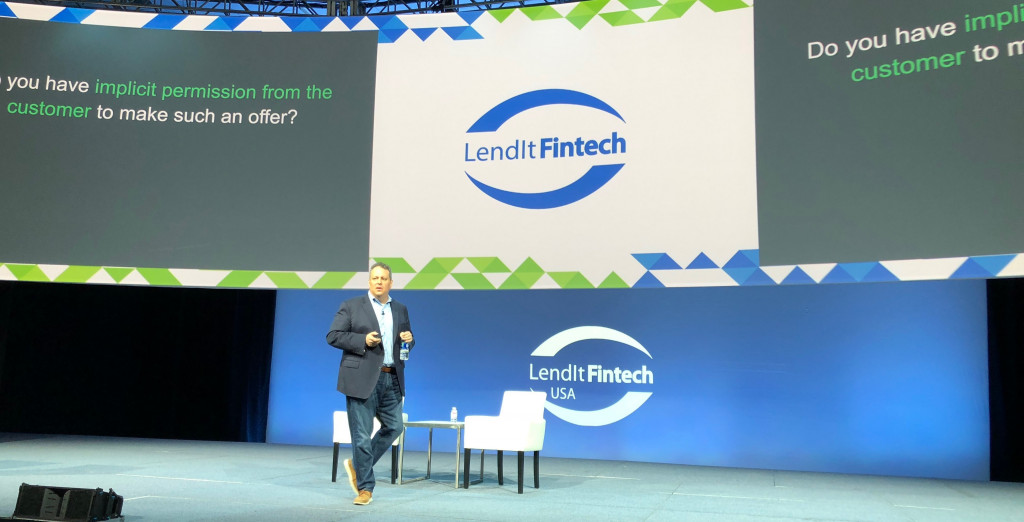
Kabbage CEO Rob Frohwein has a knack for speaking his mind at lending conferences and LendIt two weeks ago was no different. Below are some of the most notable quotes from his April 10th presentation.
On building a brand
Unfortunately, in the online lending space, most companies basically think that boiler rooms = brand. Boiler rooms don’t equal brand. They have these huge call shops and that’s what they’re focused on. That doesn’t create brand. It just doesn’t. You have to spend money in order to build a brand over time. You have to have a brand obviously from a user experience and a customer service experience that people love. That’s how you build a brand.
We’ve invested over $125 million into building our brand specifically. We don’t use brokers and brokers are those 3rd parties that go out and find loans for you, but they don’t represent your company in the process.
How 2018 differs from 2015
About 6 months ago, I was asked to speak on a panel and it wasn’t this conference. And so, I got on the phone with the conference organizer and he said to me “Hey, we’d like to do a panel on fintech and bank partnerships.” Total yawn. 2015 called. They want their panel topic back. I mean, after all, there are probably more panels on fintech and bank partnerships than there are actual conversations going on between fintechs and banks. 2018 is all about relationships.
If the only thing you’re doing is lending money online, it’s going to go the way of the dinosaur. It’s very important. It doesn’t mean that the companies are gonna blow up. It doesn’t mean that there’s going to be any challenges, you know, trying to grow that business, but they’re not going to be the kind of exciting companies that we saw just a few years ago.
The only way to build substantial enterprise value is to be in a position to expand your brand’s offerings.
On whether or not your relationship with the customer can naturally extend to other products
I’ve heard lots of people say I had 2 million customers so I can sell them an auto loan. Actually, you can’t. That’s not the way it works. That’s not the way you build the company. You can certainly try, but the question becomes do you have implicit permission from the customer to make this kind of an offer?
How close is the next product you’re launching from both the function and a brand perspective to your last product? Right? Is it close? Smith & Wesson came out with a lot of bicycles. I am not sure what amendment covers bicycles, but they did not do great with the Smith & Wesson bicycles as far as I know.
The challenge is that most online lending companies don’t really have much of an idea about what their customers want or need because they only have basic credit info at the time of qualification and they also are just getting repayment information. That does not equal understanding the customer.
On engaging with your customers
If you’re not interacting with them very often, then they’re not thinking about you very often.
Kabbage customers take 20 loans over 4 to 5 years, 4-5 loans a year every year. We have that many positive interactions. Our competitors average 2.2.
Finally, I really think of this as the potato chip dream. And I think about Amazon a lot when I talk about the potato chip dream. What that dream is the day that Kabbage is able to sell bags of potato chips to our customers and our customers are like “of course, I’m gonna buy potato chips from Kabbage, why would I buy them from anybody else?” That will mean that Kabbage is worth hundreds of billions and our customers are incredibly happy in the process because it necessarily means that we will provide them with every product and service between where we are today and potato chips tomorrow. And that’s really the key for what we’re trying to accomplish, is allow us to expand our offerings in a natural evolutionary way and take care of our customers. And I really do think that all of us here should think about that as well especially if you’re running an online lending company. Focus back on the customer. Build those relationships. Figure out how to take it to the next level.
Wayward Merchants
April 19, 2018
Wayward merchants and outright criminals are continuing to bilk the alternative small-business funding industry out of cash at a dizzying pace. In fact, an estimated 23 percent of the problematic clients that funders reported to an industry database in 2017 appeared to have committed fraud, up from approximately 17 percent in the previous year. That’s according to Scott Williams, managing member of Florida-based Financial Advantage Group LLC, who along with Cody Burgess founded the DataMerch database in 2015. Some 11,000 small businesses now appear in the database because they’ve allegedly failed to honor their commitments to funders, Williams says.
Whether fraudulent or not, defaults remain plentiful enough to keep attorneys busy in funders’ legal departments and at outside law firms funders hire. “I do a lot of collections work on behalf of my cash-advance clients, sending out letters to try to get people to pay,” says Paul Rianda, a California-based attorney. When letters and phone calls don’t succeed, it’s time to file a lawsuit, he says.
Lawsuits become necessary more often than not by the time a funder hires an outside attorney, according to Jamie Polon, a partner at the Great Neck, N.Y.- based law firm of Mavrides Moyal Packman Sadkin LLP and manager of its Creditors’ Rights Group. “Typically, my clients have tried everything to resolve the situation amicably before coming to me,” he observes.
That pursuit of debtors isn’t getting any easier. These days, it’s not just the debtor and the debtor’s attorney that funders and their attorneys must confront. Collections have become more difficult with the recent rise of so-called debt settlement companies that promise to help merchants avoid satisfying their obligations in full, notes Katherine Fisher, who’s a partner in the Maryland office of the law firm of Hudson Cook LLP.
 Meanwhile, a consensus among attorneys, consultants and the funders themselves holds that the nature of the fraudulent attacks is changing. On one side of the equation, crooks are hatching increasingly sophisticated schemes to defraud funders, notes Catherine Brennan, who’s also a partner in the Maryland office of Hudson Cook LLP. On the other side, underwriters and software developers are becoming more skilled at detecting and thwarting fraud, she maintains.
Digitalization is fueling those changes, says Jeremy Brown, chairman of Bethesda, Md.-based RapidAdvance. “As the business overall becomes more and more automated and moves more online – with less personal contact with merchants – you have to develop different tools to deal with fraud,” he says.
A few years ago, the industry was buzzing about fake bank statements available on craigslist, Brown recalls. Criminals who didn’t even own businesses used the phony statements to borrow against nonexistent bank accounts, and merchants used the fake documents to inflate their numbers.
Altered or invented bank statements remain one of the industry’s biggest challenges, but now they’ve gone digital. About 85 percent of the cases of fraud submitted to the DataMerch database involve falsified bank documents, nearly all of them manipulated digitally, Williams notes.
Merchants alter their statements to overstate their balances, increase the amount of their monthly deposits, erase overdrafts, or hide automatic payments they’re already making on loans or advances, Williams says. Most use software that helps them reformat and tamper with PDF files that begin as legitimate bank statements, he observes.
To combat false statements, alt funders are demanding online access to applicants’ actual bank accounts. Some funders ask for prospective clients’ usernames and passwords to examine bank records, but applicants often consider such requests an invasion of their privacy, sources agree.
That’s why RapidAdvance has joined the ranks of companies that use electronic tools like DecisionLogic, GIACT or Yodlee to verify a bank balance or the owner of the account and perform test ACH transfers – all without needing to persuade anyone to surrender personally identifiable information, Brown says.
Other third-party systems can use an IP address to view the computing device and computer network that a prospective customer is using to apply for credit, Brown says. RapidAdvance has received applications that those tools have traced to known criminal networks. The systems even know when crooks are masking the identity of the networks they’re using to attempt fraud, he observes.
RapidAdvance has also developed its own software to head off fraud. One program developed in-house cross references every customer who’s contacted the company, even those who haven’t taken out a loan or merchant cash advance. “People who want to defraud you will come back with a different business name on the same bank account,” Brown says. “It’s a quick way to see if this is somebody we don’t want to do business with.”
Sometimes businesses use differing federal tax ID numbers to pull off a hoax, according to Williams at DataMerch. That’s why his company’s database lists all of the ID numbers for a business.
All of those electronic safeguards have come into play only recently, Brown maintains. “We didn’t think about any of this five years ago – certainly not 10 years ago,” he says. In those days, funders were satisfied with just an application and a copy of a driver’s license, he remembers.
Since then, some sage advice has been proven true. When RapidAdvance was founded in 2005, the company had a mentor with experience at Capital One, Brown says. One piece of wisdom the company guru imparted was this: “Watch out when the criminals figure out your business model.” That’s when an industry becomes a target of organized fraud.
As that prediction of fraud has become reality, it hasn’t necessarily gotten any easier to pinpoint the percentage of deals proposed with bad intent. That’s because underwriters and electronic aids prevent most fraudulent potential deals from coming to fruition, Brown notes. The company looks at the loss rates for the deals that it funds, not the deals it turns down.
Brown guesses that as many as 10 percent of applications are tainted by fraudulent intention. “It’s meaningful enough that if you miss a couple of accounts with significant dollar amounts,” he says, “then it can have a pretty negative impact on your bottom line.”
Some perpetrators of fraud merely pretend to operate a small business, and funders can discover their scams if there’s time to make site visits, Rianda notes. Other clients begin as genuine entrepreneurs who then run into hard times and want to keep their doors open at all costs, sources agree.
 Applicants sometimes provide false landlord information, something that RapidAdvance checks out on larger loans, Brown notes. Underwriters who call to verify the tenant-landlord relationship have to rely upon common sense to ferret out anything “fishy,” he advises.
Underwriters should ask enough questions in those phone calls to determine whether the supposed landlord really knows the property and the tenant, which could include queries concerning rent per square foot, length of time in business and when the lease terminates, Brown suggests. All of that should match what the applicant has indicated previously.
Lack of a telephone landline may or may not provide a clue that an imposter is posing as a landlord, Brown continues. Be aware of a supposed landlord’s verbal stumbles, realize something’s possibly amiss if a dubious landlord lacks of an online presence, note whether too many calls to the alleged landlord go into voicemail and be suspicious if a phone exchange with a purported landlord simply “feels” residential instead of commercial, he cautions.
Reasonable explanations could exist for any of those concerns, but when in doubt about the validity of a tenant-landlord relationship it pays to request a copy of the lease or other type of verifications, according to Brown. Then there are the cases when the underwriter is talking to the actual landlord, but the applicant has convinced the landlord to lie. It could happen because the landlord might hope to recoup some back rent from a merchant who’s obviously on the verge of closing up shop.
Occasionally, formerly legitimate merchants turn rogue. They take out a loan, immediately withdraw the funds from the bank, stop repaying the loan, close the business and then walk or run away, notes Williams. “We view that as a fraudulent merchant because their mindset all along was qualifying for this loan and not paying it back,” he says.
Collecting on a delinquent account becomes problematic once a business closes its doors, Rianda notes. As long as the merchant remains in business, funders can still hope to collect reduced payments and thus eventually get back most or all of what’s owed, he maintains.
In another scam sometimes merchants whose bank accounts are set up to make automatic transfers to creditors simply change banks to halt the payments, Brown says. That move could either signal desperation or indicate the intent to defraud was there from the start, he says.
Merchants with cash advances that split card revenue could change transaction processors, install an additional card terminal that’s not programmed for the split or offer discounts for paying with cash, but those scams are becoming less prevalent as the industry shifts to ACH, Brown says. Industrywide, only 5 percent to 10 percent of payments are collected through card splits these days, but about 20 percent of RapidAdvance’s payments are made that way.
Merchants occasionally blame their refusal to pay on partners who have absconded with the funds or on spouses who weren’t authorized to apply for a loan or advance, Brown reports. Although that claim might be bogus, such cases do occur, notes Williams of DataMerch. People who own a minority share of a business sometimes manipulate K-1 records to present themselves as majority owners who are empowered to take out a loan, Williams says.
In a phenomenon called “stacking,” merchants take out multiple loans or advances and thus burden themselves with more obligations than they can meet. Whether or not that constitutes fraud remains debatable, Rianda observes. Stacking has increased with greater availability of capital and because some funders purposely pursue such deals, he contends.
Some contracts now contain covenants that bar stacking, notes Brennan of Hudson Cook. As companies come of age in the alt-funding business, they are beginning to employ staff members to detect and guard against practices like stacking, she says.
Moreover, underwriting is improving in general, according to Polon “The vetting is getting better because the industry is getting more mature,” he says. “The underwriting teams have gotten very good at looking at certain data points to see something is wrong with the application – they know when something doesn’t smell right.” They’re better at checking with references, investigating landlords, examining financials and requesting backup documentation, he contends.
Despite more-systematic approaches to foiling the criminal element and protecting against misfortunate merchants, one-of-a-kind attempts at fraud also still drive funders crazy, Brown says. His company found that a merchant once conspired with the broker who brought RapidAdvance the deal. The merchant and the broker set up a dummy business, transferred the funds to it and then withdrew the cash. “The guy came back to us and said, ‘I lost all the money because the broker took it,’” he recounts. “Why is that our problem?” was the RapidAdvance response.
Although such schemes appear rare, some funders are developing methods of auditing their ISOs to prevent problems, notes Brennan. They can search for patterns of irregularities as an early-warning system, she says. It’s also important to terminate relationships with errant brokers and share information about them, she advises, adding that competition has sometimes made funders reluctant to sever ties with brokers.
 Although fraud’s clearly a crime, the police rarely choose to involve themselves with it, Brown says. His company has had cases where it lost what it considered large dollar amounts – say $50,000 – and had evidence he felt clearly indicated fraud but the company couldn’t attract the attention of law enforcement, he notes.
Rianda finds working with law enforcement “hit or miss,” whether it’s a matter of defaulting on loans or committing other crimes. In one of his cases an employee forged invoices to steal $100,000 and the police didn’t care. In another, someone collected $3,000 in credit card refunds and went to jail. If the authorities do intervene, they may seek jail time and sometimes compel crooks to make restitution, he notes.
“Engaging law enforcement is generally not appropriate for collections,” according to Fisher from Hudson Cook. However, notifying police agencies of fraud that occurs at the inception of a deal can sometimes be appropriate, says Fisher’s colleague Brennan, particularly when organized gangs of fraudsters are at work.
At the same time, sheriffs and marshals can help collect judgments, Polon says. He works with attorneys, sheriffs and marshals all over the country to enforce judgments he has obtained in New York State, he says. That can include garnishing wages, levying a bank account or clearing a lien before a debtor can sell or refinance property, he notes.
When Rianda files a lawsuit against an individual or company in default, the defendant fails to appear in court about 90 percent of the time, he says. A court judgment against a delinquent debtor serves as a more effective tool for collections than does a letter an attorney sends before litigation begins, Rianda notes.
But even with a judgment in hand, attorneys and their clients have to pursue the debtor, often in another state and sometimes over a long period of time, Rianda continues. “The good news is that in California a judgment is good for 10 years and renewable for 10,” he adds.
So guarding against fraud comes down to matching wits with criminals across the country and around the world. “It makes it hard to do business, but that’s the reality,” Brown concludes. Still, there’s always hope. To combat fraud, funders should work together, Brennan advises. “It’s an industrywide problem … so the industry as a whole has a collective interest in rooting out fraud.”
Broker Fair 2018 On Pace for Major Success
April 4, 2018 Broker Fair 2018 is on pace to be a major success!
Companies still wishing to become a sponsor of Broker Fair 2018 have until Friday, April 6th to do so. After that, no additional sponsors will be accepted.
The coming May 14th conference in Brooklyn, NY has already sold out of funder/lender and general admission level tickets. Only ISOs, brokers and those employed by them can continue to register!
The inaugural event has lined up dozens of awesome speakers and sponsors from around the MCA and small business lending industry. In addition to the 31 confirmed speakers and 50 sponsors, TV sales celebrity Ryan Serhant will be the keynote speaker of the event and will offer the audience sales tips. Serhant’s new TV show, Sell It Like Serhant premieres on April 11th.
Salespeople will also be in for a treat with the Be A Better Closer panel featuring Jared Weitz (United Capital Source), Joe Camberato (National Business Capital), Ed Tucker (Yellowstone Capital), Evan Marmott (CanaCap), and Justin Bakes (Forward Financing) as Moderator and the Marketing Your Business panel with Jennie Villano (Kalamata Advisors), Adam Stettner (Reliant Funding), and Tom Gricka (Babylon Solutions).
Industry captains will also teach you how they underwrite deals and tips for ISOs to succeed. Attorneys will walk you through the ins and outs of telemarketing law and legal advertising. There’s more of course, like networking with the funders, tips to raise capital, debates on industry issues, and checking out industry CRMs.
Afterwards, all attendees are invited to network upstairs at Westlight sponsored by RapidAdvance, while enjoying free food and drinks. Westlight offers full views of the Manhattan skyline from Brooklyn’s William Vale.
To date, there’s never been anything like it. I hope to see you at Broker Fair.
Strategic Funding Builds Executive Team
April 2, 2018
New York-based Strategic Funding has announced the expansion of its executive team with the appointment of a new CFO and the addition of two new roles, Chief Risk Officer and Chief Product Officer.
“It’s a very competitive world and you have to be able to offer more capabilities and have the right players on the field,” Strategic Funding CEO Andrew Reiser told AltFinanceDaily regarding the creation of these new positions.
Jeffrey Newman will take on the new role of Chief Risk Officer and his responsibilities will be to enhance Strategic Funding’s credit, risk, and fraud management models.
“We’re rolling out 3.0 of our credit risk modeling,” Reiser said.

As Chief Risk Officer, Newman will also play a key role in managing the company’s portfolio to ensure that it meets profitability goals. Newman is not new to this role. Since 2010, he was Chief Risk Officer of Consumer & Small Business for Citigroup.
The role of Chief Product Officer will be filled Arun Narayan, who has been with Strategic Funding since 2014, most recently as Senior VP of Risk and Analytics. Raiser said that this role is very data oriented and deals a lot with the customer experience, for both brokers and merchants. The role will be about “keeping the process smooth, fast and predictable,” Reiser said.

The Chief Financial Officer, not a new role, will be filled by Anthony Rose. Rose developed strategic and financial initiatives at JPMorgan Chase, Credit Suisse and, most recently, at Dime Community Bancshares, a publicly traded finance company.
Founded in 2006, Strategic Funding primarily offers MCA financing and business loans, but also does some equipment financing and factoring as well. The company has 240 employees spread across four offices in New York, NY, Williamsburg, VA, Rockwall, TX, and Boca Raton, FL.