
OnDeck Regains Their Swagger in Q4 Earnings Call – Lends $1.9 Billion in 2015
February 23, 2016 OnDeck’s chief executive Noah Breslow and chief financial officer Howard Katzenberg brimmed with confidence in their Q4 earnings call, assuring investors that it’s full steam ahead. After two previous quarters of profitability and getting no love from the market for it, they’re back to doing what they know best, growing.
OnDeck loaned a record $557 million in Q4, an increase of 51% year-over-year. Despite market fears of an impending economic downturn, the company is just not seeing signs of the alleged doom in the performance of their loans. “We are not seeing weakness in our portfolio at this time,” Breslow said.
Later in the call they reemphasized that their early warning systems are not setting off any alarms. In fact, they said, origination growth is their main goal in 2016. “We currently believe we can grow annual originations by 45% to 50% in 2016,” Katzenberg said.
OnDeck reminded investors that their unique model is specifically built for economic downturns. Among their strengths are their short duration, pricing spreads and daily payments, they said. Those attributes (which are sometimes criticized by consumer groups today) will serve as the backbone of sustainability if the economy goes south.
Also coming back into the fold are outside brokers, which they refer to as “Funding Advisors.” OnDeck spent a lot of time recertifying those relationships in 2015 and the bulk of the effort associated with that is over, they said. The percentage of loans generated from brokers rose from 18.6% in Q3 to 20.1% in Q4.
They also rebuffed speculation that they were giving up their business model in favor of becoming a bank technology service. While they admitted finding value in the partnerships they’ve formed, particularly with JPMorgan Chase, their core business is and will continue to be lending to small businesses. According to Katzenberg, 2016 will have two key objectives however, “One, launching and refining our pilot program with Chase, and two, continuing to build out our infrastructure to add and support additional partners that understand the small business capital assets problem and are willing to invest in a great customer experience.” They expect to see bank service revenues really begin to scale in 2017 and 2018.
Breslow said in regards to the Chase deal, “Chase will be able to offer almost real-time approvals in the same or next day funding a dramatic improvement over a traditional loan process that might take weeks. Chase will hold the loans, which will be priced like bank products on their balance sheet and OnDeck will earn servicing and platform fees based on volume.”
Their 15+ Day Delinquency ratio was down.
Their partnerships with Minor League Baseball and Barbara Corcoran have been very successful.
They lent $1.9 billion in 2015 across the U.S., Canada, and Australia.
‘Year of the Broker’ Gives Way to ‘Year of the Reduced Commission’
February 21, 2016 Many brokers just starting out in the alternative funding space may be in for a rude awakening. It’s not that the ‘Year of the Broker’ is over, per se, but 2016 certainly represents a new chapter for newbies—one in which getting rich quick and succeeding over the long-haul will be much more difficult.
“It’s the ‘Year of the Leader’ now. Fresh brokers coming into our space will have to work harder to set themselves apart, and it will be harder for many of them to make the money they once did,” says Amanda Kingsley, chief executive of Sendto, a Palm Bay, Florida-based firm that assists companies in the alternative finance industry with referral marketing and operational growth programs.
Funders today remain hungry for deals and are still paying relatively high rates to bring in new business. Yet there are several competitive realities putting a damper on a new broker’s earnings power.
“A few years ago, individual brokers could be making $20,000 or even $40,000 a month. Now those numbers are much more difficult to reach unless brokers have a unique lead generation method or their own money to participate in the deals,” says Zachary Ramirez, a vice president and branch manager in the Orange, California office of World Business Lenders, a New York-based lender.
Most funders today allow brokers to charge merchants between 8 and 12 points above the buy rate, with some allowing as high as 15 to 20 points, according to industry participants. But to win business amid a flurry of competition, brokers are being forced to take a lower cut on many deals. Not only are there more brokers to compete with, but merchants are also savvier—and more price-conscious—about alternative funding products than they were several years ago.
For higher quality deals, there’s another force at play driving down what sales reps can earn. That’s because a handful of large funders are instituting caps on what brokers can charge top-quality merchants. “They want to make sure that the price that’s charged to the merchant is fair,” says Stephen Sheinbaum, founder of Bizfi, a New York-based funder that has not instituted these caps.
Together, these competitive realities mean that sales reps, on average, are making much less than they did a few years ago. For example, on high quality deals, brokers might only be able to make 3 to 8 points per deal on average. For lower quality deals, on the other hand, brokers might make as much as 15 to 20 points.
So far, the changing economic tide hasn’t discouraged new sales reps from jumping in. In fact, the market is still hot for new brokers who continue to pour into the market at a torrid pace, buoyed by rampant media attention and aggressive advertising by funders and large brokerage houses. “I think it’s even worse now,” says John Tucker, a solo broker since 2009 who also blogs for DeBanked. “They’re signing up anybody with a heartbeat and a pulse.”
Clinging to Misperceptions
Despite the overcrowding issue, industry watchers expect new brokers will continue to flood in as alternative funding continues to gain traction. Many of these new brokers, however, won’t be around very long. That’s because many of them are coming into the space, especially from other sales-oriented jobs, thinking it’s easier than it is. “I think many people are going to come into the space, fail and leave bloodied and bruised,” says Ramirez of World Business Lenders.
Indeed, there are many new brokers who are still holding on to outdated notions about the business. Some are primed to think that they can easily make 10 points on a $100,000 deal and if they do that once a month, they have the potential to make $120,000 a year. “It’s just not as easy as it’s promoted to be,” says Tucker, who owns 1st Capital Loans in Troy, Michigan. Even Tucker, a seasoned broker, frequently has trouble connecting with merchants nowadays because they are inundated with sales pitches. They’ll hang up on him as soon as he makes it clear he’s a broker because they are getting so many calls from competitors, he says.
William Ramos, owner of Right Away Funding in Phoenix, Arizona, recently worked with a new broker who was convinced he was going to make $5,000 a week from the get-go. Ramos tried to manage his expectations by explaining he’d first have to learn the business and be persistent if he hoped to make that kind of money.
 Ramos says the broker took his advice by asking lots of questions and working hard over the next six months. He’s not making what he had originally hoped, but he is up to about $5,000 a month, says Ramos, the former president of Staten Island, New York-based Supreme Capital Group, which he sold in 2015 to open a new firm.
In talking to new brokers, Nathan Abadi president of Excel Capital Management in New York, a lender and MCA funder, also sees a lot of misconceptions about what they think they can make and how easy it will be. It becomes problematic when the reality doesn’t match up with their expectations. For instance, he recently hired a used car salesman who worked for his company for about two months before they parted ways. The broker thought that because he had sold so many cars in the past, he could easily apply that to alternative funding. But he didn’t want to take the time to thoroughly learn about the new product set. He was just trying to ink deals based on cost, which is no longer a viable strategy, Abadi explains. “Customers know what the rates are. They’re not just applying with one person,” Abadi says.
The first month, the new broker closed a $175,000 deal based on a lead he was given and with Abadi doing the bulk of the legwork. After that, the broker got a few more deals, but he couldn’t do it on his own without significant support from the firm. A big problem was that he didn’t understand the math behind the deals he was pitching. “If merchants ask you a question and you can’t answer it properly, you’re done. The deal’s over. Not enough people are taking the time to understand the market as a whole,” says Abadi, whose firm is in the process of hiring new brokers for its internal sales force.
Edward Siegel, founder and chief executive of Fundzio LLC, a funding company in Fort Lauderdale, Florida, says he still sees plenty of new brokers who come into the business believing they can easily close a deal for $50,000, make 10 points and sustain that type of income. “The market has changed. The cost of capital has gotten a lot lower for the customer, and since there are more brokers in the marketplace they are willing to take a lesser amount just to get the deal to the finish line,” he says.
A lot of brokers come into the industry all gung ho and then flounder when they see how hard it really is. Siegel says he’s seen them submit deals for a few months and then realize they were living a pipe dream and leave the industry. “It’s not easy, especially in a competitive marketplace, especially when 10 other brokers might be knocking on that same guy’s door,” he says.
Nearing the breaking point
Andrew Reiser, chairman and chief executive of Strategic Funding Source, a New York-based funder, says that many brokers are operating under a false sense of security. “We’re in a strong economy in our space largely because of lack of other available sources of capital from larger institutions. When a market is very forgiving, mistakes are easily absorbed and swept under the carpet.”
He believes it’s going to get even harder for brokers over time, likening the situation with brokers today to that of stockbrokers a few decades ago. People used to be inundated with calls from stockbrokers at firms of all sizes about this stock or that one. Now many small brokerage houses have disappeared and larger firms have moved away from cold calling. Instead they are focused on money management and proving their prowess as specialists.
“You can’t be all things to all people serving a market this size,” he says.
Survival Strategies
Kingsley of Sendto says she receives many questions from new brokers about how to compete effectively, and it’s not an easy answer. Having a niche product, though, can help. “If you can learn how a particular industry works along with appropriate deal placement, you can develop a really good client base. It helps when presenting your clients to funding companies and you will build a more professional relationship,” she says.
 Tucker, the broker with 1st Capital Loans, notes that UCCs and Aged Leads are outdated marketing tactics and says most new brokers don’t have enough industry knowledge to critically think to create new strategies for survival. “All they will end up doing is burning through the little capital that they do have and be out of the business within 12 to 18 months,” he says.
Having good training is critical for new brokers to survive, according to Mike Andriello, president of Cushion Capital Corporation in Poughkeepsie, New York. “I think that if brokers focus on the nature of the industry, actually pick the business owners’ minds and learn their business as best as they can, they will have a lot of success. It’s not all about making the biggest commissions; it’s about having the biggest client book,” he says.
Ramirez of World Business Lenders believes brokers can do better for themselves long-term by syndicating because it’s a way to make more money. “I don’t think it’s a long-term strategy if a broker’s not participating in his own deals,” he says.
 Granted, some funders make it easier for brokers to participate than others do, but Ramirez believes brokers should seize opportunities to earn interest income over the life of the loan. So, for instance, on a $100,000 loan, instead of earning a $20,000 commission upfront, a broker might be able to apply that money to the deal and earn $26,000 or $28,000 over the life of the loan.
Of course, this strategy won’t work well for brokers living paycheck to paycheck. “But if you don’t need the commissions right away, you can roll the commissions into deals and increase your earnings exponentially,” he says. “Because of rising acquisition costs and decreased commission averages per deal, being forced to participate, or syndicate, is the natural evolution.”
Gearing for the Future
To be sure, industry watchers believe there is still ample opportunity for new brokers with drive and ambition to enter the space. “Successful brokers will always have a place in the ecosystem,” says Sheinbaum of Bizfi.
But there’s a general consensus that from now on these brokers will have to work harder than they have in the past to thrive. Says Andriello of Cushion Capital: “2016 will be the year of who was smart enough and made the right business moves to stay progressing and growing. It will also be the year a lot of funders and brokerage firms close shop.”
Over time, the changing economic reality will continue to set in. While it will be harder for individual brokers, it’s best for the industry when new sales reps understand the realities of the market and how to compete effectively. “You want the smartest people in the space. The more well-educated they are about the products and the processes, the better off everyone is,” Sheinbaum says.
Despite everything, it’s still a great time to be getting into the industry, provided you have the right mindset and proper resources behind you, according to Ramos of Right Away Funding. “If you’re just coming in and you just want to collect your weekly check, now’s not a good time to be a broker. It’s a great time for people who are hungry, motivated and determined to make something out of it.”
Without Scalia, Media Outlets Reporting Marketplace Lenders Supposedly Doomed With Supreme Court Case (They’re Wrong)
February 18, 2016 Without Antonin Scalia, marketplace lending is apparently doomed, according to news outlets reporting on the matter. A high profile case (in the banking world anyway) known as Madden v Midland, is pending before the U.S. Supreme Court. Midland Funding seeks to reverse an appellate court ruling that said that interest rate preemption under the National Bank Act did not apply to them and thus they were subject to New York State’s usury laws.
According to BankRate.com’s reporting on the Scalia angle, “The U.S. Supreme Court has been asked to review a lower court decision that prevents marketplace lenders from getting around state usury laws by hooking up with banks headquartered in states that don’t have those rules.” But that’s not true at all. The case isn’t about marketplace lenders and the appellate court’s ruling isn’t currently preventing marketplace lenders from doing anything.
Midland Funding is a debt collector. Saliha Madden, a New York resident, obtained a bank issued credit card with an interest rate of 27% APR, racked up charges and didn’t pay them. The debt got written off and the bank sold the debt to Midland Funding. Midland continued to assess interest on the credit card debt while it attempted to collect. Saliha Madden sued on the basis that Midland was violating New York State usury laws. Midland Funding won and Madden appealed. Then a weird thing happened. The United States Court of Appeals for the Second Circuit held that in order “[t]o apply NBA preemption to an action taken by a non-national bank entity, application of state law to that action must significantly interfere with a national bank’s ability to exercise its power under the NBA.”
And from there began the somewhat justifiable panic in the marketplace lending industry. If a collector buying a charged-off debt from a bank can’t continue to enforce the terms as originally contracted, then could you make the same argument for loan platforms that buy newly issued loans? The answer is simply that you could make the argument. It’s not definitive. It’s one of those things that would likely have to be challenged in court by a borrower confident that a case involving a debt collector and a bank issued credit card somehow related to the matter between a marketplace lender and a borrower.
But there’s another problem in trying to make that link.
The Madden v Midland case involved a national bank and preemption under the National Bank Act. Many marketplace lenders such as Lending Club are not even conducting their business with national banks but with state-chartered banks. Their preemption ability falls under the Federal Deposit Insurance Act.
Lending Club did not shut their business down after the appellate court ruling and they didn’t stop lending in the states in which the Second Circuit has jurisdiction (New York, Connecticut and Vermont). Lending Club’s CEO Renaud Laplanche even expressed little worry about how it would impact their business when asked about it during their 2015 Q2 earnings call.
American Banker reported that “Scalia’s Death Is a Setback for Online Lenders in Key Court Fight.” But it’s really only a setback in the sense that a loss would peel away just one layer of the onion. Marketplace lenders weren’t going to suspend their operations regardless of whether or not the Supreme Court heard the case and regardless of whether or not Scalia was there to dissent.
Consider also that exporting home state interest rates using national and state chartered banks is only one system available to marketplace lenders. Square’s working capital program for example, is actually structured as a purchase of future receivables. There is no bank, no loan, and no preemption. An unfavorable Madden v Midland ruling would have no impact on that model or the dozens of merchant cash advance companies that offer similar products.
There’s also state by state licensing, which while costly and time consuming to set up, would at least allow marketplace lenders to lend in many states without relying on a bank or preemption. “I think the stronger business model is the state licensing model, as opposed to partnering up with a bank,” said Richard Eckman, a lawyer at Pepper Hamilton, to American Banker.
Even further distanced from this case are commercial marketplace lenders since state lending laws are generally less burdensome for business-to-business transactions.
And even if all else failed, a choice-of-law provision in a loan agreement can potentially decide which state’s law applies. Lending Club’s Laplanche said as much last year. “We continue to operate in the Second Circuit district where that decision was rendered, exactly as we did before and are relying on our choice of law provisions,” he said during an earnings call.
Scalia’s absence is at most a bummer for marketplace lenders. A win would only serve to tie up loose ends and finally put an end to bank charter model naysayers. Madden v Midland became so famous because the ruling was just so shocking. It practically begged the industry to take a look and wonder, what if? If this, then why not that? And if that, then who’s to say not this then? Even on AltFinanceDaily, we’ve explored the nightmare scenario in which a well established system totally unravels and the world ends. The real world holds much more promise.
The real losers in an unfavorable Supreme Court ruling would be national banks and credit card companies. And that’s because if debt collectors can’t enforce their loan agreements, then they’re not going to buy that debt to begin with. And if debt collectors won’t buy that debt, then banks are going to have to figure out a better way to collect on their own, else they make even less risky lending decisions.
Something tells me though that banks would find a creative work-around for that anyway. Because if they didn’t, Madden v Midland would end up being a massive boon for marketplace lenders.
Imagine that.
The Dual Aura of Fora – How Two College Friends Built Fora Financial and Became the “Marketplace” of Marketplace Lending
February 16, 2016A recent Bloomberg article documented the hard-partying lifestyle of two young entrepreneurs who struck it rich when they sold their alternative funding business. The story of their beer-soaked early retirement in a Puerto Rico tax haven came complete with photos of the duo astride horses on the beach and perched atop a circular bed.
But two other members of the alternative-finance community have chosen a different path despite somewhat similar circumstances. Jared Feldman and Dan B. Smith, the founders of New York-based Fora Financial, are about the same age as the pair in that Bloomberg article and they, too, recently sold an equity stake in their company. Yet Smith and Feldman have no intention of cutting back on the hours they dedicate to their business or the time they devote to their families.

They retained a share of Fora Financial that they characterized as “significant” and will remain at the head of the company after selling part of it to Palladium Equity Partners LLC in October for an undisclosed sum. Palladium bought into a company that has placed more than $400 million in funding through 14,000 deals with 8,500 small businesses. It expects revenue and staff size to grow by 25 percent to 35 percent this year.
The deal marks Palladium’s first foray into alternative finance, although it has invested in the specialty-finance industry since 2007, said Justin R. Green, a principal at the firm. His company is appointing two members to the Fora Financial board.
Palladium, which describes itself as a middle-market investment firm, decided to make the deal partly because it was impressed by Smith and Feldman, according to Green. “Jared and Dan have a passion for supporting small businesses and built the company from the ground up with that mission,” he said. “We place great importance on the company’s management team.”
Negotiations got underway after Raymond James & Associates, a St. Petersburg, Fla.-based investment banking advisor, approached Palladium on behalf of Fora Financial, Green said. RJ&A made the overture based on other Palladium investments, he said.
The potential partnership looked good from the other point of view, too. “We wanted to make sure it was the right partner,” Feldman said of the process. “We wanted someone who shared the same vision and knew how to maximize growth and shareholder value over time and help us execute on our plans.”
 It took about a year to work out the details of the deal Feldman said. “It was a grueling process, to say the least,” he admitted, “but we wanted to make sure we were capitalized for the future.”
The Palladium deal marked a milestone in the development of Fora Financial, a company with roots that date back to when Smith and Feldman met while studying business management at Indiana University.
After graduation, Feldman landed a job in alternative funding in New York at Merchant Cash & Capital (today named Bizfi), and he recruited Smith to join him there. “That was basically our first job out of college,” Feldman said.
It struck Smith as a great place to start. “It was the easiest way for me to get to New York out of college,” he said. “I saw a lot of opportunity there.”
The pair stayed with the company a year and a half before striking out on their own to start a funding company in April 2008. “We were young and ambitious,” Feldman said. “We thought it was the right time in our lives to take that chance.”
They had enough confidence in the future of alternative funding that they didn’t worry unduly about the rocky state of the economy at the time. Still, the timing proved scary.
Lehman Brothers crashed just as Smith and Feldman were opening the doors to their business, and all around them they saw competitors losing their credit facilities, Smith said. It taught them frugality and the importance of being well-capitalized instead of boot-strapped.
Their first office, a 150-square-foot space in Midtown Manhattan, could have used a few more windows, but there was no shortage of heavy metal doors crisscrossed with ominous-looking interlocking steel bars. The space seemed cramped and sparse at the same time, with hand-me-down furniture, outdated landline phones and a dearth of computers. Job seekers wondered if they were applying to a real company.
“It was Dan and I sitting in a small room, pounding the phones,” Feldman recalled. “That’s how we started the business.”
At first, Smith and Feldman paid the rent and kept the lights on with their own money. Nearly every penny they earned went right back into the business, Feldman said. The company functioned as a brokerage, placing deals with other funders. From the beginning, they concentrated on building relationships in the industry, Smith said. “Those were the hands that fed us,” he noted.
By early 2009, Smith and Feldman started raising capital from friends and family members so that they could fund deals themselves. About that time, they developed a computer platform to track the payments they received from funding companies where they placed deals.
Smith and Feldman’s first credit facility came from Entrepreneur Growth Capital. The stake enabled them to begin handling deals on their own instead of passing them along to funders. At the same time, they expanded their computing platform to handle entire deals.
From there, Smith and Feldman expanded their computing capability to help with accounting, underwriting and other functions. A combination of staff and outside developers guided the platform’s evolution. Today, three full-time in-house tech people handle programming.
Smith and Feldman emphasize that they don’t consider Fora Financial a tech company, but Green said the company’s platform helped cinch the deal. “We view Fora Financial as a technology-enabled financial services company,” he maintained.
While building the platform and expanding the business, Fora Financial secured mezzanine financing from Hamilton Investment Partners LLC, a company that bases its investments on the strength of management teams. “I am industry-agnostic,” said Douglas Hamilton, managing partner and and cofounder. “Dan and Jared are one of the best young teams I have encountered in my 35 years of doing private investing.”
 Meanwhile, Fora Financial moved six times to larger accommodations. The company’s 116 employees now occupy 26,000 square feet in Midtown, with half of the staff working in direct sales and the other half devoted to back office, underwriting, finance, IT, customer service, collections and legal duties.
Seventy percent of the company’s business flows from its inside sales staff and the rest comes from ISOs, brokers and strategic partners, Feldman said. “Most of the industry is the opposite,” he noted.
Finding salespeople presents a challenge in New York, where they’re in great demand. “We’ve invested a lot of money in finding the right salespeople,” Feldman said. “We also have to make sure that we’re right for them.” The sales staff includes recent graduates and experienced people from other sectors of financial-services or other businesses, Feldman noted.
“We don’t hire from within the industry,” Smith added. “From Day One, we’ve been training our staff our way and not bringing in tainted brokers.” That way, the company can make sure salespeople hew to the company’s ethical approach to business, he maintained. It’s part of creating a company culture, he said.
The Fora Financial culture also includes strict compliance with state and federal regulation because until recently Smith and Feldman owned the entire company, Feldman said. “Regulatory compliance is a core value with us and has been for some time,” he noted, adding that it’s also resulted in conservatism and due diligence.
 Those traits have not gone unnoticed, according to Robert Cook, a partner at Hudson Cook, LLC, a Hanover, Md.-based financial-services law firm that has worked extensively with the company. “Fora was one of the first clients in this small-business funding area that took compliance to heart,” Cook said. “As time has gone on, we’re seeing more and more companies make compliance part of their culture, but Fora was one of the early adapters in this area.”
Top management at alternative finance companies often talk about compliance, and the discussion too often ends there and doesn’t filter down through the ranks, Cook said. But that’s not the case at Fora Financial, he maintained. “It’s throughout the organization,” he said of the company Smith and Feldman founded. “From a compliance attorney’s standpoint, that’s always a great sign.”
Nurturing a penchant for compliance and dedicating a company legal and compliance department to pursuing it became a factor in Palladium’s decision to become involved with the company, Feldman said.
The focus on compliance also spread to the way Fora Financial brings brokers on board, Smith said. The company scrutinizes potential partners carefully before taking them on, he maintained.
“We probably missed out on some business as the industry grew because we were more cognizant of doing things the right way, but that paid off in the long run and some of our competitors have followed suit,” Smith said.
Compliance first became particularly important when Fora Financial added small-business loans to their initial business of providing merchant cash advances. They began making loans because lots of businesses don’t accept cards, which serve as the basis for cash advances.
On a cash basis, the current portfolio is 75 percent to 80 percent small-business loans. Loans started to surpass advances during the fourth quarter of 2014. The shift gained momentum after the company began funding through its bank sponsor, Bank of Lake Mills, in the third quarter of 2014.
Growth of loans will continue to outstrip growth of cash advances because manufacturers, construction companies and other businesses usually don’t accept cards, Smith said. If a customer qualifies for both, Fora Financial helps decide which makes the most sense in a specific case, Feldman added.
“We don’t sell our loans – we carry everything on the balance sheet and assume the risk,” Feldman said. “If it’s not good for the customer, it’s going to come back and hurt the performance of our portfolio over time,” he noted.
That thinking helped the company recognize the importance of adding loans to the mix. “We were one of the first companies (in the alternative-finance industry) to get our California lending license,” Feldman said. The company obtained the license in 2011 and got to work on lending. Offering loans required some retooling because the underwriting criteria differ so much from those in the cash advance business, Feldman said.
With the help of several law firms, they made sense of regulation from state to state and began offering the loans one state at a time, Smith said. “We wanted to make sure we rolled it out the right way,” Feldman noted.
As the company was changing, Smith and Feldman saw a need to rebrand. Initially, they called their company Paramount Merchant Funding to reflect their merchant cash advance offerings. When they added small-business loans to the mix, they used several additional names. Now, they’ve brought both functions and all of the names together under the Fora Financial brand. Fora means marketplace in Latin and seems broad enough to cover products the company might add in the future, Feldman said.
Smith and Feldman are contemplating what form those future products might take, but they declined to mention specifics. “We’re constantly getting feedback from customers on what they need that we’re not currently delivering,” Feldman said. “We have ideas in the pipeline.”
Despite changes in the business, Smith and Feldman have managed to remain true to timeless values in their personal lives. Smith grew up near Philadelphia in Fort Washington, Pa., and Feldman is a native of Roslyn, N.Y. Both now reside in Livingston, N.J. and occasionally ride the train together to work in New York. Smith is married and has two children, while Feldman and his wife recently had their first child.
“We’re at it everyday,” Feldman said of their work-oriented lifestyle. “When we’re out of the office, we’re traveling for work. So is the rest of the team. We’re only going to go as far as our people.”
And what about that other pair luxuriating in the Caribbean? As Feldman put it: “New Jersey is a long way from Puerto Rico.”
—
Learn more about Fora Financial at www.forafinancial.com

Transaction Successful: Visa Buys 10% Stake in Square
February 12, 2016 Visa just bought a 10 percent stake Jack Dorsey’s payment company, Square.
The payments network revealed an SEC filing announcing its 9.99 percent stake in the company and Square’s stock jumped 11 percent at market opening. Visa seemingly upped its stake, from the previously undisclosed investment it made in the company in 2011, according to CNNMoney. The deal makes Visa the fourth-largest investor in Square following Jack Dorsey himself, venture capital firm Khosla Ventures and major mutual fund, Capital Research and Management.
Square was started in 2009 as a point of sale solution for merchants. It turned heads with $10 million in Series A funding from Khosla Ventures and Marissa Meyer at a $40 million valuation. Since then the company has diversified into p2p payments with Square Cash and Square Capital, offering merchant cash advances to small business merchants.
The company went public in November 2015 and debuted on NYSE with a 30 percent discount, pricing its share at $9.
As it tries to gain a foothold in the competitive payments space, this fresh infusion of capital comes as good news for the stock which has generated close to 27 percent losses since its IPO.
Meet Fora Financial’s Co-founders Jared Feldman and Dan Smith
February 5, 2016
Entrepreneurs Jared Feldman and Dan Smith launched their company Fora Financial in 2008. Today it has placed more than $400 million in funding through 14,000 deals. Late last year, they sold part of their company to Palladium Equity Partners LLC for an undisclosed sum, but it is rumored to be quite sizable. It’s almost by coincidence that they named their company “Fora,” which means marketplace in latin, years before “marketplace lending” would become an industry buzzword.
Palladium, which describes itself as a middlemarket investment firm, decided to make the deal partly because it was impressed by Smith and Feldman, according to Green. “Jared and Dan have a passion for supporting small businesses and built the company from the ground up with that mission,” he said. “We place great importance on the company’s management team.”
The Palladium deal marked a milestone in the development of Fora Financial, a company with roots that date back to when Smith and Feldman met while studying business management at Indiana University. After graduation, Feldman landed a job in alternative funding in New York at Merchant Cash & Capital (today named BizFi), and he recruited Smith to join him there. “That was basically our first job out of college,” Feldman said.
It struck Smith as a great place to start. “It was the easiest way for me to get to New York out of college,” he said. “I saw a lot of opportunity there.”
The pair stayed with the company a year and a half before striking out on their own to start a funding company in April 2008. “We were young and ambitious,” Feldman said. “We thought it was the right time in our lives to take that chance.”
The full 4-page featured story appears in AltFinanceDaily’s January/February 2016 issue.
Subscribe FREE
to make sure you get it!
How the FDIC Defines Marketplace Lending
February 5, 2016Marketplace lending is one of this year’s hottest buzzwords but its meaning is not very intuitive. According to a recent Federal Deposit Insurance Corporation (FDIC) report, “marketplace lending is broadly defined to include any practice of pairing borrowers and lenders through the use of an online platform without a traditional bank intermediary.” This might sound similar to peer-to-peer lending and that’s because it’s the same thing, the FDIC explains. “Although the model, originally started as a ‘peer-to-peer’ concept for individuals to lend to one another, the market has evolved as more institutional investors have become interested in funding the activity. As such, the term ‘peer-to-peer lending’ has become less descriptive of the business model and current references to the activity generally use the term ‘marketplace lending.'”
Voilà, marketplace lending is what you get when peers are replaced by private equity firms, pension funds, and hedge funds. Additionally, there is a general assumption that the intermediary platform is also underwriting and grading the loans.
The FDIC separates marketplace lenders into two categories, the “direct funding model” and “bank partnership model,” both of which are illustrated below:
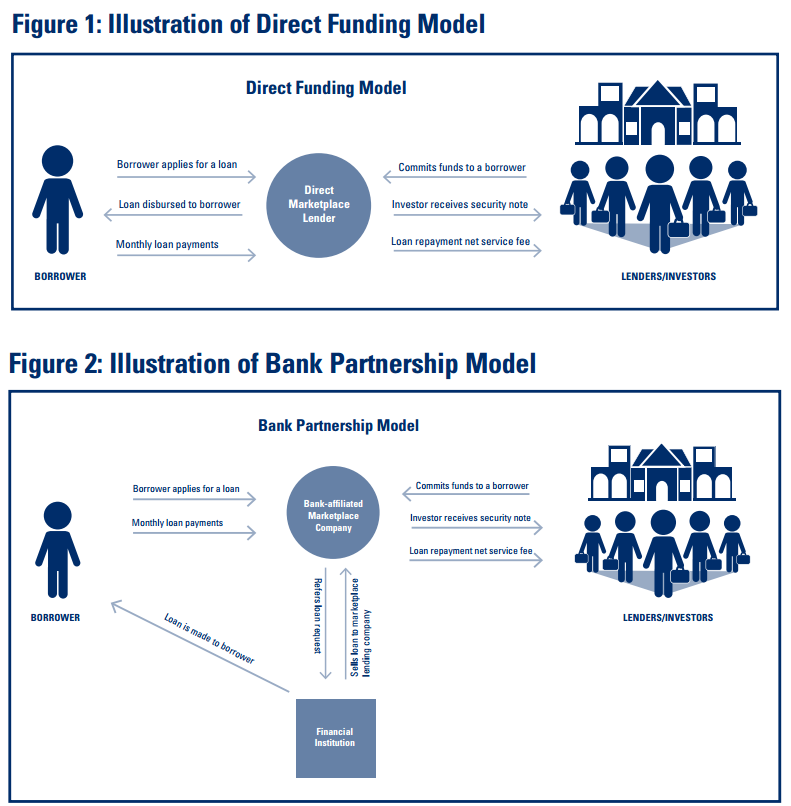
In both circumstances, investors are actually buying securities, rather than participating in the loans themselves.
The FDIC says that marketplace lending can encompass unsecured consumer loans, debt consolidation loans, auto loans, purchase financing, education financing, real estate loans, merchant cash advance, medical patient financing, and small business loans.
For even more information, read the official report.
Industry Trade Group Coming of Age: The SBFA is Becoming More Political
February 1, 2016By hiring an executive director, the Small Business Finance Association hopes to achieve at least two goals – taking a step toward becoming a full-service trade group and providing a public voice for the alternative finance industry.
Stephen Denis, formerly deputy staff director of the U.S. House Committee on Small Business, went to work in the new role in mid-December, setting up shop with his cell phone and laptop in a Washington, DC, area coffee emporium. He’s the SBFA’s first full-time employee.
Hiring Denis, who also has association experience, represents “the next evolution” of the trade group, according to David Goldin, SBFA president and Capify’s founder, president and CEO.
 The SBFA, which got its start in 2008 as the North American Merchant Advance Association, changed its name last year because members have added small-business loans to the their merchant cash advance offerings. Although the trade group’s not exactly new, it has plenty of room to grow and its leadership and members seem open to change.
“The goal is to start from scratch and take a look at everything the association is doing,” Denis told AltFinanceDaily, “and to really build this out to a robust group that represents the interests of small businesses.”
Denis appears optimistic about pursuing that goal. He’s a native of the Boston area and a Harvard University graduate whose first job out of school was as an aide to Republican Sen. John E. Sununu of New Hampshire. After three years in that position, he took a job for two years with a UK-based trade association, traveling frequently to London to inform the group of Congressional action in the United States.
From there, Denis went on to become director of government affairs and economic development for the Cincinnati Business Committee, a regional association that included Fortune 500 companies among its members. After two years in that role, Denis joined the staff of Rep. Steve Chabot, R-Ohio, moving back to Washington and serving as the congressman’s deputy chief of staff during a five-year stint that ended when he joined the SBFA.
While working for Chabot, Denis also became deputy staff director of the House Committee for Small Business, the No. 2 position there, and he has held that job for the last three years. The committee’s tasks include learning as much as they can about small business, including financing, and using the information to advise members of the House on policy initiatives.
The experience Denis has amassed in government should serve the association well because his duties include briefing federal legislators and regulators on how the alternative-finance business works. With Denis as spokesperson, the industry can speak to government with a single voice, Goldin asserted.
“We are going to be aggressive in our outreach to legislators and regulators as well as be active reaching out to local, state governments,” Denis said. The SBFA will “work with other trade groups and small business groups to promote our mission to ensure small businesses have alternative finance options available to them.”

Until now, too many players from the alternative finance industry have been vying for lawmakers’ attention, Goldin said. To make matters worse, some of those seeking to influence government in hearings on Capitol Hill are brokers instead of lenders and thus may not have a perfect understanding of risk and other aspects of the business, he maintained.
“We’re hearing that there are people trying to be the voice of small-business finance that either don’t have a lot of years of experience or they’re not telling the whole story,” Goldin said. “We want to make sure the industry’s represented properly.”
Denis can draw attention away from the “noise” created by unqualified voices and focus on information that Congress needs to make reasonable decisions about the alternative finance business, Goldin maintained.
Besides getting the word out in Washington, the SBFA hopes to convey its message to the general public on “the benefits of alternative financing,” Goldin said. At the same time the group can help make small business owners aware of the finance options, Denis added.
 Asked whether hiring Denis marks the beginning of an effort to lobby members of Congress for legislation the association deems favorable to the industry, Goldin said only that additional announcements will be forthcoming.
Meanwhile, updated “best practices” guidelines might be in the offing to help industry players navigate the business ethically and efficiently, Goldin said. A set of six best practices the association released in 2011 included clear disclosure of fees, clear disclosure of recourse, sensitivity to a merchants’ cash flow, making sure advances aren’t presented as loans and paying off outstanding balances on previous advances.
Addressing other possible steps in the association’s growth, Goldin said the group doesn’t plan to publish an industry trade magazine or newsletter. However, a trade show or conference might make sense, he noted.
Denis said he and the board had not discussed the possibility of a test, credential or accreditation to certify the expertise of qualified members of the industry. However, associations often establish and monitor such standards, so it would be reasonable for the SBFA to do so, he added.
The association might establish a Washington office, Goldin said. “We’ll look to Steve for his thoughts and guidance on that,” he observed. Denis seems amenable to the idea. “Down the road, we would love to open an office and hire more people,” he said.
In Goldin’s view, all of those moves might help the rest of the world comprehend the industry. Understanding the industry requires taking into account the cost of dealing with risk and business operations, he said.
Placing a $20,000 merchant cash advance, for example, requires a customer-acquisition effort that costs about $3,000 and a write-off of losses and overhead of about $4,000, Goldin said. That’s a total of $27,000 even without the cost of capital, he maintained.
“Most people don’t understand the economics of our business,” Goldin continued. The majority of placements are for less than $25,000, he said, characterizing them as “almost a loss leader when you factor in the acquisition costs.”
While spreading that type of information on the industry’s inner workings, Denis will also conduct the day-to-day for the not-for-profit’s affairs. The association’s board of directors will continue to set policy and objectives.
Members elect the board members to two-year terms. Current board members are Goldin; Jeremy Brown of Rapid Advance, who’s also serving as the group’s vice president; John D’Amico, GRP Funding; Stephen Sheinbaum, Bizfi; and John Snead, Merchants Capital Access.
Member companies include Bizfi, BFS Capital, Capify, Credibly, Elevate Funding, Fora Financial, GRP Funding, Merchant Capital Source, Merchants Capital Access (MCA), Nextwave Funding, NLYH Group LLC, North American Bancard, Principis Capital, Rapid Advance, Strategic Funding Source and Swift Capital.
Companies pay $3,000 in monthly dues, which Denis characterizes as inexpensive for a DC-based trade association.
Membership could spread to other types of businesses, Denis said. “I’d like to expand the tent to other industries,” he noted. “The association is trying to represent the interests of small business and make sure they have every finance option available to them.”
But a key purpose of the trade association is to provide a forum for members to come together as an industry, Denis said. “We’re thinking big,” he admitted. “We hope that all members of the marketplace will want to become a part of it.”