
The Empty Loan Marketplace – Lending Club Zero?
September 2, 2016Update: 9/2/16 – At 1 PM, Lending Club uploaded a batch of 600+ loans on to the platform.
Update: 9/3/16 – The only notes available on the platform today are C-grade notes. No A,B,D,E,F,G…
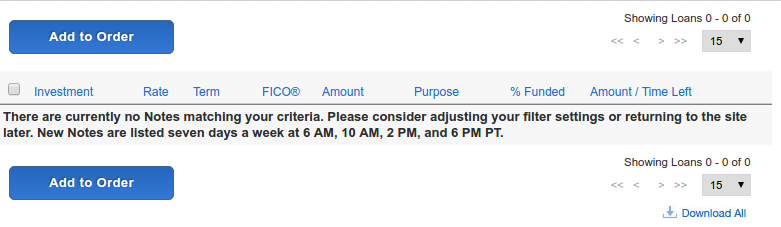
The leader in marketplace lending is showing ZERO available notes in its retail marketplace, according to a screenshot captured of Lending Club this morning. This indicates that Lending Club either hasn’t uploaded its latest batch or that no loans are currently being allocated to retail investors. It doesn’t mean that the company isn’t lending.
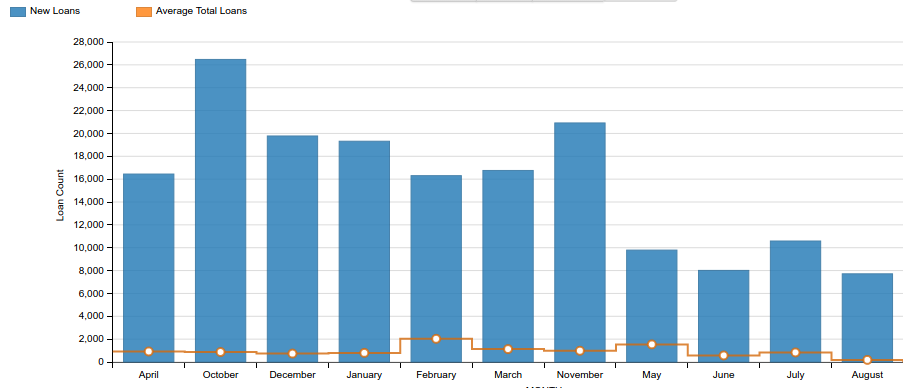
PeerCube, which tracks the amount of new and total loans on the Lending Club platform, also shows zero availability over the span of several hours.
Even if it’s a technical issue, Lending Club’s purported 135,000 self-managed active individual investors will be sure to notice that the marketplace is currently out of stock.
PeerCube also shows that there were 27% fewer loans listed on the retail marketplace in August than in July.
Meanwhile, a thread started on the LendAcademy forum where many Lending Club retail investors hang out, shows users discussing a dearth of new loans going back to July 22nd. Anil Gupta, who runs PeerCube, said in the thread that Lending Club had recently stopped releasing new loans to the retail platform on weekends.
Lending Club has not yet responded to an email sent to them inquiring about the zero note availability, but recently company CEO Scott Sanborn reassured investors that they were committed to the marketplace.
Some of our investors have observed the funding environment and asked: “Are you going to become a balance sheet lender, just like a regular bank? Has Lending Club’s business model changed?”
Let me be very clear: Lending Club is committed to the marketplace model and we do not plan to become a balance sheet or “hybrid” lender. Our mission of connecting borrowers and investors has not changed.
– Scott Sanborn, in an email on 7/28/16
On August 4th, Bloomberg reported that Lending Club was in talks with Western Asset Management Co. to set up a fund that would purchase as much as $1.5 billion of loans over time. Institutions like these may be responsible for the periodic lack of notes made available to the retail market.
Motivating Your Sales Force – Tips From the Floor
August 30, 2016
Fancy steak dinners, electronic devices and cold hard cash are just some of the ways ISOs and funders these days are motivating sales reps to bring in business.
Although it’s largely a field for self-starters, many companies find that even small tokens of appreciation do wonders to increase rep productivity. “Waving a carrot in front of your reps can make a massive difference,” says Zachary Ramirez, branch manager of the Costa Mesa, California branch of World Business Lenders, an ISO and a lender.
When it comes to motivating sales reps, every company does things slightly differently. Some have more established incentive programs, while others are more ad hoc, depending on how the day, week or month is shaping up. The common goal of all the programs, however, is to give a little something to get something greater in return.
Ramirez remembers one sales rep who won a trip to Las Vegas and then continued to be the top rep for three months running. “Those types of rewards can keep a sales team motivated, hungry and excited,” he says.
From time to time, Ramirez offers rewards such as a small cash bonus if a rep meets certain metrics like getting three submissions in a day or multiple fundings in a week. In addition, whenever his reps, who are all hourly employees, hit key performance indicators, Ramirez rewards them with a poker chip. After they accumulate enough, they can trade in their chips for various prizes. Twenty-five poker chips might be worth a flat-screen TV and 50 chips could be an expense-paid trip to Las Vegas, for example.
When it comes to motivation, it’s important to incentivize the correct behavior, Ramirez says, noting that in his earlier years running an ISO, he used to reward reps based on the number of calls they made in a day rather than applications, approvals or fundings.
The latter represent a much more serious commitment and are worth motivating for as opposed to simply making a phone call, where the outcome is uncertain. “Even if they make as many as 500 phone calls in a day, it’s irrelevant if they are not moving the transactions forward by getting applications and bank statements,” he says.
It’s also very important to have clear-cut expectations; reps need to know the consequences of not performing, Ramirez says. Most top salespeople won’t need the stick. But it’s still necessary for them to know the policies, he says.
THE POWER OF SELF-ORIGINATION
One major way United Capital Source incentivizes its 15-person sales force is by self-originating leads. It provides its reps—who are all W2 employees—with merchants that are actively expecting phone calls as opposed to handing them a laundry list of names to pitch which may or may not pan out. It costs more for United Capital to do this, but it works well for the company and for its sales force, says Jared Weitz, chief executive of the New York-based alternative-finance brokerage.
“It enables us to put our guys in a position where they are growing with the company and the company is growing as well,” he says.
In addition, United Capital has an aggressive pay structure that allows salespeople to grow with the company. For instance, the pay plans are all based on how the company is doing overall, as opposed to an individual salesperson’s performance. In this way, it encourages the sales force to work together, as opposed to each person being out for himself. Weitz says its sales team understands that if the company hits x, the sales team gets y. United Capital also offers competitive healthcare and 401(k) plans and there’s no vesting period for employees to receive their 401(k) employer match. Additionally, the company does small things like Friday lunches on the company’s dime as a thank you for time spent. It’s another way to keep the sales team happy, Weitz says.
Fundzio, an alternative funder in Fort Lauderdale, Florida, also works very hard to make sure it keeps up its pipeline of fresh leads so that reps don’t have to do that on their own. Indeed, Fundzio provides them with between seven and ten fresh and promising revenue-earning opportunities each day. This helps tie the reps to Fundzio because they have a continuous stream of business and don’t have to find it on their own.
“It guarantees them at bats every day,” says Edward Siegel, founder and chief executive of Fundzio. It also helps tie the reps to Fundzio because they have constant business. “The key thing is having new leads,” he says.
 Additionally, anyone who funds a deal gets to spin a wheel in the office at the end of the business day and earn cash or special prizes like concert tickets or a fancy dinner or a $200 gift certificate. Reps really appreciate getting those prizes, which is evident when they come back to work after enjoying their steak dinner at a Fort Lauderdale waterfront restaurant. “I think it creates a fun and relaxed atmosphere feeling. A little bit goes a long way,” Siegel says.
One way Fundzio motivates reps from the get-go is to bring them on initially as independent contractors. If they prove themselves over a 90-day period, they have the opportunity to become an employee. At any given time, the company has about 20 to 25 sales reps, representing a combination of contractors and W2 employees.
Another way Fundzio helps motivate reps is by allowing them to earn residuals from repeat business for the life of the account as long as they are still employed by the funder. Many funders have renewal departments and reps don’t directly benefit when a customer does repeat business, but that’s not the case at Fundzio, Siegel says.
REVVING UP SALES WITH CONTESTS
Certainly, to succeed in the alternative finance industry, sales reps have to be self-starters. It’s a key requirement to do the job well, in part because so many shops are purely commission-based. Nonetheless, many companies find it helps to grease the wheel a bit—regardless of whether reps are independent or W2 employees.
Fast and Easy Funds, for instance, holds weekly contests to encourage its internal sales force of 15 independent contractors. One week the contest may be for the rep with the most dials, another week it’s for the most submissions and another week for the highest number of deals funded. Each contest pays in the vicinity of $150 to $250 cash. “Every week I change it up. They don’t know what the contest is going to be until the last day of the week,” says David Avidon, president of Fast and Easy Funds, a broker and alternative funder in Boca Raton, Florida.
iAdvanceNow, a brokerage firm in Uniondale, New York, runs daily, weekly and monthly bonuses for its 38-person sales force. For instance, if a rep submits two completed deals for approval in a day he or she might get $100 cash; for three completed deals, the cash bonus might be $250, says Eddie Hamid, president of iAdvanceNow.
On a weekly basis, for submitting six complete files, reps get one spin on a big Wheel of Fortune-like apparatus in the office. Everybody is a winner; the prize depends on where the arrow lands. It may be a cash prize of $20, $50, $100 or a physical prize like a 40 inch-Samsung TV, an Apple Watch or iPad, Hamid explains.
On a monthly basis, meanwhile, each team of five to seven sales reps has a goal. If as a team they reach their goal, they get $1,500. Additionally, the top producer of the month—provided he or she has achieved a minimum of three merchants being funded—receives the top producer bonus of $1,500. The runner-up receives a $1,000 bonus and the third place sales rep receives $500. The top team in the office also gets a steak dinner at a local establishment, Hamid says.
The system works because it gives them a drive to obtain a goal while also encouraging friendly competition, says Hamid, noting that he once overheard reps talking about how much they value being named the top producer. “With sales people, they are more concerned with the recognition than the prize or the money they are receiving,” he says.
iAdvance has been in business for about two years. The current motivational system has been in place for about a year-and-a-half and it seems to work very well to motivate the sales force, Hamid says. In addition, if they are having a down sales month, Hamid ups the ante for the daily goals, adding not only cash, but also prizes.
These techniques all help to light a fire under the sales force, he says.
 STRATEGIES FOR SLOW DAYS
Sometimes around 3 p.m., if he feels like the room is starting to quiet, Jordan Lindenbaum, director of sales at Excel Capital Management in New York, a business financing ISO, might offer $20 or $30 cash for the next submission. Or he might offer $40 to $50 for two or three submissions by the end
of the day.
“All it takes is one slow day to kill the energy of a sales rep,” he says.
Lindenbaum finds that motivation checkpoints seem to work well. For instance, at the end of the month, the firm commonly gives a $200 bonus to the sales rep with the most submissions. For actual deals funded, Excel Capital is also working to implement a more concrete revenue-based bonus system as well, Lindenbaum says.
Excel Capital works with independent ISOs in addition to its in-house staff to bring in business. To encourage independent ISOs to refer business, the funding company offers higher payouts to those who consistently bring in high quality deals than to ISOs who bring in deals sporadically.
Chad Otar, co-founder and managing partner at Excel Capital, says a key piece of motivating sales reps is to make sure the sales manager feels motivated as well. Accordingly, the firm also makes sure to motivate Lindenbaum with larger payments for doing an outstanding job of motivating the sales force to bring in deals. “We need to motivate the sales manager so the sales manager motivates the people on the phone. It’s a chain effect. You motivate one and it motivates the others,” he says.
Excel Capital also believes in the power of team rewards. Recently, for instance, company executives treated all staffers to a steak dinner at Delmonico’s in New York City. “We’ve done it many times so our team knows they are appreciated and that our goals were met because everyone worked together,” Otar says.
THE SALARY VS COMMISSION CONUNDRUM
Paying reps a base salary in addition to commissions is another strategy some ISOs use to motivate sales reps. A salary is especially meaningful to reps just starting out, notes Ramirez of World Business Lenders.
He says he has worked with a lot of ISOs and many of them don’t want to pay reps a base salary because they feel it’s a mistake to give them a cushion. Because by doing so, reps get comfortable and when they get comfortable, they don’t push deals—or so the thinking goes. But Ramirez believes this is counterproductive to the rep’s career and the ISO’s sales.
He believes reps should be given a big enough base while they are learning the industry—say for 90 days. Giving them $2,500 a month or so, motivates them and it doesn’t choke their possibility for survival. “You have to give every salesperson the opportunity to succeed. Give them some coaching, give them some guidance, give them a little time. But if there’s no possibility of that rep succeeding or being an asset to your team, it’s important to remove them as efficiently as possible,” he says.
It may seem counter-intuitive, but removing dead weight is also motivating for reps who are really working hard to sell, Ramirez says. To keep that person is demoralizing for the other reps—who may feel they don’t have to work as hard either or who feel they have job security even without doing their best. “It fosters complacency,” he says.
LendIt’s Peter Renton is Still Earning 8.72%
August 25, 2016
LendIt, speaking to LendIt USA 2016 conference in San Francisco, California, USA on April 11, 2016. (photo by Gabe Palacio)
LendIt Conference founder Peter Renton made more from his marketplace lending investments in the last twelve months than some people earn in a year just from their nine-to-five job. $54,936 to be exact, according to his latest blog post detailing his performance. That’s a result of investments on the Lending Club platform, Prosper, P2Binvestor (which requires you to be an accredited investor), the LendAcademy P2P Fund (which includes Funding Circle, Upstart, Lending Club and Prosper), and the Direct Lending Income Fund managed by Brendan Ross (which invests with lenders such as Quarterspot and IOU Financial).
Unsurprisingly, his business loan performance through the Direct Lending Income Fund has earned the highest yield, a TTM return of 12.77%.
While reporters and critics seem to be planning the funeral for several lending platforms, Renton remains steadfast in his optimism. “Eventually, I plan to have a diversified seven-figure portfolio made up of consumer, small business and real estate loans,” he wrote on his Lend Academy website.
Though Renton is reaping the benefits of being a platform investor, it’s the platforms themselves that may be in trouble, according to a recent op-ed by Todd Baker, a senior fellow at the Mossavar-Rahmani Center for Business and Government at Harvard University’s John F. Kennedy School of Government. On American Banker, Baker wrote, “Almost all [Marketplace Lending] revenue is generated from ‘gain on sale’ fees earned from new loan sales. This dependence on origination volume and gain-on-sale margins makes MPL results exquisitely sensitive to macro and micro trends in investor demand and risk appetite.”
And if a platform isn’t sustainable, the theory is that future investment opportunities may not be as available as they have been historically.
“MPLs need to shift to a more sustainable mode — either as banks or as nonbank balance-sheet lenders — before the end of the current credit cycle brings on a real shakeout and the MPL experiment becomes a financial failure,” Baker wrote.
Renton himself acknowledged a downward trend in his yield, conceding that it may never return to previous levels. “While I would love to be earning more than 10% again I don’t expect to get back there any time soon,” Renton wrote.
He also recently rebutted a Bloomberg article that argued Lending Club was being shady with repeat borrowers.
Can Technology Be More Than Automation?
August 19, 2016
In yet another Lending Club exposé, Bloomberg revealed the identity of the man who allegedly first discovered suspicious Lending Club loans that would later be confirmed connected to disgraced CEO Renaud Laplanche in a post-resignation audit. Brian Sims, a retail investor in Lending Club loans used a specially designed algorithm to spot patterns such as multiple loans made to a single borrower at different interest rates. No easy task considering Lending Club takes great strides to protect borrower identity.
And this truly is the argument both for and against technology. Irrespective of what side of the debate you’re on, it’s hard to argue its indispensability in day to day business. It’s the one thing CEOs think long and hard about and rightly so — automation makes or breaks the size and scale of a business, vastly improves productivity and narrows if not eliminates the margin for human error (up for debate).
So, at AltFinanceDaily we were curious to discover how small business financing companies use technology in their companies, what processes are automated and which side of the man vs machine debate they fall on.
Boston-based Forward Financing that makes merchant cash advances, working capital finance and small business loans up to $300,000 started investing in proprietary software right from the beginning, four years ago. It uses Salesforce for customer relations and basic reporting.
Its underwriting tool, channels leads and performs varying levels of automation to underwrite files quicker. The app pulls data from a number of different sources like credit bureaus, public record databases, social media and Google APIs before it goes to an underwriter. “Our goal over the next 3-4 months is to automate a percentage of all the deals that comes through the system,” said CEO Justin Bakes.
The company also has a banking application, a portal where customers log in with their bank details, with read-only access to their bank accounts to identify and analyze transactions which are then used to underwrite. Separately, it also has a portfolio management system that manages all the funding, transactions and all the collections.
While Bakes started investing in technology early on, it wasn’t until a year and a half ago that he tried automated underwriting. “Some hear the word automation and think they are going to lose their jobs,” said Patrick Hereford, Director of Technology at Forward Financing. “I can understand that automation can reduce jobs, but here, they found that they could underwrite more deals faster and with more accuracy.”
Hereford was hired in October last year from the TV show America’s Test Kitchen where he was working as a software engineer. Hereford makes a case for automated underwriting with proof — “We went from spending 20 minutes per file to six minutes per file,” he said. “We were expecting 50 percent efficiency in underwriting but we got more and increased productivity.”
 The company hired full-time engineering staff last year to move all their tech support and development in house. “A majority of our new hires and investments have been in technology. The tech team has grown the most over the last year,” said Bakes. He noted that the company has spent over a million dollars in building proprietary software alone and 20 percent of its selling, general and administrative (SG&A) is allocated to technology development.
“There is no doubt that we are a financing company but we are a tech-minded financing company. To be a true industry leader, you have to automate a certain amount. Our philosophy is we plan to keep improving our technology and the ability to approve faster than anyone else,” Bakes said.
Forward Financing is among other companies moving in that direction. California-based lender National Funding who has deployed $1.5 billion to small businesses over the last 17 years is also preparing for a technology overhaul, trying to get access to data pools to automate underwriting. “We need to be tech driven, as deals get smaller, we need to automate them to make it affordable,” National Funding CEO Dave Gilbert told AltFinanceDaily earlier.
And five-year-old Pearl Capital is on a similar journey. The company grew its tech team from two to twelve people over a year and a half ago including data analysts and statisticians and is making significant investments in scoring technology, portfolio management and risk assessment. “We had a human model running successfully for years and they produce good results but move to machine is additive and supplemental,” said CEO Sol Lax. “Data and tech add a lot more texture and nuance to the market, it’s like the weather radar, you have visibility and can price accordingly.”
But technology doesn’t have to necessarily mean automating underwriting. In fact, there is a strong bastion of people actively resisting it. Isaac Stern, CEO of New York-based Yellowstone Capital is one of them. “I am going to get my underwriters as much information as possible – background check, credit check to make good decisions but that does not mean I am going to let a computer decide whether to fund or not.”
That doesn’t mean Stern doesn’t care about efficiency. In fact, Yellowstone has invested over a million dollars over the last year in ramping up technology. It hired AIG’s chief data scientist and has improved data mining with access to over 140 data points including SIC codes, credit scores and loan history. The company uses an application called Clear®, a Thomson Reuters product, through which it can conduct background checks as well as review business history and public records.
No matter what camp you belong to, there are strong arguments to be made for each side and it really comes down to the philosophy of the matter. But in a crowded lending market, does it make sense to grab every opportunity to scale better?
“Different people have different thoughts on whether this is frankenstein going off the rails or not and whether that will blow up or not,” said Lax. “But the barrier to entry is low as a funder, and the spend on tech can be small yet profitable.”
There are many alternative finance companies who believe that staying in the game requires some change in incumbent models to boost efficiency and speed that’s driven by auto approvals and declines. But there are also some like Stern who treat technology as an aid rather than an aim.
Perhaps time will tell which system is better.
Lend Us An Ear: Women in the Industry Speak Their Mind
August 11, 2016
The majority (52.5 percent) of employees in the banking and insurance industries are women — if this sounds strange, that’s because it is, considering only 1.4 percent eventually go on to become CEOs. While the male dominance is not apparent at the mid-management executive level, the sex ratio is rather skewed on top. Needless to say?
AltFinanceDaily grabbed the opportunity to speak to three women in the alternative business financing industry, charting their journey, reliving their experience, knowledge and the lessons that got them to where they are. Here are excerpts from the interviews.
Back to Roots
For some, their careers are not a deliberate choice, but a serendipitous stumble.
Heather Francis, CEO of Florida-based Elevate Funding, who went to college to become a healthcare professional entered finance by happenstance. “I went to school for health promotion and education at the University of Florida and graduated in 2007,” said Francis, who comes from a family of entrepreneurs and is a fifth generation Floridian. “I found that the position I was looking for was not a necessity for companies, it was a luxury like setting up gyms, that people were not willing to pay for at that time.”
Francis landed her first job in finance with a private equity firm called Strategic Funding in Gainesville, Florida where she set up the firm’s merchant cash advance business. After spending seven years there, in 2014, she set up Elevate Funding which in a short span of 16 months has made over 1,000 advances to businesses.
For Kabbage Loans cofounder Kathryn Petralia too, fintech was a far cry from wanting to be an English professor. A graduate from Furman University, Petralia’s tryst with finance was when she got roped into a project, valuing companies using data compression tools. Riding on building her tech expertise, she founded her first company at 25 which made store catalogues digital. “I was a kid and did not know anything about marketing or sales, so I ended up selling the startup to the company which helped me build it.” The venture however gave her an in into finance and she went on to work for Revolution Money and eventually built Kabbage Loans.
But for Danille Rivelli, VP of Sales at United Capital Source, however, the jump wasn’t as big or unusual. Although finance was not originally on her mind as an art major, it was a natural path from what she began doing to acquire real-world work experience during school, selling mortgages. Rivelli changed her academic focus and went on to get a business degree from Briarcliff College, where she also played on the softball team.
“A year or two into college, I started doing mortgages, making 5 percent commissions. It was natural and it just kinda flowed,” said Rivelli whose first job out of college was on the sales floor at Merchant Cash Capital, now Bizfi. “I wanted to get out of mortgages and I was hooked when I saw the sales floor, it was fun and upbeat.” She was also one of the company’s youngest salespeople at the time.
Women Can Do No Wrong. Or Can They?
When we asked what women need to do differently at workplaces? The answer was quick, resounding and not surprisingly – be more assertive.
“Women think from the heart more than the mind,” said Rivelli. “I find myself in situations sometimes where I know that I should be ‘leaving the emotions out of it’ so that I’m not second-guessing myself as much.” But it’s what helps her build lasting relationships with clients. “I think most effective sales people will agree that the most important part of our job is listening. You want to really know and understand who your client is and what they’re looking for before you try to sell to them.”
According to Petralia, who thinks of herself as ‘one-of-the-guys,’ the problem lies in overplaying the differences between men and women. “I think we perpetuate the stereotype that men are supposed to behave a certain way and women aren’t. I notice that when men crack a joke or use a curse word, they immediately apologize to the women in the room. We are making that happen,” she said. Petralia’s strategy in such scenarios is to swing to the other side and initiate banter. “I am very comfortable with dirty jokes and f-bombs.”
“Men are really good at faking it ’til they make it. They position themselves as experts when they are not but women are unsure of jumping into the deep end when they are not sure they can swim and that’s a big part of what we have to overcome,” Petralia said.
Francis is on the same page, “Men have no problem tooting their horn, but women don’t do that. We cannot expect anyone to stand up for us. If you think you’re getting looked over for a promotion, walk up to your boss and say it,” she said. Francis talks about most of the struggle being personal rather than operational. “I will admit to us having a need to be right… right about decisions, right in arguments and right about where the furniture goes,” she says jokingly. “A lot of what led me to start Elevate was my belief in that you could service the risky credit market without taking advantage or putting insane demands on the performance of the portfolio and still be successful… having that theory validated and accepted and in the end, being right.”
What’s the hurdle, what’s the race?
And the assertiveness comes from one’s belief in their struggle and the value of that struggle. Petralia reminisces of a time when as a scrimping 25-year-old entrepreneur, she pitched a tent and stayed on a campsite in San Francisco while raising money for her startup. Two decades later, she runs a billion dollar lending company. Petralia recognizes that not all women have the same opportunities.
“When I was raising money for Kabbage, I realized that I had only been in one or two meetings where a woman wasn’t bringing me water,” said Petralia who believes that bringing diversity requires work and companies should set targets and find qualified diverse candidates.
Kabbage allows for 12 weeks of maternity leave but that pales in comparison with other countries, says Petralia. “The problem with women is, we have the babies. Women have to choose between their careers and personal life and we are not even close to making that situation better. The key time in their 30s when they are having kids, they come back to compete with younger people who are cheaper.”
The movement to make it better, according to her should begin with creating a system of incentives like better child care, easy commute to work etc. where women don’t have to choose between advancing their career and having a child.
And her other gripe is limp handshakes from men. “Shake women’s hands better. Men give this limp, deadfish like handshake at conferences to women and it’s the worst.”
According to Francis, equal footing comes from striving for professional equality and representation. She says being a woman opens many doors but that’s where it stops. “People will talk to you nicely if you’re a woman but they don’t think you are the person making the decision. You have the ability to start the conversation but no one thinks that you can finish it.”
And for Rivelli, that means giving it your all. “The point is to keep being so good that no one can ignore you,” she said.
Calling Timeout On Financial Regulations, A Pump For Trump?
August 10, 2016
Only 24% of small business owners say that Hillary Clinton is the presidential candidate that has their best interest at heart, according to a survey conducted by Capify, a business financing company based in New York. 53% selected Donald Trump.
And whatever your opinions about Trump, his proposed moratorium on new financial regulations could entice both small businesses and alternative financial companies to consider a Trump presidency.
“Under my plan, no American company will pay more than 15% of their business income in taxes,” Trump said in Detroit on August 8th.
A report published by the National Federation of Independent Business (NFIB) last month found that 20% of business owners ranked taxes as the single most important problem facing their business. Only 2% reported that financing was their top business problem.
Message received? It appears not
In states like Illinois, some legislators are focusing their efforts on finding ways to make it harder for small businesses to obtain financing, convinced that questionable lending practices are the source of their problems, not taxes. But in a call with Bryan Schneider, secretary of the Illinois Department of Financial and Professional Regulation, he told AltFinanceDaily that no one has complained of any small-business lending problems in Illinois to state regulators.
Regulators should not indulge in creating solutions in search of problems, Sec. Schneider cautioned. “When you’re a hammer, the world looks like a nail,” he said, suggesting that regulators sometimes base their actions on anecdotal isolated incidents instead of reserving action to correct widespread problems.
And that’s why a moratorium on financial regulations (albeit on the federal level) might also resonate with small businesses. Lawmakers don’t appear to be addressing their grievances and ironically, passing new laws that make it harder to obtain financing could potentially even exacerbate the problems they’re already vocalizing.
Small businesses seemed to have become aware of the government-as-obstructionist role however since 22% of them surveyed in the NFIB study, said that government requirements and red tape were the single most important problem they faced, more than anything else.
The Finance Side
A timeout is not a sure-fire way to woo Wall Street however, since a moratorium on federal regulations could actually serve as a hindrance for some financial companies hoping to reach some legal framework consensus down the road. Last year, Bizfi founder Stephen Sheinbaum, said that a 50-state patchwork of laws would make operating companies like his more challenging. “Personally, I’d be glad to see it on the federal level, we won’t have to deal with 50 individual states, which is more unruly,” Sheinbaum said in regards to potential regulation.
But a timeout on making any moves might indeed be in order anyway, given the questions that are being asked by some federal legislators. Last month during a hearing, Rep. David Scott asked what made business loans different from consumer loans. Parris Sanz, the Chief Legal Officer of CAN Capital, who was there testifying on behalf of the Electronic Transactions Association (ETA), gave his answer.
But there is a fear, just by those questions, that some legislators are still having trouble understanding the fundamentals. And that may be why a dozen trade associations and lobbying groups have formed in the last year to provide educational resources about alternative financing.
In states like Illinois, Scott Talbott, SVP of government affairs for the ETA, said they are encouraging legislators to adopt a “go-slow approach” that affords enough time to understand how the industry operates and what proposed laws or regulations would do to change that.
Keep it Simple?
With Trump, despite all his quirks, it’s possible that his ideas about a moratorium, could be a deciding factor in how small business owners and those employed by alternative financial companies vote. Lower taxes, timeout on regulations, has the potential to resonate far and wide.
60% of small business owners think that the outcome of the presidential election will have a severe impact on small businesses, according to the Capify survey. 29% said it possibly will have a severe impact. With taxes and government red tape at the top of their list of grievances, there might just be a pump for trump on both sides of the alternative finance aisle.
Hold The Loans Or “Marketplace”? It Depends
August 1, 2016
At the risk of stating the obvious, the motivation to keep loans on balance sheet or sell them off through a marketplace is related to the type of lending one does. But even then, opinions on the best strategy varies. Is there a winning formula?
Not all online lenders are marketplaces. Some consumer lenders like Affirm, for example, hold all the loans they issue on their balance sheet. Avant, another consumer lender, has either held all or some of the loans on its balance sheet, making it a kind of hybrid.
But for companies like Lending Club, long considered to be the definition of marketplace, their May debacle showed the weakness that model can have, at least with those lending to consumers.
Interest rates, terms and risk profiles associated with businesses are different from those for retail consumers. According to Fora Financial co-founder Dan Smith, this changes the economics of the game since consumer loans are typically longer (3-5 years) compared to business loans where the weighted average term could be as short as under 12 months. This, not only makes consumer lending a lot more capital-intensive it also begs for diversification of sources.
“When I started the business, I had one lender in 2007 and they said they couldn’t work with us. Today, my credit facility has eight different lenders,” said Stephen Sheinbaum, founder of Bizfi which buys future receivables with its balance sheet in addition to running a loan marketplace. “We are undoubtedly seeing a shift from the B2C side. Any model that has sources of funds concentrated in one area is risky.”
Relying on your own balance sheet can lead to handsome returns, sources say. Sheinbaum, said that his company can make twice as much by holding than gains on sale. For companies engaged in consumer lending, that margin can be anywhere between 5 percent to 20 percent depending on borrower profiles and the type of loans, said student lender CommonBond CEO David Klein.
The unit economics of assuming risk can be higher if risk is assessed well. “If you do it well, balance sheet lending provides better unit economics,” said Fora Financial’s Smith. “You have to have the right capital structure, a low cost of capital and need to be able to underwrite effectively so it can scale.”
Smith however warned that this is not prescriptive and consumer lending companies like Lending Club might be forced to take a multi-pronged approach given the barriers to entry and the regulation around balance sheet lending for consumer loans. “There is clearly a more significant regulatory environment to get into on balance sheet consumer lending and that might be a barrier to entry.”
Often referred to as ‘having skin in the game,’ balance sheet lending potentially forces companies to assess risk better and be scrupulous about underwriting. But marketplaces whose prerogative may be seen as trying to make as many loans as possible, will inevitably be scrutinized over perceived conflicts of interest in their underwriting.
There are arguments to be made for each of the models but a better case is made for hybrid models which aims to take the best of both. Klein of CommonBond, said that his company leans heavily on balance sheet at times and the marketplace at other times. “Unless your investors are broad in profile and deep by type, then it is possible for a loan sale purchaser to walk away.” Klein said. “It all comes down to control. If you have more of it, there’s less risk.”
While more consumer lenders gravitate towards hybrid models, Lending Club at the end of Q2 held only 2 percent of the loan volume on balance sheet and CEO Scott Sanborn is very clear about the company operating purely as a marketplace.
“Some of our investors have observed the funding environment and asked: Are you going to become a balance sheet lender, just like a regular bank? Has Lending Club’s business model changed?”
“Let me be very clear: Lending Club is committed to the marketplace model and we do not plan to become a balance sheet or ‘hybrid’ lender. Our mission of connecting borrowers and investors has not changed,” wrote Scott Sanborn in a letter to investors.
The letter reiterated that the limited use of balance sheet does not affect Lending Club’s Notes. And while the company soldiers on, Lending Club’s story has taught many lessons to other lenders.
“In the wake of Lending Club’s news, you realize that if you have a hiccup on the way, it’s good to control some of your capital and assets because if you are truly marketplace, a hiccup in investor confidence can meaningfully change their trajectory,” said Klein who believes that for a pure marketplace player to survive, it needs to have more retail investors than institutional investors.
And there seem to be more people who agree than disagree. “The B2C model of selling 100% to a secondary market will cease and fault,” said Sheinbaum. “If buyers go away, your entire model is jeopardized. In a perfect world you want options. You see whichever way the wind is going and you try to go with it.”
The challenge then is in telling which way the wind will blow and be prepared for a storm.
Fundry Secures $75 Million Credit Line, Confirming That This Niche Is Still Hot
July 5, 2016
Fundry has secured a new $75 million credit line, according to the company’s CEO Isaac Stern. The transaction was facilitated by Brean Capital and Pi Capital.
Fundry is commonly known by one of their subsidiary companies, Yellowstone Capital. According to a document obtained by AltFinanceDaily, the company did more than $40 million in deals last month, with the vast majority funded in-house. The positive announcement follows their recent big move from NYC’s financial district to Jersey City, NJ, after being wooed to the state with tax incentives in return for creating jobs.
While confidence has retreated from online consumer lending after the scandals at Lending Club, specialty tech-enabled commercial finance companies, some of whom specialize in merchant cash advance, are still finding enthusiasm from institutional investors. Just over the last three weeks, Bizfi secured a $20 million investment from Metropolitan Equity Partners, Pearl Capital secured $20 million from Arena Investors, and Legend Funding secured a $3 million debt facility from Ango Worldwide. That’s $118 million invested into a very specific niche industry in less than a month.
Fundry alone, facilitated $422 million in funding to small businesses just last year.