
AI Sales Assistant Penetrating Alternative Finance Raises $34 Million in Series B Round
December 15, 2016 Wondering how your competition always seems to be so on top of their game? They might be using an artificially intelligent sales assistant. Such technology was reported on last month when AltFinanceDaily learned that it had penetrated the alternative business financing industry through at least one company named AI Assist. AI Assist is powered by Conversica, a Foster City, CA-based technology firm that announced it had raised $34 million in a Series B round on Wednesday led by Providence Strategic Growth Capital Partners L.L.C. More than 1,000 companies across technology, automotive, higher education, finance, insurance, real estate and hospitality are using Conversica.
“Conversica’s AI technology has helped IBM be smarter about engaging our prospective customers and maximizing their value as they move through our sales funnel,” Kevin Pollack, head of IBM’s Global Email Marketing Practice, is quoted as saying in a press release. “Not only have we freed up resources within the marketing team and gained immediate value in the form of qualified sales opportunities, we are also seeing how AI can help transform our entire business moving forward.”
For Roman Vinfield, who launched a merchant cash advance ISO in 2015, it changed his life. “I hadn’t heard anything like an artificial-intelligence sales assistant,” said Vinfield. “The results we got within a month of using it were unbelievable.” Within the first month, Vinfield made $35,000 in revenues by spending just $4,000 and he eventually reduced his staff of 24 to 4 people. He’s since launched AI Assist, the exclusive reseller of Conversica to the alternative finance industry.
“We’ve gone way beyond the theoretical,” Conversica CEO Alex Terry told Fortune. A demo given by Vinfield of AI Assist, demonstrated that its artificial intelligence can communicate with merchants over emails in a way that is indistinguishable from a human. According to Fortune, Terry said the sales assistant software has proven so effective for some customers that recruiters have even mistaken the software for a human and tried to make a hire. Other contacts have sent in thank-you notes and flowers, he added.
Conversica has raised more than $56 million since inception. Providence, who led the Series B round, also owns stakes in Hulu and the Yankees Entertainment & Sports Network (YES Network). Conversica’s technology is only available to this industry via AI Assist.
Alternative Business Funding’s Decade Club
October 22, 2015 The working capital business is a very different animal now than it was a decade or so ago when many of today’s established players were just starting out.
“At that time, the industry was a bunch of cowboys. It was an opportunistic industry of very small players,” says Andy Reiser, chairman and chief executive of Strategic Funding Source Inc., a New York-based alternative funder that’s been in business since 2006. “The industry has gone from this cottage industry to a professionally managed industry.”
Indeed, the alternative funding industry for small businesses has grown by leaps and bounds over the past decade. To put it in perspective, more than $11 billion out of a total $150 billion in profits is at risk to leave the banking system over the next five plus years to marketplace lenders, according to a March research report by Goldman Sachs. The proliferation of non-bank funders has taken such a huge toll on traditional lenders that in his annual letter to shareholders, J.P. Morgan Chase & Co. chief executive officer Jamie Dimon warned that “Silicon Valley is coming” and that online lenders in particular “are very good at reducing the ‘pain points’ in that they can make loans in minutes, which might take banks weeks.”
The burgeoning growth of alternative providers is certainly driving banks to rethink how they do business. But increased competition is also having a profound effect on more seasoned alternative funders as well. One of the latest threats to their livelihood is from fintech companies, like Lendio and Fundera,for example, that are using technology to drive efficiency and gaining market share with small businesses in the process.
“Established lenders who want to effectively compete against the new entrants will need to automate as much decisioning as possible, diversify acquisition sources and ensure sufficient growth capital as a means to capture as much market share as possible over the next 12 to 18 months,” says Kim Anderson, chief executive of Longitude Partners, a Tampa-based strategy consulting firm for specialty finance firms.
Of course, there is truth to the adage that age breeds wisdom. Established players understand the market, have a proven track record and have years of data to back up their underwriting decisions. At the same time, however, experience isn’t the only factor that can ensure a company will continue to thrive over the long haul.
WORKING TOWARD THE FUTURE
Indeed, established players have a strong understanding of what they are up against—that they can’t afford to live in the glory of the past if they want to survive far into the future.
“With every business you have to reinvent yourself all the time. That’s what a successful business is about,” says Reiser of Strategic Funding. “You see so many businesses over the years that didn’t reinvent themselves, and that’s why they’re not around.”
Strategic Funding has gone through a number of changes since Reiser, a former investment banker, founded it with six employees. The company, which has grown to around 165 employees, now has regional offices in Virginia, Washington and Florida and has funded roughly $1 billion in loans and cash advances for small to mid-sized businesses since its inception.
One of the ways Strategic Funding has tried to distinguish itself is through its Colonial Funding Network, which was launched in early 2009. CFN is Strategic Funding’s secure servicing platform which enables other companies who provide merchant cash advances, business loans and factoring to “white label” Strategic Funding’s technology and reporting systems to operate their businesses.
“When you’re in a commodity-driven business, you have to find something to differentiate yourself,” Reiser says.
FINDING WAYS TO BE DIFFERENT
That’s exactly what Stephen Sheinbaum, founder of Bizfi (formerly Merchant Cash and Capital) in New York, has tried to do over the years. When the company was founded in 2005, it was solely a funding business. But over the years, it has grown to around 170 employees and has become multi-faceted, adding a greater amount of technology and a direct sales force. Since inception, the Bizfi family of companies has originated more than $1.2 billion in funding to about 24,000 business owners.
 Earlier this year, the company launched Bizfi, a connected online marketplace designed specifically to help small businesses compare funding options from different sources of capital and get funded within days. Current lenders on the platform include Fundation, OnDeck, Funding Circle, CAN Capital, SBA lender SmartBiz, as well as financing from Bizfi itself. Financing options on the platform include short-term funding, equipment financing, A/R financing, SBA loans and medium term loans.
Sheinbaum credits newer entrants for continually coming up with new technology that’s better and faster and keeping more established funders on their toes.
“If you don’t adapt, you die,” he says. “Change is the one constant that you face as a business owner.”
David Goldin, chief executive of Capify, a New York-based funder, has a similar outlook, noting that the moment his company comes out with a new idea, it has to come up with another one. “If you’re not constantly innovating you’re in trouble,” he says. “It’s a 24/7 global job.”
Capify, which was known as AmeriMerchant until July, was founded by Goldin in 2002 as a credit card processing ISO. In 2003, the company began focusing all of its efforts on merchant cash advances. Four years later, the company made its first international foray by opening an office in Toronto. The company continued to expand its international presence by opening up offices in the United Kingdom and Australia in 2008. The company now has more than 200 employees globally and hopes to be around 300 or more in the next 12 months, Goldin says. The company has funded about $500 million in business loans and MCAs to date, adjusted for currency rates.
THE CULTURE OF CHANGE
Five or six years ago, Capify’s main competitors were other MCA companies. Now the competition primarily comes from fintech players, and to keep pace Capify has made certain changes in the way it operates. From a human resources standpoint, for instance, Capify switched from business casual attire to casual dress in the office. The company has also been doing more employee-bonding events to make sure morale remains high as new people join the ranks. “We’ve been in hyper-growth mode,” he says.
CAN Capital in New York, another player in the alternative small business finance space with many years of experience under its belt, has also grown significantly (and changed its name several times) since its inception in 1998. The company which began with a handful of employees now has about 450 and has offices in NYC, Georgia, Salt Lake City and Costa Rica. For the first 13 years, the company focused mostly on MCA. Now its business loan product accounts for a larger chunk of its origination dollars.
This year, the company reached the significant milestone of providing small businesses with access to more than $5 billion of working capital, more than any other company in the space. To date, CAN Capital has facilitated the funding of more than 160,000 small businesses in more than 540 unique industries.
Throughout its metamorphosis to what it is today, the company has put into place more formalized processes and procedures. At the same time, the company has tried very hard to maintain its entrepreneurial spirit, says Daniel DeMeo, chief executive of CAN Capital.
One of the challenges established companies face as they grow is to not become so rule-driven that they lose their ability to be flexible. After all, you still need to take calculated risk in order to realize your full potential, he explains. “It’s about accepting failure and stretching and testing enough that there are more wins than there are losses,” says DeMeo who joined the company in March 2010.
ADVICE FOR NEWCOMERS
As the industry continues to grow and new alternative funders enter the marketplace, experience provides a comfort level for many established players.
“The benefit we have that newcomers don’t have is 10 years of data and an understanding of what works and what doesn’t work,” says Reiser of Strategic Funding. With the benefit of experience, Reiser says his company is in a better position to make smarter underwriting decisions. “There are many industries we funded years back that we wouldn’t touch today for a variety of reasons,” he says.
Experienced players like to see themselves as role models for new entrants and say newcomers can learn a lot from their collective experiences, both good and bad. Noting the power of hindsight, Reiser of Strategic Funding strongly advises newcomers to look at what made others in the business successful and internalize these best practices.
One of the dangers he sees is with new companies who think their technology is the key to long-term survival. “Technology alone won’t do it because that too will become a commodity in time,” he says.
Over the years Strategic Funding has learned that as important as technology is, the human touch is also a crucial element in the underwriting process. For example, the last but critical step of the underwriting process at Strategic Funding is a recorded funding call. All of the data may point to the idea that a particular would-be borrower should be financed. But on the call, Strategic Funding’s underwriting team may get a bad vibe and therefore decide not to go forward.
“We look at the data as a tool to help us make decisions. But it’s not the absolute answer,” Reiser says. “We are a combination of human insight and technology. I think in business you need human insight.”
Seasoned alternative funding companies also say that newbies need to implement strong underwritingcontrols that will enable them to weather both up and down markets.
The vast majority of newcomers have never experienced a downturn like the 2008 Financial Crisis, which is where seasoned alternative financing companies say they have a leg up. Until you’ve lived through down cycles, you’re not as focused as protecting against the next one, notes Sheinbaum of Bizfi. “Every 10 years or 15 years or so, there seems to be a systemic crisis. It passes. You just have to be ready for it,” he says.
Goldin of Capify believes that many of today’s start-ups don’t understand underwriting and are throwing money at every business that comes their way instead of taking a more cautious approach. As a funder that has lived through a down market cycle, he’s more circumspect about long-term risk.
 One of the biggest problems he sees is funders who write paper that goes two or three years out. His company is only willing to go out a maximum of 15 months for its loan product, which he believes is s a more prudent approach. He questions what will happen when the economy turns south—as it eventually will—and funders are stuck with long dated receivables. “You’re done. You’re dead. You can’t save those boats. They are too far out to sea,” Goldin says.
Having a solid capital base is also a key to long-term success, according to veteran funders. Many of the upstarts don’t have an established track record and need to raise equity capital just to stay afloat—an obstacle many long-time funders have already overcome.
Goldin of Capify believes that over time consolidation will swallow up many of the newbies who don’t have a good handle on their business. Hethinks these companies will eventually be shuttered by margin compression and defaults. “It can’t last like this forever,” he says.
In the meantime, competition for small business customers continues to be fierce, which in turn helps keep seasoned players focused on being at the top of their game. Getting too comfortable or complacent isn’t the answer, notes DeMeo of CAN Capital. Instead, established funders should seek to better understand the competition and hopefully surpass it. “Competition should make you stronger if you react to it properly,” he says.
The Dumbest Guy in the Room
May 11, 2015 “This is the absolute dumbest thing I’ve ever seen,” she said while raising her voice. She was visibly agitated as if someone had just attempted to pass off a child’s crayon drawing as their doctoral dissertation. I began to laugh, not at her, but at the irony of the truth she was going on about.
“So what would need to be different in order for this to be a more viable idea? Like what would I need to change and come back with?” I asked.
“Come back?! COME BACK?! Don’t come back,” she shouted while taking my business plan and literally crumpling it into a ball and throwing it on the ground. She then got up and left. She was shaking from the rage. I was the dumbest person she ever encountered and it took effort for her not to kill me.
This experience happened to me three years ago when a NYC-based Venture Capital group sent out invitations to a free seminar and workshop. I liked the refreshing thought of hearing what VCs had to say, especially those not familiar with the merchant cash advance industry. Besides, I had a few concepts I wanted to get feedback on, and thought this would be a great opportunity to do it.
The seminar was more of a fireside chat, held by a zen-like VC I’ll refer to as Rain. He was in his mid-30s, wore a long flowy purple velvet shirt and sat indian style and barefoot in the front of the room. It was a stark contrast to the attendees in the audience, all of whom were wearing suits. Rain walked the crowd through his experience as a VC, most of which seemed to be an annoyance to him. Startups were full of personal drama of which he often got roped into. There was always a partner who was an idiot, a delusion the founder(s) couldn’t see past, or an insatiable need for additional funds.
And during the Q&A at the end, an attendee asked him if he would ever consider using a VC to raise money if he were not a VC himself. “Put the phones down guys, this stays here,” he said. “I wouldn’t.”
However confusing that might come across as, it didn’t change the energy in the room. Just about everyone who attended had an idea for a startup and desperately wanted VC funding.
Afterwards, you were allowed to schedule a one-on-one with one of their startup experts to develop your ideas further. It sounded cool and it was free, so I signed up.
I drafted up a concise business plan based upon a model that was just starting to take root in the merchant cash advance industry. It had its own little twist and I’m sure flaws too, but I believed this one-on-one would be a helpful conversation where I could get honest feedback without giving anything away to potential competitors.
Three minutes into the meeting, I was being scolded. “What do you mean it would break even for the first 2 years?!”
“Oh, well what I’m try –,” I attempted to respond. She talked over me. “You mean to tell me you would make no money in the first 2 years? Are you starting a charity?!”
“Well I was under the impress–,” I started, but she kept going. “This is the absolute dumbest thing I’ve ever seen.”
 It was the hardest no I had ever gone through. I looked around the room to see if the other one-on-ones being conducted were going the same way. They weren’t. Everyone else looked to be cozying up to each other, crunching numbers, sharing laughs, and possibly on their way to even getting funded.
Not me though. I was the dumbest guy in the room, too dumb to even come back with something better. It was a humiliating moment considering I thought this was supposed to be an instructional meeting where the experts would essentially help you master a business plan.
As I walked out of the office towards the elevator, I noticed that even the cheery receptionist who had excitedly welcomed me in, ignored me with her head down as I walked out.
There goes the dumbest guy that ever existed, I imagined she was thinking.
My world spinning as the elevator descended, I tried to recount how it went wrong so quickly. I had showed her a pro-forma P&L that broke even for the first two years as I would reinvest 100% of the profits back into marketing to scale. I personally didn’t like it that way. I wanted to make money, but everyone around me was bleeding red and raising tens of millions along the way. I had started to believe that sacrificing any shred of profitability in exchange for growth is what got investors excited.
My expert didn’t share that view. A business that wasn’t profitable wasn’t a business. It was dumb, and not just regular dumb, but the dumbest thing that anyone ever thought of. EVER.
A couple of days later when I had shaken off the blow to my self esteem, I was thankful for the experience. She was a New Yorker to the core and so was I. I had no inner desire to start a business that didn’t make money (for the sake of disrupting or whatever), but I was being swept up in the craze of companies that were doing just that. She brought me back to reality, though she left a lasting imprint of a boot on my ass.
Three years later, companies with models similar to the one I had cooked up have raised hundreds of millions of dollars. They don’t break even. They lose money, lots of it. But they are looked upon and celebrated as some of the brightest guys in the room. Many of those guys are smarter than me and are probably executing their concepts way better than I ever could. But the lose-a-lot-of-money and grow model isn’t meant for everyone. It all depends on who you’re talking to.
In HBO’s Silicon Valley, a hit that many view as more of a reality show than a sitcom, they poke fun at a truth purveying the California startup scene. Forget profits, the show explains, just having revenues hurts your chances of raising money.
 “If you have no revenue, you can say you are pre-revenue,” says the show’s billionaire Russ Hanneman. “You’re a potential pure play. It’s not about how much you earn; it’s about what you’re worth. And who’s worth the most? Companies that lose money! Pinterest, Snapchat, no revenue. Amazon has lost money for the last 20 years, and that Bezos motherfucker is the king!”
Two years ago, Bezos was worth $25 billion and was the 20th richest person in the world. Some experts might say a business model that loses money for 20 years would qualify as the new winner for dumbest thing that ever existed ever. It’s apparently just the opposite.
But once you find an investor that believes in the loss model, do you take the money and then go out and disrupt, hoping that somehow you’ll end up a billionaire?
Loan broker Ami Kassar is faced with that very dilemma. In his recent blog post, he wrote about the offer he has on the table from a VC, “While I could substantially grow my top line – the chances of making any profit are small and the chances of losing money are high.”
Fictional billionaire Russ Hanneman would surely approve, but over in realityville, Kassar is balking. “I can only speculate that they’re more interested in market share – than profits. Their investors want growth. They’re on the venture capital treadmill.”
Admittedly, I poked fun at Kassar, an entrepreneur I’ve often sparred with online. “Should I be worried that in their quest for growth they will build a train and run me over?” He asked in his blog.
Of course I linked to it in the following manner:

Kassar concludes that sustainable long term value is the only logical way forward. Is he wrong?
The current investment atmosphere where anybody with a model and a programmer is raising hundreds of millions of dollars to basically see how fast they can spend it all, is affecting those that have always believed in profits and longevity.
In another post by Kassar just a week earlier, he wrote, “Am I missing the boat and doing something wrong? That’s how I have felt lately as I’ve watched the emergence of the online small-business financing space. It seems every other week I wake up to another announcement about a company in the small-business financing space who has raised a lot of money from venture capitalists at a really high valuation.”
Just last week, consumer lending startup Affirm raised $275 million in a Series B round. Many people in the alternative lending community had never heard of Affirm but they are apparently so good that they can raise a quarter billion dollars.
Investors are scrambling. They don’t want to be left out. On multiple occasions, I have heard of investors skipping basic due diligence in a rush to capture a deal. Some of those deals blew up in a matter of weeks, others in months when they realized they didn’t even know who the owners were or what financial standing they were in.
Lending Club and OnDeck have received billion dollar valuations. That’s what everybody wants, though the market has temporarily cooled on OnDeck, a company that has lost money for almost eight straight years.
Even Shark Tank investor Kevin Harrington has gotten in on it, through his new business loan marketplace, Ventury Capital.
One thing looks certain three years after I met with that expert. The supposed dumbest thing that could ever be conceived of ever has made tons of people millionaires.
A year ago, Kevin Roose of New York Magazine wrote this of profitless startups, “They’re simply taking millions of dollars in venture capital with the hope of keeping prices low, pushing rivals out of the market, and eventually finding a way to turn a profit.” It can be predatory pricing, Roose argues. Basically large venture backed companies can sell below their cost using unlimited funds until the competition is out of business. Then with the entire market all to themselves, they can figure out a model towards profitability.
There seems to be a lot of this happening in the alternative lending space where the lenders backed by hundreds of millions of dollars are not only undercutting the competition at a loss, but they’re running lobbying campaigns that accuse their profitable brethren of being greedy and predatory. The media and general public eat this message up. There is no defense for a lender who has been accused of charging too much by one charging less even if the one charging less will need to declare bankruptcy if it does not raise a fresh round of new capital to sustain operations.
Only the rare observer can read between the lines as Forbes contributor Marc Prosser did. In his own research, he discovered that, “a company which loans money to small businesses at an interest rate of more than 50% was losing money.”
Though I won’t name names, there are a few players out there that believe the answer to their cycle of losses is to push regulatory agencies to attack profitable companies, or at least constrain them through penalties and new laws. Essentially, if it looks like they can’t win the war of attrition, then they might as well stick the government on them.
Speaking of the war of attrition, the race to bring costs to merchants down to zero doesn’t seem to be having the desired effect on the competition. In OnDeck’s Q4 earnings call for example, CEO Noah Breslow said the following:
Overall this market is still characterized by extreme fragmentation. The behavior that we see with our customers is that they might research other competitive options online but then when they actually apply to OnDeck and receive that offer, they kind of have this bird in hand dynamic, and there’s so much search cost associated with going out and looking at other places and so much uncertainty around that, they typically just take that offer that OnDeck has provided to them.
Translation: Once merchants have an offer from somewhere, they go with it. There is no price-competitive marketplace on the macro level.
OnDeck has been undercutting the entire merchant cash advance industry for years. None of their competitors have gone out of business, at least not because of a profit squeeze. Instead, everyone is growing, OnDeck included.
So why lose money?
In the case of OnDeck, they can argue that growth has allowed them to expand into Canada and Australia. They’ve forged partnerships with Prosper and Angie’s List. They’ve acquired more data because they’ve done more deals than most. And who is another billion dollar company likely to partner with in the lending space? Probably the one doing 10x the volume of everyone else, the one whose name is all over the place. They have the advantage to win the partnerships.
Five years from now, when the competition is trying to catch up in volume, all the lucrative partnerships might be snatched up already. Maybe it really is about who can spend the most the fastest. It’s a depressing thought.
Some startup vets will you tell that the most important aspect is actually the team. The CEO of 140 Proof for example has written, “You succeed or fail not on the strength of your idea or your product, but on the strength of your team. Venture capitalists fund teams, not business plans.”
With that in mind, I tried to imagine how that meeting three years ago would’ve turned out had I showed up with OnDeck’s CEO Noah Breslow and Lending Club’s CEO Renaud Laplanche in tow. “We’re going to disrupt lending,” I imagine the three of us tell the fierce startup expert.
The expert knew nothing about me. As far as she knew, I was just some random guy off the street holding a stack of papers with an incredulous plot to dominate the lending industry. I had never worked for a bank. I was young. I had no partner. I didn’t graduate from Harvard or MIT. It probably looked pretty ridiculous. “Duhhh so whaddya think?” I imagined I appeared to her.
With her guard down, she had no reason to hold back from saying what she really felt, that the plan was the absolute dumbest thing she’s ever seen.
Might the dumbest guy in the room only be that because he believed what she said? Or did she have it right all along?
Meet the New UCCs
January 27, 2014 For all the small businesses that have gotten funded over the last few years, it’s been said that merchant cash advance companies and their lending counterparts have only filed UCCs against 50,000 unique merchants (not saying that’s correct). It’s an impossibly small number but those that have been in the industry a long time know that deals get recycled again and again. Some merchants have been using this product for a decade now. They jump from funder to funder or they stay with one for a long stretch until one doesn’t want to do business with the other anymore. I’ve seen merchants with a UCC history so long and so chronologically perfect that it’s like reading the book of Genesis. AdvanceMe begat funder B who funded the merchant for 365 days and begat funder C who begat funder D who put the merchant on a starter and begat a 2nd location with funder E, who begat 3 more funders each offering the merchant a 6 month program, Amen. And now they’re applying again still in 2014. Don’t get me wrong, it’s great that businesses have been able to put outside capital to use again and again, but it couldn’t hurt to have some fresh faces.
The market is saturated, the old school UCC market anyway. Businesses that have used a cash advance historically can potentially get up to 1,000 calls a year by UCC poachers trying to convince them to switch, stack, or do something else. It makes a lot of companies not want to file a UCC, and many don’t or they mask their filing name because of it.
Other companies in the greater alternative lending space would say, “A UCC? Why would we file that?” In the case of purchasing future revenues, it makes sense to put a public claim on assets purchased. Future revenues are an indeed an asset. But to an unsecured creditor, there are no claims to assets. So when I spotted Lending Club in the wild funding a business, I couldn’t help but check to see if they filed a UCC-1. They didn’t and they don’t. Unsecured business credit cards don’t file them either. I don’t think any unsecured creditor can.
With no UCC-1 on record, is merchant cash advance’s newest competitor invisible? Not quite. Each loan serviced on Lending Club’s platform is registered as a security with the SEC. Each deal has a prospectus and investors rather than “syndicates” can choose to participate in the loan based on limited information provided about the borrower. These loans only range up to $35,000.
Since each loan is registered with the SEC, all of that information is public. But there’s one catch, Lending Club’s borrowers are anonymous. As an existing investor on Lending Club’s platform, I can only see the borrower’s credit score range, location, and other basics. It’s like browsing leads on iBank and deciding which ones you want to buy but instead of paying to get their personal information so you can contact them and collect docs to underwrite, you have to fund them right then and there based on what you see. You never ever get to find out who they are or see their docs.
Here’s a screenshot of a real live business loan listing that any of their registered investors can participate in:

28 people are already participating in this loan. I think the smallest you can contribute is $25. Each loan gets filed with the SEC, which anyone can look up using Edgar.
But what you and I can see on the site seems to be all you can see in the SEC filings as well. Business location, credit, loan terms, and date filed, but nothing that identifies them personally. Unless of course you are smarter than I am and find a way.
Lending Club has made $3.5 billion in consumer loans in just a few short years. I have no doubt that they will be a billion dollar player in the business loan market as well. It sure would be nice to find out more about who they’re funding,especially since their cap is $35,000. There’s a good chance they’ll be underserving their clients’ capital needs.
The guys who figured out reverse UCC searching in MCA early made a fortune. Could reverse SEC filings be the next gold rush?
Funding Down to a Science
December 21, 2012Account rep: Congratulations, you’ve been approved for $27,000!
Merchant: How did you come up with these figures?
Account rep: It was science. Science did this.
Funny? Maybe not, especially since an underwriting super algorithm may be on its way to the United States. In the days after we posted Made for Each other?, friends, acquaintances, and strangers have been telling us to keep an eye on Wonga’s potential acquisition of On Deck Capital. “It’s not just a european company’s gateway to the US. They’re going to change everything,” a few have said. Aside from their background of being a payday lender, having prestigious VC backing, and the resources to throw a quarter billion dollars at a main street lender in a takeover bid a lot of people didn’t see coming, apparently there is much more to be seen.
Just like MCA in years past, Wonga has worked hard to repel a negative image. Not easy stuff, especially considering they embrace their hefty costs wholeheartedly. Sure, it’s easy to calculate an APR equivalent of a very short term loan and spin whatever number you come up with as the symbol of something evil. If I let a stranger borrow $100 today with the stipulation that they pay me the whole thing back tomorrow plus 1 dollar extra to make it worth my while, would I be evil? That’s an APR of 365%. If I did the same thing with 100 strangers, what are the real odds that all 100 would actually pay me back? Somewhere along the line because of a borrower’s circumstances, bad decisions, or even malicious intent, I’m going to lose the entire $100 I lent out. Others might need more time to pay me back. If one person out of those hundred doesn’t pay back, I break even. If two people don’t pay back, I lose money. If one person doesn’t pay back and another can’t come up with the whole thing, I lose money. You can lend money at 365% APR and lose BIG.
So how do banks manage to charge 4, 7, and 10% APR? Is it just because they’re smarter? No. They don’t make money off loans at these rates either. In the US, interest rates are distorted by government guarantees. Politicians have decided that certain interest rates sound “fair,” then push big banks to lend money at these low unsustainable rates. But of course it doesn’t work and so government agencies sweeten the deal by reimbursing banks for up to 90% of the losses on the borrowers that default. Banks make money on the loan closing fees and other services they sell to the businesses. The loan is the doorbuster offer the bank puts in the storefront window. Once you come inside, they try to sell you on other things so that you don’t walk away with just the loan, otherwise they’re losing money.
So when you hear “banks aren’t lending,” don’t be so surprised. Lending money means giving it away to someone that might not pay it back. That’s a really tough business to be in, no matter how qualified the borrowers are or how good the underwriters are supposed to be.
But somewhere in between the opinions of the Merchant Processing Resource staff and government bureaucrats over what is fair, is a special recipe that determines once and for all what works best. It’s science. Wonga’s lending success is rooted in science and propelled by an advanced algorithm that can systematically calculate risk better than any bank in the world, or so they say.
 One of Wonga’s major investors, Mark Wellport, is a knighted renowned immunologist and rheumatologist that has defended Wonga’s methods against regulation. He believes their data-based process and strong motivation to make their borrowers satisfied places them in an entirely different category than payday lenders.
Wonga takes a human-free approach, something no MCA provider in North America does regardless of how automated their process may seem. In the UK, their business loan application process takes only 12 minutes and the funds are wired 30 minutes later. That’s it. Their max loan is £10,000 but just think about how that compares to MCA in the US. How much time and overhead is being spent on printing documents, underwriters, conference room meetings to discuss deals, setting up the merchant interview, trying to reach the landlord, trying to get page 7 of a bank statement from 6 months ago and the signature page of the lease, etc. etc. Funders might have had the wrong approach all along.
Wonga’s founder, Errol Damelin believes in data. According to some quotes in The Guardian, Damelin believes interacting with the borrower actually impairs a lender’s judgement.
From the Guardian:
Asking for a loan from a financial institution had traditionally involved making a strong first impression – putting on a suit to see the bank manager – then rigorous questioning, checking your documents and references, before the institution made an evaluation of your trustworthiness. In a way, it was exactly the same as an interview, but instead of a job being at stake it was cash.Damelin found this system old-fashioned and flawed. “The idea of doing peer-to-peer lending is insane,” he says. “We are quite poor at judging other people and ourselves – you get to know that in your life, both with personal relationships and in business. You realise that we’re not as good as we think we are at that stuff, and that goes for almost everybody. I certainly thought I was much better at it.
The 42-year-old entrepreneur grew up in apartheid South Africa, and he believes the experience of living in that country in the 80s has had a significant impact on his outlook. He was active in student politics at the University of Cape Town and marched in civil disobedience protests. So, when it came to deciding who should be lent money, Damelin says he wanted to strip away some of the prejudice – decisions would be taken without a face-to-face meeting; you wouldn’t even speak to an adviser on the phone, because people subconsciously judge accents too. The final call on whether to hand out cash would be based on “the belief that data could be more predictive than emotion”.
According to Wired, Damelin and his team created a system to approve or decline applicants all on its own. They tested it on a site called SameDayCash by using Google Adwords and within ten minutes of their ad going live, their system had already approved its first customer. In its early forms, it wasn’t very profitable from a lending standpoint but it did allow them to collect a massive amount of data.
From Wired
its strategy over this period wasn’t just to disburse money — it was to accumulate facts. For every loan, good or bad, SameDayCash gathered data about the borrowers — and about their behaviour. Who were they? What was their online profile? Did they repay the money on time? The site was feeding an algorithm that would form the basis of Wonga, launched a year after the beta experiment that was SameDayCash.
MCA has utilized Adwords for lead generation for years with mixed success, but few have used it for the purpose of accumulating facts. This isn’t to say that the firms collecting information for the purpose of leads aren’t sitting on treasure troves of data, it’s just that none of it to date has led to 100% computerized underwriting. The MCA industry is quite possibly about to undergo a major shift in how they promote their product on Adwords as a result of Google’s ominous warning a couple weeks ago. New disclosure requirements may change the way consumers respond and apply, ultimately impacting the data collected.
So will european science work in the good ‘ol US of A? If Wonga acquires On Deck Capital, you can bet they’ll try to replicate their success. There is a gigantic market of really small businesses that aren’t getting funded, and even the ones that are, they’re waiting 3-7 days to deal with the paperwork, handle the phone calls, fax documents, complete a landlord verification, and in some cases, deal with a credit card processing equipment change. If On Deck Capital becomes a household name as Wonga is in the UK, a lot of smaller funders are going to get squeezed.
Wonga claims to have a net-promoter score above 90%, a customer satisfaction metric that beats most banks and even Apple Computer. It’s a company that seems to be winning on every front.
Critics will say that the American lending market is big enough for everyone, that the loans Wonga has done traditionally are really small and therefore not in the same league as MCA, or that their own company has something similar or better. We believe however, that if this deal goes through that it’s a bad idea to get comfortable. There are Wonga-like companies in the US already, data fortresses that will soon revolutionize how loans are issued and determine what makes a successful business. New York based Biz2Credit is one such example.
We’ve been right about a lot of things in the last couple years and wrong about some. But we believe it is inevitable that any lender ignoring the automation revolution on the horizon is not going to last very long. Go ahead, brush it aside and convince yourself that this whole Automation thing is just hype as BusinessWeek did in 1995 about the Internet. “Automation? Bah!”
As Damelin told Wired in June, 2011, “For me the epiphany was right there. People were online, looking for a solution to a problem.” Ask any funder using Adwords or pouring work into SEO and they’ll tell you the same thing. People are looking online for money. What happens after they fill out the form on the website is what makes the USA MCA/alternative lending industry different from Wonga.
 But will a perfected european algorithm work in the US? Americans approach debt and money differently than the rest of the world and small businesses operate in a much more open manner. You never know, the european lab coat wearing scientists could come here and get their butts handed to them. Plenty of smart companies have jumped headfirst into MCA and left after disastrous results. Some veterans that have been in this business a long time will you tell that an impressive resumé, big investors, and a fancy algorithm will help you make it through the first six months. After that, you better know what the hell you’re doing, if you can continue to do it at all.
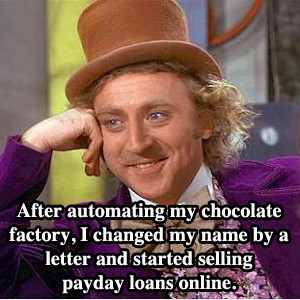
If in three years the average small business owner thinks Wonga is the last name of a guy that owns a chocolate factory, we promise to write a jingle that admits we were wrong about them. But On Deck Capital has been around the block and knows the business. They would allow Wonga to skip the learning curve and together could quite possibly nail lending down to a science.
Oompa Loompa do-ba-dee-doo, I’ve got another algorithm for you.
– Merchant Processing Resource
../../
There is great feedback to this article in a LinkedIn Group HERE
Why You Need FundersCloud – An Independent Review
August 29, 2012Picture this:
You get up in the morning, take a shower, brush your teeth, and hop on to your computer. 73 new e-mails are waiting in your inbox. Ugh! Some of them are saying “Hey buddy, I got this deal that I think you might want to co-fund. Give me a call later and I’ll try to give you a breakdown.” Half of the time when you call these guys back, they’re busy, have already found a participant, or the deal is way too risky for you to be interested in. Fortunately, you don’t really have to deal with this hassle ever since you joined FundersCloud. You close Outlook, log in to the Cloud and check out the menu of fresh deals that have been posted to the site. You read them aloud to yourself as you scroll down the list. “15k in monthly credit card sales, 40k gross, 720 credit, in business 3 years, ooo.. and it’s a restaurant! $10,000 advance for $13,700… I like… I like… oh and $7,000 has already been raised.” You click ‘Bid’, type in $3,000, and click ‘Bid’ again to finalize. That’s it. You’re done. Once the agent closes the deal, your $3,000 is automatically withdrawn, along with the amounts from the other participants to fund the merchant the $10,000. Satisfied, you walk into the kitchen to make toast…
And that’s what FundersCloud has done. Whether you are an independent agent, an ISO, or a funder, deal syndication is now as easy as:
FundersCloud is not the competition. They’re the turbo boost button to the marketplace that already exists. This Cloud doesn’t threaten or replace your existing cloud, system, database, or CRM but rather complements it, integrates with it, and adds even more value to what you already have.
 FundersCloud makes funding quicker, smarter, more efficient, and incredibly transparent. This isn’t a paid advertisement. In fact we spent a few weeks on the phone with the FundersCloud team to come up with our own independent assessment. “How does this work? Who reviews this data? How can people trust you?” and so on… We’re actually thankful their team is still accepting our phone calls after our barrage of questioning and requests for details.
The reason we believe FundersCloud is the future of syndication is because it allows people to continue syndicating with funders and people they already trust.
Huh?!
Allow us to explain using a fictional example:
Funder 123 encourages friends, agents, and funders to participate in funding certain deals. ISO ABC likes to syndicate some of those deals but not all of them. So the owners of ISO ABC wait and hope that Funder 123 will call them sometimes with a deal that they like. Sometimes they hate the deal. Sometimes they like it. Other times, they play so much phone tag that they miss out on the opportunity. The process takes phone calls, emails, and time, time, time. Not to mention that Funder 123 may make several of these calls to other people to join in on the participation as well.
In a perfect world, ISO ABC would automatically be notified that Funder 123 has approved a deal and is seeking participants. The key factors like credit score, processing volume, batch frequency, gross sales, and other pertinent information would be immediately available. The ISO could then click a button if they wanted to participate and the rest of the process would all be automated. This perfect world exists because this is the FundersCloud model.
Ohhh yea! And it gets better
An agent is tired of submitting his/her deals to 5 funders at once, hoping that one of them will approve it. The funders are tired of the agent doing that too. Because the agent is forced to maximize the odds of approval, there is really no alternative solution than to continue operating this way. FundersCloud resolves the mess.
Hypothetical Agent DEF uploads their deal to the Cloud and selects one company from the vast array of Deal Controllers to verify and underwrite the file. Deal Controllers are typically existing funding providers, companies that have the ability to pay commissions, collect funds back from the merchants, and track the activity. Perhaps Agent DEF’s deal does not accept credit cards but does more than $10,000 a month in gross revenue, something that a lot of companies like to look at now. So Agent DEF selects a funder as the Deal Controller in the Cloud. The underwriters at that funder are then able to access the deal through the Cloud and underwrite it. If the file meets their standards, they Verify it. The funder can then choose to fund 100% of the deal themselves or pledge to fund anywhere from 1% to 99% of it and put the remaining percentage of the approved funding terms up for auction on the Cloud.
The key details of the deal are then immediately posted and viewable to all members of the Cloud. Thousands of people will now see that a funder has verified this deal and is willing to fund part of it. If you trust that funder’s judgment, have participated with them before, or just love funding anything you can get your hands on, you can opt to participate in the deal with them. You’re not flying blind because the credit score, processing volume, gross sales volume, time in business, type of business, and batch count are all there for you to see. Cloud members can’t steal deals because any information that could be used to identify the merchant is not visible.
So why is this better? You’re only submitting your deal to one Deal Controller (funder) through the Cloud, which then allows thousands of agents, ISOs, and funders to participate if the Deal Controller chooses to fund none of it or less than 100% of it. With this kind of system, why the hell would any agent continue to send out their deal to multiple funders and then wait a week to hear back from all of them? The merchant’s credit would get hit 5 times, one of those funders might steal the deal for themselves, and at the end of the day, only 5 people are looking at it. Wouldn’t you rather let one funder Verify your deal and then give thousands of companies and agents the chance to fund it? Seriously…
If the Deal Controller is verifying the deal and can see the full file, what’s to stop them from stealing it?
A contract, a zero-tolerance policy, and a reminder that it’s up to you to choose your Deal Controller. If there are two choices in the Cloud to Verify your deal and one is XYZ Funder and the other is someone you know very well, you can pick the company you like. Many other people may trust XYZ Funder but if you don’t know who they are, then you need not select them. Besides, if a Deal Controller is caught stealing a deal from the agent through the Cloud, they will be banned. The industry is competitive and even though there are many safeguards already in place, FundersCloud will not tolerate anyone who tries to pervert the system.
Is this process difficult for the agents?
We must admit that when it was all first explained to us, some of the terms went over our head. That’s mainly due to the fact that for all the evolution within the Merchant Cash Advance industry, many things are still kind of old-fashioned. For all the systems, databases, and clouds floating around out there now, too much time is spent e-mailing, calling, and meeting up for lunch to discuss the details that we must then go back and enter into these systems, databases, and clouds. Once you sit down and play around in FundersCloud for yourself, you’ll kick yourself for not developing this on your own or curse the Merchant Cash Advance gods for not having introduced this into your life years ago. This process is just as easy for the agent as it is for the other roles.
Agent uploads deal -> Agent chooses Deal Controller -> Deal Controller Verifies Deal -> Cloud members pledge money by placing bids -> funding contract is automatically generated and made available for download to the agent -> Agent closes the deal and uploads signed contract to the
Cloud -> The Cloud automatically pulls the funds from the pledged participants and transfers them to the Deal Controller -> Deal Controller funds the merchant and is responsible for managing the account -> Agent gets paid the commission by the Deal Controller -> Agent makes toast
The deal’s performance is then made available to the involved parties through the Cloud in real time. And since the Deal Controller is obligated to manage the deal on the Agent’s behalf, the Agent retains full control of the deal on renewals. Similarly, participants are given the option to join in on renewals or new participants can be brought in altogether. Many things can happen, but all of them lead to more funding, faster funding, and a system that’s more transparent for all the parties involved.
Your own internal cloud, system, database, or CRM is probably doing wonders for data management within your company. So why resist technology in other areas? FundersCloud isn’t a concept, it’s live. Deals are already being posted, funded, and tracked. Which means, even if you’re skeptical or have a thousand more questions, you need to sign up (it’s FREE) and see this for yourself. We’ve kept tabs on a lot of events in the Merchant Cash Advance industry, and this is one of those moments where we need to pause, join the Cloud, and make toast. Because the toughest part of getting a deal funded in the future, will be deciding if you want White, Rye, or Whole Wheat afterwards.
The FundersCloud Website
– AltFinanceDaily
../../
Note: This article was originally drafted in late April but was on hold while FundersCloud made some key upgrades. We apologize if we left out any of the new cool features.