

SmartBiz Becomes the Number One Provider of SBA Loans Under $350,000
February 14, 2018
SmartBiz Loans announced today that it was the number one facilitator of SBA 7(a) loans under $350,000 for the 2017 calendar year, surpassing JP Morgan Chase.
“I think the biggest factor [in hitting this milestone] is that we have been laser focused on meeting the needs of small business customers in the U.S.,” SmartBiz CEO Evan Singer told AltFinanceDaily.
SmartBiz facilitated $329 million in funded SBA 7(a) loans for $350,000 or less for the 2017 calendar year while JP Morgan Chase generated $322 million, putting it in second place. SBA loans (the acronym stands for Small Business Administration) are guaranteed by the U.S. government. Traditional SBA 7(a) loans, which SmartBiz focuses on, are backed by the government 75 to 80 percent, according to Singer, while 7(a) Express loans are only backed 50 percent, making the interest on those loans higher. Previously, SmartBiz was number one in funding SBA 7(a) loans, excluding Express loans. Now it leads in both categories.
The San Francisco-based company was incubated by PayPal and launched in 2010. Originally, it was a consumer credit platform, but then pivoted to the small business space in 2012 and started facilitating SBA loans in 2013, Singer said. The company sold off its consumer business and is now exclusively devoted to facilitating SBA loans, which typically have a repayment term of 10 years for a loan of $350,000 or less.
SmartBiz has made obtaining SBA loans easier for small businesses by making loan underwriting and origination easier for banks. The key has been technology. For instance, Singer said that many banks will not make small business loans for less than $250,000 because it isn’t profitable for them. Banks tell Singer that it takes the same amount of time to underwrite and originate a $200,000 loan as it does for a $2 million loan.
“So what we are focused on is [making] software to help automate the underwriting and origination process for banks so that smaller loans become profitable for them,” Singer said.
So far, this has been working. Singer said the company’s partner banks tell them that they are able to reduce 90 percent of the costs on the retail side when looking at smaller loans. Some of SmartBiz’s partner banks include Celtic Bank in Salt Lake City, UT, First Home Bank in St. Petersburg, FL, and Five Star Bank in Sacramento, CA.
SmartBiz also has an office in Austin, TX and employs a little over 100 people.
Behalf Secures $150 Million in Debt Capital
February 8, 2018 Behalf, the New York City-based alternative business loan company, obtained $150 million in debt financing this week from a private investment fund managed by Soros Fund Management LLC. Viola Credit also participated in the debt financing.
“This is a significant step forward for Behalf. This funding allows us to expand our fast-growing e-commerce B2B financing platform and enhance our ability to provide the best business terms to customers, in a fraction of the time of a traditional business lender,” said founder and CEO of Behalf, Benjy Feinberg.
The company, founded in 2012, initially started doing MCA only and is now transitioning to offer loans, according to Feinberg.

Behalf’s business model works in the same way as a credit card. The small business customer doesn’t receive money from Behalf. Instead, Behalf pays the vendor of its small business customer directly, and then the customer pays Behalf. Customers pay different rates depending on their risk profile.
As an analogy for the business model, Feinberg told AltFinanceDaily: “If you give a kid $50,000, he could go to Vegas. If you give the college $50,000, the kid goes and gets an education.”
With Behalf’s transition into loans, the company partnered with FinWise Bank, a Utah-chartered bank, in August of last year. Behalf, which also has an office in Tel Aviv, has a virtual MasterCard feature that allows its customers to use their Behalf credit line to fund purchases across the MasterCard network.
The company has a total headcount of about 90 between its two offices, according to Feinberg.
StreetShares Completes $23 Million Investment, Sticking With Their Plan
January 30, 2018 StreetShares, the small business lender focused on making loans to veteran-owned businesses, completed a $23 million series B funding round last week. The round was led by a $20 million investment from Rotunda Capital Partners, LLC, with an additional $3 million from existing investors, including Stoney Lonesome Group.
According to the company’s June 30th 2017 fiscal year-end financial statements, it only made 751 loans in a 12-month period. Other companies may make thousands in the same period.
However, this is because StreetShares approach to earning is different than most online lending companies. Rather than relying primarily on increasing the volume of loans to generate revenue, they also earn by co-investing in loans, according to Mark Rockefeller, CEO and Co-founder of the three and a half year-old Reston, VA-based company.
In an email, Rockefeller, who is himself a veteran, also conveyed that they have sought out VC equity investors who are patient and want them to issue high quality loans.
According to StreetShares’ June 30th fiscal year-end financial statements, the company’s revenues were $2,168,067 and its losses were $6,193,154. While this might be of concern to other companies, this isn’t alarming to Rockefeller. It’s part of the plan.
“Our patient approach means we’re not going to be profitable for a couple more years. But it also means we’ll still be here in 50 years.”
MCA Helpline, A Debt Settlement Company, is Sued For Tortious Interference
January 25, 2018
Debt settlement is under fire again. This time it’s a trio of defendants, namely MCA Helpline, LLC, Decision One Debt Relief, LLC and Todd Fisch individually, according to a complaint filed by plaintiff Everest Business Funding on Wednesday in Broward County, Florida.
Everest is seeking damages for Defendants’ tortious interference with at least a dozen of its merchant contracts.
“Defendants have engaged and continue to engage in the business practice of making misleading representations to Everest’s customers; namely, promising to save the merchants money on their existing contracts with Everest when they have no intention or ability to uphold such a promise,” the complaint states. “In so doing, Defendants tortiously interfere with Everest’s merchant agreements by inducing the merchants to breach their contractual obligations to Everest in favor of entering a new payment relationship with the debt relief company.”
Fisch is alleged to be the mastermind behind both MCA Helpline and Decision One Debt Relief.

Complicit ISOs were also put on notice. “To the extent any specific ISOs or their affiliates who have ISO Agreements with Everest have leaked information about Everest’s merchants to Defendants, or to any other third party, such conduct constitutes both a breach of the ISO Agreement and tortious interference with Everest’s merchant contracts,” it reads. “Through the course of discovery in this lawsuit, Everest plans to add as additional Defendants, as yet unidentified ISOs, which have been working with Defendants to target Everest’s merchant accounts in violation of their contractual agreements.”
Everest has been vigorously pursuing debt settlement companies. In September, they, along with Yellowstone Capital, filed a lawsuit against eight defendants (later amended to include 1 more) in New York.
Another lawsuit examining similar issues was also filed last year in New York. In Pearl Gamma Funding and Pearl Beta Funding v Creditors Relief, Pearl tacked on a defamation claim in addition to tortious interference. That case is still pending.
Jersey City is Quietly Becoming a Fintech Hub
January 11, 2018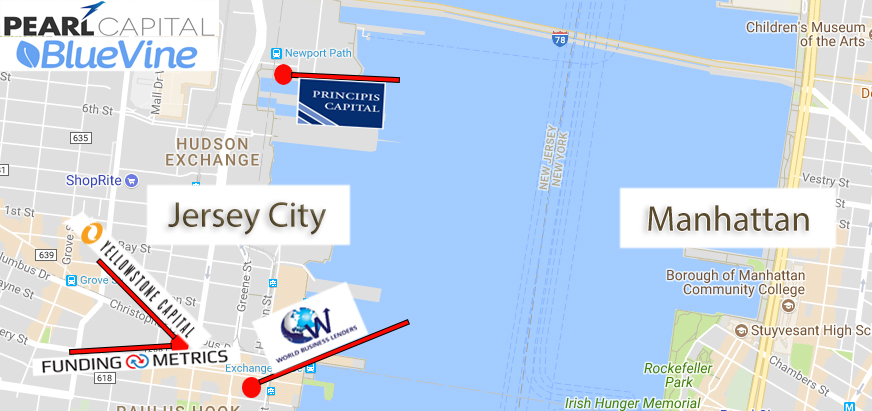 Jersey City is luring yet another innovative small business finance company to their community. This time it’s NYC-based Pearl Capital. According to NJ state records, Pearl was approved on January 9th for a total of $5.6 million over 10 years to relocate under the Grow NJ tax program to boost jobs in the area.
Other finance companies that have relocated to Jersey City, thanks to Grow NJ, are Yellowstone Capital, World Business Lenders, and Principis Capital. But that’s not all, companies like BlueVine and Funding Metrics have also set up operational centers there.
We do not yet know what address Pearl intends to move to.
Technology Drives Changes in CRE Lending Space
December 21, 2017 Online technology, which paved new paths for consumer and small business lending, is making similar inroads with the commercial real estate industry.
Over the last few years, several online marketplaces have been established to try and match commercial real estate borrowers with lenders quickly and efficiently using technology. In the past, commercial real estate lending depended heavily on having local connections, but online platforms are blurring these lines—making geographical borders less relevant and opening doors for new types of lenders to establish themselves.
While banks remain the largest source of commercial real estate mortgage financing, non–bank players—including credit unions, private capital lenders, accredited and non–accredited investors, hedge funds, insurance companies and lending arms of brokerage firms—have become more formidable opponents in recent years. Online platforms offer even more opportunity for these alternative players to gain a competitive edge.
At present, most of these commercial real estate marketplaces are purely intermediaries—they’re matching borrowers and investors, not actually doing the lending. Certainly, it’s an easier business model to develop than a direct lending one, but things could change over time, as borrowers become more comfortable with the online model and develop confidence that these platforms can perform, industry participants say.
 “You have to be viewed as credible with a certainty of funding for borrowers to come to you. You can’t just put up a flag and say ‘Hey we’re making loans’ because borrowers won’t trust you and they won’t have the confidence that the loan is going to close,” says Evan Gentry, founder and chief executive of Money360, one of the few online direct lenders in this space. “However, once you develop a reputation of strong performance, the tide turns very quickly and that confidence is established,” he says.
For now, however, many of the marketplaces say they are content to remain intermediaries and offer business opportunities to lenders instead of competing with them. The sheer size of the market— commercial/multifamily debt outstanding rose to $3.01 trillion at the end of the first quarter, according to data from the Mortgage Bankers Association—and the fact that is an enormously diverse industry with no plain vanilla product makes it more likely that several platforms can co–exist without completely cannibalizing each other’s business, observers say.
Each of the online marketplaces has a different business and pricing model. Some marketplaces focus on small loans, while some have larger minimums; some focus on just debt; some focus on a mixture of equity and debt. Some sites cater to institutional lenders and accredited investors to help fund loans. Other sites invite non–accredited investors who meet certain criteria to participate in loans, opening doors to a segment of the population which previously had minimal access to commercial real estate deals. While the sites differ in their approach, the upshot is clear: banks—while still formidable competitors in commercial real estate lending—are no longer the only game in town for funding these deals.
The struggle for lenders is how to work most effectively with these marketplaces. “If you can acquire customers through only your own channels, then of course you’re going to do that,” says David Snitkof, chief analytics officer at Orchard Platform, which provides data, technology and software to the online lending industry. Otherwise, these marketplaces present a viable opportunity to expand distribution, he says.
GROWTH OPPORTUNITIES ABOUND
The surge of new companies acting as marketplaces between borrowers and lenders of all kinds comes as the commercial real estate industry is finally coming up to speed with respect to technology. The commercial real estate business has been static for decades in terms of how loans are processed and originated, according to industry participants.
“The use of technology is going to be an enormous disrupting force in that space,” says Mitch Ginsberg, co–founder and chief executive of CommLoan, one of the newer marketplaces for commercial real estate lending. Commercial real estate lending is “probably one of the last industries that hasn’t been touched by technology, and it’s ripe for massive disruption,” he says.
CommLoan of Scottsdale, Ariz., was founded in 2014, but the marketplace has only been fully operational since 2016. The platform targets borrowers seeking $1 million to $25 million of capital for all types of commercial real estate loans. It works with more than 440 lenders—including banks, credit unions, commercial mortgage companies, private money lenders and Wall Street firms. Altogether, CommLoan says it has processed more than $680 million in commercial transactions.
Online marketplaces can help make the commercial real estate industry more efficient and transparent, says Yulia Yaani, co-founder and chief executive of RealAtom of Arlington, Va., another new online commercial real estate marketplace. “People are tired of paying huge fees as a result of the market being so opaque,” she says.
RealAtom began operating in 2016 and targets borrowers who are seeking commercial real estate loans from $1 million to $70 million. The lenders on the platform include banks, alternative lenders, insurance companies, pension funds, hedge funds and hard money lenders. The company processed $468 million in commercial loans in its first 11 months of operating, according to Yaani.
Another benefit of online marketplaces is that they “create a liquid, national marketplace where lenders all across the U.S. can bid on a borrower’s business,” says Ely Razin, chief executive of commercial real estate data company CrediFi, which operates the upstart CredifX marketplace. Historically people who own commercial real estate have only been able to get financing through a local relationship with a bank or broker. “For borrowers, this means more certainty of obtaining a loan and optimized capital not limited by the relationship with the local lender,” he says.
CredifX started operating earlier this year to match commercial real estate borrowers, brokers and lenders including banks, finance companies, mortgage companies, hard money and bridge lenders. The platform is for loans of $1 million to $20 million across all major property types in the commercial space. It matches borrowers with appropriate lenders using the information that parent company CrediFi collects and analyzes. The company declined to disclose how much it has processed in commercial transactions.
To be sure, it’s hard to say how the marketplace model will evolve over time and which players will withstand the test of time. Certainly a similar model has faced challenges on the consumer and small business lending side.
“I think the pure marketplace will become more rare as time goes on,” says Peter Renton, founder of Lend Academy, an educational resource for the P2P lending industry. “There are examples of successful companies with a pure marketplace, but they are rare and difficult to scale. The only well-established company that seems completely wedded to the pure marketplace is Funding Circle; pretty much all other companies have switched to a hybrid model of some sort,” he says.
Commercial vs Residential
While much of the recent growth has been within commercial real estate, there are also some marketplaces that cater to residential borrowers or offer a mix of commercial and residential opportunities.
 Magilla Loans, for instance, started out in 2016 as a solely commercial marketplace, but expanded outside this silo because customers were asking for residential and other types of loans, says Dean Sioukas, the company’s founder. The company now connects borrowers with lenders for a whole host of loan types—commercial, residential and others like franchise loans and equipment loans. Lenders on the platform include roughly 130 banks, mortgage loan originators, accredited investors, credit unions and online non-depository institutions. The average loan size is $1.4M for business loans and $500K for home loans. Nearly $4 billion in loans has been channeled through the platform since January 2016; of that 70 percent is tied to commercial real estate, according to the company.
While there are marketplaces that focus on residential mortgage lending, some industry participants say that side of the business isn’t as appealing to new online entrants in part because the cost to acquire customers is really high and there are more challenges to working on a national scale.

“It may not be that commercial is more attractive. It may just be easier. Going directly to borrowers in the residential space has proven harder than many companies expected,” says Brett Crosby, co-founder and chief operating officer of PeerStreet, a marketplace for accredited investors to invest in high-quality private real estate backed loans. Experience seems to suggest that for residential mortgage origination, “it’s much better to have a good ground game and know your local market,” he says.
To be sure, as the online market for real estate matures, it’s not so surprising that companies would shift business models to find their own sweet spot. RealtyMogul.com is one example of a company that has morphed over time. The online platform began operating in 2013 in both the residential and commercial space, but has since moved away from the residential business. Accredited investors, non-accredited investors and institutions can use the platform to find equity or debt-based commercial real estate investment opportunities, and borrowers can apply for private hard money loans, bridge loans and permanent loans.
Money360 is another example of a company that has shifted gears. It started out as a pure marketplace, but changed its business model to become a lending platform in 2014. Now the online direct lender in Ladera Ranch, Calif., provides small-to mid-balance commercial real estate loans ranging from $1 million to $20 million. It’s one of the only companies targeting the commercial real estate space in this way and has closed nearly $500 million in total loans since 2014.
Gentry, the company’s founder, says he would expect to see more industrywide changes as the online commercial real estate business continues to evolve. The key to success, he says, is executing well and “knowing when to pivot when you realize something’s not working just right.”
Ultimately, Gentry predicts more online lenders will target the commercial real estate space. He says technology-based alternative lenders have an advantage because they can operate more quickly and efficiently while still being very competitive from a pricing perspective.
“You put all those things together (speed, efficiency and competitive pricing) and that’s what borrowers are looking for,” Gentry says.
MCA’s Top Social Media Voice
December 18, 2017 LinkedIn has unveiled its top 10 voices for marketing and social media. Fintech did not make the list, but perhaps the social networking site didn’t look hard enough. If they had been following Jennie Villano, who on Dec. 1 joined Kalamata Advisors as vice president of business relationships, that list might have included a nod to the MCA industry.
By most standards she’s a newbie to fintech, having joined her previous employer Pearl Capital only two years ago. But that hasn’t prevented her from making her social media presence known. And while she reserves Facebook for her personal life, if you know Villano then you wouldn’t be surprised at her success on LinkedIn, as she seems to have a knack for social media.
“I felt like I needed a very strong presence in this industry to get anywhere,” Villano told AltFinanceDaily. “It’s funny, I think a lot of people associate sales with a type A personality and being pushy. I’m not an aggressive, pit-bull woman. You don’t have to be that type of woman to get ahead. I thought about how am I going to show this to the industry? Social media was my answer. My Facebook and LinkedIn attract a lot of views.”
Indeed, it was because of her Facebook profile that Villano was featured by a famous painting by David Uhl. The painting, dubbed Steampunk Seduction, is the first in Uhl’s Steampunk series. “I got that through Facebook,” Villano explained. “Someone saw my profile on Facebook, reached out and said, ‘you should contact the artist.’ I told them they were crazy. They insisted, and he chose me. It’s been a blessing.”
Meanwhile, her LinkedIn posts designed for MCA ISOs have similarly caught on like wildfire, and she only “amped up” her activity on the site in July. Villano has been posting on LinkedIn once per week, and the proof is in the pudding. “Since then, in September, October, and November, we broke funding records every month. It works,” said Villano of her previous employer Pearl Capital.

Underpinning that deal flow has been a flow of new relationships she’s forming, evidenced by more than 500 ISOs having contacted Villano on LinkedIn via her previous employer’s Salesforce network.
“That was from posting one time per month and just educating; not posting pictures of me on a beach sipping a Pina Colada,” said Villano. Instead, she was educating them about Pearl’s funding options, the types of deals they wanted, their bonus structure, etc. “So, it’s very basic information. I was just letting them know what they can expect from Pearl, what kind of fundings we were doing, just being a constant reminder,” she added.
While Villano is no longer employed by Pearl Capital, her posts from her tenure there have had a lasting impact. “[Last month] I put up a post announcing that I was leaving Pearl Capital,” Villano said. “The post generated more than 35,000 views.” Meanwhile, since she’s been posting, she’s seen the number of LinkedIn connections skyrocket.
Villano is continuing her social media push at her new employer, Kalamata Advisors.
“Kalamata has a partnership-culture mentality. It’s an amazing opportunity to be elected a partner, like a partner at Goldman Sachs or McKinsey, here after a couple of years. Then you have a real stake in the company and work at a firm where everyone wants to pitch in,” she explained. “Second is their great reputation. The partners put their mission and values first. They’ve grown so fast; but they’ve grown with the purpose to genuinely help people. And lastly, they’re very respected in the industry. Everyone here is very responsive, honest and professional.”
And while she’s no longer employed by Pearl Capital, she has nothing but respect for her former employer as well. The feeling is mutual, evidenced by a going away party that they threw for her on her way to Kalamata.
Gender Gap
 So why isn’t social media more pervasive among MCA market participants? According to Villano, the reasons are two pronged, the first of which is compliance. “It’s very important to make sure we convey ourselves properly,” she said.
The other has to do with the fact that MCA is a male-dominated industry. “Women are more conversationalists through texting or social media. I find women are more intimate with it on a professional level. I have to say that I have the most active social media in our industry,” said Villano, who again only joined fintech two years ago. She’s inspired by the many women who are behind the scenes at ISO shops, many of whom she explained work as processors.
We asked Villano about whether sharing her trade secrets with competitors in the industry made her uncomfortable. “Not at all. I’m not made like that,” she said. “And Kalamata believes trust is the importance of every brand. With transparency, there is trust. Everyone is authentic and unique. Everyone should have the opportunity to share his/her own self in any industry.”
Kabbage Crosses $4 Billion in Loans, Taps C-Suite Exec for Intl Expansion
December 6, 2017
Alternative lender Kabbage is exiting 2017 with a bang, having just crossed the $4 billion threshold for loans deployed across more than 130,000 small businesses so far. The latest milestone represents a 30% spike in both total funding and the number of merchants on its platform since April 2017, which is when they celebrated their previous new threshold. Victoria Treyger, chief revenue officer for Kabbage, took some time to talk with AltFinanceDaily about the latest milestone, international expansion and mobile strategy.
“Our lines of credit and amounts taken continue to increase as we begin serving more and larger small businesses. We see great momentum across all industries in all 50 U.S. states,” Treyger said, adding that the momentum is particularly evident among the restaurant, construction, professional services and automotive industries for funding strategic investments such as new locations, specialty equipment, business expansion, etc. The $4 billion milestone is the result of the company’s direct business in America only.
According to recently released data by Kabbage cited in CrowdFund Insider, nearly three-quarters of 400 small business owners polled are forecasting higher revenues by year-end. More than 50% of those merchants are targeting a jump of at least 10%. Kabbage certainly appears to be benefiting from this optimism and an economy that is functioning on all cylinders. Treyger points to the lender’s “fully automated lending process and unique, live data connections with our customers.”
Fintechs & Banks
The relationship between alternative lenders and banks has been at the forefront, and Kabbage has been involved in some of the most high-profile pairings, evidenced by SoftBank’s famous investment. And while there’s no crystal ball, fintech and bank partnerships are one of the trends that will likely persist in 2018.
“Data will be at the heart of everything, how it’s shared, accessed, applied, protected and given back. Expect to hear more about the personalization of lending and to see stronger partnerships between fintechs and banks,” said Treyger. Consumer data, of course, is the Holy Grail for lenders, with banks having a tendency to keep that information close to the vest. And with the Equifax breach so recent in the rearview mirror, the importance of data security is certainly paramount.
“The CFPB recently published data-sharing guidelines between banks, their customers and financial services they choose to permission their data. Kabbage applauds the CFPB guidelines, small business owners should control how, where and with whom their data is shared to best serve their needs. Security is the primary concern, as it should when handling customers’ data. All entities, from fintechs to data aggregators should be held accountable to the same security standards as banks,” Treyger said.
She also pointed to a mobile push in yet another sign that the industry has turned a corner. “Anticipate greater adoption in mobile lending. Today, approximately 20% of Kabbage’s originations come from mobile. We’re the only provider that allows its customers to apply, qualify and draw funding from a mobile app; we have seen growth and expect to see more in 2018,” she said.
Kabbage’s Global Ambitions
Meanwhile, as Kabbage sets its sights on global expansion, they’ve tapped a C-Suite executive from the consumer goods industry who has held leadership roles across North America, Europe and Asia. Robert Sharpe was tapped for the newly created position of COO at Kabbage. Most recently, Sharpe served as president and COO at National DCP, LLC, a supply chain management company. He has also led CSM Bakery Solutions and Spain’s Campofrio Food Group, serving as chief executive at both companies.
According to the press release: “Sharpe will be responsible for Kabbage’s continued growth and operational oversight as the company expands internationally and scales its services to serve more and larger small businesses.”
As Kabbage readies its 2018 roadmap, notwithstanding its $200 million revolving credit facility with Credit Suisse in November, don’t be surprised to see them revisit the capital markets.
“Continuing to diversify our funding options for small business lending is certainly of interest,” noted Treyger.




























.JPG)