
AltFinanceDaily Presents: The Broker NFT Collection
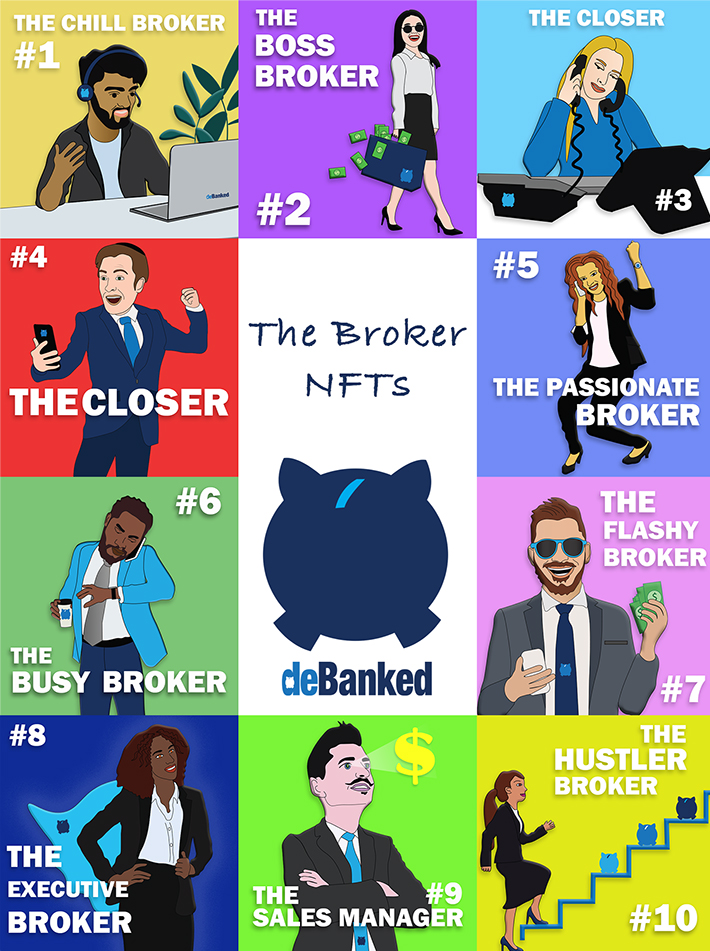
October 26, 2021Watch out CryptoPunks, AltFinanceDaily has minted a limited edition set of its own Broker NFTs.
Drawing from the animated style popular in the NFT community, this collection of ten “brokers” is a diverse light-hearted tribute to the professionals in the business finance industry. Each broker in the collection has been individually minted on the ethereum blockchain.
The artwork was drawn by Cindy Recile and the NFTs minted via AltFinanceDaily’s own ethereum smart contract. (See here on etherscan.)
The other news is that we’ll be giving some of these away for free. (stay tuned for those details!)
Today’s NFT market has things like pixelated punks and bored apes literally selling for millions of dollars.
A jpeg with no picture other than 4 words of text that say: “Fintech is Killing me,” is currently up for sale for more than $400, if that can be believed.
The act of minting an NFT cost Ethereum gas but if there is any particular thing you would like to see AltFinanceDaily turn into an NFT, let us know and maybe we’ll make it happen! Email info@debanked.com.
New York DFS Provides New Guidance on Disclosure Law, 6 Month Delay
October 20, 2021 New York’s Department of Financial Services has provided updated guidance on the impending commercial finance disclosure law scheduled to go into effect on January 1st.
The main news? A six month delay.
“Financiers and brokers shall comply with disclosure requirements six months after the effective date,” the proposals state.
The comment period has also been corrected/extended to December 19, 2021. Comments are to be directed to George Bogdan at DFS.
The regulation’s draft has been amended as well and can be VIEWED HERE.
Pandemic-Induced Pivot Results in Innovative Lending Software
October 15, 2021 “What the hell are we going to do now?”
Kunal Bhasin, CEO of 1West, saw the light at the end of the tunnel for his business in March of 2020. Instead of closing his doors and pursuing other options in finance, Bhasin held strong and began developing a product that was merely an idea prior to his business’s abrupt halt.
“I made the decision at that point when everyone was running, I hired two full time engineers. I said hey, I’ve had this idea for a long time, the whole company has had this idea for a long time, we just never had the time to implement, and then all we had is time because we [weren’t] closing that many deals.”
The idea, a software called ABLE (Automated Business Lending Engine) is a platform that minimizes the lapsed time that occurs in the funding process. “There were deals all over the place in different people’s inboxes. And then those people would have to put those deals into our processors, which created huge gaps of time,” said Bhasin.
“We needed to centralize the deal flow. Whether the deal is coming from a partner, or the deal is coming from a customer, [we needed] a centralized place where a customer could land and start completing the process.”
With the help of his former college roommate, engineers, and staff, Bhasin put his idea to fruition— and ABLE took off. “We rolled up our sleeves and spent the better part of the last 16 months building it, and now the largest percentage of my time devoted to running 1West is on the software and the platform.”
Bhasin claims that his product gives his company a huge competitive advantage, as he is able to use AI to evaluate, process, and determine the type of funding and through which lender is best on an individual basis.
“[ABLE] really shrinks that entire gap time so when the lenders get in early morning, when the funders get in early morning, our stuff is always in queue, and it’s created really nice returns on the amount of customers we’re getting and the amount of deals we’re funding.”
The automation of the application process has allowed potential borrowers to not only find the ideal package for their needs, but allows them to apply for different types of capital streams, something that would take tons of manpower and time without the ABLE software.
“Greater than 90% of the customers who come into ABLE apply for more than one product,” said Bhasin.
When asked about if there were any plans to license the product in the future, Bhasin was hesitant to give a definite answer for the future of his creation. ABLE is already white labeled by 1West for brokers.
“Maybe,” he said, I want 1West to reap the benefits of it for 6-12 months and fix all the tweaks we have to make. We have a lot going on.”
Small Business Finance Industry Mulls Crypto, NFTs
September 16, 2021 As the crypto craze roars on, NFTs are starting to stake a claim in the finance world as a legitimate option for those looking to invest or stash money in a virtual space. The sports world recently took their swing at NFTs, and here at AltFinanceDaily we minted NFTs of our own early this week. It seems that NFTs have sparked the interest of the media, athletes, and art enthusiasts— but in small business finance, the conversation is only in the early stages.
“I think of it more not so much as a currency, but from what I’ve been reading, more of an investment vehicle,” said Noah Grayson, President of South End Capital, when asked what he thinks an NFT represents. “It’s a way for people to put tangible items in a digital format to get ownership from.”
Grayson says those in his industry have brought up the topic around the office, but it hasn’t made its way into any type of business practices yet. “It’s tough to see how [NFTs] would affect the lending industry at this time, cryptocurrency is something a little more probable in the long term.”
Grayson stressed how difficult small business lending can already be with dollars, and it seems as though the industry just isn’t ready to start conducting business in other types of currencies. “When you consider that many small business owners have no credit score and a large portion of those still pay for things in cash, I think it’s going to be a long time before the industry as a whole considers [crypto] an option to make loans with or compensate partners [with] as a whole,” he said.
“I’d describe it as a digital asset that can be purchased, owned, and used by an individual, giving that individual exclusive rights to the asset,” said James Webster, CEO and founder of ROK Financial when asked how he would define an NFT. “Like any other asset, the price can go up or down over time.”
Although his company has never created an NFT themselves, Webster won’t eliminate the possibility for one in the future. With the interest of the industry and his employees being focused around crypto as of late, Webster can’t keep the crypto and NFT talk out of the office.
 “We have a [clever] and nimble-minded staff at ROK. NFTs and crypto like other tradable assets are always being discussed and invested in here,” said Webster. “The team has been buying crypto for years now and I don’t see that slowing down any time soon.”
Webster believes it’ll inevitably make its way into the business with positive effects. “I see it streamlining, as well as making lending and banking for that matter more efficient over time,” he said.
At Velocity Capital Group, crypto has already seeped into the business. The company began offering commission payments to brokers this past August with an immediate positive reception. Velocity Capital Group CEO Jay Avigdor attributes “speed” as the primary use-case of crypto in his business.
“The feedback has been fantastic!” Avigdor said.
With crypto on the minds of fintech gurus everywhere, it’s evident its interest comes from the ability to put the technology in practice. Until these types of things can be borrowed, used to buy goods, or seen as a means of collateral at a mainstream level, the small business finance community will continue to eye their development and evolve if necessary.
Cannabis Boom Exposes Difficulties in Lending
September 15, 2021 The legalization of cannabis across the U.S. has exposed an interesting opportunity for banks and small business lenders. With tons of capital, insane amounts of cash flow, and an industry outlook that couldn’t be better, banks and lenders should be swarming in droves to get their hands on a piece of the legal marijuana action. Seemingly a match made in heaven, lenders and cannabis cultivators are running into some serious trouble when it comes to how the cash crop operators manage their businesses’ finances.
“We had too much cash to keep in one place,” said Charles Ball, the owner of Ball Family Farms, a wholesale grow operation based in Los Angeles. By stashing cash in different safe-houses around LA, Ball had to operate his completely legitimate and legal business like an illegal operation. “Traditional banking wasn’t an option for us,” Ball said.
“We used to drive the cash around,” said Ball. For recent renovations of lighting fixtures, Ball had to pay $125,000 in cash to the company who did the service for him. Ball also paid taxes in cash, a process in which he had to walk into a Los Angeles government building with $40,000 cash on his person. At the time, there was no bank that was willing to hold the cash for him — even for tax purposes.
Prior to going fully cash, Ball did do business with some big banks, but he realized quickly that they weren’t interested in servicing his cash upon learning what his business was doing.
 “They closed my account for wearing a shirt with my business name on it, they put two and two together,” said Ball, when referencing the closing of two accounts with Bank of America and Chase after representatives of the banks saw him wearing his company shirt to make deposits. One of the biggest difficulties of running a cannabis distributor isn’t the growing or the distribution of the product, it’s what to do with the money, according to Ball.
“We had no way of banking,” he said, up until February of this year, when he was able to secure his first type of deposit account with a local bank in the Los Angeles area that was fully aware of what his business was doing. “I have to pay more fees, and I don’t get the same type of customer service, everything is different,” Ball said.
With service fees on his deposit account between $2,000-$3,000 per month, the security of doing business with a bank must be worth the price. When pursuing a loan with that bank to expand his operation however, the lending process was halted at the last second after federal regulators told the bank they wouldn’t allow the deal to go through.
“We were denied on the approval date [of the loan],” said Ball. According to him, the bank told him the FDIC stepped in and killed the deal. Once again, Ball Family Farms was forced to explore other options outside of banking, such as exploring renovation options through landlords or simply waiting until the cash is on hand to make the move. “The banking system in this industry is very flawed,” said Ball.
“We’ve never taken private investor money,” Ball said when asked about whether he had explored any other avenues of receiving a loan. “We took [the start] slowly and it works, we are a ground up operation.”
This problem is not unique to Ball Family Farms. Legal cannabis cash flow has been a major issue since legalization first took place in the states. It seems like local governments want the tax revenue, but the bank’s regulators want to make it difficult for lenders to get their hit off the cash pipe until the federal government changes the law on their end.
The opportunity for funding in the industry isn’t going unnoticed however, as cannabis-exclusive funders and brokers are beginning to pop up across the U.S.
Judy Rinkus, for example, CEO of Seed to Sale Funding, is a Michigan based broker who works exclusively with cannabis businesses.
 “[The industry’s] biggest problem is simply finding a lender who isn’t prohibited from lending to cannabis-related concerns,” said Rinkus. According to her, one of the biggest issues is the infancy of the industry, as many cannabis wholesalers and retailers just haven’t been around long enough to be reliable borrowers.
“Most businesses have been established for 3 years or less, they haven’t kept good financial records, and accept a lot of cash payments, and they lack sufficient collateral,” Rinkus said.
Rinkus stressed the importance that real estate plays in giving cannabis businesses borrowing power. “Having real estate to pledge as collateral is key,” she said. “There are ways to get other types of loans, but they are often enormously expensive and are limited to no more than 10% of an entity’s historic revenues.”
Rinkus’ outlook on the industry remains positive, and she remains a supporter despite the difficulties associated with cannabis lending. “Businesses in this space are the true American entrepreneurs,” said Rinkus. “In many areas of the country, they are creating jobs and wealth for folks that would otherwise not have the same chances.”
The outlook on the industry is bright. More states are pushing for legalization, social taboo of marijuana is relatively nil, and the potential of an untapped industry in the eyes of both government and banking are becoming too good to pass up. As the industry begins to cultivate its presence, look for the money surrounding cannabis to creep its way into fintech sooner than later.
SEC Mentions Ban of PFOF, Robinhood Suffers
August 31, 2021 SEC Chairman Gary Gensler told Barron’s on Monday that a ban of payment for order flow (PFOF) may soon be implemented by regulators and the controversial business model for companies like Robinhood may be coming to an end.
Gensler has gone on record as an opponent of PFOF, where wholesale market makers send client orders to brokers in exchange for a fee. Gensler and many other regulators have claimed that the PFOF business model is a major conflict-of-interest.
In response to the release, Robinhood’s stock fell to $43.64 per share shortly after Gensler’s thoughts were publicized. A nearly 7% skid in price may be the tip of the iceberg for the company if the SEC does indeed have plans to end PFOF. Robinhood’s business model of zero-commission trading may have to be reconstructed should something like this occur.
The PFOF model was heavily criticized in February during the federal hearing regarding Robinhood’s trading limits to counteract the GameStop short squeeze. Robinhood CEO Vlad Tenev was criticized at the hearings by the House Financial Services Committee in regard to how the PFOF business model supported biased relationships with companies like Citadel and Melvin Capital during the controversy.
Despite the overall success of Robinhood’s shares since going public earlier this month, the group has had some recent roadblocks besides the latest regulatory sentiments. PayPal is considering a stock trading platform in the United States, sources say.
With federal regulators and new competition breathing down the company’s neck, Robinhood may be due for drastic changes sooner than later.
Enova Originated $400M in Small Business Loans in Q2
August 3, 2021 Enova, the international lending firm that owns the OnDeck brand, reported Q2 small business loan originations of $400M. That brings the year-to-date figure to $722M, approximately half of the volume OnDeck was producing prior to Covid. (OnDeck’s 2019 originations were $2.475B)
“OnDeck’s performance continues to exceed our expectations,” said Enova CEO David Fisher during the quarterly earnings call, “and we will easily exceed our forecast of $50 million of annual cost synergies, primarily from eliminated duplicative resources, as well as $15 million in run rate net revenue synergies.”
Cash has also come pouring in.
“…While we originally thought that OnDeck’s legacy portfolio would have very little value, we now expect to receive over $220 million of total cash from the acquired portfolio, net of securitization repayments,” Fisher said. “In fact, we’ve already realized over $100 million from the legacy portfolio.”
Although ISOs (aka brokers) will remain an important part of driving OnDeck’s growth, Enova is happy that OnDeck brings more to the table.
“The good news about OnDeck, is at least they had a direct channel and a pretty good direct channel because of their terrific brand on the small business side, where our small business products had no direct channel,” Fisher said. “It was all through ISOs. So, we gain that capability through OnDeck.”
Enova reported $80M in net income for the quarter on $265M in revenue.
Velocity Capital Group Becomes First Funder to Offer Broker Commissions Via Crypto
August 2, 2021 Velocity Capital Group is bullish on crypto as a means of payment. Company President and CEO Jay Avigdor told AltFinanceDaily that the company is officially incorporating cryptocurrency in two ways:
(1) Brokers can now choose to get paid commissions in cryptocurrency instead of cash.
(2) Merchants can now choose to get funded via cryptocurrency instead of cash.
In both cases, Avigdor touted the speed in which cryptocurrency can change hands versus waiting around for an ACH or a wire.
“Our goal since day 1 of VCG, was to give ISOs and merchants the ability to access capital as fast as possible,” Avigdor said. “With VCG’s proprietary technology, we have been able to change that mindset from ‘as fast as possible’ to ‘the FASTEST possible.'”
The company says it will use stable coins (USD Coin and DAI) to conduct these transactions “in order to limit market volatility” but that depending on the merchant or ISO relationship, they would be open to transmitting Bitcoin, Ethereum, etc.
Merchants getting funded with crypto would still have their future receivables collected via ACH so that part of the arrangement would not change. The underlying business is the same.
VCG alluded to there also being potential tax benefits of taking payment in crypto.
Avigdor believes that among industry peers, VCG is the first to offer commissions in crypto. He further explained that this is only one piece of the puzzle and that there are plans to integrate the company’s technology in a way that will allow merchants to access funding in less than 20 minutes from the time of submission to funds actually being received.