
Deja vu? Merchant Cash Advance in Wall Street Journal
August 10, 2011 Have you ever had a deja vu moment where you feel like something has happened already even though it hasn’t? And then all of the sudden it happens? Yeah, we just got a little of that. Or maybe we’re just psychic.
It was just a couple months ago that we published a scathing editorial on the failure of the Merchant Cash Advance (MCA) industry to reach mainstream acceptance. (See: The Colossal Marketing Failure of the Merchant Cash Advance Product – June 28th, 2011). Most of our readers acknowledged the shortcomings but were at a loss for suggestions to overcome them. ISO&Agent Magazine quickly added their two cents by claiming that MCA was waiting for its big moment (See: Cash Advances: Negotiating a Maturing Market – July 26th, 2011) but completely missed the mark when they identified cost as the obstacle holding it back. It’s not cost, it’s communication.
How often is MCA cited in mainstream news publications? Wall Street Journal? New York Times?
-direct quote from our piece on June 28th
Today we can say that Merchant Cash Advance got its mention in the Wall Street Journal. :::Applause::: Though it’s only in their blog section, most people today get their news online anyway. The article features AdvanceMe, the largest and oldest player of the bunch. So how does the glorification of one company carry over to the industry as a whole? There were a bunch of good messages in there that describe the product itself: The article title implies it’s becoming more popular: “Cash-Advance Demand Rising” A description of how it works: “Merchant cash advances, which first appeared about a decade ago, provide capital in exchange for a share of future debit or credit-card sales. As such, they tend to be used by retailers, restaurants and other small businesses where a large number of customers pay with cards.”The common uses for it: “Business owners use the cash to buy new equipment, restock inventory or pay off debt” Yes, Yes, and Yes. Good for AdvanceMe and good for the MCA industry but this is only the beginning.
Every business owner should be aware of MCA, not just the ones that read the Journal today. It is Un-American (Yeah, that’s right) to withhold information from business owners that may enable them to capitalize on opportunities. With no bank loans available, most projects in this country are on hold. It’s simply not fair. We badly want to take the credit for today’s Journal mention, especially since we delivered our two previous articles on this topic to their editors in July. But the real hero here is AdvanceMe. Their press release the day before clearly caught the attention of the mainstream media. Great job guys. And we’d be remiss if we didn’t point out they forecasted an increase in funding by $1 billion in the next 2 years. That’s about equal to the industry’s entire volume combined. Is Merchant Cash Advance about to hit its growth spurt? AdvanceMe seems to think so. If they’re about to have their ‘moment‘, they’ll likely pull everyone else along with them.
– AltFinanceDaily
../../
Merchant Hash Advance
July 16, 2011
Short on capital? Your business may benefit from a Merchant ‘Hash’ Advance. Restaurants, retail stores, and auto repair shops can easily obtain funding, but medical marijuana dispensaries need love too.
A few cannabis related deals have floated around the Merchant Cash Advance (MCA) industry before, but rarely do they close. At best they elicit a few chuckles from underwriters, who will likely make a few juvenile jokes before turning down a viable, serious, and legal business. The store owners walk away frustrated but neither side is to blame.
In states like New York, where many MCA powerhouses reside, marijuana of any kind is illegal. That makes the sale of it for medicinal purposes in states where it’s legal a foreign concept. We spoke to an underwriter of one Long Island, NY based MCA firm who shared this: “I’ve eaten dinner at a restaurant and I’ve bought flowers from a florist. I understand what makes both businesses tick. I’ve never been to, nor met anyone who has been to a medical marijuana dispensary. I don’t really know what the transaction is like, what risks they face, what their profit margins should be. It’s a big unknown. Is it easy for a dispensary to lose their license and suddenly go out of business? Are there laws that prohibit outside financing? Do we need to keep tabs on where they obtained their inventory from? We typically call a restaurant’s vendors prior to funding to ensure they’re in good standing. I would feel a little weird calling up a weed farm for a reference.”

And he’s not the only one that feels that way. Banks do too. Funding aside, evidence shows cannabis related businesses stuggle to fulfill basic needs such as opening a bank account or accepting credit cards. According to a report by creditcards.com, it’s not uncommon for their checking accounts to be closed without warning, sending the business scrambling for help elsewhere.
But the situation isn’t all grim. We interviewed Nick Emerson, the Managing Director of 420 Card Processing in Campbell, CA (420 CP), a firm that’s changing it all. 420 CP not only provides card acceptance services to medical marijuana dispensaries but can also connect them with access to capital.
Using the concept of MCA, 420 CP and their funding partner will provide actual loans based on credit/debit card processing volume It’s a joint partnership. (Sorry couldn’t resist!). And there’s great news. The typical easy criteria that made traditional MCAs so popular still applies. So long as the license to sell medical marijuana can be proven, dispensary owners have the same odds of being approved as a restaurant would.
So the oportunity is there and the target market is bigger than most people think. According to Nick, “Medical marijuana is legal in sixteen states and DC to the best of our knowledge. Those states are: AK, AR, CA, CO, DC, DE, HI, ME, MI, MT, NV, NJ (still pending), NM, OR, RI, VT and WA. Some of these states are in the throes of evaluating how to implement the ballot measures that were passed and they do not all enjoy the same structures.” But once the ground rules are in place, it’s business as usual. “We have faced no problems as our company is dedicated to providing credit card processing services solely to the medical marijuana industry. As you can imagine, our clients love us.”
Add that to the ever growing list that the Mechant Cash Advance concept is being applied to.
- Damaged Credit? Funded!
- Short Time in Business? Funded!
- Restaurants? Funded!
- Retail Stores? Funded!
- Auto Shops? Funded!
- Las Vegas Casinos? Funded!
- E-Bay Stores? Funded!
- Medical Marijuana Dispensaries? Funded!

Short on capital? If you accept electronic payments, someone somewhere is willing to provide cash against those future sales. No matter what you do…
– The Merchant Hash Advance Resource
###
About 420 Card Processing
420 Card Processing was founded by card processing professionals, with decades of combined experience, who are committed to equal access and opportunity for those involved in all aspects of providing medical marijuana to patients in states that have legalized its use. 420 Card Processing provides services to retailers, wholesalers, suppliers of gardening equipment, and physicians. 420 Card Processing is a member of Americans for Safe Access, California NORML and the National Cannabis Industry Association.
For more information on obtaining a merchant account or funding from 420 Card Processing, contact Nick Emerson:
Sales@420cardprocessing.com
(800) 579-1675900 E. Hamilton Ave.
Suite 100
Campbell, CA 95008
Yellowstone Capital Has Record Month June 2011
June 30, 2011
From what we’ve heard, June was a pretty fabulous month for the Merchant Cash Advance business. How good is fabulous? According to Yellowstone Capital‘s facebook announcement, they did 435 deals for nearly $7 Million. Holy Smokes!

Great work guys! America’s small businesses are fortunate to have a source of capital.
What was your opinion of June? What’s your outlook for 2011? Write to us at webmaster@merchantprocessingresource.com
Merchant Cash Advance Diminished by Growth of Payment Technologies
May 15, 2011
Technology will be the end of us all
When bank lending dried up, Merchant Cash Advance (MCA) providers fulfilled the need to keep America’s small business owners going strong. By withholding a percentage of each credit/debit card sale automatically, there was no need to worry about a client’s ability to make payments. Without the risk of late payers or non-payers, MCA providers singlehandedly eradicated credit score from the underwriting guidelines. Or so they thought.
Only a small percentage of businesses in default actually close their doors. Circumventing the MCA provider’s merchant processor or incentivizing customers to pay with cash are issues that have plagued the industry for years. While this would constitute a clear breach in the sale of one’s future receivables, it’s not always a deliberate act of malice. However, there is a direct correlation between the frequency of breaches and *surprise* declining credit score.
But in the instances without malice, such as if damaged POS equipment prevents the flow of processing, there’s not much a MCA provider can do other than help fix it. These gaps in collection affect the bottom line and lead to upward pressure on costs or tighter restrictions on approval, two outcomes that nobody wants.
And as if there already wasn’t a strain, changes in payment technology are quickly eroding the MCA industry’s turf. The credit/debit card sales of a business aren’t exactly limited to one of these:
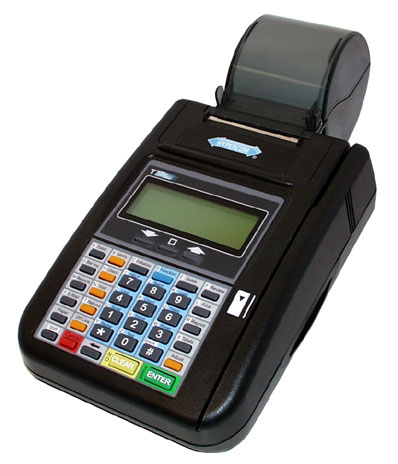
Now there are options, lots of them. In today’s world you can accept electronic payments with almost anything, a conundrum for MCA providers aiming to collect a percentage of all of it. And how about those routine PCI compliance upgrades? There are countless businesses with a basement full of old credit card machines that could be plugged back in, put back into service, and freely used to circumvent their financial obligations.
Take this clothing retailer for example. She qualified for an advance of only $5,000 but when it came time to convert the merchant account, the process wasn’t so easy:

Nearly all of the transactions conducted inside the store happen through the touch screen POS. The merchant statements reflect consistent historical sales of nearly $4,800 per month, instilling the belief that the future won’t be much different. But when the customer lines get too long, there’s a backup credit card terminal that they pull out from under the counter that still has an active account with a previous processor. Around the holidays, they dig out the old Tranz model terminals from the basement and use them too. For street fairs and trade shows, they attach their Square to their iPhone and process on the go. And when it comes to their website and Ebay, PayPal is their preferred method of payment.
This doesn’t mean the touch screen POS won’t continue to see $4,800 worth of action per month, but the situation doesn’t inspire a lot of confidence if the goal is to collect a percentage of their credit/debit card sales. What if they occasionally use Square inside the store? What if phone orders are punched into PayPal? These things may happen inadvertently or simply because their customers demand it.
To firmly secure a purchase of future sales, the MCA provider would need to do the following:
- Convert the touch screen POS system (which will very likely come with a fee from the POS reseller)
- Reprogram their backup terminal
- Reprogram all the old terminals collecting dust in the basement
- Force the return of the Square and replace it with their own iPhone processing attachment
- Delete PayPal from the HTML of the business’s website
- Instruct them to stop conducting business on Ebay
- Cancel the PayPal account altogether and replace with an authorize.net virtual interface or something equivalent

That’s a lot of effort for $5,000 but doing anything less is a gamble. That’s another reason why MCAs are more expensive than bank loans. Without set fixed payments, they are extremely vulnerable to economic ups and downs and now the explosion of payment alternatives.
Rather than stay ahead, the industry is becoming more fractured as evident by the rise of new funding sources such as Kabbage, that lends against future PayPal sales. It’s innovative but vulnerable. Kabbage depends on the success and status quo of PayPal for survival, a characteristic that is not likely to carry them far. Similarly, MCA providers are dependent on withholding a percentage of future sales, an uneasy task in a world where the point of sale itself is changing.
Innovation in the MCA space has gone as far as automated bank debits and a lockbox. One depends on the merchant’s use of a single bank account and the other is equally exposed to the issues we’ve discussed.
Which of course begs the question: If electronic payments are becoming more elusive to capture, how can the MCA industry survive? The obvious answer is to transform the product itself into a loan. Secure it against collateral and have the credit bureaus at your disposal. Breaches will become far less likely and electronic payments less elusive when there are actual consequences involved. It’s a dreaded word and one MCA representatives have spent years avoiding, but according to the state of California, it’s probably a loan already anyway.
As MCA providers struggle to keep up with payment alternatives, banks are wondering when we’ll all wake up from the “it’s not a loan” euphoria. If the goal is to provide capital and get more back, reprogramming a terminal isn’t going to cut it. How many free hours can America Online offer to bring people back to their dialup internet service? Technology changed and the age of AOL ended. So too may the age of Merchant Cash Advance…. at least in its current form.
– The Merchant Cash Advance Resource