
How a Former Banker is Servicing Clients that Turned Down Alternative Funding Offers
December 15, 2021 What do brokers do with the clients that don’t want to pay the costs of an alternative product, but are still too underqualified for traditional financing?
Juan Caban, CEO and Co-Founder of Financial Lynx, has leveraged his interpersonal relationships as a former banker with his passion for networking and his discovery of a niche type of client into a business that is now spread across 44 states. Lenders aren’t the only ones turning down deals, the applicants do too, he says.
Caban built a referral business by talking to people, being an active member of the industry, and taking advantage of pandemic-induced halts in business to research the best ways to serve a section of business owners that prior to Financial Lynx, were either using less attractive products or never taking on financing at all.
“I’m a big networker,” said Caban. “I always go out, I meet a lot of people, I always get referrals from a lot of different areas.” He spoke about how as a decade-long banker with major banks, he knew right off the bat in his career that traditional financing was excluding financially-sound merchants who weren’t meeting overzealous bank qualifications.
“I would meet people who want to do business with me and I would present it to my bank, but it was always a challenge,” Caban said. “You want to help out a client, but you’re limited to the credit appetite of the bank that you are working for. After getting frustrated and declining a lot of clients, I wanted to seek out how I can help these clients out.”
After leaving the traditional finance world in 2019, Caban began work at an alternative lender, where the doors to a variety of new options opened up for him.
Caban still felt limited in his abilities to get deals done because of the confines funders mandate through their qualifications, and left to start his own company within seven months. After seeing a market in financing for merchants who fall between the high risk and traditional financing qualification threshold, he began talking to people across the financial community about what products exist for these types of clients.
“I used my banker network, I probably know about 200 bankers here in New York, and I started asking them, ‘hey, do you have a program in your bank that can help this type of client?’” Seeing that merchants with good credit and no desire to pay a 40% cost of capital were being pushed aside throughout the industry, Caban decided to pursue a business out of servicing this type of merchant.
“What I found was that there are some banks out there that as long as [the merchant] has a 700 FICO score, has been in business at least two years, and are considered to be in a preferred industry, some banks are willing to lend in some cases 20% of annual sales, up to $250,000, with just an application and one year of tax returns.”
The lending services being provided through Financial Lynx based on these qualifications are bank lines of credit that revolve and renew annually.
Caban described the qualifications for this type of financing as a look into the business owner themselves, and not as much into the business. “[These banks] focus on you as an individual and if you have personal credit.”
The concept took off.
“I started working exclusively with one MCA broker shop, they were calling hundreds of businesses a day,” said Caban. “They were trying to sell [merchants] cash advances obviously because it is a very lucrative commission business, but anything that was non-cash advance, or didn’t fit the cash advance space, or merchants who wouldn’t accept the expensive cash advances, they would refer that client to me.”
The twist is that the banks don’t pay him a commission so he has to charge a fee to the merchant once the financing is completed.
“At the end of the day I feel good because I am providing the client with something that they couldn’t find on their own,” Caban said. “So I am helping the client, and almost 100% of my clients are satisfied with what they have, because they’re getting cheap financing, 5% instead of 30% money, so even with my 10% consulting fee to connect the client, it’s still 50% cheaper than what they would’ve gotten in any type of cash advance.”
The biggest hesitancy Caban sees from alternative finance companies in terms of working with his niche product and client is the patience required in dealing with bigger banks. “Everything is quick in MCA, [brokers] get approved today, get funded today, and get paid tomorrow. I say look, I can provide the client what you’re looking for, but it is a three week process.”
“The ones that say, ‘hey we want to do what’s best for the client,’ they buy into it, they send us referrals on a constant basis,” Caban continued. “The ones that say ‘it’s taking too long, they’re not into it’ and I tell them ‘you’re going to lose that client eventually.’ As opposed to losing them, make some money out of it before you leave them.”
Trying to convince the legitimacy of his product seems to be part of the daily ritual for Caban. “Having a bank line of credit is considered a unicorn in the industry. Everyone says that they have it, but it’s not really a line of credit. We’re actually providing true lines of credit. It’s truly a revolving line of credit.”
“It’s always a thing where it’s like, are you for real?”
MCA-Centric Fintech Looks to Continue Expanding into US Market
December 14, 2021
“I had an ISO once ask me if our software was for real. He was like, ‘Can it really do all that?’”
SysArc, an Indian fintech company that has branched into the US market via Texas, attended Broker Fair last week in order to pitch their product to the industry’s head honchos. The company offers software specifically catered to each component of the MCA process. With software program names like FUNDperfect and ISOperfect, AltFinanceDaily was all ears.
“FUNDperfect, is a highly configurable solution with an exceptional capacity to adapt and is function-based on diverse organizational needs,” said Pria Chandrakumar, Vice President of Customer Engagement at SysArc, and winner of 2021 Fintech Woman of the Year in India. “We have a merchant portal where merchants can submit an application online, upload documents and even authorize bank verification so bank statements can be automatically pulled.”
When asked about the company’s thought process on creating an MCA-focused software, it appears as if SysArc came upon a niche after casting a net into the greater finance world. “[We’ve] always had a strong presence in the US servicing banks, credit unions, FHLBs, and MCAs,” said Chandrakumar. “We are experts in lending and cater to all forms of lending right from real estate, mortgages, personal loans, [and] small business loans.“
The biggest difficulty it seems for fintechs across the space, including SysArc, is trying to explain how tech can be useful to an industry that has been dominated by sales tactics and practices that go back generations. Chandrakumar spoke on some of reasons that make brokers and funders who operate in old-school sales mentalities hesitant to adopt fintech.
“Common misconceptions [among MCA] are affordability, complexity of software, loss of commission and mostly ignorance of what technology is capable of,” said Chandrakumar. “Brokers and funders must understand that the fintech industry has come a long way and has solved most of their operational problems.”
“The software also plays a huge role in reducing the risk since first level scoring and underwriting is done by the system, avoiding any human errors,” Chandrakumar continued.
FUNDperfect seems to be flexible in nature, so much so that it is broken down into smaller modules if needed, allowing ISOs and funders to pick the modules they need.
“ISOs can get just the brokering piece of the software called ISOperfect,” said Chandrakumar. “This takes the application through the point of selecting an offer and passing it on to the funder.”
After talking about plans of further expansion into the American market, Chandrakumar reiterated SysArc’s value in their gameplan of how to sell it here in the states. “We will use technology to make MCA financing quicker, while at the same time reducing the risks associated with funding by sharing data on merchant, ISO, and funder performances; so companies can make informed business decisions.”
Citi Uses Branding and Fintech to Bring Merchants Directly to Funders
December 3, 2021 Citi’s release of Bridge, a virtual loan broker offering merchants a three step process to apply for capital through over a dozen banks, has branched out across seven states and is continuing to grow four months in— according to recent LinkedIn posts from Citi employees.
“I am excited to announce I have been working on a new and innovative platform along with the Citi team for the past few months!” wrote Caitlyn Boyle, Assistant Vice President and member of the team who designed Bridge. “I am extremely proud to be part of such an amazing team, and to assist in building out a great platform to connect small and medium sized businesses with local, regional, and community banks.”
“If you are looking for a loan, do not hesitate to visit our platform!” Boyle wrote.
Richard Banziger, Head of Citi’s U.S. Commercial Bank, commented during the launch of the program about Bridge’s potential to not only improve the application process for merchants, but how the program gives access to capital that will be given to minority business owners who may have never been able to get access to that capital in the past.
“Citi believes in the power of local, small businesses and continues to find ways to support businesses that are the foundation of communities across the U.S. Citi funded loans totaling more than $5 billion as part of the Small Business Administration’s Paycheck Protection Program during 2020 and 2021.”
“As both a lender and a community stakeholder, we have a deep understanding of the problems businesses face when trying to navigate the borrowing process” said Banziger. “We are committed to finding digital solutions that can make the process easier, more seamless and more equitable.”
According to Citi, Bridge’s goals are broken down into five points. They hope to create liquidity and access to capital, modernize and automate prospecting, add digitization, transparency, and standardization to the loan process, continue to digitize small and medium sized business lending, and democratize the loan process for lenders and brokers.
“Citi prides itself on encouraging a spirit of entrepreneurship among its employees to solve financial access issues and improve digital offerings for our clients and community partners,” said Vanessa Colella, Citi’s Chief Innovation Officer.
Loan options range from as little as $100,000 to as high as $10,000,000.
The Broker: A Sister Duo Gets Borrower-Centric
November 29, 2021
When the company she worked at was halted by pandemic woes, Porsha Brooks, then an MCA salesperson, was asked by her sister Mercedes how they could get together and pick up where her other company left off. “My sister approached me at that time saying, ‘well what is it you’re doing, I want some action in that’, then I said, ‘that action is kind’ve drying up— but we can do our own thing, we can start our own business.'”
“So, that’s what we did.”
While offering a suite of loan options to their clients, Porsha spoke with AltFinanceDaily about how her experience in sales, combined with her small business finance knowledge, has powered the creation of a borrower-centric lending product through their company, Brooks Partners Finance.
“As far as MCAs go, I’m not pro or against it, but at the same time, I know what they are,” said Brooks. “The industry for the most part, every MCA [funder], every broker, is pushing MCAs. Everyone is pushing MCAs. But I see that it really does do a detriment to businesses and business owners.”
Although Brooks Partners still writes MCA deals, that’s only if that is the best option for the client at that time. Brooks claims her company’s business model isn’t to push businesses into whatever type of loan makes sense for her company, but rather the opposite, using different types of tools to figure out exactly what loan is best for the borrower.
“If I have every option for that individual, I don’t have to push them into an MCA,” Brooks continued. “I can still get paid, and still do right by that business owner.”
When speaking about her past work, Brooks spoke about how coming up in an all-male environment was actually a motivating experience.
“They quickly judged, saying ‘you know, she’s a woman, and she’s probably not going to last here for too long, because they normally don’t’ and it turns out I did,” said Brooks. “Three months in, I rose to be one of the top salespeople at the firm. Within that time, I got the attention of both partners at the firm, and I would say about a year in, I was promoted to head their new banking department.”
But when the pandemic slowed the business down, it led to the genesis of Brooks Partners Finance. “I already had certain contacts, I had my foot in the door, and I had a taste for bank loans,” said Brooks.
“I’d say the biggest moneymakers for us are SBA and conventional [loans],” said Brooks. “We have a range of banks that we work with and we are able to give to individuals, not just existing businesses, but startup businesses too. We’ve learned the SBA world like the back of our hand. We’ve been studying this for several months, we basically have to know everything about how to get somebody approved for an SBA.”
With access to these types of loans being notoriously difficult for small businesses to qualify for, Brooks spoke about how teamwork between a broker and a merchant can lead to a plan for approval.
“We’re different [from] most brokers in the industry; we’re very, very hands on here. We stay on from the onset until the funding process. Now what we’re doing is we’re holding our clients’ hand. We’re telling them how they can get qualified, taking them through that process, we’re working with the lender, and not letting the lender cut us out.”
“We make sure that we stay in our lenders’ faces for our clients’ benefit,” Brooks continued. “Making sure we are always a part of that process and making sure things go smoothly, so we do get a lot of SBAs and conventional loans done.”
“I’m not just the ordinary middleman, I am supposed to help [my] client and guide them to their best loan option for their business,” Brooks continued. “If I don’t know where I’m sending them or don’t know if they’re going to be qualified, I am doing them a crazy disservice to my client. That’s where we differ.”
Broker Fair Ticket Registration To Shut Off Any Day Now
November 28, 2021 Broker Fair 2021 ticket registration will shut off days before the December 6th event. The broker-centric conference is now officially counting down to its kickoff at Convene in New York City.
“This pretty much happens every time we put on a show,” said Broker Fair founder Sean Murray. “Even though this event is post-covid, we’re looking at the number of registrations so far and are very pleasantly surprised.”
Hundreds of small business finance brokers are registered to attend Broker Fair. The annual event first launched in 2018.
“I don’t know what day we’re going to disable registration yet, but based on the pace I’d say there’s no way we make it until Friday,” Murray said.
It’s Time to Check That ISO Agreement and Balance the Broker/Funder Relationship
November 8, 2021 The fine print of ISO Agreements, long a thorn in the side of brokers when it’s worked against them, is an area that is ripe for change. All too often the price of a referral relationship is a take-it-or-leave-it contract that is not up for negotiation. So says Jared Weitz, CEO of United Capital Source and Co-Chairman of the Broker Division at the SBFA. He told AltFinanceDaily that he’s gotten major pushback from some funders for redlining deals prior to inking them.
Aware that he is not alone in dealing with this, Weitz is looking to push out uniform agreements to the industry that would align both sides, creating a fair arrangement and providing for mutual indemnifications.
“I want to explain the importance of it on a broker’s side because I think that what is happening is that there are funders who solicit business [by saying] that they are broker and customer-centric, us being the customer, and [then] we get handed an agreement that literally signs [our] business away,” said Weitz.
“If you don’t know any better, you’re totally screwed.”
Weitz spoke in detail about how the concept of redlining an agreement is a part of doing business with large financial institutions, but when it comes to funders, it’s an entirely different situation.
“In most industries, it’s such a normal thing to redline an agreement. We were [working] with AMEX, a huge company, and it was understood like ‘hey, shoot this over to your lawyer, let us know,’ it was already understood that we were going to redline it. In [small business lending] if you want to redline something, it’s almost like the funder gets offended.”
When it comes to mutual indemnification, Weitz talked about how this is the biggest issue in these types of deals, especially as new laws are creeping into certain states that are going to change the way many funders do business. In response to some of these new laws, funders are not only trying to put all of the legal responsibility on the brokers, but forcing them to give up their book of business in order to get deals done.
“Now that there are new laws popping up in different states and being enforced differently, funders have come out with new agreements, and look, that’s okay to do right, any broker worth their salt is going to say ‘hey, we agree to not lie and mislead, we agree to follow the TCPA laws, to follow the CAN-SPAM email laws,’ that stuff is easy. What is with these agreements is that you have funders that say to a broker in the [contract], we want the right to come and fully audit your books.”
After the implementation of his own mutual agreement, Weitz claims that a quarter of the funders he worked with prior to his agreement no longer want to do business with him.
 “There is a large 25 percent, and were talking about big name funders that I have stopped working with over the last twelve to eighteen months because they have literally tried to hit me with the most onerous agreement you could ever see, and when I spoke to them about it, they said ‘you know what Jared, most people just sign this and send it back.’ And that made me afraid for the broker industry.”
Although a positive relationship with a funder is imperative to being a successful broker, Weitz believes that some type of mutual agreement will protect people like him from being taken advantage of when things don’t go as planned for the funder.
“The guy that doesn’t let you redline his agreement, you should run away from that guy, because I have been in that scenario, where I’ve hugged, I’ve eaten at a man’s house with his family, and I’ve had that same man when things are down do what he has to do.”
Weitz talked about how the relationship with a funder can start a business relationship, but stressed that a fair agreement keeps it going. “Everyone’s friends when they’re making an agreement. Everyone’s [all] smiles, everyone is handshakes and hugs, but when things are bad in the world, and those smiles turn into straight faces, people look to that agreement, and say ‘okay what can I do?’”
When asked about losing deals to brokers who are willing to sign their lives away to get a deal done, Weitz said that those types of brokers are the ones that even if they do make a quick deal, they will never survive long enough to make a legitimate impact on the industry.
“I think funders will say ‘listen, you sign this agreement we will give you XYZ,’ and let me tell you, that’s the funder that is going to take your lunch from you, and that’s real,” said Weitz.
“The guy that offers you everything to just sign without a redline, is the guy that will crush your business, mark my words.”
IOU Financial Inc Surpasses $US 1 Billion in Loan Originations and Establishes All-time Record in Quarterly Loan Originations
November 2, 2021in its 12-year history of funding small business growth in North America
Atlanta, November 2, 2021 – IOU FINANCIAL INC. (“IOU” or “the Company”) (TSX-V: IOU), a leading online lender to small businesses (IOUFinancial.com), announced today that it has surpassed US$1B in total loan originations.
“This is a major milestone for all IOU team members, partners and stakeholders,” said Robert Gloer, President and CEO. “In 12 years, the company has grown but our values have not changed: now more than ever we are committed to exceeding the expectations of our broker partners and the small business owners across North America who rely on our funding solutions to drive their growth plans.”
In addition, IOU announced today that its loan originations for the quarter ended September 30, 2021 surpassed all previous records. The company originated over US$52 million in small business loans in Q3, a new high-water mark in the 12-year history of the company, representing a sequential growth of 51.5% vs. Q2 2021, and 183.1% over Q3 2020.
“We are thrilled to surpass pre-pandemic loan origination numbers and start setting new all-time records for IOU Financial,” said Robert Gloer, President and CEO. “We remain cautiously optimistic that the economic recovery will continue despite the lingering potential macroeconomic and public health risks.”
IOU Financial originated its first loan in December 2009 and quickly positioned itself as a trusted alternative to banks by helping small business owners get fast and easy access to funding visa its proprietary IOU360 technology platform. The Company continued funding small businesses throughout the Covid-19 pandemic and has subsequently introduced the industry-first IOU Financial Cash Back Loan and announced an-all-time record in monthly loan originations.
“We faced the challenges of the COVID-19 pandemic with the same entrepreneurial spirit that drove us to launch IOU Financial on the heels of the 2008 financial crisis – and both experiences have reinforced the importance of helping small businesses adapt to new challenges and grow” added Gloer. “Here’s to the next 12 years of small business growth!”
The Company is due to share its Q3 Financial Results in the coming weeks.
About IOU Financial Inc.
IOU Financial Inc. is a wholesale lender that provides quick and easy access to growth capital to small businesses through a network of preferred brokers across the US and Canada. Built on its proprietary IOU360 technology platform that connects underwriters, merchants and brokers in real time, IOU Financial has become a trusted alternative to banks by underwriting over $984 million as of September 20,2021 in loans to fund small business growth since 2009. IOU trades on the TSX Venture Exchange under the symbol IOU (TSXV: IOU), and on the US OTC markets as IOUFF. To learn more about IOU Financial’s corporate history, financial products, or to join our broker network please visit www.IOUFinancial.com.
Forward Looking Statements
Certain information set forth in this news release may contain forward-looking statements that involve substantial known and unknown risks and uncertainties. These forward-looking statements are subject to numerous risks and uncertainties, certain of which are beyond the control of IOU including, but not limited to, the impact of general economic conditions, industry conditions, dependence upon regulatory and shareholder approvals, the execution of definitive documentation and the uncertainty of obtaining additional financing. Readers are cautioned that the assumptions used in the preparation of such information, although considered reasonable at the time of preparation, may prove to be imprecise and, as such, undue reliance should not be placed on forward-looking statements. IOU does not assume any obligation to update or revise its forward-looking statements, whether as a result of new information, future events, or otherwise.
Neither TSX Venture Exchange nor its Regulation Services Provider (as that term is defined in policies of the TSX Venture Exchange) accepts responsibility for the adequacy or accuracy of this release.
For more information, please contact:
Robert Gloer, Chief Executive Officer, 866-217-8564 ext.308
David Kennedy, Chief Financial Officer, 514-789-0694 ext. 278
Carl Brabander, EVP of Strategy, 866-217-8564 ext. 4378
Ohio Sends State Reps to Vegas to Pitch Fintech Companies
October 28, 2021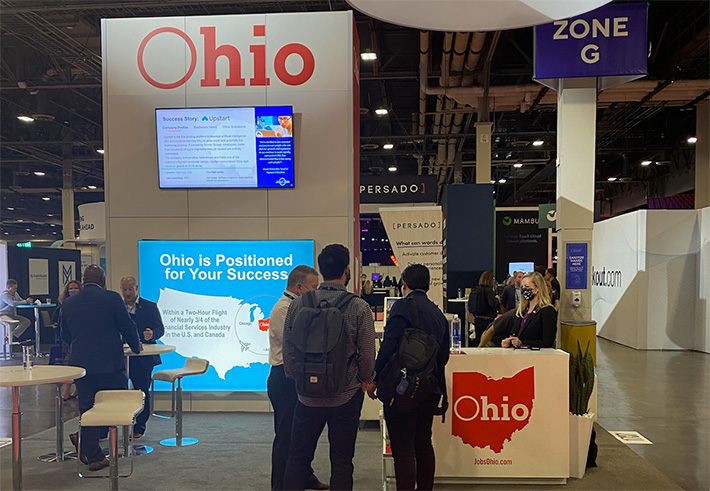 As brokers, lenders, and fintech companies look into having offices outside of New York or California now more than ever before, the state of Ohio used Money 20/20 to pitch their state as the best home for any company dealing with money or the innovations surrounding it.
With Ohio’s lack of a state-level corporate income tax, relatively low rent, and modest wages compared to places like New York, headquartering in the state is a business decision that Terry Gore, Senior Director of Financial Services in Fintech for Jobs Ohio, referred to as a “no brainer.”
“I’ve been coming to this event for the last four years, the organization probably the last five or six years, and we think we have a very unique value proposition for the audience this year,” said Gore. That [proposition] is fintech, insurtech, in terms of the ecosystem that we have in Ohio, and using that to support their continued growth and expansion.”
Gore broke the pitch down into three main components about why Ohio is the most economically sensible state to headquarter a company in.
“We’re ranked in the top three in terms of headquartered banks and insurance companies, and we’re the fifth largest final services sector in the US market, so from a potential partner standpoint, I think we’ve checked that box.”
 He went on to stress the access to higher education that Ohioans have, arguing that their talent pool is right up there with that of New York and California.
“Most people don’t know, just from a number of citizens’ perspective, we’ve got just under twelve million, we have talent,” said Gore. “We’ve got over 200 colleges and universities, from a talent pool perspective, those companies could tap into that.”
The final component Gore stressed was Ohio’s geography. Nestled in between New York and Chicago, he described it as the perfect place for a company that does a wide array of business across the heartland and the coasts to call home.
“We’re in the eastern standard time zone, we’re just a short two hour flight from three quarters of the financial centers in North America. So you know it’s one of those things where you don’t have to be located in New York to be able to drum up business in New York, you can just literally have a day trip and work that market.”
Ohio has already become a home for major players in the fintech world with companies like Klarna and AllianceData already hosting their headquarters in the state.
“We’ve been able to attract California based companies like Upstart, who moved into central Ohio and opened up their second headquarters, which is now larger than their California based location,” Gore said.
In the midst of their efforts to express all the benefits their state offers, Gore admitted that perception of his state to the rest of the country has a major influence on the decision making that goes into doing business there.
“We want to be viewed more traditionally than what the state has been viewed as, and that’s pretty much focused on manufacturing or a fly-over state. If you’re going to complain about the weather, I can’t help you.”