The Highway to Quality Leads and Closing Deals
July 13, 2022 In the early months of 2020, twenty-two year-old Gary Parker found himself on a nature walk along a stretch of highway in Canada. As a savvy marketer in the medical spa field, the wide grip of Canadian pandemic lockdowns had quickly turned his thriving business into dust.
Swept off of his feet by the suddenness of his predicament, he turned to nature to clear his mind and found his next venture in the unlikeliest of ways.
“I went for a walk outside, and so I saw these trucks,” Parker said, “just like trucks on the road just driving. I was like, ‘everything is shut down but there’s trucks just moving things across the country.'”
Parker’s verbal description of the moment was enhanced by his scenic Zoom background when he was interviewed for the story. Parking his laptop on the hood of his car next to a real life mountain range along a Canadian highway, he explained that he didn’t have to tell me how that walk felt because he could show me. Moving his laptop camera around to show off tractor-trailers behind him in the distance, the inspiration that had come to him in 2020 was still present.
Though the country was supposedly closed for business back then, he couldn’t help but notice how many trucks were still on the highways shuttling supplies around.
“I’m a bit of a curious guy,” Parker said, “so I started Googling, like, ‘How much for a truck this big?’ and you know, they were like 70,000 bucks, 100,000 bucks. And I was like, ‘how do people even purchase these trucks?'”
Parker went on a research mission and discovered that few people, if any, were buying large trucks outright with cash, that so much of it was done through financing.
“And so I look up ‘what’s financing? How do people get truck financing?’ And then I recognized that other than truck-sales groups, there’s a section of people where their job is just to help people find the right financing methods.”
Parker thought he might be able to work with the latter group, given his marketing background, to help connect truckers with financing, but discovered the market in Canada was relatively small.
 “Things really started to boom when I met my first USA client,” Parker said, because the demand in the US for truck financing seemed endless. “…in one day you could generate 100 inquiries of people who wanted financing for trucks,” he said.
Parker soon figured out that trucks were just one market in a wider industry of equipment financing, a rabbit hole of endless opportunity that led him to other big name entrepreneurs in the space like Josh Feinberg and Cheryl Tibbs. Feinberg, coincidentally, was a featured cast member in AltFinanceDaily‘s recently produced equipment finance sales reality show.
Parker found common synergy with both and with their help was further introduced to the entire gamut of small business financing solutions.
“And that’s when I got fully immersed,” he said.
He didn’t want to be a broker or a lender, however, so instead he set out to focus on one very particular area of the process, lead generation. First, he built a system to help others, and then he gravitated towards creating a matchmaking system where brokers could connect with businesses that came to his company for help. The end result is his current company that many brokers have now become aware of, Fundly.
“So Fundly is an online marketplace,” he said, “where we have two things. Right now we have real-time matches, so [merchants] who are looking for funding every single day can come in free-of-charge and submit their inquiries, and we have funding members who can join for $1 a month who can see all these inquiries come in and then decide whether or not they want to pitch or share their profile with someone for five bucks.”
Parker explained it as a Tinder-style system where brokers can see the inquiries but can’t talk to the merchants unless the merchants also choose to engage with them. The upside is that when merchants say ‘yes,’ the brokers get to speak to someone that is interested right at that moment and with them specifically.
But Parker is a marketing guy, not a developer, and the execution of this required additional people to put the vision together.
“So we have a team now. Before when we just started, it was just me,” he explained. “If you’re going to write anything, let them know [about the team], because I have a hard working team who is behind every single thing and it wouldn’t have been possible, the technology wouldn’t have been possible without the team.”
Despite the business being born in Canada, Fundly is only targeting the US market because of its scope. Finding interested business owners is not even the hard part of his job, he explained, but rather the hard part is about educating brokers about how to communicate with businesses.
“I’m trying to teach our community members as they come into our orientation, what they think small business owners care about,” he said.
A big mistake for a broker, he explained, is starting off with a pitch about how many lenders they work with.
“Small business owners do not care about how many lenders you have in your back pocket,” he stated. “We’ve come to recognize a small business cares about one thing, what can you do for them? speak in terms of them.”
He imbues them with this marketing wisdom not just because he wants to improve their success rate, but also because he is adamant about making sure the businesses that come to his company get access to the right people with the right programs and prices. He doesn’t want to see these customers get a bad deal.
That Parker is a 24-year old former medical spa marketer hardly matters to brokers who recognize talent when they see it. When AltFinanceDaily asked a senior executive of one reputable broker shop off the record what they thought about Parker, they responded by saying “he’s a genius.”
And besides, he’s not exactly that far off from where he started.
“The machines that some of the brokers finance, like laser therapy machines, stuff like that, I was working on the flip side, from the consumer perspective, having people sign up for high ticket packages from these machines,” he said.
And yet he’s very appreciative of how far he’s come since he went for that walk to reflect on his loss.
“God helped me. It was, it was rough, man. Yeah, not going to lie,” he said. “It was really rough.”
Toward the end of the interview, Parker had already shifted into marketing teacher mode.
“What really sets us apart is psychology,” he said. “Most people think that to get a business owner, you have to hit them and say, ‘Are you looking for the lowest terms? And you know, X, Y and Z??'”
The better approach, he explained, is to tell them that you will get them answers quickly.
“That results in a lot more funding,” he said, “because it’s not making a promise upfront, saying ‘let’s get you funds in 24 hours,’ it’s saying ‘let’s get you answers. And here’s someone to help you find these answers.'”
Thoughts on Inflation, a Recession, and Regulation From Someone Who’s Seen ‘This Movie’ Before
July 7, 2022 “I can tell you that in the US that originators are starting to adjust their underwriting policies,” said David Goldin, CEO of Capify and Head of Originations at Lender Capital Partners, “I don’t know about pricing. I haven’t heard that yet.”
Goldin, who has been a small business finance chief executive for 20 years, believes that the economy, inflation, and interest rates are front-and-center issues that the industry should be thinking about right now. In the UK, one region that Capify operates in, Goldin said that several small business finance executives there are already talking about raising margin and doing shorter term deals to prepare for the increased risk.
“Some originators are smart enough to be proactive and others are saying, ‘oh we’ll just watch it.’ So it’s either going to take trickling down through the economy globally or defaults to go up for these adjustment to happen,” he said.
During the Great Recession of ’08/’09, Goldin was right in the thick of it as the CEO of AmeriMerchant, one of the first MCA companies in the US. He explained that there’s a notable difference between now versus then.
“One of the things that didn’t exist back then, someone doing a second [position] was like unheard of in 2008,” he said. “Now, what is it now? first, 2nd, 3rd, 4th, 5th? 6, 7, 8, 9. It’s like a horse race. Ten horses in the race in some cases. […] You have to be careful, right? You have to make sure you’re covering your margin by charging enough and going shorter.”
But in a competitive environment where nobody wants to reveal their cards or risk losing business, not every funder is keen to start making changes right now. Goldin said that many funding companies will wait to see if their competitors start tightening up first especially if they’re driven by their ISOs and brokers. The downside of becoming more conservative is that brokers might just decide to take all of their business elsewhere.
But a looming recession isn’t all bad. “There are some positives,” he said. “The positives are the banks do tighten up. It’s just a question of when not if. So, you may get applicants that come to alternative financing that may have never taken or considered these types of products because they got bank financing.”
Complicating the landscape now, however, is that funding companies are wrangling with new state regulations. Goldin is aware of several originators that have temporarily paused business in Virginia, for example, where a disclosure requirement went into effect just last week. The soon-to-be implemented New York and California laws are also causing rumblings about funding suspensions respectively. In each of those states it was “sales-based financing” products that were specifically targeted, a trend that looks sure to continue as states like Maryland, Connecticut, and others are determined to reintroduce disclosure legislation next year.
“I think more and more originators will eventually get away from the MCA model,” Goldin said, “and go more towards the business loan model by partnering with a bank. I think you’re going to see more companies trying to implement bank programs to become full business loans and not deal with all the nuances of a state by state and MCA program.”
 Goldin’s point of view, wisdom, and predictions are aggressively sobering. Only three months ago, industry sources were telling AltFinanceDaily that their outlook for 2022 was optimistic and that the end of covid-era government stimulus suggested that there would be growth for non-bank finance companies. Suddenly the tone has shifted, the stock market has plummeted, and interest rates are rising.
“I think if you resurveyed originators now, I think you’d get a different response than you did eight weeks ago or even four weeks ago,” Goldin said. “I can tell you right now that capital providers are asking their originators about how they’re making adjusments in this environment…”
Indeed, AltFinanceDaily did speak with several players just last week and did notice that the general sentiment had shifted to one of concern and caution.
“I think funders should be thinking about redundancy,” Goldin said. “More than ever the best time to raise capital is when you don’t need it. And I don’t know if [funding sources] will pull lines, yes if defaults go up, but they may not be as inclined to enter into new relationships in this environment.” Because of that, now might be the last best opportunity to secure additional credit sources even they’re not necessarily needed, he suggested.
With that, he said that funders should be thinking about tightening up the bottom of their credit profile, increasing their margins, doing shorter term deals, looking for more mature businesses, and working with businesses with higher credit scores.
“I think that those that don’t make credit adjustments, raise margin, and go shorter are going to have their you-know-what handed to them,” he said. “I’ve seen this movie too many times. It doesn’t have to be called a recession. […] It’s all about affordability to repay, and the more debt [the customers] have, and the more their margins are squeezed, or the more their sales go down. That’s when problems begin. You’re less likely to have a problem if you’re only out six months instead of eighteen months. I’ve used this saying a million times: ‘When the ships are too far out to sea and it’s a tidal wave, you can’t get them back.'”
Virginia Disclosure Law Quietly Goes Into Effect
July 6, 2022 On July 1st, Virginia’s “sales-based financing” disclosure law quietly went into effect. The Delegate from Virginia that introduced it in the first place, Kathy Tran, marked the occasion by retweeting a caucus announcement that it was live. Elsewhere, it was hardly mentioned. It was even absent from the Official Code of Virginia where it was supposed to be ceremoniously entered on July 1st. The State insists that its omission is just a glitch.
“There have been significant technical difficulties during the 2022 code upload process,” reads a notice on the Virginia State Law Portal. “Due to these difficulties, the portal does not currently reflect the changes to enacted law. The Division of Legislative Automated Systems and the publisher are working diligently to resolve these issues as quickly as possible. Once the data is obtained from the publisher in the correct format, the standard quality check of the entire body of law that went into effect July 1 will be conducted.”
The law focuses primarily on disclosures. Sounds simple enough, but in the preceding weeks the draft disclosure form was met with some resistance by potentially covered parties because of how little time there was to integrate it into their systems and processes. Regardless, at least one small business funding company told AltFinanceDaily off the record that ambiguous language and terms in the law had led to the decision to cease doing business in the State of Virginia, at least for now. Their focus is shifting toward compliance with the upcoming California and New York disclosure laws where the population pools are larger and the soon-to-be enacted requirements are seemingly more complex. Utah too will soon implement its own version of a disclosure law.
For commercial finance brokers, the defining elements of the Virginia law are that commissions earned will have to be disclosed to customers and that they’ll have to register their businesses with the State to even continue doing business there.
Early Bird Pricing for Broker Fair 2022 Ends Soon
June 30, 2022Early bird pricing to Broker Fair 2022, taking place this October 24th at the New York Marriott Marquis in Times Square, ends soon. This large annual commercial finance expo has already sold out the top level sponsorships. Among the premier names are National Funding, Lendini, and Rapid Finance as Platinum Sponsors and Balboa Capital, Fintap, ROK Financial, and Ocrolus as Gold Sponsors.
This event brings together brokers, lenders, funders, vendors, and more from around the small business finance industry. Attendees can expect education, inspiration, networking opportunities, and more.
Time’s Almost Up: Are You Ready to Comply With the New Virginia Disclosure Law?
June 26, 2022Remember when Virginia passed a landmark sales-based financing law? Well, it’s supposed to go into effect on July 1st.
This is a draft of what the disclosure form is supposed to look like, though with only days left to begin compliance, it hasn’t even been 100% finalized.
Notably, funders will have to begin disclosing to merchants the amount of compensation being paid to the broker in connection with a deal. Also, by November 1st, funders and brokers will have to register their business with the State if they wish to continue working with Virginia-based businesses, a process that would include a background check and registration fees.
Please consult an attorney for official guidance on compliance.
Lender / Broker Ecosystem Transparency Solved
May 4, 2022What happens when a broker sends in a deal and is told it’s declined, only to find out that it was approved and funded for another broker? Usually, a very angry post on social media. The problem is that everyone wants maximum transparency, but how to get it? Who can trust who? What can be done? When will someone do it?
Well, call me insane, but I’ve taken a crack at solving it. And don’t get mad at me because I use the word blockchain because I promise this is not about crypto. Everything would still be ACH-based and recorded just as you already do it, but this little piece of tech would sit underneath it without any manual effort. All automated. No work. Also, it’s possible I’m just totally wrong or have missed some possibilities. You be the judge. Realistic or dream world?
1. Brokers and Merchants don’t need to use the blockchain or know how to use it.
2. A dev at a lender justs need to understand digital wallet addresses and a little feature about them called Non-Fungible Tokens to build or implement a third-party add-on of this. (These “NFTs” have nothing to do with art, they are just uniquely identifiable text files logged into the blockchain with metadata inside them.)
First, here’s my diagram:

Here’s what it’s doing:
1. When brokers sign up with a lender, the lender assigns a uniquely identifiable blockchain wallet address to them on an automated basis.
2. When a broker sends in a deal, the lender creates a unique encrypted hash of the applicant’s bare minimum identifiable data (like last name and EIN #). This hash is placed into a text file in plain english along with the applicant’s application data encrypted. (also automated).
3. The lender creates a Non-Fungible Token from the broker’s wallet address and sends it to the lenders’s official submission wallet. (automated). This wallet will show the NFTs for every deal ever submitted to this lender. Nobody will be able to reverse engineer info about the deals and only the broker who submitted the deal will be aware of what the hash of the deal is. This gives them a chance to view exactly when their deal was logged and if there’s any duplicate hashes in the wallet that would signal that same deal had already been submitted by someone else and when it was submitted.
4. If the deal is approved by the lender, the lender pays the broker and funds the merchant via ACH like normal. Then the lender creates an NFT with the same public hash and sends that one to its approval wallet. The original NFT sent to its submissions wallet is now sent to the broker’s wallet, signaling that they have been awarded the commission on this deal. (automated).
5. If the deal is declined, the lender creates an NFT with the same public hash and all the NFTs for this deal are sent to the decline wallet, signaling that the deal was killed and nobody was awarded the commission on it. (automated).
Every deal’s NFT has to eventually be moved to approved or declined. They can’t sit in submissions in perpetuity.
End result: brokers that submit deals can see if their deal has been submitted before and when it was submitted. Brokers can verify if the deal was funded, when, and if commissions were paid to someone. No actual money is changing hands via crypto (though there might be transactions fees to move NFTs around.) Investors and regulators can also examine the flow and if necessary, be given access to a private key so that they can unlock and view the metadata in the submissions, approvals, and declines themselves.
Naturally, everyone’s first question is: what happens if the lender tries to bypass this?
1. A broker who submits a deal that does not see an NFT created for it in the lender’s submissions wallet, already knows that the lender is trying to operate outside the system. Time to move on!
2. A lender that shows a deal was declined and commissions paid to nobody could be easily discovered if the borrower shows a statement with proof that they received a deposit. No need to speculate what happened. Time to move on!
3. A broker that submitted a deal first can show that its deal was logged first in the submissions wallet. Anyone on social media or the public square could also confirm that and the lender could not manipulate the data to play favorites.
4. Lenders that operate outside of it would show little-to-no submissions or approval volume, signaling to a broker that for some reason they do not want the anonymized data auditable.
5. Lenders that are not real that go around pretending to be a lender just to scoop up deals would be hard-pressed to provide the three verifiable wallet addresses showing the volume of submissions, approvals, declines, and the respective ratios for the latter two. If they can’t show that they’ve ever done any deals or paid commissions, even if you can’t see what the individual details are, they’re not real.
6. After a lender moves the deal’s NFT to a broker’s wallet to signal they’re being awarded the commission, it’s possible the lender does NOT actually ACH the broker the commission. In that case, the broker would have a nice verifiable public display that shows it was supposed to be paid the commission for all to see. Public pressure ensues.
7. If the lender secretly pays a broker the commission but then publicly marks the deal as declined so that another broker who sent in the same deal doesn’t suspect what happened, well then the broker who got paid is going to be suspicious that the lender could do the same thing to them. There’s an incentive to be honest.
8. Merchants need not know about any of this. It doesn’t concern them.
9. The broker does not interact with the blockchain in any way except in the case it just wanted to view the data.
10. The lender does not have to manually interact with the blockchain at all. The system would just be bolted on to an existing CRM. It would do all the above by itself.
BROKER FAIR IS BACK! – NYC
May 2, 2022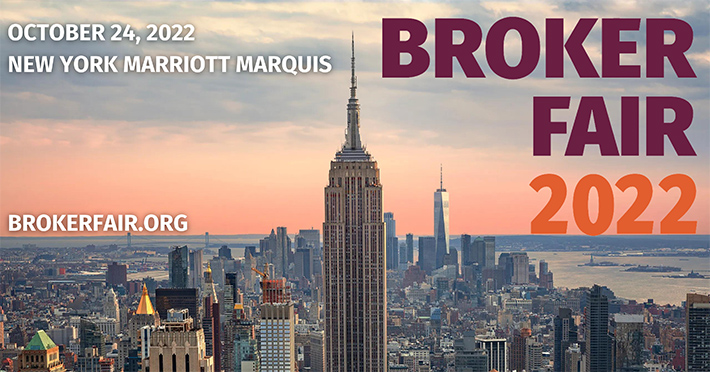 Broker Fair is coming back to New York City on October 24th at the New York Marriott Marquis in Times Square. Anticipated to be the biggest Broker Fair ever, brokers from the small business lending, commercial financing, revenue-based financing, leasing, factoring, and MCA industries, will come together in the heart of New York.
“It’s amazing to have participated in the industry’s growth over the last four years,” said Broker Fair founder Sean Murray. “Our first event launched in Brooklyn in 2018 and now the demand has brought us into a massive newly-renovated venue in the middle of Times Square.”
Brokers, lenders, funders, factors, equipment financiers, fintechs, and the whole small business finance ecosystem can expect a full day of education, inspiration, and high quality networking opportunities.
Register here. For inquiries or questions, email events@debanked.com.
See last year’s sizzle reel:
New Domain Name Gold Rush Sets Up Possible Battle for Future of SMB Finance
April 25, 2022 If you could have businessloan.com or businessloans.com as your website, would you jump on the opportunity to get it?
It’s evident that the market for keyword-based domains has evolved over time. Couldn’t get the .com? You could’ve tried to get the less coveted .net or .org. Don’t like those? Today, you can get the .business, .deals, .financial, .loan, .loans, or hundreds of other customized tlds. With so many to choose from, most experts in the field would advise that if you don’t own the .com version, to not even bother getting cute with customizations for your brand or keyword because customers will just get confused.
But recently, another domain name market has quietly been gaining steam. It’s for something called a .eth, an Ethereum blockchain-based crypto address shortener by the Ethereum Name Service. It’s not necessarily something one could use to build a website with, at least not yet. Originally envisioned as a way to condense long impossible-to-remember crypto wallet addresses into memorable words, users have started to buy up a bunch of keywords that may be familiar to AltFinanceDaily readers. Just to name a few:
- businessloan.eth
- businessloans.eth
- smbloans.eth
- merchantcashadvance.eth
- ach.eth
- syndication.eth
- lending.eth
- ppploan.eth
- underwriting.eth
- brokers.eth
- loanbroker.eth
- mca.eth
- factoring.eth
- funding.eth
- backdoored.eth
At face-value, this might appear to be a vanity crypto play, one in which one could send crypto to your-name-here.eth instead of trying to type out a long address like: 0x64233eAa064ef0d54ff1A963933D0D2d46ab5829. But an ENS domain name holds much more potential than just that. It’s moving towards becoming the backbone of one’s identity in the upcoming era of the web called web 3.0 (web3 for short). Instead of having to remember passwords for hundreds of websites, identity can be validated through one’s digital wallet. Such a concept is not theoretical. It’s already being used.
 Take seanmurray.eth for example. You could send eth, bitcoin, litecoin, or dogecoin to it, but at the same time it’s connected to an email address and a url (this one). Plus it’s linked to an NFT avatar (broker #7 from The Broker NFT collection) which is in that wallet. I can use it to do an e-commerce online checkout in 5 seconds without ever needing to enter any payment information even if I’ve never visited the site before. It’s faster than PayPal and with less steps involved. I can connect it to my twitter account, OpenSea, or use it to vote in an official poll without ever having to create an account on something. The wallet is the identity verification. The .eth name, therefore, has the potential to become the defining baseline of who or what one is on the internet. Not theoretically. It’s already happening.
Crypto is already starting to creep into the small business finance industry. In August, a funding company announced that it would begin offering commissions and fundings in crypto because of the speed potential. Far from being a gimmick, brokers started to choose crypto payments over ACH or a wire because of how fast it would be. There’s also no chargeback risk with crypto.
Currently, the owner of mca.eth has listed the domain for sale on OpenSea at a price of 20 eth (approximately $60,000). That’s less than what MerchantCashInAdvance.com sold for in 2011. Perhaps the value of an Ethereum Name Service domain holds less promise than a website that ranked well on Google in 2011. But then again, being well ranked on Google is not as important as it used to be. It’s impossible to say what, if any impact web3 will have on the small business finance industry long term, but for now there are those out there quietly buying up names like ach and funding and syndication on the chance that they will become something.