Canadian Lending Looks Strong Post-Pandemic
January 11, 2022 After having their entire industry threatened by pandemic-induced restrictions, the Canadian alternative finance space has started 2022 off with a bang. Canadian lending saw billions in growth, as the industry hopes to utilize fintech’s technology and the government’s new take on open banking to bring their industry back to full swing.
“Main Street small business recovery is looking very strong for 2022 as restrictions ease moving into the warmer weather,” said Tal Schwartz, Senior Advisor for the Canadian Lenders Association. “However, in the short term, lenders are paying close attention to the Omicron variant, and particularly how aggressive the federal government is prepared to be in terms of sustained subsidies.”
Despite the uncertainty of the next several months, Canadian finance seems to have a healthy balance of offering modern financial products alongside an effort a return to normalcy. The crypto-lender Ledn raised $70M USD for the world’s first crypto-secured mortgage product, while the BNPL company Flexiti received a $527M facility from the National Bank of Canada. Merchant Growth, a small business lender, also raised $4m in equity financing.
According to Schwartz, most lenders who stayed in business used the last year to deeply invest in their technology across the board.
“[Lenders] have equally repositioned themselves in ways that better service a post-pandemic SMB clientele,” he said. “There is significant effort among lenders to evolve into financial health dashboards of a business, rather than being viewed exclusively as a financing source.”
According to the numbers, there has been significant growth by two notable Canadian lenders that are acting both as a financial management tool and a lending source. Canada’s largest subprime lender goeast Ltd, and Borrowell, a mobile loan marketplace, achieved $2B in portfolios and 2M users respectively to end the year.
“Fintech platforms become more sticky and can capture more client data if they become a hub for business management, with financing simply being a component of their platform,” said Schwartz. “Fintech lenders are coming out of the pandemic much stronger and with a sharper mandate than before.”
Kabbage Co-founder Rob Frohwein Steps Down from the Company
January 6, 2022 Rob Frohwein, who served as the CEO of Kabbage for more than a decade, has left the company. A post he published on social media revealed that his last day was December 17th.
“I didn’t make a big deal – the company has always been about our customers & our employees – and never about any person,” Frohwein said about the quiet exit.
The move is not altogether unsurprising. American Express acquired Kabbage in August 2020 after covid heavily disrupted its small business financing business. Amex first reintroduced Kabbage as a checking account brand and only just recently resurrected its funding operations.
That re-emergence was the catalyst to move, according to Frohwein.
“Why now? Lots of blah blah blahs but it’s the right time,” he wrote. “We’ve relaunched our products with Amex. Now, it’s time to fully devote myself to being an entrepreneur once again.”
Frohwein has kept busy on the side as an advisor & investor in SentiLink, the vice chair of StimLabs, and the CEO of Drum Technologies, Inc, according to his profile, but he apparently has even more plans in the works.
“So what now? Well, I’m pretty excited for what is next. Keep a lookout!”
The benign salutation may actually be a nod to what his next venture is. We’ll see…
RadioShack is Launching a Crypto Swap
December 19, 2021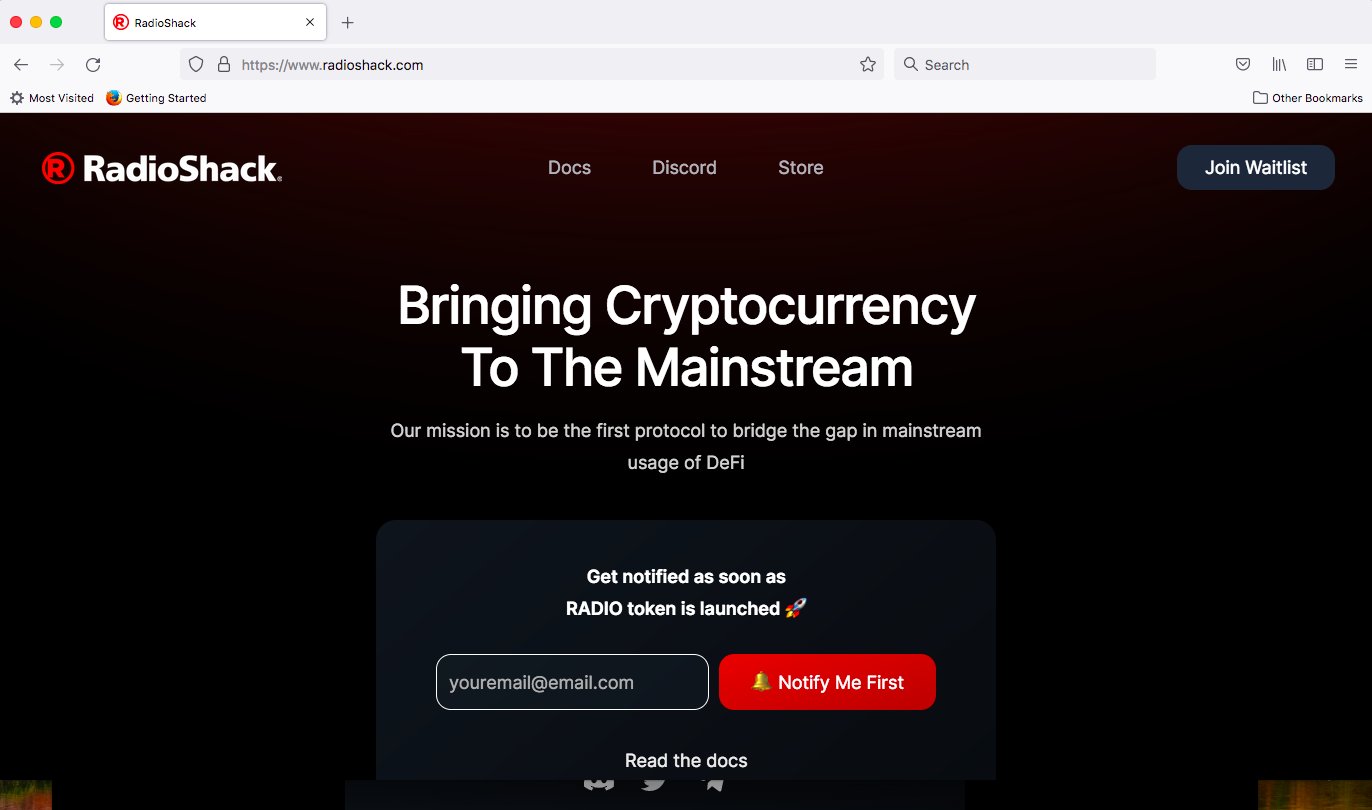 If you had RadioShack on your 2021 DeFi bingo card, congratulations, you’ve won. The company announced that its “mission is to be the first protocol to bridge the gap in mainstream usage of DeFi” and it plans to do this, apparently, by launching a swap.
RadioShack wants to compete with the likes of Uniswap, a smart-contract-based crypto exchange where users can “swap” tokens without having to register on a formal exchange like Coinbase.
The business is a gold mine, according to RadioShack.
“The concept of a swap stands out first and foremost as the place of low-hanging fruit – fruit that is spinning off incredible levels of net profit,” the company said. “Profit not just from speculation like Bitcoin or other cryptocurrencies, but ones born out of trading fees. Some existing swaps like Uniswap or Sushiswap reportedly are doing $1-$7 million net profit per day! They are the current profitable forces of nature in the DeFi world.”
Use of a “swap” is how tokens issued by the ConstitutionDAO crowdfunding saga leaked out into the publicly tradeable marketplace, for example. What was supposed to be a “governance token” to vote on where a copy of the United States Constitution would be held, instead turned into a tradeable novelty asset (like pogs or baseball cards) with a soaring value, all because of decentralized swapping. More than $100 million worth of the novelty governance tokens stemming from the failed bid to buy the Constitution were traded just in the last 24 hours alone, according to Coinmarketcap.com.
“RadioShack DeFi is focused on the early majority,” the company said. “It will become the first to market with a 100 year old brand name that’s recognized in virtually all 190+ countries in the world.”
EIDL Applicants Still Waiting for Funds as Deadline Approaches
December 16, 2021 There is a major pileup of applicants waiting to hear back from the SBA regarding EIDL applications, according to Iron Capital Equities, a fintech firm who owns websites that help businesses through the EIDL application process. According to a press release by the company, many applicants who have not yet received funding seem to believe they’ve been ghosted by the SBA.
The EIDL deadline to file an application is December 31.
“90% (9 out of 10) of our 400 client applicants are still in limbo, with no update regarding the status of the funds,” states co-founder Matthew Elling. “The short-term economic outlook from small businesses is dim, so these funds are highly sought after.”
Elling insisted that he is in constant contact with his customers, and says his company is doing everything they can to service these clients who are playing the waiting game.
“Even though we are a financial technology company, we still ‘talk’ with our customers,” Elling continued. “We understand their struggles in a post COVID economic environment, we have provided them with advice on the SBA assistance like EIDL and the two PPP rounds for payroll and business expense assistance during and after the government-imposed lockdowns.”
EIDL loans were a beacon of hope for many businesses struggling to survive in the pandemic. This type of government funding isn’t a grant, and needs to be paid back by the merchant at a term of 30 years at 3.75% annual interest.
Elevate Announces New Financing Facility for Non-Prime Credit Product
October 13, 2021
Elevate Credit, Inc., a top provider for credit solutions marketed for non-prime individuals, announced Wednesday a $50 million financing facility, which may increase to $100 million, according to a company press release. The funding is to grow the Today Card, a credit card designed to expand access to credit while promoting intelligent credit decisions for people with less than perfect credit scores.
Financing for the Today Card will come from Park Cities, an asset management and alternative investment company that provides flexible debt solutions to its customers. The partnership will help reduce the amount of capital required by Elevate for the project.
“The Today Card has seen outsized demand and has been the fastest growing brand over the last 12 months,” said Elevate CEO, Jason Harvison. “To continue that growth, we have announced a new lower cost credit facility. Park Cities has demonstrated a deep understanding of our space. I am pleased to both diversify our financing and promote our platform’s ability to serve non-prime consumers at even lower APRs.”
Backed by Mastercard, Today Card offers all the benefits of a regular credit card to individuals who may not qualify for the same perks through other creditors. Family share, fraud control, and flexible payment options are all packaged into the Today Card product. These options will familiarize cardholders with these types of benefits should their credit improve in the future and they qualify for other cards with different banks.
“Elevate is changing the game for non-prime Americans. We are proud to partner with a mission driven organization and help enable their growth,” said Park Cities Managing Partner, Alex Dunev.
Elevate has originated $9.2 billion in non-prime credit to more than 2.6 million non-prime consumers to date, and has saved its customers more than $8.5 billion versus the cost of payday loans, according to the report. They already offer borrower incentives like reduced interest rates over time, free credit monitoring, and free financial training.
What Makes a Great ISO?
October 13, 2021 Working and developing relationships with ISO’s can be some of the best and most difficult parts of working in the small business finance industry. The relationships between the merchants and these individuals can make or break the success of a funder, and a great ISO can take a funder and the merchant to the next level.
Kristin Parisi, ISO Relations Manager for Park East Capital, shared with AltFinanceDaily what traits, characteristics, and commonalities separate the best reps from the rest of the pack.
“I think the top thing is someone that is super attentive,” said Parisi, when asked what is the biggest factor that makes a successful ISO. “Someone [who] is available to speak at all times, after sending something in an email or they send me something, I’ll call them and they’ll pick up, someone easy to reach out to, and someone who cares about the deal.”
Kindness also plays a big factor in making a great ISO according to Parisi, who said that sometimes the attitude of certain reps can impede business and make funding deals much more difficult. “I have come across some people who can be super rude,” she said. According to her, kindness and honesty can make or break not only an individual deal between a funder and a rep, but can be the foundation for the entire relationship between the two.
“It’s like a friendship type of thing,” she said, when describing the ideal relationship between both parties. “Someone who is trustworthy, loyal, someone who won’t screw you over behind your back, who won’t send your deals somewhere, someone who won’t screw you over for money. Honesty is the main thing.”
Parisi credits her success to these developed relationships. “The ISO’s I do work with are all my friends now, and I think we have a great thing going,” she said.
She noted the challenge of dealing with ISO’s from a female perspective, setting boundaries and being assertive while also trying to be kind and develop positive relationships. “Being a woman in this industry is a little different than being a male. I’m kind of approached differently, the girls on my team are approached differently. I’m one for being really kind and honest, but [only] to a certain extent because [ISO’s] will walk all over you.”
Apart from the personality that is projected on the funders themselves, another key trait is the professionalism of the ISO themselves, according to Parisi. She spoke about the younger, money-hungry mentality that can lead to ISO’s becoming disingenuous or difficult to work with. Rather than a hustle and bustle mentality, she credits understanding the terminology and how the industry functions as a desirable trait in a potential ISO.
“You don’t need ten plus years in the industry,” said Parisi. “You need a few months in the industry, you get it, and you’re good.”
Facebook is Buying Invoices, But is it Factoring?
October 8, 2021 After Facebook announced Facebook Invoice Fastrack, a program that would allow the company to enter the invoice factoring business effective October 1st, few knew what to expect.
“My gut tells me here that Facebook is not all of the sudden getting into the lending business,” said James Cretella, Partner at Ottoburg LLC and guest speaker at the IFA conference last Spring. “Big tech is seeing the information symmetries, especially in small business lending. It’s very fragmented, and [tech] is trying to exploit that to bring down the cost, and to consolidate that industry,” he said.
Cretella expressed a positive outlook on Facebook’s entrance into the factoring sphere. “I think it’ll be a very good thing for small businesses when big tech gets involved.”
Others believe that big tech is doing pseudo-funding in an effort to break into the space and improve their public image. “There’s always a question when big tech or similar big anything’s get into factoring,” said Robert Zadek, Of Counsel for Buchalter and CEO of Lender’s Funding. “They might call that factoring, but it’s not. It’s a fake factoring product. Fake in the sense that it’s only part of what factoring is,” Zadek said.
Since then Facebook has revealed its program partners, Supplier Success and Crowdz.
The major component here is whether or not Facebook is doing the standard operating procedures of a factoring company, or just purchasing invoices owed. “They’re probably not filing a financing statement a UCC-1, because that takes a long time, and [tech] likes fast,” Zadek said. “Filing is slow and almost manual.”
Without going through the processes of a factoring company, Facebook may just be banking on the good faith of borrowers to pay and eating the costs of those who don’t. “[Facebook] is left with an earned 1% fee with no work, which would be profitable if they get back. If they don’t it’s like a write off,” said Zadek.
According to a Facebook announcement, the company has already practiced factoring with a handful of small businesses, claiming that the program has successfully helped these select businesses grow, even giving some businesses opportunities to just keep their doors open.
 We wanted to make a commitment to building tools that made information and inclusive funding partners easy to find and understand,” said Ronnie Cameron, Product Manager, Social Impact at Facebook. “We’ve been able to engage with some amazing [organizations]. The pandemic brought to light the gaps in access to funding that have always existed for underrepresented business owners.”
Facebook is positioning itself in a way that appears that the company is providing an exclusive service to a community who had already been underserved prior to the pandemic, and now, according to them, needs help more than ever before. As the company has had a tough time maintaining a positive image to the public, this could also just be a slightly profitable way to fix their public perception.
Zadek compared tech’s entrance into funding to when MCAs began competing with Factoring Companies. “Instead of whining about MCAs, why don’t you give the client more money?,” he asked his predominately factoring audience when they would complain to him about MCAs. “The MCAs don’t have a death wish,” he told his audience. “They are giving money because they believe they are going to be paid back.”
Sticking to the notion that Facebook’s take on factoring is different from what his industry does, Zadek summed up his take on Facebook’s announcement.“They’re not doing factoring, they’re doing something that has little pieces of factoring in it.”
Miami is Now Making Money Off of Its Own Crypto Coin
October 7, 2021 Francis Suarez, the crypto-crazed mayor of Miami that has attempted to make his city the next center of innovation in the industry, has recently generated more than $7.1M in funding for Miami’s government via MiamiCoin. Arriving in the form of a crypto “donation” to the city, it was all made possible by CityCoins, a nonprofit that allows users to mine coins that the company claims can help the wallets of both coin holders and the cities with whom they look to invest in.
According to CityCoins’ website, each time a city launches a new coin, users can mine coins themselves. They are an open-source network that allows developers to create smart contracts on top of the same layer used by Bitcoin, a feature normally reserved for blockchains like Ethereum or Cardano.
“Each time a new CityCoin such as MiamiCoin launches, 20+ unique wallets are needed to activate the token’s mining process,” the site reads. “Once this happens, a 150 block (~24 hour) countdown begins, signaling the start of the CityCoins’ mining process at the end of the countdown period. From there, anyone is eligible to participate in the CityCoins mining process within a given Stacks block and be rewarded for their contributions.”
The system creates a bidding process, sending Stack tokens to the chosen city’s smart contract for a specific block. The more Stack tokens that are sent to the contract, the more likely a user is to win rewards for that block. This creates a system where anyone can compete for the coins, as the process of mining a CityCoins product is completely free of any type of hardware.
Thirty percent of miners’ forwarded Stacks is directed into a crypto wallet for the respective city, and the remaining 70% can be used to earn Stacks or Bitcoin. Winners of the coins through CityCoins’ mining process, are chosen by a Verifiable Random Function (VRF) that takes into account the number of Stacks sent to specific contracts.
Anyone would be forgiven if the process and potential utility sounds convoluted. It becomes even more so after examining what exactly a “Stack token” is.
Stacks, a type of blockchain token originated into existence in 2019, were previously registered as securities with the SEC, a rarity in the crypto space. The company that issued them, however, has since changed course and has chosen to no longer register them. This was based upon the company’s own legal opinion, not the SEC’s.
Bottom line: However this CityCoins systems works and whatever the reasons why anyone would participate in it, it has somehow managed to yield more than $7 million for the city of Miami.
While everyone today likes to focus on the negative and want to create conflict and division…We made 1 million dollars on Miami Coin…TODAY…think about that! https://t.co/Ycbwre6Wss
— Mayor Francis Suarez (@FrancisSuarez) October 1, 2021
When speaking about the city’s involvement in becoming a fintech hub with The Floridian, Suarez credited timing to why his city is becoming the go-to spot for fintech businesses to flock. “We had an opportunity,” Suarez said. “You had cities across America, urban cities, pushing out innovators through taxation policies, sometimes elected officials saying “F” Elon Musk, or Amazon picks New York and they push them out.”
Suarez, a member of the Florida BlockChain Task Force, also credited his December 2020 viral tweet as a reason for tech’s attraction to Miami. Suarez answered a tweet with “how can I help?” after a user took to Twitter asking people if they believed Silicon Valley should move to Miami. “It was so counter-narrative to the way elected officials were dealing with technology and technologists,” he said, in reference to the Tweet.
According to Suarez, the city’s focus on crypto and fintech has made Miami a tech-trendsetter for other cities. Thanks to tech’s arrival, Miami is the first city to pursue paying workers in Bitcoin, the first to allow citizens to pay taxes in Bitcoin, and hitting huge numbers in the city’s job market. According to Suarez, the city added 8,000 jobs with an average annual salary of $120,000 in the past nine months.
“For the first time in [Miami’s] history, we are now creating high paying jobs,” Suarez said.