
Square’s Merchant Cash Advance Program Now Among Biggest in the World
March 10, 2016Square originated more than $400 million worth of merchant cash advances advances in 2015, according to their Q4 earnings report. Their average deal size was just shy of $6,000. The result is a 300% increase year-over-year and makes them one of the largest players in that industry worldwide.
RANKINGS
| Company Name | 2015 Funding Volume | 2014 Funding Volume |
| OnDeck | $1,900,000,000 | $1,200,000,000 |
| CAN Capital | $1,500,000,000 | $1,000,000,000 |
| Funding Circle | $1,200,000,000 | $600,000,000 |
| PayPal Working Capital | $900,000,000 | $250,000,000 |
| Bizfi | $480,000,000 | $277,000,000 |
| Fundry (Yellowstone Capital) | $422,000,000 | $290,000,000 |
| Square Capital | $400,000,000 | $100,000,000 |
| Strategic Funding Source | $375,000,000 | $280,000,000 |
A much longer list will be available in AltFinanceDaily’s March/April 2016 Magazine Issue. SUBSCRIBE FREE to make sure you obtain a copy.
Herio Capital Breaks $20 Million in Funded Deals
March 9, 2016 It might feel like 1997, but in early 2016 Herio Capital has surpassed $20 million in funding since inception. Co-founded by Sherif Hassan, the company’s chief executive, Herio launched only one year ago. Hassan was one of OnDeck’s first employees who stayed with the company all the way up until just before they went public.
Today, Hassan does not appear to be regretting that choice. “We have lots to be grateful for and even more to be excited about in 2016,” he said.
The company’s chief product officer and co-founder, Patrick Janson, summed up their vision like this, “When we started Herio, we saw a huge opportunity to improve upon the software that currently supports the marketplace lending industry.”
The Herio team will be attending the LendIt Conference in San Francisco next month.
“Reaching the $20 million funding milestone is a testament to the execution, creativity, and diligence of everyone at Herio. We are grateful to our team and our loyal industry partners. We are excited about the advancements our industry will make in the next period as we continue to design the future of credit,” concluded Hassan.
PayPal’s Merchant Cash Advance Program Grows, Performance Improves
February 27, 2016The PayPal Working Capital program has advanced more than $1 billion to small businesses since inception. Rooted in merchant cash advance methodology since PayPal withholds a percentage of each transaction until receiving payment in full, they are not actually buying future receivables. Rather, they originate loans through WebBank, the same Utah-chartered industrial bank that OnDeck uses. But OnDeck’s payments are fixed and PayPal’s are tied to sales activity.
PayPal’s loans therefore don’t have a fixed term but they evaluate historical sales activity and use that to project a loan payoff usually within 9 to 12 months. According to their Q4 2015 earnings report, their 2015 results performed just as well if not better than their 2014 results.
$421 million was outstanding at the end of 2015 compared to $103 million at the end of 2014. 77% of the $421 million was on pace to pay off within 30 days of their planned projections. 11.16% was on pace to finish 30-59 days beyond them. PayPal broke it down by dollars in their earnings report.

But we’ve broken it down into percentages below:
| Total outstanding balance | Within Projections | 30-59 days greater | 60-89 days greater | 90-180 days greater |
| $421 million | 77.43% | 11.16% | 4.99% | 5.70% |
| Total outstanding balance | Within Projections | 30-59 days greater | 60-89 days greater | 90-180 days greater |
| $103 million | 76.70% | 9.71% | 4.85% | 6.80% |
PayPal borrowers cannot simply stop accepting PayPal payments in order to avoid loan repayment. They are required to pay at least 10% of their total loan amount (loan + the fixed fee) every 90 days so that they make consistent repayment progress regardless of their sales volume. Notably, their website warns, “If you do not meet the requirements in the above policies and your loan goes into Default status, your entire loan balance could become due and limits could be placed on your PayPal account.” For businesses that depend on PayPal sales, that is certainly a downside worth avoiding.
Merchant Cash Advance Predictions for 2016
January 10, 2016 I hate new year’s resolutions, as most of the time the people making them on January 1st have already broken them by the time January 10th comes around. The reason they’re broken quick and easy is because they aren’t goals, but rather wishful thinking. A goal is something that should fit within the S.M.A.R.T criteria, which is a goal that fits five general metrics:
- It must be specific
- It must be measurable
- It must be attainable
- It must be realistic
- It must be time-bound, or have some sort of deadline established
In other words, you don’t just randomly set goals, a goal has to first be done based upon critical thought, research, opportunity analysis and an examination of realistic outcomes, from there you set your objectives along with the step-by-step procedures to achieve them. Once this is done, you slap a deadline on each step-by-step procedure and continue to track your progression along the way.
I don’t set new year’s resolutions, I set new year goals and objectives. My goals and objectives for 2016 (in relation to our industry), will be based upon my predictions for the following 12 months. What do I see in my crystal ball for the year of 2016? This article will pinpoint my forecasts for our landscape this year. Some of you might agree and some of you might disagree, but nevertheless, these predictions ought to create a lot of quality discussion and debate.
“THE BIGGEST” WILL CONTINUE TO BE “THE BADDEST”
I’ve talked about the future of our industry before, with the belief that Strategic Networks will be the key going forward in terms of market dominance. These networks include the Center of Influence Network, the Mom and Pop Network and the Online Network. The Center of Influence Network includes other professionals such as banks, credit unions, merchant processors, etc., who have direct access to the prospective clients. The Mom and Pop Network is just a collection of random brokers from across the country that resell on a 100% commission basis. The Online Network is that of technology automation, especially the internet and how it will shape the market going forward in terms of communications, new lead generation, and more.
Well, the biggest funders on AltFinanceDaily’s Official Business Financing Leaderboard will continue to dominate the industry in 2016, taking more market share and growing the market in general, based on their efficient utilization of Strategic Networks.
PRICING PRESSURE WILL INCREASE AND COMMISSIONS WILL DECREASE, ACROSS THE BOARD
For higher paper grade deals, I believe that the pressure on pricing for A+ Paper, A Paper and B Paper clients will continue to increase, which will cause many funders and lenders to just stop competing for them (due to no longer being able to compete), while others will find innovative ways to reduce their operational costs so they can reduce down their buy rates, passing the lower costs onto these clients to compete against alternatives from the traditional lending system or P2P lenders. This entire process might also cause the commissions for these higher paper grade deals to decrease as well.
C Paper, D Paper and E Paper commissions will go down as well, as most of the new funders and lenders will target these paper grades due to not being able to compete in the high paper grade markets. Due to the increased amount of players, this will put pressure on pricing which will have brokers slicing their commissions even for the lower credit graded merchants.
TO HELP COMBAT PRICING PRESSURES, MORE PRIVATE FUNDERS WILL WELCOME SYNDICATES
More private funders and lenders will offer syndication programs for their brokers, and do so in a much more efficient, streamlined and transparent way than most of the other syndication partners are doing currently. This will help reduce the risk for a lot of these private funders and lenders, which would assist in bringing down their pricing across the board, helping them stay competitive in a marketplace where new competitors will cause merchants to put more pressure on pricing.
MORE FUNDERS WILL RESTRICT BROKER ACCESS
You will see more funders and lenders start to restrict their working relationship with new brokers. Basically, instead of just signing up anybody with a pulse, I believe more funders and lenders will actually vet new brokers they are considering partnering with. This will come as a result of the funders getting fed up of dealing with unscrupulous acts, fraud and other actions from these new and/or rogue brokers, which does nothing but hurt their brand and online reputation.
FUNDERS AND LENDERS WILL FIGHT BACK AGAINST STACKING
More funders and lenders will fight back against stacking by doing as I suggested before, which is to add a page to their Funding Agreement that says if the merchant stacks, then the merchant is liable for additional fee such as $5,000 or $10,000 per stack. This is similar to how on the merchant services side, early termination fees (ETFs) are used so merchants stop switching their merchant accounts over every month to try and save “$5.” In addition, I believe more funders and lenders will just stop filing UCCs altogether unless they are filed only on merchants that breach their contracts. This means that those new funders who specialize in “stacking”, might have to come up with a new model, as these updated practices will make it so that they will have a difficult time finding new “clients” to market to.
THE MAJORITY OF NEW ENTRANTS WILL BE SLAUGHTERED
You will continue to see new brokers, funders and lenders enter the market, with many of the funders/lenders being nothing but brokers in secret who seek to backdoor deals. Nevertheless, most of these new entrants will be slaughtered in terms of burning through their savings and capital on outdated marketing strategies or trying to compete within Strategic Networks that are already dominated by the biggest funders/lenders/brokers in the marketplace. Most of these companies will be fly-by-night companies, exiting the market as fast as they came running in.
UCC RECORDS WILL STILL BE POUNDED
I believe the UCC as a marketing tool will continue to be utilized by most of the newer entrants, despite the fact that the UCC Boom is Over.
BACK-DOORING WILL SIGNIFICANTLY DECREASE
Back-dooring will decrease significantly as brokers smarten up by researching the partners they decide to work with beforehand, and not just sending over ISO Agreements to “anybody” that calls them up and says they might be able to do something for their deals that other funders can’t do. Also, brokers will stop functioning as a sub-broker as well, which makes no sense, and this will also assist with bringing down the back-dooring issue. The heart of the back-dooring issue is the broker’s laziness, it is their laziness in properly vetting the partners they choose to work with, as well as deciding to sub-broker on a deal instead of researching the players in the marketplace on their own so they have adequate platforms available for any type of merchant they receive.
INDUSTRY WIDE REGULATION WILL GET CLOSER
While we can pinpoint that this is already going on in California, I believe you will continue to see some type of industry wide regulation that will restrict access to new brokers and seek certain levels of ethics from current brokers. This might be from within the industry itself, or it might be forced upon us from some type of regulatory agency. I’m hoping we can do this ourselves and not bring in the Government.
MARKETPLACE LENDING AS A WHOLE WILL CONTINUE TO GROW
It’s been estimated that we will see over $100 billion globally in marketplace lending (consumer and commercial side) in 2016, and I agree with this metric. I believe our products will gain more mainstream attention and be accepted more as the “standard” rather than an “alternative”, based on the efficiency of how we deliver capital, versus the extensive and inefficient process of the traditional lending system.
CAN Capital: Beyond Hyperbole
December 11, 2015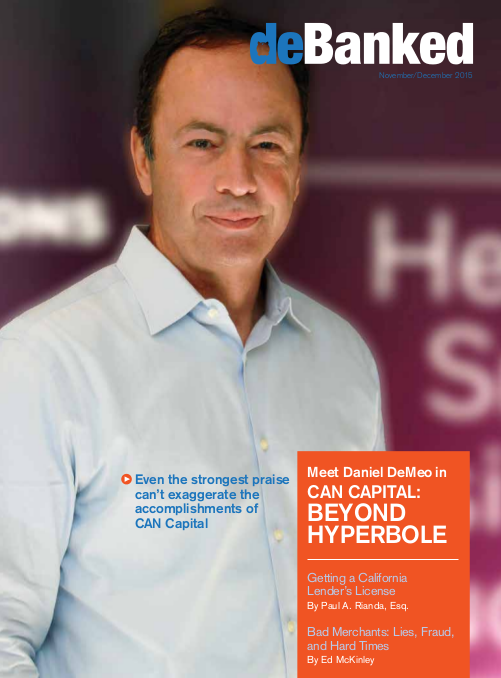 It’s usually risky to say “first,” “largest” or “best,” but CAN Capital invites those superlatives and more.
Asked whether the company’s the biggest in the alternative funding business, CEO Dan DeMeo hedges only a little with qualifiers like “might” or “probably” before proudly announcing that the company has provided access to more than $5.5 billion in working capital through 163,000 fundings to merchants operating in over 540 different kinds of businesses.
Glenn Goldman, the company’s CEO from 2001 to 2013 and now Credibly’s chief executive, doesn’t mince words about his former employer when he calls CAN Capital the biggest and most profitable small business alternative finance company in the U.S.
Cofounder and Chairman Gary Johnson proclaims without hesitation that CAN Capital was the first alternative small business finance company. His wife and cofounder, Barbara Johnson, came up with the idea of the Merchant Cash Advance in 1998 when she had trouble raising funds to promote her business, he said.
CAN Capital developed the first platform to split card receipts between the merchant and funder, and it gave birth to the idea of daily remittances, Johnson continued. Within a few years of its founding the company was turning a profit, another first in alternative finance, he claimed.
The innovation continued from there, according to Andrea L. Petro, executive vice president and division manager of Lender Finance, a division of Wells Fargo Capital Finance. She cited a couple of possible firsts she’s witnessed in her dealings with CAN Capital.
When CAN Capital received a loan from Wells Fargo in 2003, it may have been the first sizeable placement in the alternative finance industry by a major traditional financial institution, Petro said. In 2010, CAN Capital was among the first alternative funders to offer direct loans, she noted.
Petro stopped short of characterizing CAN Capital as the best in the alternative finance business, but she praised the company’s management and lauded its systems for underwriting and monitoring funding. “They continually upgrade their systems, upgrade their software, upgrade their people,” she said.
Calling CAN Capital one of the best comes naturally to Kevin Efrusy, a partner at Accel Partners and a CAN Capital board member. Accel saw opportunity in alternative finance because banks were reluctant to lend at the same time that an explosion of data on small businesses was informing the underwriting process. When Accel sought a position in the industry, it contacted CAN Capital, he said.
“Frankly, CAN Capital didn’t need or want our money,” Efrusy said. “We approached them.” Five years ago, Accel convinced CAN Capital that additional resources could help the company grow, and it bought a stake in the company.
With so many extolling the virtues of CAN Capital, AltFinanceDaily asked DeMeo for a look at the thinking that underlies the success.
PLOTTING STRATEGY
CAN Capital pursues a strategy that DeMeo visualizes as a honeycomb. In the center cell, he places the objective of “helping small businesses succeed.” The compartmental element above that provides a place for the goal of serving as “the preferred provider of financial solutions to small business,” he said. The company’s cultural values, summarized as “Care, Dare and Deliver,” reside in the compartment below the center cell as table stake underpinnings, he added.
DeMeo also describes the company as driven by four strategic planks: “1) Expand the market, 2) broaden the product set, 3) deepen relationships with customers, and 4) achieve operating excellence,” he said.
What does success look like to the company? To DeMeo, it’s dramatic growth in the number of customers, resulting in increased revenue, a more valuable company and better career opportunities. “Digital automation and customer experience are at the center of those efforts,” he said.
CAN Capital operates with a “huge appetite for ‘test and learn,’” according to DeMeo. “That’s how we keep innovation alive,” he said.
And the result of all that? The company has increased fundings by 29 percent (CAGR) and revenue by 24 percent (CAGR), with corresponding growth in earnings, DeMeo said. It has also grown its digital business by 600 percent since 2014, he noted.
 AT THE WHEEL
DeMeo, the man at the top of CAN Capital, joined the company in 2010 as chief financial officer and became CEO early in 2013. He was previously CFO at 1st Financial Bank, and also served as CFO for JP Morgan Chase’s consumer and small business unit. DeMeo also was chief marketing officer and ran business development head for GE Capital’s consumer card unit. His career began at Citibank, where he held senior roles in marketing and customer analytics.
“I was very fortunate to work for some pedigree companies earlier in my career,” DeMeo said. “Those companies emphasized market based training and development, and I worked with very smart and hardworking people. I also had great experience in unsecured lending.” His formative years left him with great appreciation for “behavioral analytics and the quantitative, information-based approach to business finance.”
Experience convinced him, as a CEO, the importance of attention to the balance sheet and income statement. It’s vital to combine that with innovation and growth orientation, DeMeo said. He seeks to lead, inspire and motivate employees, he emphasized.
DeMeo grew up in Atlantic City, NJ, with parents who valued hard work, education and maximizing opportunity. His wife and three children have supported him in his career despite the long hours and dedication necessary for success.
At CAN Capital DeMeo has faced the challenge of managing the business through internal and external cycles. Running the company often comes down to balancing what customers want with what makes economic sense, he said. “Pigs eat, and hogs get slaughtered,” he maintained. “You can’t get too greedy.”
DeMeo runs the company without the help of a President or Chief Operating Officer. While DeMeo serves as the public face of the company, he also devotes himself to every aspect of operations, he said.
WHAT’S IN A NAME?
Although CAN Capital’s drive for technological innovation and its measured approach to fundings have remained constant, the company has renamed itself several times to fit changing times.
In November 2013, it rebranded itself publicly as CAN Capital, and the company now provides access to business loans through CAN Capital Asset Servicing Inc, and Merchant Cash Advances through CAN Capital Merchant Services.
With the CAN Capital rebranding, it dropped the umbrella name of Capital Access Network. At the same time, it retired the AdvanceMe, New Logic Business Loans and CapTap names.
Most of the company’s old names applied to products or distribution channels, DeMeo said. The company had added them when it presented a new product, such as loans, or introduced a way of going to market, like end-to-end digital technology.
Consolidating the names reflected the company’s decision to put its direct marketing efforts on equal footing with business generated by partner companies, DeMeo said. Having just one name would result in a more efficient approach to building a stronger brand, he noted.
“The opportunity is to create one brand, multiple products and omni channel distribution under one company,” he said. “For a company our size, it would be hard to create brand awareness if you had to put significant promotional support behind every one of those sub brands.”
CAN Connect is a sub-brand that has survived. “That’s not a product name or distribution channel name,” DeMeo said. “It’s the technology suite we use to connect with partners so that we can exchange information in real time.”
CAN Connect is a way to speed up the process and eliminate friction for customers and partners. For example, a partner is able to link their CRM directly into CAN Capital’s decision engine, eliminating manual steps in submitting and generating offers. For partners with a customer-facing portal, CAN Connect enables an offer to be made available in real time to a small business owner, taking advantage of data sharing APIs to tailor the marketing message to fit the prospective customer’s needs.
Attention to detail pays off in repeat business for CAN Capital, in DeMeo’s view. “Almost 70% of our merchants return for another contract,” he said
THE GENESIS
By all accounts, CAN Capital is a company born of necessity. Barbara Johnson, who had the brainstorm that became CAN Capital, was running four Gymboree playgroup franchises in Connecticut and needed funds to finance summertime direct marketing efforts for fall enrollment.
But her company didn’t have much in the way of assets to pledge, so banks weren’t interested in providing funds. Why, she reasoned, couldn’t she just borrow or receive an advance against the credit card receipts she knew would flow in when the kids came back in the autumn? Thus, she gave birth to an industry.
Barbara Johnson and her husband, direct marketing executive Gary Johnson, cofounded the company as Countrywide Business Alliance and put up their own money to build a computerized platform to split card revenue, Gary Johnson said.
Then they persuaded a card processor to partner with them. Once they were operating and had signed their first customer, venture capital began flowing their way to grow the business. These days, the Johnsons remain major shareholders.
“What made it an interesting concept was how huge the market potential was,” Gary Johnson said. “That’s what the attraction still is today.” Although Merchant Cash Advances may now seem commonplace, they were startling at first, he said. “When we first went out in the marketplace, everybody thought it was a crazy idea,” he noted.
The company earned patents on processing related to Merchant Cash Advances and daily remittances, Gary Johnson said. At first, the patents deterred potential competitors from entering the business, but the company was unable to defend the patents successfully in court. Rivals then entered the fray.

Just the same, the company became profitable early on through “deliberate decision-making, having the right people in place and being bigger than everybody else,” he said.
Much of the company’s early business came through firms that provide merchants with transaction services, and that remains the case today, DeMeo said. Many were placing point of sale terminals in stores and restaurants to accept credit cards, and working capital became an upsell or cross-sell, he noted.
The large base of business CAN Capital built with merchant services companies means it will always be an important channel for the company. Recently, new merchant sign-ups have come from more diverse channels, including cobranded and referral partners, and the fast-growing direct marketing channels.
From the beginning, the merchants receiving capital used it to grow their businesses, DeMeo said. “That feeds the whole economic system and creates jobs,” he said.
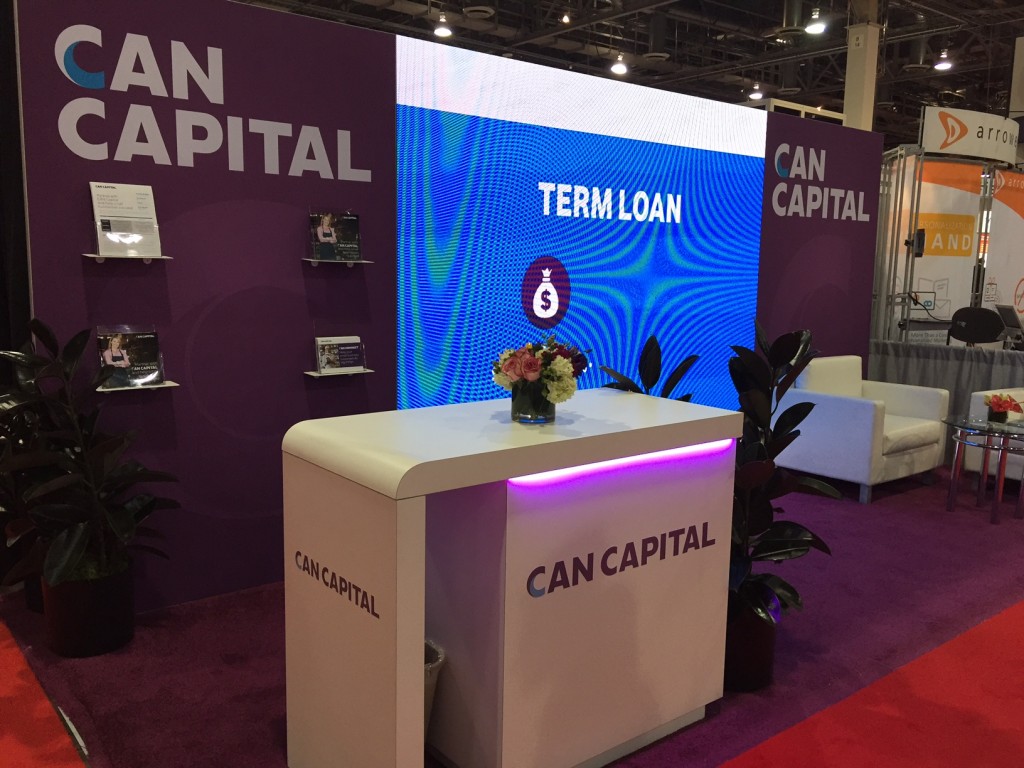 TODAY’S NUTS AND BOLTS
Daily remittances give CAN Capital nearly constant insight into how well customers are performing, which enables the company to discover potential issues quickly and take action. Such close monitoring also provides the company with enough information to enable funding opportunities that competitors might pass up, DeMeo said.
“The basis for our decisions is how the business performs and business-specific indicators, such as capacity and consistency, versus looking at the personal credit history of the business owner,” DeMeo noted.
Having that data also helps the company create models it can use to serve other businesses in the same classification, DeMeo said. “It’s poured into machine learning for future decisioning,” he maintained. “It’s a cool concept, right?”
The company’s 450 or so employees work in several locations. Three hundred of the total are attached to the office in Kennesaw, GA, the region where the company first set up operations. To this day, that’s where the company conducts most of its business, DeMeo said.
About 25 employees work in technology and operating support in offices in Salt Lake City because the area offers a strong talent pool and provides the company with additional time zone coverage, DeMeo said.
Some of the company’s former executives came from Western Union, which had a presence in Costa Rica. About a hundred employees are now stationed there, working on technology, maintenance and development. That location also houses back-office redundancy for the company, too.
 On Manhattan’s 14th Street, the company has 30 or so employees, who include digital engineers, marketing and business development teams, the human resources lead, the chief financial officer, the chief legal officer, and the chief executive officer. The company moved its executive office there from Scarsdale, NY to take advantage of the digital boom, he said, adding that, “Google’s right around the corner.”
Compared with most companies in alternative finance, CAN Capital has little venture capital as part of its ownership structure, DeMeo said. “It’s a self-sustaining business. We’re not forced to approach the capital market to cover our burn rate. We’re cash-flow positive.” Competitors have to borrow to fund their growth, he noted.
The company has taken on infusions of debt financing, not equity financing. In the latter, a company is selling part of itself, DeMeo said. “We raised $650 million from a syndicate with five new banks and 10 banks in total.” The company completed a securitization of $200 million the year before, he said.
CAN Capital recently introduced the new TrakLoan product that has no fixed maturity date, with daily payments that are based on a fixed percentage of card receipts. This way, payments ebb and flow with the merchant’s card sales. CAN Capital is also testing “bank-like” installment loans of as much as $500,000 with a payback period of up to four years.
And there’s nowhere to go but up, in the view of CAN Capital executives. With a market of 28 million small American merchants and penetration of between 5 and 10 percent, they see plenty of potential to keep earning superlatives.
Google Serves Low Blow to Merchant Cash Advance Seekers
December 2, 2015 Almost eighteen months ago, I explored whether or not Google was rigging the search results to benefit two lending companies they had equity investments in, Lending Club and OnDeck. At the time, both companies ranked at the top for highly coveted keywords even if they weren’t directly related to the user’s search query.
Now that those two companies are public, a company called Credit Karma seems to have inherited the top spots. And wouldn’t you know it, Google has also invested in them.
Google: loans
Google: personal loan
But that’s not the worst of it. Thanks (or no thanks rather!) to a relatively new search result feature called “People Also Ask,” one keyword recently started serving up results with a different kind of hidden agenda.

While my captured results may not be identical for everyone, I have conducted tests with other people on other devices and from other areas and it was present each time. With this box, Google is subtly planting the negative seed that payday loans and merchant cash advances are basically so identical that other people just like you are wondering what the difference between the two are. But here’s the rub, the two have nothing to do with each other and it’s unlikely so many people are asking that.
Pay no mind to the fact that the box makes reference to a “cash advance” not a “merchant cash advance.” The painstaking mishap could be innocently chalked up to an algorithmic error if only googling just cash advance revealed the same box in the results. But it doesn’t. Only merchant cash advance brings this up.
Comparing merchant cash advances to payday loans is straight out of the anti-merchant cash advance propaganda playbook. At least one Google-owned business lending company is actively lobbying against short term business lending and merchant cash advances in Washington so the placement and comparison of the People Also Ask box in their results is highly suspicious.
It’s no secret that Google is also directly lobbying in the online lending space too. One month ago, right before Google magically started to suggest to searchers that merchant cash advances and payday loans were related, Google formed a lobbying organization called Financial Innovation Now with Amazon and Apple. On their main agenda is online lending.

Given the suspicious search rankings for companies they have an equity stake in, I would not doubt for a second that something like this was manually inserted. I admit that my evidence and my case are weak, but given the circumstances, it’s quite possible there’s something deliberate happening here.
What do you think? Do you see this when you google merchant cash advance?
Merchant Cash Advance | A Look Back and Plan Forward
November 29, 2015 Merchant Cash Advance is still a relatively unknown term and product to the masses, but amongst most of its target customer base, it definitely has a stigma that is rightly deserved in some ways, but I believe that it is also misunderstood in many other ways. Having been in the industry for nearly 10 years, I can say that I have seen my fair share of positive and negative events as they relate to the industry, but I believe that it has all been for its betterment and growth. Furthermore, by having been on the underwriting side for a majority of that time, I can say with great certainty that I have seen this product help several small business owners over the years, and it will continue to do so as the stigma fades away and acceptance increases.
For those of us working in this industry now, let’s face it – most small business owners that have taken a merchant cash advance or have been solicited for the product would much rather go to their bank for the money. The problem, as many merchants have come to realize in recent years, is that lending in general essentially dried up after the recession. The faucet is now running again, but small businesses were all but forgotten. Only the most well qualified borrowers are able to obtain the desired amount of capital needed at a reasonable cost through traditional bank loans. In addition to meeting all of the necessary criteria for a bank loan or line of credit, a borrower must also be prepared to wait months for the process to be finalized.
The days of a small business owner being able to go down to his or her community bank or local branch for a quick cash injection are long gone, but that’s where we come in. We are catering to a customer base that has been left out to dry. We are dealing in a marketplace that is grossly underserved by the larger financial institutions. We are charging a premium for taking on risk that most cannot stomach. We are keeping America running. That might sound ambitious, but is realistic when you put things in perspective.
SBA and IDC data show that small businesses employ at least half of the US workforce and produce anywhere from 60% – 80% of the new jobs annually while also accounting for nearly half of total US private payroll. As if that weren’t enough, small businesses also produce six trillion dollars or over 50% of all non-farm GDP in the US. When looking at additional SBA data which also states that more than 80% of all small businesses need to use some sort of financing to grow their business, it’s perplexing as to why banks have turned their backs on the people that have put America on their very own backs.
However, I do not want to go into great detail or make any assumptions on why “big banks” are not lending to small businesses. Rather, I would like to take some time to focus on how we can continue to support the growth of small businesses across America. The MCA product in particular has evolved quite a bit over the past 10 years, but a lot of that development has taken place in the past 3-5 years, and the industry has grown leaps and bounds as a result. When I started working as an underwriter several years ago, there were less than 10 lenders and 50 brokers operating within the space. Nowadays, there are hundreds on both sides of the fence, and there are multiple new entrants every day – senior guys starting their own operations, one man rogues from the insurance and mortgage businesses, consumer payday lenders, et cetera. – all looking for our piece of the pie, but who out there is really looking to improve upon and grow the product for the better?
 I suppose therein lies the problem. Unfortunately, the tremendous growth we have recently witnessed also comes with a flood of unqualified and unknowledgeable management and staff that are simply following the direction of their unqualified and unknowledgeable employers. As an industry, if we expect to continue making headway in the small business lending environment, we must first better ourselves by taking the time to learn and understand the product in order to better educate our customers. If you know me, you have heard me say on a few occasions that it is easy to put the money on the streets, but the problem for most people is getting it back.
As with anything in life, you cannot jump into something and expect to master it. Over time, you get a grip of what you are doing, and you begin to build on that understanding. Therefore, no one should enter the market expecting to make huge returns without learning the ins and outs of the business. I, along with several of my peers, have seen plenty of well-intentioned but aggressive entrants “lose their shirts,” so to speak, because they did not do the proper diligence on the industry or the actual diligence required to operate within the space. Lending money with only a UCC-1 in place only on future receivables or sometimes no collateral at all is risky business as it is, but not taking the necessary steps to mitigate that risk is only asking for a rough road ahead – not only for the lender itself, but also for their potential clients, brokers, other lenders, and the industry as a whole.
Our underwriters and sales people, in addition to management, should have a solid understanding of the product they are working on. They should be able to educate customers as well as their peers. Transparency throughout the process is key for maintaining a long and mutually benefiting relationship with the client. By having this firm grip and understanding of the product, we reduce the risk of an unsatisfied customer. As with the mortgage and insurance industries, sales and underwriting must work together to determine the best possible result for both the client and the company. This is definitely a challenge for most groups due to the amount of balancing required to meet the needs of the company, but by establishing best practices and procedures in both the sales and underwriting processes, we can begin to think and work within separate verticals and group goals but streamline the process to achieve the agenda of alternative small business lending which should be to help provide small business owners with the fast and efficient capital they need.
Whether you have been in the industry for years, you have just joined this year, or you are considering taking the dive now, it’s only fitting that at this time of year we give thanks to those small business owners and celebrate their entrepreneurial spirits because they are the reason we, ourselves, are currently employed. But more importantly, they are setting us up for quite an adventure which will change the landscape of small business lending for good. I, personally, cannot wait for the next 3-5 years of continued growth because I can only see a bright future if we are able to collectively educate ourselves and pass that knowledge along to our clients. As long as the proper steps to learn have been taken, the competition from new entrants mentioned previously is also welcomed because this further drives new ideas and developments within the space – new financial products to offer clients, lower costs, and most importantly easier and efficient access to quick capital for the busy small business owners constantly on the go in an effort to grow their business while putting the rest of us on their backs.
Merchant Cash Advance APR Debate (Sean Murray v Ami Kassar)
November 24, 2015The other day, Inc. writer and loan broker Ami Kassar took some time out of his day from taking photos of his shadow in the park to engage me in a debate about the use of APRs in future receivable purchase transactions. He was apparently very bothered by my analysis of Square’s merchant cash advance program which has transacted more than $300 million to date.
To clarify my position here, I am indeed in favor of transparency, so long as it’s intelligent transparency. Coming up with phony percentages based on estimates and applying them to transactions where they don’t make sense is not transparency. Similarly, advocating that merchant cash advance companies and lenders alike move away from a dollar-for-dollar pricing model to one that requires the seller or borrower to do math or hire an accountant is also not transparency.
Even a Federal Reserve study that attempted to prove merchant cash advances were confusing inadvertently proved that APRs in general were confusing. If someone doesn’t know how to calculate an APR, then it’s unreasonable to assume that they could work backwards from an APR to determine the dollar-for-dollar cost of capital. In effect, APR is a surefire way to mask the trust cost despite arguments to the contrary.
My unplanned debate with Ami Kassar on twitter is below:
Sorry Ami. The only thing unclear is your argument.