
ERC And The Broker Relationship
January 11, 2023 Like many business loan brokerage CEOs across the US, Jared Weitz is familiar with the Employee Retention Credit (ERC). His company, United Capital Source (UCS), which in 2021 surpassed $1B in small business financing volume, regularly speaks to thousands of small business owners. Weitz told AltFinanceDaily that through his own experience most business owners have become sufficiently aware of the ERC as well. That in turn raises the question of what role a company like UCS can play in the ERC process.
“We have a few different referral partners that are lending against those credits,” Weitz said. “And that’s what we’re doing.”
In that regard, UCS is doing what it is already used to doing, connecting the business owner with a compatible source of funding. While other brokers may attempt to generate fees by assisting businesses with filing for the tax credits themselves, Weitz said he prefers to avoid the headache and/or potential liability that can come along with doing that.
“We’re able to get 100% of what a client is owed right up front,” Weitz said. “They can either have an interest-only program or a no-payments program for 12 months, and then after 12 months there would be a factor rate attached to the program that would be paid back weekly.”
UCS earns a commission when a deal goes through but ERC has not by any means become a primary driver of business, according to Weitz. Rather, it’s something that could come up during a customer consultation.
“When we’re peeling back the layers and chatting with the client on why they need funds, if they say ‘well, actually I’m falling short here and I also just filed for [the ERC] and I’m still waiting for that,’ it can be one of the options that we offer them […] and we’ll just see what they qualify for and if they’re interested in it.”
 It’s the waiting part that is creating a cottage industry around ERC. Weitz says he hasn’t heard of any business getting an ERC refund in less than 7 or 8 months and he is aware of at least one business that is still waiting for it 2 years later since filing. But just because most businesses are aware of the ERC doesn’t mean they’ve all actively pursued it. On this, UCS simply offers free helpful advice.
“What I would say to them is ‘hey, heads up, you should probably look into this with your local accountant and payroll company, make sure you get your tax attorney or your accounting firm’s attorney involved just to make sure you’re doing it the right way.'”
Putting business owners on that path of pursuit, informing them of its existence and advising them to seek out qualified counsel to assist with it, generates no revenue to UCS, but Weitz thinks it’s important to help business owners in any way possible.
“I think it does build a bridge of trust a bit more between you and your clients because you’re showing them that you’re not solely looking at products that are beneficial to you, and you shouldn’t be doing that anyway,” Weitz said. “But I think when you’re dealing with someone there’s always that thought in their head, right? And so this has helped solidify that you’re not.”
Fora Financial Surpasses $3 Billion Funded Since Inception
December 14, 2022 Fora Financial has surpassed $3 billion in funding to small businesses since inception, according to a post the company shared on social media. That was spread across 35,000+ businesses. The milestone coincides with a new look, which includes a new logo and website.
“Behind our new look, we’re making tons of operational refinements,” a blog post about the improvement says. “Fora Financial’s Capital Specialists are doubling down on their collaborations with customers to build creative, innovative funding solutions.”
Just Jump In: Three Women Making Their Mark in The Industry
November 29, 2022Forty-Six percent of women make up the workforce in the financial services industry with only 6% of them being CEOs. Reshaping the narrative of men dominating the finance world, women in various components of the industry are making their mark. Sarah Kelly, Lindsey Rohan, and Heather Francis are three women that particularly stand out in the commercial finance industry.
Equipped at Birth
Born into equipment finance, Sarah Kelly got her start by working for the family business at KLC Financial. After a decade of becoming an expert in the trade, she spent some time in the medical equipment finance side of the industry before finally landing at Dedicated Financial GBC, where she is now the Director of Servicing. Dedicated has been experiencing growth, according to Kelly, as the company just hired five new employees in the last couple of weeks.
“I have a lot of confidence in the leadership team and was excited that they were open to having a woman on the team,” said Kelly. “They’ve welcomed me in wholeheartedly, they always ask for my opinion, I’m always willing to give it and I feel like we’ve really all connected to make Dedicated a great company.”
Kelly believes that women should support one another to do better. Even a little friendly competition to push each other to be their best selves doesn’t hurt.
“I believe that we can really show other women that you can be whatever you want to be in this industry, that there’s no limit, there really aren’t,” said Kelly. “I feel like some people think that there might be just because they are a woman but there really is no limit and we just need to get that word out there to them…”
Practicing the Laws of Finance
Finance wasn’t exactly the plan for Lindsey Rohan after law school. Working for a law firm in Long Island she dabbled in real estate closings, but with having two small children at the time, balancing work and motherhood were always at odds. Determined to have her own practice, she started Pollack Cooper & Fisher, P.C. where she worked as a real estate attorney for 8 years. She hadn’t ever foreseen commercial finance as her next career path, but a call from a family friend led her to join a merchant cash advance company.
“It actually became quite a good fit because it’s a lot of multitasking, a lot of looking at all the various aspects of a corporation and its life, and how you can protect it,” said Rohan, Deputy General Counsel at Basepoint Capital.
Handling the legal infrastructure of the company, building out departments to make sure there are checks and balances, and making sure all the collections teams abide by the regulations are routine in Rohan’s schedule. Having much success in her position, a notable point in her career has been about building the Alternative Finance Bar Association. The AFBA was created to facilitate the exchange of information with attorney members concerning alternative finance.
“What’s interesting about this is that while the industry itself is male dominated, most of the dominant attorneys in the space are women,” said Rohan. “Some of the largest originators, the General Counsel are women. The leading compliance and regulatory firm, the two attorneys that lead the group that handle commercial business are both women. And that’s an interesting dynamic.”
Working in a predominately male-led industry can have its challenges but Rohan claimed she never found it to be anything that’s held her back. Acknowledging at conferences that only about 10% of attendees are women while the rest are men, she does not believe it has had a negative impact on growth. Rohan agrees it’s important to support women in every endeavor and to not shy away from positions in this industry.
“Just do it, just jump in,” said Rohan. “Don’t hesitate, you’re in control. The amount that you learn is the amount that you allow yourself to be exposed to.”
Funding with Francis
Graduating with a degree in Health Promotion and Education, Heather Francis took a left turn into finance. Working for a private equity firm, she managed portfolios as well as oversaw many others. That position became her crash course into the industry, fueling her relationship into the financial services world and eventually encouraging her to start her own company in 2015, Elevate Funding. As CEO and Founder, Francis has had to do it all.
“I think owning my own business is accomplishment in itself, as well as being a mom and a wife,” said Francis.
Without dwelling on the industry being predominately male, Francis believes it has opened many doors for her. The women in the field are a “close knit group” propping each other up and sharing information, she explained. She believes it is important to support everyone that demonstrates drive and attitude to better themselves. That can be providing pathways, being a soundboard, introducing people, and simply giving out words of confirmation.
“I’ve always seen that the boys have a club, so do the girls, it’s never been anything that’s been a worry to me, or I’ve been like, ‘I’m being held back because of being a woman in finance,’” said Francis.
As a Board member of the SBFA, Francis helps solve problems in the industry and contributes ideas. And with rapid change surrounding the business, she has a hopeful disposition on where it’s heading as we enter a new economic phase. Experiencing the recession back in 09’, Francis saw the industry grow exponentially between 2009 and 2011.
“Traditional finance pulls back when times are hard, and we’re able to be a little bit more nimble and move around to adjust for it, but still keep funding,” said Francis.
Bonded through finance, women are navigating throughout the industry with strong personalities, outspoken voices, and confidence. Born into the field or pivoting their way in, they seem to be embedded into every aspect. While being a team player to everyone, these women continue to push their career forward with hard work, sticking to core values, and knowing who they are.
Your Default Rate Is Too Low, And It’s Hurting You
November 22, 2022 There may be no word as terrifying to stakeholders in the merchant cash advance business than the term ‘defaults’.
In an industry where a significant portion of revenue is generated from daily or weekly automatic withdrawals from a merchant’s bank account, defaults can cause deep and lasting problems. Not only do they eat into profits, but they damage relationships with banks and processors- both of which are essential to the success of any merchant cash advance company. Defaults can also be contagious: if one merchant in a large portfolio decides to stop making payments, it can have a ripple effect that leads to other merchants doing the same thing.
All these are reasons why MCA companies go to great lengths to avoid defaults at all costs: they exhaustively screen merchants before approving them for funding and do all the due diligence needed to ensure they can follow realistic payment plans. They also attach a fee to every deal to cover the percentage of the deal they expect will not come back, and conventional thinking would be to aim to keep that number as low as possible.
That’s a lot of work to keep that default rate low, but what would you think if I were to contend your default rate is too low, and it’s hurting your bottom line?
Fear of defaults is paralyzing MCA funders and inevitably leading them to leave opportunities-and money- on the table.
Better Accounting Solutions has been the leading accounting firm in the MCA space for over a decade, and has seen this across the board:
Many MCA companies have adopted a risk-averse approach to avoid defaults, opting for sure-fire deals in higher positions, rather than taking calculated risks that could enhance their bottom line. In the name of capitalizing on low-risk deals with a lower chance of default, many companies choose to fund deals where they charge smaller fees than what they could be charging if they choose to fund deals others are wary of taking.
Let’s look at two deal examples for an example of my thesis:
Average Andrew is the perfect merchant for an MCA company. He is getting a $100,000 advance with a deal length of 7 months (140 days) and with his rock-solid history, his default rate is a meager 6%. The RTR on the deal is 44%, the UR fee is 7%, broker’s commission is 10%, meaning the profit on this deal will be $35,500- a net unit profit percentage of 35%, profiting $5000 a month. He is a great client, and a pleasure to work with.
Now let’s examine his buddy, Reformed Ricky. He’s made some mistakes in the past and now wants a business advance to grow the business he believes is The One. No one else wants to touch him, so you offer him a deal of $35,000. Because he is a riskier advance proposition, you can raise the RTR to 49%, and the UR fee to 12%. On a deal like this, the commission is around 14% and the default rate will be a whopping 18% on a merchant like this, but the profit to be made on this deal is $10,150- a 29% net unit profit, getting $3,383.33 monthly profit over the length of the deal.
Now, looking at the structures of both deals, why would I advocate that someone advancing Reformed Ricky instead of Average Andy? What’s the advantage of working with the weaker merchant over the perfect one?
It’s simple:
Because of his history, you can set the duration of Reformed Ricky’s deal to 60 days (3 months). That means according to the terms of his deal, your profit is 9.67% a month. You’ll be stunned to learn that when you break down your monthly profit on Average Andy’s deal, it is a considerably smaller percentage of 5.00%!
 This means every month you’re making more back on the smaller deal, and are getting it to work for you by placing it into new deals and generating more income for you, because of its shorter term. If you’re only taking deals with longer outstanding balances, it will take you a considerably longer amount of time just to make a smaller profit percentage.
On top of this, we also have to account for the compounding effect you will quickly be seeing when you take these ‘riskier deals: because you’re earning more money per month due to the shortened duration of supposedly weaker deals, you will be able to turn it around more times per year, supercharging your growth quicker than what you’d be seeing you stuck to only ‘traditionally-safe’ deals.
I’m not advocating for funders and brokers to be irresponsible and create a new and much less entertaining version of The Big Short, throwing money around to people that don’t stand a chance of paying it back.
I am saying that they should consider funding merchants and positions they were wary of till now, and responsibly assessing the opportunities and upside for them at those positions.
Of course, this doesn’t mean that you should mindlessly funnel money into every deal that comes your way. You still need to be responsible and vet your investment opportunities carefully, and of course, if it turns out you’re picking the wrong deals and your default rate explodes, you will have to reevaluate your approach.
However, working from a place of fear is not the way to grow and thrive, certainly in this business. Moreover, by avoiding risk altogether, MCA companies are likely to become less competitive over time. After all, it’s only through taking risks and innovating that businesses can thrive in today’s rapidly changing world, especially in the rapidly evolving and growing MCA industry, where more and more people are seeking to find their niche.
A great number of successful investors in MCA companies have complained to me that their partners are too conservative with the deals they are choosing to fund and leaving too much capital in the bank, costing the investors higher facor rates instead of working for them.
This approach is a way to break away, and ahead, of the pack, because only by taking the opportunities others keep passing by will MCA companies be able to grow and compete in the long run.
How the Amazon / Parafin Merchant Cash Advance Deal Came to Be
November 2, 2022Back in December, Parafin, then a fintech startup with 20 employees, submitted a proposal to Amazon to roll out a potential Amazon merchant cash advance product. At the time, Parafin was little known to the general public and its surprise deal with DoorDash wouldn’t even become public until a month later.
 The prospect of an MCA would not have been foreign to Amazon given that the company already offers direct business loans, lines of credit through Marcus by Goldman Sachs, and other loans thanks to a successful pilot with Lendistry. But the team behind Parafin were virtual unknowns in the merchant cash advance industry itself. The company’s 3 co-founders, including CEO Sahill Poddar, all hail from Robinhood, the investment app that became wildly popular especially with younger adults over the last several years.
Coincidentally, more than a dozen people employed by Parafin, including the co-founders, are former Robinhood employees, according to profiles reviewed on LinkedIn. It’s part of a trend, it appears, as other members of their team hail from well known Silicon Valley firms like Lending Club, Stripe, Funding Circle, Google, Amazon, Facebook, StreetShares, and more.
Ultimately, Parafin’s big bet paid off. On Tuesday, November 1st, Amazon announced that the Parafin team was the one it had chosen to debut its official merchant cash advance product.
“Amazon is committed to providing convenient and flexible access to capital for our sellers, regardless of their size,” said Tai Koottatep, director and general manager, Amazon WW B2B Payments & Lending, in the announcement. “Today’s launch is another milestone in strengthening Amazon’s commitment to sellers, and builds on the strong portfolio of financial solutions we already provide. This latest offering significantly expands sellers’ reach and capabilities, and broadens their access to capital in a flexible way—one that helps them control their cashflow, and by extension, their entire business.”
“We founded Parafin with the mission to grow small businesses, and we’re thrilled that we have the opportunity to do that by providing Amazon sellers with this merchant cash advance option,” said Vineet Goel, co-founder of Parafin. “It’s a privilege to count ourselves among Amazon’s suite of financial solutions, and we look forward to making a difference for Amazon.com sellers looking to expand their business.”
The product is already listed on Amazon’s website and was rolled out to some US businesses immediately. It will be available to hundreds of thousands of additional sellers by early 2023, the company claims.
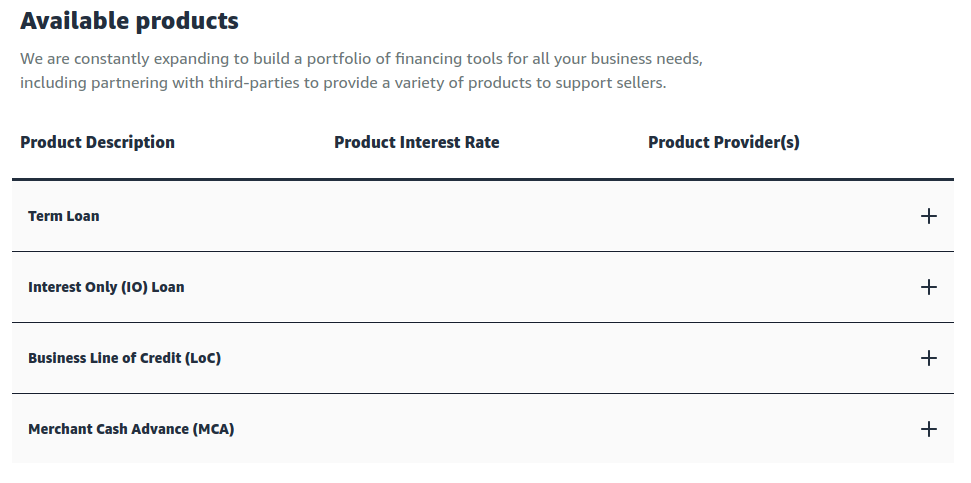
Unique to an Amazon MCA is that funding amounts can start as low as $500 and go up to $10 million.
Amazon’s entrance into the merchant cash advance market coincides wih a unique moment in the product’s history as several states are in the midst of imposing strict regulations on their sale.
Lavu Adds MCA Product Through Partnership With Parafin
October 7, 2022 It’s not just DoorDash that Parafin has partnered up with to provide MCA funding. Last week, the restaurant software company Lavu launched Lavu Capital to help restaurants owners access capital.
“We are a restaurant software company that focuses on small and medium restaurants,” said Saleem S. Khatri, CEO of Lavu. “Think of your favorite restaurants that have one or two locations that are really really popular, that are ingrained in the community. We do everything from point of sale to online ordering, payment processing, and anything a restaurant would need to start and grow their business.”
Khatri said that one thing they noticed is that these restaurants have a fundamentally hard time getting loans and that led them to connect with Parafin. Parafin’s product is an advance on future sales, not a loan, and their offerings have been simply integrated into Lavu’s technology. Parafin automatically generates an offer for restaurant owners that they can see in their Lavu dashboard.
“…it’s just really beautifully designed,” said Khatri. “It basically says, ‘Hey, you have an offer to borrow up to $5,000. Do you want it yes or no?’ And you just click ‘yes’ and you’re good to go, the money deposits straight into your bank account, and then you have a repayment schedule. And it just pulls it directly from your bank account according to that repayment schedule.”
Khatri says they haven’t really begun to market the product yet and they’ve just started off with a limited base of customers but that the plan is to roll it out to all their customers around the US. They’d even do it with their customers outside of the US if they could, but the tech is not set up to do that just yet.
“This is going to be a feature and an offering that really really benefits our customers because it gets to the heart of what they need, which is they’re in constant need of liquidity, they’re in constant need of kind of tools to run their business better,” Khatri said. “And it just really fits our portfolio of products that we offer to these customers. So the reception has been awesome.”
Got a Mantle, Bryant, or Mahomes Card? This Company Wants to Fund You
September 12, 2022 Last month, an anonymous bidder paid $12.6M for a 1952 mint condition Topps Mickey Mantle baseball card, the highest amount ever fetched for a piece of sports memorabilia at an auction. Understandably, the news electrified a fast growing market of collectors, traders, and financiers that predicted the next big asset class wasn’t just going to be real estate or crypto or NFTs, but physical sports trading cards.
The value of the Mantle sale came as no surprise to one budding entrepreneur in South Florida. On Instagram, he’d been talking about Mantle cards for weeks, even going so far as to hold up another ’52 Topps Mantle card to the camera to promote what his company can do, which is provide quick cash advances to owners of valuable sports cards.
The entrepreneur’s name is Edward Siegel, CEO of Card Fi. Siegel’s no stranger to the alternative finance space because he spent about a decade in the MCA industry, most recently as the founder of Bitty Advance, which he sold in 2020. Since then, Siegel returned to his roots and early passion of his youth.
“I had a background in sports cards as a collector, you know as a kid, but then in my early twenties, I was promoting card shows at malls,” Siegel said. “I was heavily into the hobby, setting up the card shows and promoting them and doing player appearances where players come in and do an autograph appearance.”
That was back in the late 80s, early 90s, according to Siegel.
When Covid hit and he exited his most recent company, he noticed a massive resurgence in the sports trading card market. His next business ultimately became Card Fi, a company that will evaluate the market value of a card and make an advance against it. There’s obviously risk involved so they take possession of the card for the duration.
“We have to get a hold of these cards and we’re responsible for them and then we vault them in our in-house bank vault,” Siegel said. The cards are stored in a highly secure climate controlled environment. Card Fi shows the vault off frequently in its Instagram videos.
Such a business requires large amounts of capital so Siegel went searching for investors, a pursuit that led him to a unique place, an Instagram Live pitch competition hosted by famed CEO and reality TV star Marcus Lemonis. Siegel entered himself in as a contestant, knowing full well that the odds of even being chosen to present his business to Lemonis were about a million-to-one.
Somehow, he was called up to pitch.
“So [businesses] went on there during the quarantine and you pitched your business,” Siegel explained. “I went on there and I pitched it […] And he understood it and he thought it made sense.”
The moment eventually led to a deal with Lemonis’ company and Card Fi was on its way.
 Siegel, meanwhile, dispels the notion that the burgeoning trading card industry or his business hinges upon old vintage cards or that it’s a baseball-card-centric universe.
“If we look at it, there’s two different markets, you have the modern card market [where] I would say it’s basketball [that leads the pack],” he said. “For the vintage card market it’s baseball.”
Football is huge as well, he explained. A Patrick Mahomes rookie card, for example, an NFL Quarterback that’s still currently playing, recently fetched $861,000. There are only one of five like it in the world, the scarcity playing a major role in the value. Meanwhile, a Justin Herbert rookie card, an NFL Quarterback who’s only in his third year was already receiving bids above $1 million at the time this story was being written.
“It really depends on the card itself,” Siegel explained. “Some players might be known for having better careers but then you have cards that have more scarcity to them. Something that’s a one of one or maybe a very low populated card and a graded PSA 10 could very well be worth more than a [Michael] Jordan rookie because it has scarcity in it.”
PSA refers to cards that have been verified as authentic and graded on the condition of the card itself. Ten is the highest level a card can receive. Card Fi will only work with graded cards to avoid any funny business when it comes to advancing funds based upon the value.
 Siegel explained that Card Fi’s average advance is about $40,000 – $50,000. The max right now is $500,000. There’s a big market for this type of funding it turns out because Card Fi’s much larger rival, PWCC, just raised $175 million to make similar offerings to sports card owners.
“This financing benefits the market as loans and cash advances have become an increasingly asked-for offering among trading card collectors,” said Chad Fister, PWCC’s CFO in a story that originally appeared on Sportico. “Enabling our clients to access liquidity through a menu of capital offerings is key as trading cards continue to prove themselves to be a valuable tangible asset class.”
For Card Fi, customers that take an advance can track everything through an online portal, including details about their cards, payments, and balance.
“We want to note that we built a full-service automated underwriting and collection platform to where, whether it’s the customer or the broker, they can log into our system and put the description of the card into the system and it’s going to automatically underwrite it and price it out,” Siegel said.
That description sounded like something straight out of the fintech industry of his past, especially the component about brokers.
“Just like the MCA space, we have a whole partnership side, a broker side, where brokers can refer us customers just as an affiliate where they just send the info over,” Siegel said. Similarly, they can earn a commission if a transaction is completed, he explained.
In this industry, brands like Topps, Upper Deck, and Panini have become the bread and butter for Card Fi. Even though it’s all business for Siegel these days, he couldn’t help but mention a particular card he had a personal attachment to.
“My personal favorite card in my collection is the 1965 Topps Joe Namath rookie card,” Siegel said. “Of course being a die hard New York Jets fan, that has to be my favorite card.”
A Code “Quiltt” for Fintechs
July 18, 2022 It’s called Quillt, a low-code tool that allows companies to integrate with several third-party services to either pull in datasets or act on data.
Quiltt says their tool detracts the need for companies to hire costly engineers to integrate their services one at a time. In doing this it allows for data to be accessed instantly by “abstracting away” the need for any organization to integrate with services one at a time and “right the business logic” required to each individual service into a single integration.
“So, with us, regardless of who’s in your data stack, we can essentially have a backend that processes all that information so you can focus on whatever your core focus is at the end of the day, as opposed to repetitive data, plumbing, and infrastructure,” said Mark Bechhofer, Cofounder & COO.
The low code aspect of it is modules with just a couple lines of code that anyone can paste into their application and embed a frontend experience. Startup companies that are looking to build in fintech with small teams and little funding could also seek assistance through Quiltt, according to Bechhofer. It could even be a bank or a credit union that wants to focus on their core competency and not worry about adding commoditized feature sets that their competitors already have.
“We are issuing cards and processing transactions, we are really doing the data intelligence around money,” said Bechhofer.
Before Covid, Bechhofer and business partner Ruben Izmailyan were selling a white label suite of DFM apps to banks and credit unions. The two business partners were often asked how they had built this backend infrastructure to take in data from “disparate sources” and combine it, analyze it, standardize it and make sense of it.
“We realized that was actually a much larger market with potentially a much larger play. And so we kind of ripped apart our old application into what I call like a Lego box and fintech infrastructure, and pivoted the company into what it is today,” said Bechhofer.
Driven by the mission of bringing financial wellness to as many people as possible, the team at Quiltt is excited about the possibilities ahead.
“We think that providing this new abstraction layer of technology will empower many new types of fintech builders and essentially give license to folks who maybe aren’t full time data scientists or engineers without worrying about hiring expensive teams. We’re really excited about what people might build on our platform that we haven’t even envisioned,” Bechhofer said.