
CAN Capital is Changing the World’s Most Expensive Tire
January 16, 2017
Acting CEO Parris Sanz told the WSJ that what’s happening at CAN Capital right now is akin to changing a flat tire. “We hit a bump in the road and blew out a tire,” Sanz said. “We just need to change out the tire, and we’ll be back on the road.”
But sources say that the company is in the midst of trying to sell off assets including its loan portfolios to raise cash in a hurry. In the span of a few weeks the company has let go of more than half of its employees, has suspended funding new deals, put its top executives on leave, been sued by a shareholder, and suffered a rapid amortization event with its $200 million bond deal. That’s on top of a breach that the WSJ reported with CAN’s $650 million credit facility led by Wells Fargo. A spokesperson for Wells told me they could not provide any comment or information on the matter.
And CAN’s issues aren’t the result of a changing economy, but rather internal systems that couldn’t keep up with their innovations. They’ve even hired a restructuring company to assist them through this crisis. It now being more than a month and a half since the story first broke, the WSJ puts the amount CAN is trying to raise “to strengthen its financial position” at $100 million.
If this is how they go about changing a tire, it may be time they sign up for AAA Roadside Assistance. For the merchant cash advance industry, their predicament is one of the biggest events of the decade by virtue of their history, size and renown. The company has funded more than $6 billion to small businesses since they launched in 1998.
Consider that just a few months ago, CAN was seemingly riding high as it promoted its new lending transparency initiative as part of the Innovative Lending Platform Association. And in July, Sanz represented the MCA & small business lending industry in a congressional hearing dedicated to financial institutions and consumer credit.
CAN’s top competitor is OnDeck whose stock has only inched up 8% since November 29th.
A spokesperson for CAN reiterated that this was an issue that they self-discovered and self-reported. “In the absence of information, people are making incorrect assumptions,” she said. “It affected about 3% of total assets in the portfolio under our senior line. It’s a manageable situation and one we are working through as we position ourselves for success in 2017.”
Merchant Cash Advance’s David and Goliath End an Era
January 5, 2017 Before there was Capify and CAN Capital, there was AmeriMerchant and AdvanceMe. Those are the original names of the two industry rivals whose history goes back more than 10 years. When I started working for an MCA company in 2006, I was taught two things, that AdvanceMe claimed to have a patent on merchant cash advance’s core feature and that AmeriMerchant’s CEO was leading the charge to have it invalidated. Back then, AdvanceMe had sued AmeriMerchant and several other companies for violating its automated payment patent and it was the biggest threat to the industry’s future at the time.
A real life David and Goliath saga, it was only fitting that AmeriMerchant’s CEO was actually named David. His last name Goldin, he went on to win the lawsuit in such a big way, the story was featured in the New York Times. At that time in 2007, the Times quotes Goldin as saying, “It’s a victory against patent trolls. This has changed the landscape. The days of coming up with an obvious idea and patenting it and using legal extortion are over.”
With the patent invalidated, numerous entrepreneurs felt the coast was clear to start a merchant cash advance company, thus paving the way to become an industry that now originates more than $10 billion a year in funding to small businesses. AdvanceMe was a Goliath in that it held a virtual monopoly on MCA in the late 90s and early 2000s. They had such a huge head start on everyone, that they were still the largest MCA company in the US in 2014 (if you don’t count OnDeck which only does loans).
 That era is coming to a close. AdvanceMe, today CAN Capital, suspended funding in late November of 2016 after internal issues were discovered, which resulted in mass layoffs and executive departures. And AmeriMerchant, today Capify, announced it is integrating its US operations with another industry rival, Strategic Funding Source (SFS), who will be managing all of their US customers going forward.
While CAN Capital’s ultimate fate is still yet to be determined, the end of Capify’s US presence is an M&A event, the first one of 2017. An insider at SFS said on a call that Capify’s international operations were not part of the deal in any way. Goldin will continue to run his company’s other offices such as Capify UK like normal. In the US however, more than twenty of Capify’s employees are being transitioned to work as SFS employees and to work from SFS’s office.
In the transaction’s announcement, Goldin is quoted as saying “we are very pleased to have put together a deal with Strategic Funding that will provide our customers a future source of important capital. As a company that shares our values of providing simple, transparent and responsible access to capital for small and mid-sized businesses, it was a logical transition.”
SFS, founded in 2006, and today one of the largest MCA funders in the nation, is a worthy successor. In a way, the more things in this industry change, the more things stay the same. As a testament to that, the antagonist of the 2007 NY Times story is Glenn Goldman, then the CEO of AdvanceMe and today the head of Credibly, another MCA competitor that also underwent a name change.
At the time, Goldman wrote to the Times, saying, “Although we feel vindicated that the court found clear infringement of our patent by each of the defendants, we respectfully disagree with the court’s findings on validity.”
Ironically, ACH is now the main payment mechanism for merchant cash advances, not split-processing, rendering the patent battle that took place a decade ago practically moot. It’s the end of an era.
CAN Capital’s Collateral ‘Adjustment’
December 24, 2016Last month, CAN Capital disclosed that they had “self-identified that some assets were not performing as expected” on the same day that three of the company’s top executives were put on leave. Since then it’s been reported that a discrepancy arose when CAN’s old systems were not equipped to handle the shift from variable payment advances to fixed payment loans. This is notable given that CAN began doing fixed payment loans all the way back in April 2010.
The discrepancy found its way into CAN’s 2014 securitization. S&P Global Ratings recently reported on this that “there was a correction of previously misclassified assets that affected the results of the calculation of [the] adjusted performing asset balance” on CAN Capital Funding LLC Series 2014-1.
Ratings agency DBRS illustrates the collateral dip on CAN’s securitization once the classifications were reported correctly on Series 2014-1 below.
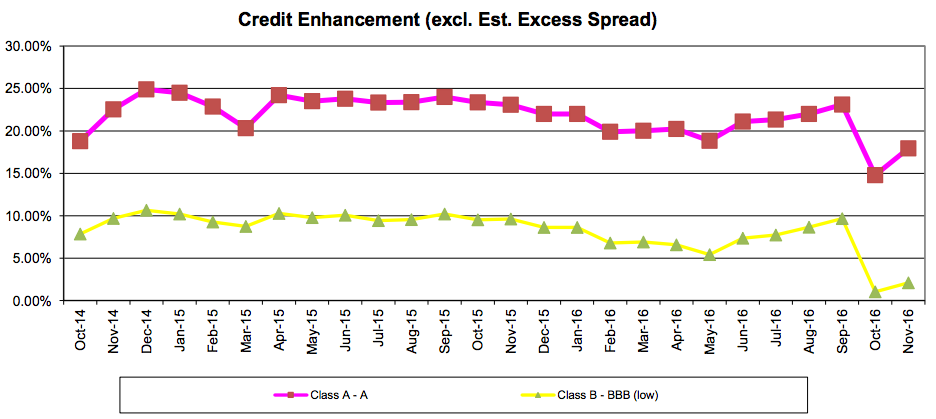
This is the first public glimpse into what CAN’s old systems got wrong and by how much.
The drop triggered a rapid amortization event, potentially causing liquidity issues for CAN, hence why new funding may be paused. The principal balance on the $200 million notes has dropped by nearly $70 million in the last two months, indicating big payouts.
The process to manage a rapid amortization event is described in the original DBRS ratings report. The implications aren’t good given that this appears to be brought on by misclassifying assets rather than a natural deterioration of loan performance.
Last week, CAN laid off nearly half of its employees as it tries to correct course.
Update: On December 25th, AltFinanceDaily published a brief of a newly discovered lawsuit filed against CAN Capital on December 19th by an aggrieved shareholder alleging the company had failed to pay her a $150,000 settlement payment.
A True Rapid Advance For Mark Cerminaro
December 16, 2016 In the 1999 film “Any Given Sunday,” Al Pacino plays a pro football coach whose obsession with winning has torn apart his family. He’s also plagued by a meddlesome team owner, challenged by an offensive coordinator who’s after his job, and vexed by a talented but narcissistic backup quarterback. But none of that stops the coach from reaching deep inside to deliver a stirring halftime pep talk to his dispirited losing team. Assuring his players that life and football are both games of inches, he beseeches them to look into the eyes of the men around them. “You’re going to see a guy who will go that inch with you,” he declares. “Either we heal now as a team or we will die as individuals.” The players rally and explode onto the field.
It’s a scenario the sales staff can’t get enough of at RapidAdvance, a Bethesda, Md.-based alternative small-business finance company with more than 200 employees. Mark Cerminaro has screened a clip of the scene countless times in a company conference room to fire up his crew. Salespeople emerged from those meetings eager to make that extra phone call, provide the telling detail on an application or do whatever else it would take to taste the victory of making the sale. For Cerminaro, the movie and the sales meetings embodied his penchant for winning ethically through teamwork, dogged persistence and great customer experience. That credo has helped propel him to top management at RapidAdvance and has earned him accolades from once-skeptical financial services peers.
Cerminaro’s story begins in his hometown of Highland Park, N.J., where he experienced a small-town vibe but enjoyed easy access to New York City, Philadelphia and the Jersey Shore. He graduated in a class of 85 students from the local public high school, playing varsity football, basketball and baseball. Summers, he worked construction, did landscaping, delivered flowers and umpired Little League. “It was a great place to grow up,” he says.
 In high school, Cerminaro sometimes went along for the ride when his sister, who was five years older, was choosing a college. On a visit to Georgetown University in Washington, D.C., Cerminaro stood in the student center and gazed out at the campus. “I’m going to come here and play football,” he told himself.
He made good on that vow when his high school football team made a reputation for itself, and Georgetown was among the schools that recruited him. Besides, it made sense to go there because he was interested in studying politics and going to law school. Growing up with a father who was chairman of the local Democratic Party, Cerminaro had his eye on eventually becoming governor of New Jersey.
Playing for the NFL on the way to the governor’s mansion seemed like a good idea, too. But Cerminaro, a quarterback, blew out his throwing arm two years into his collegiate football career. His dreams of making the pros died, but that left more time for academics. He plunged into a series of four rigorous internships, three of them in politics. He served two in the Clinton White House and one on Capitol Hill with Sen. Robert Torricelli, D-N.J. He fondly recalls talking to President Bill Clinton for five minutes before a state dinner. Then two hours later, after spending time with heads of state, the President called out, “There’s Mark, my fellow Hoya.” Cerminaro will never forget it.

In the end, however, the fourth internship won out. Although Cerminaro hadn’t studied business or finance too much, he landed an internship in the local Washington, D.C., office of Morgan Stanley. If nothing else, it would help him manage his investments some day, he reasoned. However, he soon approached the operations manager and some senior brokers and offered to take on duties they didn’t want to fulfill. He had decided to learn about operations, and taking on extra work without additional compensation was in line with his new habit of figuring out what steps would take him where he wanted to go in life.
Cerminaro earned his managerial license with Morgan Stanley and accepted a job as associate branch manager in the Washington, D.C., office, managing and training new financial advisors. He considered the position great exposure to sales, management, operations and compliance – “elements that have paid dividends in the growth of my career,” he notes.
 Early in Cerminaro’s tenure at Morgan Stanley, the company sent him for training with about 300 other new employees at 2 World Trade Center in Manhattan. The date was Sept. 10, 2001. When the trainees reported to the office the next day, they were in a 64th-floor conference room when they heard an explosion and saw shreds of paper floating past the windows. They didn’t realize yet that a terrorist-controlled jetliner had hit next door at 1 World Trade Center.
As they evacuated down a stairwell, the trainees heard and felt the concussion of the second plane that hit their building. “I’m 22 years old and I may be about to die,” Cerminaro remembers thinking. “Make sure my family knows I love them,” he prayed. He made it out and was greeted with smoke, debris, the flashing lights of emergency vehicles and panic in the streets. He walked to a restaurant some family friends operated in Little Italy and borrowed a working phone to call his family in New Jersey and let them know he was OK.
Returning to the D.C. office of Morgan Stanley, Cerminaro got back to work. He loved the entrepreneurial spirit at the company, but as the years passed he realized he was unlikely to amass enough power in the giant firm to dictate how it would operate, grow and change. So he was interested when someone he knew at Morgan Stanley told him about RapidAdvance, then a two-year-old company with about 20 employees. “I saw the opportunity to be part of building a company – that’s what drew me to RapidAdvance,” he recalls.
In 2007, Cerminaro interviewed with Jeremy Brown, who was RapidAdvance’s CEO at the time and has since advanced to chairman. “It was apparent that Mark had a well thought-out, well-articulated plan for sales,” Brown says of his first impression. “He had a presence about him, a command that said this guy a real leader – somebody who could make a long term component of the company.”
Cerminaro joined RapidAdvance as national sales director and began building a sales structure and team based on some of the elements of Morgan Stanley’s sales model. Developing KPIs, or key performance indicators, helped him measure progress. “You had to roll up your sleeves and get involved in every aspect of things,” he said of working for a startup in a fledgling industry. The company’s outbound call center came up with sales leads, and he cut and pasted them from an Excel spread sheet and divvied them up among the five or six account executives.
 Cerminaro wanted to teach that handful of salespeople to function as business advisors and help them become the single point of contact for clients. His salespeople guided small-business owners through the application process and stayed in contact with them after the sale. He emphasized doing right by customers, teammates and the company as a whole. It was a vision that inspired the team.
“Mark was a great mentor and provided me a lot of guidance and tutelage over the years,” says Devin Delany, who started as an account executive at RapidAdvance and has moved up to director of sales. “His real mission was to create a sense of family and he executed on that to the fullest extent, creating a close knit team of upward of 40 folks who really care about one another.”
That sales “family” used dialogue marketing to refocus attention on prospects who had fallen out of the sales cycle. In those days they used a product-driven sales pitch based on merchant cash advances. Third-party partners included credit card processors and credit card ISOs. Brokers came onto the scene later.
Soon after Cerminaro arrived at RapidAdvance, the financial crisis struck. The company managed to navigate the troubled times and emerged with improved underwriting skills, a better understanding of leading indicators and a truer grasp of how its portfolio performs. Something else happened, too.
 As traditional lines of credit dried up during the recession, small businesses that didn’t accept credit cards began to search for working capital. In response, Cerminaro, Brown and Joseph Looney, RapidAdvance’s chief operations officer and general counsel, sat down and outlined a plan to offer small-business loans as well as MCAs. “That effort really redefined who RapidAdvance was,” Cerminaro says of the new loans. “We went from a single-product company to now being more of a solutions-based company,” he maintains. “We were able to shift from selling a product to doing needs-based analysis with our clients and focusing on what was the right solution for them.”
Cerminaro found it exciting to develop the loan program and oversee sales, but he was looking for more. He turned part of his attention to business development and even expanded his purview to include marketing. The company was thinking along the same lines. In 2010, RapidAdvance promoted him to senior vice president, sales and marketing. “As the company has grown we have had different needs, and we leaned on Mark and his skill set every time we made a change,” Brown says. “Every time we made a change he has stepped up and done what’s asked of him.”
Producing one of the industry’s first national television ad campaigns highlighted Cerminaro’s period as senior vice president. “We were the pioneers in being able to market through that medium,” he says. “It was absolutely scary at the same time. It was a massive investment for us and we had no idea whether it would pan out.” The sales staff were waiting in anticipation when the phones began ringing after the public saw the commercial. “The original spot we put together still tests well and drives a lot of traffic,” he notes. Viewers find a tune featured in the ad sticks in their minds and can’t help humming it – sometimes when they’d prefer they didn’t, he adds.
Then came another promotion. In 2013, just before Detroit-based Rockbridge Growth Equity LLC acquired RapidAdvance, Cerminaro was named chief revenue officer and became responsible for all revenue-generating activities and all of the company’s front end efforts. The company had grown significantly over the years, but the merger increased financial backing and thus accelerated growth, he says. For him, that meant pursuing a new type of partner company – asset-based lenders and factoring companies. It wouldn’t be easy. “The traditional lending market had a lot of misconceptions about our industry,” Cerminaro admits. “A lot of people in that business were very critical.”

But Cerminaro made the rounds of trade shows and visited conference rooms until he succeeded in winning the hearts of bankers, according to Will Tumulty, RapidAdvance’s CEO. “Mark and his team have developed partnerships in the commercial lending space,” Tumulty says. “There are a number of companies that have historically viewed working-capital funding as a competitor. We don’t see ourselves competing with those companies. Mark and his team have worked with those companies to get merchants what they need.”
As a testament to Cerminaro’s success in that quest, the Commercial Finance Association named him to its 2016 list of “40 under 40” achievers. He was the only person from alternative small-business funding to make that venerable list of prominent young lending executives. He helped spur his company on to other awards, too. The RapidAdvance Bethesda office was chosen for The Washington Post Top Workplaces 2016 list, and the RapidAdvance Detroit office made the list of 101 firms recognized as Metro Detroit’s 2016 Best and Brightest Companies to Work For.
Meanwhile, Cerminaro was successfully courting mega retailers, says Brown. When the possibility of becoming a partner with Office Depot arose, Brown felt hopeful but remained skeptical because of the long lead time required to convince so many executives in such a large corporation. “But mark was dogged,” he says. “It took him probably a year to land and close the deal and negotiate the agreement and sign the account. He went to countless meetings down in Florida. He participated in endless conference calls, but mark got the deal done. It’s a relationship we’re proud of, and he is singularly responsible for closing that deal.”
In those encounters with Office Depot execs, Cerminaro displayed savvy and professionalism, Brown says. They’re traits that will continue to pay off not only for RapidAdvance but for the entire industry, maintains RapidAdvance’s Looney. “He’s out there with lots of big banks and other potential partners,” says Looney. “He’s a good face for the industry.”
For Cerminaro, it’s satisfying to see RapidAdvance become all he dreamed it could be. But that still comes in second for him and differentiates him from the coach played by Al Pacino. Cerminaro’s the kind of guy who asked his father to be his best man and now has a wife and two sons of his own. “Your family and your loved ones are by far more important than anything else in your life,” he says.
+1 for Swift Capital, -1 for Lending Club
December 15, 2016Swift Capital has named Tim Naughton as Chief Legal Officer, according to a company announcement on Thursday. “Prior to joining Swift Capital, Naughton advised Bank of America’s small business lending and deposit services as assistant general counsel and senior vice president,” it says. “He served as external counsel for American Express and Sallie Mae, and was a partner at Hudson Cook specializing in financial and regulatory compliance.”
Hudson Cook law firm coincidentally produced the merchant cash advance industry’s training course.
Meanwhile, Lending Club disclosed in an 8-K Thursday that CTO John MacIlwaine had tendered his resignation “to pursue another opportunity.” MacIlwaine had been with the company for more than 4 years. He is the latest of several C-level execs to depart in 2016. Former CEO Renaud Laplanche resigned in a scandal earlier this year and CFO Carrie Dolan, like MacIlwaine, also resigned “to pursue another opportunity” back in August. Other executives including Jeff Bogan and Adelina Grozdanova, Lending Club’s Head of Investor Group and Vice President, Head of Institutional Investors respectively, also both resigned in May. Lending Club’s stock is down more than 50% since the beginning of the year.
Fifth Third Bank/ApplePie Capital Deal Great, But Bank Deals For Many Other Business Lenders Still a Pie in the Sky
December 13, 2016 Fifth Third Bank is buying a stake in franchise marketplace lender ApplePie Capital as part of a $16.5 million venture round, the WSJ reported. The prediction that non-banks are evolving into banks is slowly coming true, but will the trend in the commercial space continue?
Consider that ApplePie has only made 120 loans over the last two years, a small piece of pie compared to a company like CAN Capital which has made nearly 200,000 loans and advances since inception. But ApplePie and CAN are not competitors, nor is ApplePie really like the rest of the industry that has long proclaimed that banks can’t profitably make small business loans under $250,000 or lend to borrowers with poor credit history. Instead, ApplePie’s model, terms and customers have always had a common synergy with banks, $420k loans (on average) for up to 7 years to franchise owners at 8.62% APR (on average) and 750 FICO (on average). It’s a borrower profile that has literally resulted in zero defaults for ApplePie so far, though it’s still early days. Business owners can get term-sheets in 5 days and funding in approximately 30 days. Sounds mighty bankish to me.
ApplePie’s loans are even issued by a New Jersey State chartered commercial bank, Cross River Bank. But ApplePie is the platform, using technology to draw attention to franchise owners in need of financing, streamlining the process and providing a way for investors to participate in the deals. Denise Thomas, the company’s CEO and co-founder told the WSJ that banks’ costs are now too high to make $420,000 loans. That might be true but one wonders if such loans should be done over such a long period of time and at such low rates, especially considering that their borrowers are not asked to put up any personal collateral.
Another lender that tried their hand at prime small business borrowers closed their doors last month. In an op-ed penned by Candace Klein of the now defunct Dealstruck, she said of moving away from the mid-prime borrower to prime, “yields began to tighten. Lenders stopped making a profit and backend capital began to question whether there was a ‘there’ there after all.”
But whereas Dealstruck was constrained by their cost of capital, a bank could potentially make it work. One pitfall that ApplePie has however is limited time in business. It’s easy to claim no defaults on loans with 70 month terms (on average) when you have only been business for two years. Even still, it’s not hard to see why a bank would be interested in their particular model. The vast majority of non-bank small business funding companies operate in a totally different universe, with smaller loans, poorer credit, shorter terms and faster service. These are the ones typically associated with fintech, seeing as they have been able to make tens of thousands or hundreds of thousands of loans in a short amount of time. If that market was as easy as pie though, banks probably would’ve forged more partnerships by now.
The CAN Capital Shakeup Is A Sign of the Times
November 30, 2016Update 11/30 7:30 pm: CAN says they are still open for business and still providing access to capital for current customers and renewal business. They are not actively seeking new business at this time, but will evaluate it as it comes in.
 Part II of the industry’s season finale has begun. On Tuesday afternoon, CAN Capital confirmed that CEO Dan DeMeo had been put on a leave of absence. The chief risk officer and chief financial officer have also reportedly stepped down. Parris Sanz, the company’s chief legal officer, is now running the company, a CAN spokesperson said. His new title, acting head (which is how their statement referred to him), is perhaps a subtle clue that the company did not plan these moves far in advance. And it’s the phrasing that’s used to describe the departure of these executives that’s worth raising an eyebrow. A leave of absence? A curious fate indeed.
In an exclusive interview AltFinanceDaily conducted with DeMeo last year, he said of CAN at the time, “it’s a self-sustaining business. We’re not forced to approach the capital market to cover our burn rate. We’re cash-flow positive.”
But more recently, there’s a different tone. A spokesperson for CAN said that the company had “self-identified that some assets were not performing as expected and that there was a need for process improvements in collections.” The sudden decapitation of the company’s top officers seems a harsh consequence for this apparent underperformance, especially given that CAN has long been on the short-list as a potential IPO candidate. DeMeo himself had been with the company since 2010, having started originally as the CFO and rising to the CEO position in 2013.
While CAN Capital is a private company, they are notable in that they have originated more than $6 billion in funding to small businesses since 1998 and secured a $650 million credit facility led by Wells Fargo just last year.
Some of CAN’s ISOs report being told that originations have been put on hold until January. A source with close knowledge of the company however, said that’s not correct. The Financial Times reported though that CAN had paused new business until the end of the year and would only be servicing current customers. And they might indeed need time to upgrade their systems since American Banker cited an unnamed source that said “problems arose when CAN Capital used old systems, which were not designed to require daily repayments, to collect money owed by term loan borrowers.”
Some outsiders are not surprised by what’s going. Alex Gemici, the chief revenue officer of World Business Lenders (WBL), said that it’s an indicator that uncollateralized lending is not the panacea everyone thought it was. “What we’ve been saying all along is right there on AltFinanceDaily,” Gemici said, while directing me to the prediction they made a year ago that appears right on this website. At a December 2015 event at the Waldorf Astoria, WBL CEO Doug Naidus told a crowd comprised mostly of his company’s employees that he believed the bubble was about to burst. He doubled down on that prophecy in an interview four months ago in which he chided companies for having forsaken sound underwriting.
Is he right? In the last six months, the CEOs of Lending Club, Prosper and CAN Capital have all stepped down. Avant shed a lot of its staff. Dealstruck, Circleback Lending and Windset Capital have stopped funding. Confidence in the business side of alternative finance has also started to slip on a measurable basis before the election even happened.
“I believe companies are experiencing higher than normal losses due to a serious lack of proper underwriting practices, policies, and procedures,” said Andrew Hernandez, a managing partner at Central Diligence Group, a company that specializes in risk analysis who wasn’t commenting about any lender specifically. “As I say to people not familiar with the space, ‘putting the money out is the easy side of the business; getting it back is what proves to be the most difficult.'”
But CAN has not specifically fingered underwriting practices as the reason for their management shakeup, instead leaning towards it being a lapse in their process as the company grew. “It became clear that our business has grown and evolved faster than some of our internal processes,” they said in their statement.
The only alternative business lender funding more annually is OnDeck, a company that has garnered its fair share of criticism over its lackluster financial performance. Their stock is currently down a whopping 77% from the IPO price, but they have put on a good face for the industry they lead. The familiarity of their famous CEO and the decade in business under their belt arguably even has a calming effect on the tumultuous world of financial technology startups.
OnDeck too though, has been referenced in the context of bursting bubbles. Less than two years ago, RapidAdvance chairman Jeremy Brown voiced concern that the industry was heading into unsustainable territory, even going so far as to call out OnDeck by name. “When I see some of the business practices, offers, terms and other aspects of our business today, I am worried,” he wrote. “I am worried because I believe that 2008 has been too quickly forgotten, and very few, other than those of us that were on the front lines on the funding side at that time, appreciate what happened to outstanding portfolios at that time when average duration was 6 months and no deals were written over 8 months.”
For risk experts like Hernandez of Central Diligence Group, he thinks the newness of everything has been part of the problem. “I believe [funding companies] have faced a big hurdle in acquiring talent,” he said while adding that funding companies can be forced to hire underwriters with no prior knowledge of the product just to keep up with the growth.
While still very little is known about what exactly happened at CAN Capital, most people that AltFinanceDaily spoke with were shocked that anything could happen there at all. “It’s insane,” said the chief executive of another competitor who wished to remain anonymous. “This is CAN we’re talking about.”
A sign of the times?
Shakeup at CAN Capital – CEO and 2 other Execs Put on Leave of Absence
November 29, 2016Update 11/30 7:30 pm: CAN says they are still open for business and still providing access to capital for current customers and renewal business. They are not actively seeking new business at this time, but will evaluate it as it comes in.
CAN Capital has confirmed that CEO Dan DeMeo has gone on a leave of absence. The company’s chief financial officer Aman Verjee and chief risk officer Kenneth Gang have also reportedly stepped down. Parris Sanz, the company’s Chief Legal Officer, has been made acting head of the company, while Ritesh Gupta has been promoted to COO.
A statement from CAN Capital is below:
“As the board and our leadership team conducted our business reviews and looked at how we can best position the firm for future growth, we self-identified that some assets were not performing as expected and that there was a need for process improvements in collections. It became clear that our business has grown and evolved faster than some of our internal processes. As we work to improve these processes, the Board has named twelve-year CAN Capital veteran and senior executive, Parris Sanz acting head of the company and promoted Ritesh Gupta to COO, while Dan DeMeo, CEO, and two other members of his team are on a leave of absence. Over the past 18 years CAN Capital has consistently made decisions to position ourselves for growth and leadership in the industry and we look forward to helping small businesses succeed for many years to come.”
Some of CAN Capital’s referral partners have reported to us that the funding of new deals has been put on hold until January 2017. This could not be confirmed, however. (Update: This was later confirmed)
More than just an industry leader, CAN was founded in 1998 and is widely regarded as the first merchant cash advance company. A year ago, AltFinanceDaily featured Dan DeMeo and CAN in a story to mark their success. As of April this year, they had funded more than $6 billion since inception. In August, they secured a coveted partnership with Entrepreneur Magazine.
Having secured a $650 million credit facility last year led by Wells Fargo, they are the second largest player in the alternative business finance industry behind OnDeck.
Sanz joined the company in 2004 with more than 12 years of experience as a corporate, securities, and transactional attorney. Before joining CAN Capital, he was a senior executive and General Counsel of a specialty pharmaceutical company, the successful sale of which he led in 2003. Prior to that, Sanz was an attorney in private practice at the law firms of Latham & Watkins in Los Angeles and Paul, Hastings, Janofsky & Walker in San Francisco, where he handled a wide variety of M&A transactions, securities offerings including IPOs, and other corporate transactions, and acted as outside general counsel to a number of technology start-ups.
Sanz received his J.D. from Harvard Law School in 1993 and a Bachelor of Arts degree from U.C. Berkeley, High Honors and Phi Beta Kappa, in 1990. Sanz is admitted to practice in California and Washington, D.C., is a registered In-House Counsel in New York, and is also admitted to practice before the United States Court of Appeals for the Federal Circuit.