
Keeping Lending Club (and others) Honest
October 19, 2014 Now that institutional money is flowing into the alternative lending industry, some retail investors are starting to express concern that the rules are changing. Lending Club for example is no longer considered a peer-to-peer lending platform, but rather an online credit marketplace.
Investors don’t exactly make loans to individuals in that marketplace, but that’s sort of how the concept began. Today, a bank issues the loan to the borrower, Lending Club buys the loan and creates a note tied to the performance of the loan, and then sells that note to investors.
Lending Club holds all the power and that worries retail investors who believe that the company is not always forthcoming about what they’re doing. It’s not easy to find dissenting voices when the market is growing rapidly especially since the media is cheering the revolution on.
But in the back corners of the Internet there are groups of investors growing suspicious, if not downright paranoid that all is not right in Lending Club land.
On Peter Renton’s Lend Academy forum for example, healthy discussions are being replaced by collaborative investigations into Lending Club’s practices. As a retail investor myself, I can’t help but be drawn to it. Below is a list of some of the issues:
The Borrower Member ID number is never reused
If a consumer borrows money from Lending Club in 2013 and again in 2014, it would probably be useful for investors to know about the previous Lending Club loan. Instead, borrowers are issued additional Member IDs with each successive loan, masking the history of past loans.
Borrowers may be taking two loans simultaneously
Acknowledging that Member IDs can never be reused, curious retail investors used other data points disclosed by Lending Club to link borrowers together. They believe they discovered a number of borrowers who got two Lending Club loans back-to-back, sometimes within days of each other.
The concern here is that the borrowers were taking on much more debt than the investor was led to believe. For instance, an investor might feel comfortable with the borrower taking a $10,000 loan, but has no idea that another $20,000 is being issued to them days later under another Member ID number.
Whether or not this is actually happening and the scale of how often it is happening is tough to say, but a little detective work by others indicates that it has possibly occurred.
What happens if Lending Club goes bankrupt?
While a poll with so few responses (52 total) on the Lend Academy forum may not be statistically relevant, 75% of the respondents claimed to be concerned in some capacity that Lending Club has no Bankruptcy Remote Vehicle for retail investors. 21% said they were extremely concerned. Absent a BRV, a Lending Club bankruptcy endangers all retail investors from getting paid regardless of whether or not the borrowers are actually paying their loans.
Anil Gupta, the founder of PeerCube wrote the following on the Lend Academy forum in response to the BRV issue:
You are not alone. I am also in the extremely concerned category when it comes to BRV for LC. This segment has been wild-wild west and reminds me of combination of dot-com bubble in 1999 and housing bubble of 2007. Overall, I am very concerned with platform risks.
Premature IPO attempts by p2p platforms is also concerning. I am taking that as indication of founders, VCs and early employees want to cash out and exit while the market is hot. They may be seeing the growth reaching a plateau and increased competition. I believe we will see a lot of shake out when interest rate start to rise. Potentially stepped up government regulations of p2p platforms once investors lose money.
Startup woes?
Retail investors, particularly those that have deployed a substantial amount of their capital in Lending Club notes gripe that sometimes the financial reports they get are missing data, experience glitches, or are just totally wrong. While usually resolved to everyone’s satisfaction, as a seven year old company, one might expect for Lending Club to be much more careful at this stage in the game. With an IPO in the works at this very moment, they should be way past problems such as data in the downloadable files not matching the website.
New fees
In August, Lending Club announced they would begin charging investors 18% of the delinquent amount recovered if the loan is at least 16 days late and no litigation is involved. When investors pushed back, it turned out that was always their written policy, they were just waiving it for everyone’s benefit until now.
While the move means a few more dollars out of every investors pocket, it was noticed that loans that have been restructured at the borrowers request are not marked as current for the duration of the payment plan even if they are in fact current on the payment plan itself. So when loans get restructured, Lending Club begins taking 18% of every payment as if it were a continuing collections problem.
From a firsthand perspective, I had several loans entering into payment plans almost immediately following the issuance of the loans. Basically the loan would be issued, the borrower would make their first payment, they’d plead hardship, go on a payment plan, and then Lending Club would begin deducting 18% of every payment going forward.
In these situations, our interests are not aligned. By entering a payment plan, not only is the amount the borrower is paying monthly reduced, but 18% of each of my payments now belongs to Lending Club instead of me. Basically, the appearance that Lending Club has a personal incentive to place borrowers on a modified plan at my expense and without my consent is a conflict worth monitoring.
Automated Investing under delivers?
For those with too much money or too little time to choose notes to buy themselves, Lending Club offers Automated Investing, a program that will automatically buy notes within parameters you set when they become available. The draw back is that the filters are limited and some investors are complaining that they’re ending up with notes they never would’ve bought manually.
WebBank woes
On October 6th, Lending Club announced that investors would have to sacrifice several days worth of accrued interest to WebBank, the bank that issues the loans for Lending Club.
Citing the move as necessary to keep Lending Club robust in a changing environment, the run up to the IPO has had some investors feel like they are suddenly being nickel and dimed.
Refinanced
Not that this is necessarily bad, but there’s evidence that shows Lending Club is encouraging its own borrowers to refinance their loans to a lower rate. If they do it, it results in the original note being paid off. The payoff returns the cash to the investor who then may have to wait two weeks or more to put that money back into a new note.
It must be said that any time I’ve published a gripe about something Lending Club is doing, my account representative there has called me to try and resolve it. That’s surprisingly good service!
But while I feel safe enough about my investments now to keep them there, there’s nothing wrong with reminding Lending Club and all of the other disruptive financial companies out there that investors are watching their every move.
As long as they have your money, it’s healthy to keep them honest.
Big Deal #2 Struck in MCA Industry
May 21, 2014 Another day, another capital raise for some company or other involved in alternative business lending. That’s the way it is these days, but the news about the American Finance Solutions (AFS)/CapFin Partners deal announced on Wednesday is markedly different.
It’s the Rockbridge Growth Equity (RGE)/RapidAdvance deal all over again, the welcoming of a major MCA company into a wider lending family. Though the release does not specify the amount of equity CapFin Partners acquired in the transaction, nor any valuation figure, the headline literally says it’s significant.
CapFin Partners is also a significant investor in Contintental Business Credit (CBC), an asset-based lender that’s been in operation since 1989. The CapFin deal will bring AFS and CBC together strategically. As said in the release, “the union of these two financial lending companies will widen the portfolio of services offered, which now include merchant cash advances, factoring and asset based loans.”
The design is strikingly similar to the RapidAdvance/RGE deal.
AFS/CapFin
The investment and close relationship with CBC will provide operational expertise, a diversified client base and a larger pool of capital for funding customers
RapidAdvance/RGE
By aligning with Rockbridge, we will leverage our new relationship with its portfolio of companies, bringing best practices and expertise to nearly every aspect of our business.
Both funders were founded in the pre-recession era, giving investors a chance to review performance and returns both through good times and bad.
Two years ago I predicted that “MCA will simply assimilate into other financial products.” As is the case with these two deals, it’s already becoming just one product out of many offered by financial institutions. Elsewhere in the industry, MCA companies are offering true loans to stay competitive and some funders are passing on MCA completely to focus just on traditional business loans with terms up to 10 years and traditional interest rates.
The AFS deal proved yet again though that there is a market to buy (or buy into) established reputable merchant cash advance companies. That should give hope to new funders that are trying to formulate a long-term exit strategy.
Congratulations to American Finance Solutions.
Is PayPal’s Working Capital Program a Mistake?
October 5, 2013 A few weeks ago, PayPal announced the launch of their Working Capital program as a way to help small businesses in need. They classify it as a loan but the explanation for how it works is textbook merchant cash advance. A percentage of each PayPal sale is withheld and applied as a reduction to the merchant’s balance. PayPal joining the booming merchant cash advance/alternative lending market is really no surprise. After all, RapidAdvance just got acquired by the same group that owns Quicken Loans. We’re in a new era of alternative finance.
PayPal is respected as a payments company but are they ready for the high risk world of merchant cash advance financing? Critics are not so sure. Industry insiders have watched dozens of funding providers jump into the market with aggressive rates, attempt to undercut the competition, and acquire a lot of marketshare. The results are usually disastrous.
For years, journalists believed that the high cost of capital provided by non-bank lenders was fueled by the desire for immense profit. They didn’t understand the risks involved or realize that some funding providers weren’t even turning a profit at all. Last year, Opportunity Fund, a non-profit small business lender revealed that to make loans at 12% APR would fail to even cover costs. The for-profit sector of the industry charges factor rates (different than Annual Percentage Rates) between 1.14 and 1.50, not including fees. I explained this variance once before in The Fork in the Merchant Cash Advance Road.
So did PayPal learn anything from an industry that has been in existence for 15 years? It doesn’t look like it:
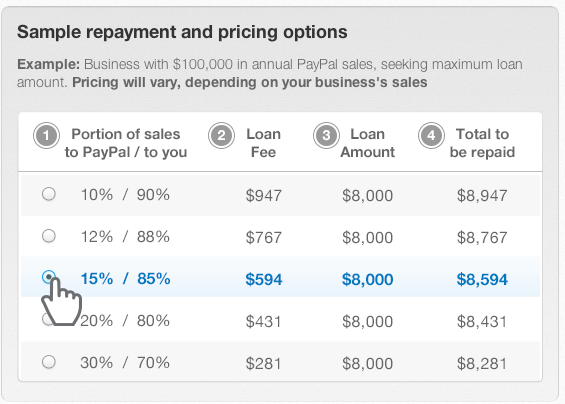
Doing some simple math (Total to be repaid / Loan Amount), the factor rates range from 1.04 to 1.12, figures that will probably only make sense if their average client has greater than 720 FICO, many years in business, and is virtually perfect on paper and in reality. Perhaps PayPal knows that and will decline 95% of applications or perhaps they believe their clients will buck the trend. I mean, is it possible that a corporate monster like PayPal could make a boneheaded mistake?

A 1.04 deal? Seriously? This has disaster written all over it. There are some people that believe that the losing proposition is intentional…
You can follow the discussion about this on DailyFunder.
Merchant Cash Advance Industry is Busy at Work
May 16, 2013 After what was one of the wildest two weeks in Merchant (MCA) history, the game-changing news finally subsided, but no one is taking a deep breath. Instead, everyone is busy working their butts off trying to help small businesses grow.
UPDATE 5/16: RapidAdvance has acquired the operating assets of ProMAC. First Instance of consolidation that we’ve been predicting would happen this year. See news release detailing the acquisition HERE.
There is just loads of capital available right now and the technology is catching up quick to support the mass deployment of it. A writer for the American Banker believes that the MCA industry is even beginning to threaten community banks.
Many community bankers would be open to using online applications and other technological tools to make faster loan decisions, says Trey Maust, co-president and chief executive at the $121 million-asset Lewis & Clark Bank in Oregon City, Ore. But most community banks use a business model that requires more hands-on interaction with borrowers, he says.
Hands-on is another term for driving back and forth to the bank for appointments, having the bankers visit your business, all the while they try to sign you up for other bank products, like checking accounts that incur a monthly fee.
Who’s at Work
We know some of the major industry players but it’s interesting to see who else is doing significantly large volume. Pearl Capital recently reported funding $7 million in a single month and United Capital source came in at a tad shy of $4 million in just this past April. These are firms you may have heard of already, but they’re now sitting at the big kids table.
What the Generals are Saying
If you haven’t been paying attention to the DailyFunder.com forum, 4 Chief Executives have contributed to the site in a very meaningful way by sharing their thoughts on the MCA industry at large. This is the kind of wisdom you would normally get in bits and pieces through occasional citation in the Green Sheet or other publications, but the full monty has materialized in the very exclusive CEO Corner. Some key highlights from what they’ve shared so far:
Excerpts from Jeremy Brown, CEO of RapidAdvance:
Those of us that have been in this business for 5 years or more – Rapid started in 2005 – are excited at the positive press we get today vs. several years ago and how we are becoming embraced and accepted as a mainstream product. More PE firms, banks, and others want to invest in or lend to the industry. Those groups have always been intrigued by the returns in this industry but the conversations are different today.One thing I think will be different next year are fewer deals offered over 12 months in payback period. When you look at the data over an extended period of time, 18 month term loans don’t make sense for the merchants that are funded. It’s not the most efficient use of funds, limits the ability for the merchant to renew and the longer term deals are far riskier. (See: Year in Review and What Next Year May Bring)
Isn’t that the point of a 6 month MCA – to meet a current need and have the merchant be able to draw again in 4-6 months for the next capital need? That is the problem with the 15 – 24 month deals that are being offered to merchants today. Our industry is based on providing working capital to merchants. By its very definition, working capital is less than 12 months. Longer term deals are permanent capital, even when they are repaid over 15-24 months.it was no surprise when the economy tanked in late 2008 that the merchants in our portfolios at that time took a major hit to sales and therefore the funding companies losses increased by 50% or more on their outstanding portfolios. So what happens when the next recession – big or small – hits and funders have portfolios out to 24 months? It doesn’t take an MBA from Harvard to figure out that answer. (See: Working Capital or Permanent Capital
Haven’t gotten into the industry myself in 2006, I can totally validate the complete 180 in press coverage. I’ve put all my energy into MCA and it’s gratifying to finally hear the praises so many years later.
Excerpts from Steve Sheinbaum, CEO of Merchant Cash and Capital:
The industry already services hundreds of thousands of small business merchants with cash advances for growth and other purposes based upon monthly credit card receipts. For years this has been the basic model of operation. But, what about the substantial number of businesses that require quick and easy access to capital who don’t accept credit cards or don’t produce enough in monthly credit card receipts to qualify under the normal MCA guidelines? Tens of thousands of businesses could use the capital infusions the industry provides daily but either don’t think they’ll qualify or, because of our lack of creativity, the industry hasn’t produced a means of addressing their needs. These businesses would make great customers but because of the rigid requirements we have in place to protect our livelihoods we’ve left money on the proverbial table.That’s not the case anymore. (See: Creativity in the C-Suite…Another way to Fund!)
In regards to advances on gross revenue instead of just credit card payments, he’s absolutely right.
Excerpts from Andy Reiser, CEO of Strategic Funding Source:
the most important part of any deal is the people. We rely heavily on the relationships we have with the client and most importantly with our ISO partners and ISO syndicate partners who invest side by side with us. Valuing these relationships is far more important than relying solely on the numbers and how sophisticated our technology is.Over our 8 year history, we have noticed that the performance of a deal has more to do with the relationship we have with our ISO partner and ISO syndicate partner, then with the deal itself. We have all kinds of tools available to help us analyze the potential success of a deal – FICO scores, due diligence checklists, signed affidavits, warranties and representations, scoring models, algorithms, etc. And yet, some of the ugliest deals on paper have been some of our best performers, while some of the most attractive deals on paper have been nothing but trouble. (See: Business and Baseball Fantasies)
During my time as a head underwriter, I witnessed the exact same thing. Solid referral partners had solid performing clients even if they didn’t look so good on paper. Likewise, the shakier resellers had clients that underperformed across the board, including the deals that looked cleanest.
Excerpts from Craig Hecker, CEO of Rapid Capital Funding
As each MCA company grows and creates a positive reputation, we all grow as an industry…together. But as our popularity grows, however, so does our competition. We already know that Amazon, eBay, and Google are stepping into the market, and AMEX is looking to expand their short term financing portfolio. These big business industry leaders will help build our brand of finance and benefit our portfolios, but I also think it is fundamental that we market ourselves as the alternative to big business finance and identify ourselves with the small business owner. (See: Small Business and How MCA Can Bridge the Gap to Success
We’ve got some big names in the industry now, whether they are financing the merchants directly or backing the funders that do the financing. I agree that you need not be intimidated by competing against these established brand names. Positioning yourself as the funder next door, people that have walked a mile in the merchant’s shoes (literally) can actually be a strong advantage.
What’s Next?
We’re pretty confident there will be more big headlines in the near future but for now we can’t confirm or say anything. DailyFunder.com is also lining up additional industry captains to participate in the CEO Corner and I’m sure there will be plenty of nuggets for us all to dissect. They’re probably the best source of MCA information that you can possibly get.
Stay tuned.
– Merchant Processing Resource
../../
MPR.mobi on iPhone, iPad, and Android
Recent Merchant Cash Advance News
April 14, 2013 In case you missed some of the big headlines in this last week, below is a summary:
Forbes changed its tune on MCA after five years
It took only a handful of journalists to set the Merchant Cash Advance industry’s momentum back YEARS. One of those journalists was Maureen Farrell, a previous writer for Forbes. Her story on January 31, 2008, titled Look Who’s Making Coin Off The Credit Crisis mercilessly labeled Merchant Cash Advance providers as blood sucking vampires borne out of the Great Recession. Sensational headlines attract attention and Farrell did her job well. But for someone whose background is Art History, English, and Journalism, she may not have been in the best position to make a qualified assessment of such a unique method of alternative finance. It’s unfortunate then that Forbes ran the story since it no doubt impacted public opinion in a negative manner for years.
That’s why it was so refreshing to see ‘Money, Money’ — How Alternative Lending Could Increase Your Company’s Revenue in 2013. Published by Cheryl Conner, she wastes no time in pointing out Farrell’s prior coverage as one of personal opinion and skepticism. Merchant Cash and Capital’s CEO, Stephen Sheinbaum was instrumental in Conner’s fresh assessment of the industry.
Read the new article on Forbes…
Deals being stretched out over 15 to 24 months may not be a step in the right direction
At least that’s the take of RapidAdvance’s CEO Jeremy Brown. In his latest post on DailyFunder Brown argued permanent capital solutions do not fit working capital needs.
Read his post…
Major executive shake-up occurs at Capital Access Network
Capital Access Network, the parent company of AdvanceMe, CapTap, and NewLogic recently let go of several top executives. Before official announcements were made, word had already leaked out and was being discussed on DailyFunder.
Read the discussion…
Merchant Cash Group announced the winner of their NCAA March Madness contest
NCAA basketball took us for a wild ride this year, but Merchant Cash Group is still awarding all their participants with bobble heads. The first place winner got cold hard cash.
His name is….
On Deck Capital embraces startup culture
Video games and ping pong tables adorn On Deck’s new office. Is the culture changing in alternative lending?
Read the story…
The ETA Expo is fast approaching. Are you going? Plan meetups
ETA expo thread on DailyFunder…
Kabbage Closed on a $75 million credit line
Read the story…
Surprise! We Are the Market
January 13, 2013Merchant Cash Advance (MCA) is an alternative to a small business loan. Look around. MCA players have spent so much energy on gaining mainstream acceptance, that we’ve become oblivious to reality. We ARE the small business lending market. There are alternatives out there such as credit cards and SBA loans, but they are industries of their own. Small businesses in 2013 really only have one place to obtain fast unsecured short term financing, and that’s here, the MCA industry. That assumes of course that you agree with our definition of MCA, which we stopped limiting to a purchase of future credit card sales some time ago.
Over the past few months, we began to realize that the only small business lenders making headlines are people we know. Is the country that small or does MCA dominate the market that much?
A glimpse at the sponsored advertisements on Bing in the NYC region:

Where are the multi-billion dollar banks? If $15 a click isn’t in their budget, something is wrong, and it may possibly be due to the fact that business loans aren’t on their priority lists.
Lenders, brokers, and bankers on the front lines can’t stop talking about MCA. It is a recurring theme in their columns:
The alternative financing industry is growing rapidly and, I believe, will continue to grow in 2013. These lenders are extremely entrepreneurial and are leaving the banks behind with their speed and use of technology. Many are backed by premier investment banks and Silicon Valley venture capital powerhouses — investors who understand that entrepreneurs and small-business owners are throwing up their hands in frustration over how long it can take to get a loan from a bank, especially if the loan is backed by the S.B.A. More and more businesses are willing to pay the price of the alternative lenders just to be able to get their capital and move on.
-Ami Kassar
The State of Small Business Lending – NY Times 1/8/13
Ami’s Column on NY Times
Cash advance companies, accounts receivable financiers, factors, and micro lenders all have become increasingly more attractive funders for three reasons: flexibility, use of technology, and speed.
-Rohit Arora
Three Reasons for the Rise of Alternative Lending – Fox Business 11/29/12
Rohit’s column on Fox Business
Here’s a dilemma that might have contributed to the growth of MCA… Banks don’t like offering loans and business owners don’t like applying for them if it’s hard:
There’s a large small business segment that needs and wants to borrow on a commercial basis, but their needs are very small. Business owners want $10,000, $20,000 or $30,000 loan–the average is somewhere around $25,000. Traditionally, that’s been a very unprofitable business for a bank. Some banks argue that they are willing to lose money on those loans because they can make it up in deposits. But what happens when the borrower has no deposits? It’s a very tough balancing act.
– The Federal Reserve Bank of San Francisco
A newsletter report that reveals banks lose money on small business loans
Community Investments Volume 8; No 4; Fall 1996
Business owners say the documentation involved is overwhelming. They’ve also found the qualification terms almost impossible to meet.
– Catherine Clifford
Feedback reveals that a burdensome application process and extensive paperwork requirements are enough to discourage business owners even if the loans carry 0% interest.
CNN 1/26/10
Thousands of researchers publish statistics on bank lending every month. Not only do they all contradict each other but journalists that use this data to make bold claims often fail to acknowledge that an increase in bank lending has nothing to do with the applicants, the economy, or the banks themselves. It has to do with the Government. We all know that the SBA will cover the losses banks incur, but there are programs that go one step further. The Federal Government actually bribes banks to make loans. For example, the Small Business Lending Fund is a dedicated investment fund that encourages lending to small businesses by providing capital to community banks. Meaning, covering the losses on defaults doesn’t seem to be enough, so they’ll actually provide the money to make the loans as well.
Click to see full size on mobile
 According to the SBA, small business bank borrowing totaled $584.1 billion in the third quarter of 2012. That number dwarfs the volume produced by the MCA industry, but its not an apples to apples comparison. A loan of $1 million dollars is within the range of a small business loan by the SBA, an amount atypical (though not impossible) in the MCA world. Banks are also prodded and coddled by the Government so much that it has reached the extent that we dare claim they are an extension of the Federal Government itself. There’s some food for thought for the Occupy Wall Street movement! They also conveniently got bailed out when they were on the verge of failure, a safety net that MCA companies don’t have.
Subtract the Federal Government’s meddling and there is only one profitable form of B2B lending, Merchant Cash Advance. That is of course again if you accept our definition. There are many young B2B lending firms that claim to be an alternative to MCA, who then go on to describe their product in a manner that is textbook MCA.
Our thesis may be debatable and lacking in concrete proof, but we’re not writing dissertations here. Business owners are increasingly looking to the Internet for loan information and it’s obvious what they’re finding. One would expect a quick Internet search to bring up ads for the billion dollar powerhouses, you know the ones that are given millions to lend out and then millions again when the loans go bad. Instead we find companies owned by friends or friends of friends. The small business loan market isn’t run by anonymous Wall Street kingpins, it’s run by a small community of entrepreneurs that all started from the ground up. Only the community isn’t so small anymore. There was once a handful of MCA companies claiming to be an alternative to a small business loan. Now there are a handful of companies claiming to be an alternative to MCA. It doesn’t take a genius to figure out why that is. After years of fighting to be recognized in the market, something remarkable happened, we became the market itself…
– Merchant Processing Resource
../../
Ten Days
September 28, 2012 It’s been ten days since Kabbage announced they had raised $30 million to fuel the growth of their Merchant Cash Advance (MCA) operations at home and abroad. MCA is changing faster than we can report it:
Former Yahoo CEO joins Kabbage. Hello Silicon Valley takeover! Quotes from the story:
Kabbage is providing an old service, merchant cash advances, with a new twist
Did they just call merchant cash advances old?
Kabbage is rapidly reshaping the small business financing space in the same way that PayPal reshaped the payments space over the last decade
Start believing this…
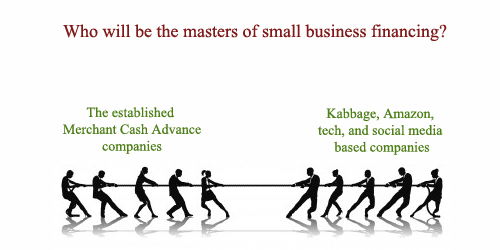
Amazon enters the MCA industry with a new division called Amazon Lending. Quotes:
Amazon is lending up to $800,000 to some merchants, Wingo said, adding that this is a pretty aggressive entrance into merchant financing.
Merchant financing…quite possibly the term that will replace “merchant cash advance” in the next couple years. Notice AMEX’s advance program is called the same thing. Trend anyone?
Amazon is competing against a start-up called Kabbage, which extends cash advances ranging from $500 to $50,000
They apparently don’t feel anyone else is a threat in the online space.
“We’re flattered that Amazon is building a business modeled on ours,” said Kabbage co-founder Marc Gorlin. “It’s validating that big companies are getting into the small business financing space.”
Dear Kabbage, you did not invent this model.
The kicker to Amazon’s new program? They charge up to 13% interest annually, on pace with what a little company in California named Opportunity Fund claimed was flat out unprofitable. Does that make them yet another new company walking around with a giant Kick-Me sign on their back? Some industry insiders would argue that offering these low rate programs are like swallowing dynamite.
We did a little bit of digging on this new program to see exactly what Amazon was up to. One of their prospective merchants posted this excerpt of the fine print:
Subject to applicable law, you will be in default under this Loan Agreement if any of the following events occur: ……..
(iii) your gross merchandise sales on Amazon.com as reported in your Seller Account (“GMS”) in any month is less than 50% of your lowest GMS on Amazon.com in any of the prior 12 months,(iv) the collective value of your units stored in Amazon fulfillment centers in the US, based on your list price of those units on Amazon.com, (“FBA Inventory Value”) in any month is less than 50% of your lowest FBA Inventory Value in any of the prior 12 months,
Except as otherwise required by applicable law, if you are in default, subject to any right you may have under applicable law to receive notice of and to cure such default, you agree that we may in our sole discretion exercise any remedy available to us at law or equity or take any or all of the following actions: (I) declare the unpaid balance of your Loan to be immediately due and payable, (II) enforce our rights as a secured party by directing Amazon Services LLC to reserve, hold, and pay to us an amount up to the unpaid balance of your Loan from your Seller Account disbursements until the unpaid balance of your debt under this Loan Agreement is paid in full, (III) enforce our rights as a secured party, by taking possession of your units stored in Amazon fulfillment centers and disposing of them in accordance with the Uniform Commercial Code,……………..
If this Loan Agreement is referred to an attorney (who is not our salaried employee) to collect the amount you owe or otherwise enforce the terms of this Loan Agreement, you agree to pay our reasonable attorneys’ fees, court costs and other costs of collection to the fullest extent not prohibited by applicable law.
6. Financing Statements. You authorize us to file and, as we may deem necessary or desirable, to sign your name on any documents and take any other actions that we deem necessary or desirable to ensure that our security interest in any item of inventory or your Seller Account is properly attached and perfected.
There’s some language in there that would make a lot of MCA companies jealous, particularly the section that states a 50% drop in sales is an automatic default!
Thoughts? Share them on DailyFunder.
– Merchant Processing Resource
../../