
Good Recordkeeping Plays Important Role in Funding Success
April 17, 2015CPA Yoel Wagschal recently started working with a syndicator who relied on Excel spreadsheets to track all his deals. The syndicator thought he had everything in tip-top shape, but it turns out that his system was hard for an outsider to understand and the data didn’t reconcile with his bank statements.
Wagschal, who heads an accounting firm in Monroe, New York, comes across this problem frequently these days. It’s been exacerbated by the exponential growth of the alternative funding industry in recent years. There are a sizeable number of alternative funders that started out small and have grown by leaps and bounds, yet they are still using rudimentary systems to keep track of their business dealings. In most cases, funders want to do the right thing, but they don’t always know how or the extent of what’s involved. Unknowingly these funders may be setting themselves up for financial or legal troubles.
 “Sooner rather than later you are going to find yourself swimming in the Atlantic Ocean without any plan on how to get out of there,” Wagschal says.
Although newbie funders may be able to get by with simple tools and minimal staff, more sophisticated efforts are required once they are doing multiple transactions a month. It’s one thing when you are tracking a few daily deals on a spreadsheet. It’s quite another when you’re trying to keep track of all the moving parts for hundreds of deals.
What’s more, there’s a lot of slicing and dicing of data that goes into properly understanding your existing business and growth possibilities. If you don’t use the right tools to help you keep precise records, it’s nearly impossible to understand the fundamentals of your business in order to grow. Excel, while a useful tool, has its limits, and funders who rely exclusively on spreadsheets don’t get the benefits of other more sophisticated options that have become available to them in the past few years. Manually entering data also increases the possibility of human error, which can lead to thousands upon thousands of lost revenue for a funder’s business.
The Pitfalls of Not Keeping Good Data
Keeping good data is especially important to funders who want to take on additional investors or who are considering a sale at some point. Kim Anderson, chief executive of Longitude Partners Inc., a strategic advisory firm in Tampa, Florida, works with a number of funders that are looking to facilitate additional growth by bringing on outside investors. Many of these companies find themselves scrambling because they don’t readily have access to the kind of information potential investors want.
Not keeping good books can also inhibit a funder’s ability to expand into additional markets. Say a funder wants to introduce a new product or migrate a product offering to a different vertical. Companies that don’t analyze their data effectively may have a hard time understanding what part of their existing portfolio would be the most appropriate or profitable segment to introduce the product to, Anderson says.
Potentially impeding growth is bad enough, but funders that don’t keep proper books can also find themselves embroiled in legal or tax troubles. Some MCA providers, for instance, have faced stiff penalties for treating transactions as loans on their books instead of the purchase and sale of future income.
“If they are showing the revenue recognition in the exact same way that loan industry companies are doing, then they are setting themselves up to be judged in the same way that a loan company would,” says Christina Joy Tharp, a staff accountant in Wagschal’s office. If you’re using the same accounting methods as lenders, you could be deemed a predatory lender by multiple enforcement agencies, even if that’s not your intent, she says.
The strength of your business can also be significantly impacted by how you classify performing and nonperforming loans or receivables. “There are thousands of pages of rules on how banks have to classify performing and non-performing loans. None of that exists for this industry, which is completely unregulated,” says Alex Gemici, managing director and head of M&A at World Business Lenders, an alternative lending company in Manhattan.
As a result, funders don’t have a universal way of keeping their books. Many funders believe that as long as they are collecting sporadic payments, a loan or receivable should be classified as performing. Gemici strongly disagrees, saying this approach sets up a funder for potential failure given that the default rate for loans/receivables is about one in five. “It’s one thing to show on your books that loans or receivables are performing, it’s another when you run out of cash,” Gemici says.
Choosing an Outside Provider
Recognizing that Excel spreadsheets can only carry a funder so far and that out-of-the-box software probably won’t be a complete solution for alternative funders, a small number of companies have stepped up to provide customized solutions for the industry. MCA funders—where the perceived need is greatest—are a particular focus for these providers.
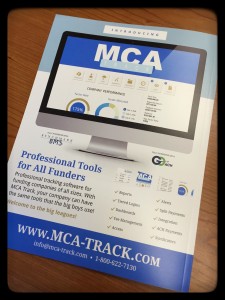 Benchmark Merchant Solutions, a processor in Amherst, New York, is one such company honing in on the MCA funder space. In 2014 the company launched MCA Track, software that’s designed to help MCA funders with their recordkeeping needs. It also helps them keep track of their income for tax purposes.
Among other things, MCA Track allows funders to view their performance at a glance. It shows them, for example, how merchants are performing, how the funds are allocated according to syndicator, the status of a deal, open cash advances, closed cash advances and defaulted cash advances. Funders can also get profitability data and other types of big picture information about their business as well. The software costs about $2,000 a month depending on the user’s size.
Benny Silberstein, chief operating officer of Benchmark, says the software was created because the processing company found that funders were often asking Benchmark to get data for them, especially when there were discrepancies. It can be real headache for funders to wade through inconsistencies with merchants, syndicators and ISOs, Silberstein says. “I can’t begin to tell you how many times funders asked us for a list of all the payments they’d received.”
PSC of Port Washington, New York, is another company trying to help MCA funders keep better records and manage their business more effectively. For a monthly membership fee, the company offers a front-end to back-end relationship management solution that allows funders to track all their contacts, documents, deals and commissions. Daily reports provide detailed data and summary information about an MCA’s funding business. The data includes the actual advance amount, the right to receive amount, the factor rate, processing fees, daily debits and credits, commissions paid to outside brokers or their own people, other management fees, ACH fees, wiring fees, payments, missing payments, collections information and participation with other syndicates.
The product has been on the market for about two years and the monthly fee varies according to a funder’s size, says Tom Nix, director of sales for PSC. He declined to be more specific about cost.
“The companies that are small and just starting out—if they are just doing a few transactions a month—they could probably get by using a spreadsheet. But that’s only feasible if you have a few transactions that you’re doing per month. Once you’re growing, when you get up to 10, 20, 30, 100 deals, the management of data becomes truly uncontrollable,” says Nix, who has seen a number of funders struggling to stay afloat or exit the business entirely because of their inability to keep good records.
“If you don’t have the right information and understand it, you’re going to give money to someone and you won’t [necessarily] get it back,” Nix says.
It’s possible for funders to set up their own infrastructure, but it can be costly and some feel it detracts from their ability to generate new business. That’s why Anthony Mannino, president of Nulook Capital in Massapequa, New York, chose to work with PSC. He researched the idea of doing all the back office and data collection on his own, but he decided not to reinvent the wheel since it would have meant hiring additional staff and would divert the company’s attention away from its primary focus—bringing in new business.
“A service provider like PSC gives us the ability to grow our company controlled and in a much quicker manner than we ever could than if we had to build our back end on our own,” Mannino says. “It takes most of the responsibility off of my company so we are able to focus on just growing the business and growing the sales.”
CloudMyBiz Inc. in Los Angeles is another company trying to service the alternative funder market, providing customized CRM systems for both lenders and MCA providers.
The CloudMyBiz system relies on a platform called Salesforce and is customized to the funding industry. It helps funders with the various facets of origination, underwriting and loan servicing. It helps them generate and track leads, automate funding workflow, understand and manage their deal pipeline and daily funding activities, collect and schedule recurring ACH payments and track syndication partners.
You could buy the Salesforce software and use it out of the box, but it provides only the basic functionality that funders need to run their business properly, says Henry Abenaim, principal consultant at CloudMyBiz. That’s where CloudMyBiz comes in by customizing the software for a funder’s specific business requirements. The fee varies widely, depending on the funder’s specifications, he says, declining to be more specific.
About two and a half years ago, Creative Vision Studio LLC in Long Beach, Calif., which had focused on the merchant credit card processing industry for more than a decade, also started offering a CRM system to MCA providers. The software is called Bankcard Pros CRM and customers can use it for merchant credit card processing, MCA or both. The software automates the data entry, underwriting, approval, funding and payback process from start to finish, says Robert Hendrix, the company’s chief executive. Funders also have access to 17 different management reports so they can track the performance and profitability of their entire portfolio per month.
The company charges an upfront fee of $4,000 to $5,000 to use the software, which is customized to a particular client’s business. There’s a $399 monthly fee after that. While it may seem costly to some funders, Hendrix says the software pays for itself within a month because of the efficiencies created. Importantly, the software eliminates the possibility of costly human mistakes that can occur in manually updating daily payments on a spreadsheet. “One little mistake can cost funders $2,000 to $3,000, even up to $10,000. They can be very costly mistakes,” he says.
It is, of course, possible for funders to keep good books and records using homegrown systems and personnel, and funders need to carefully weigh their options, taking into account that doing it right will probably require a meaningful investment in infrastructure and personnel. Whether they do it alone or hire an outside vendor, the important thing for funders is to collect the data and be able to evaluate it and display it in a way that makes sense to them, their customers, tax preparers, potential investors and others who need access.
Funders also need to remember that being successful in the business over the long term requires them to do more than simply capture accurate data. Beyond that, funders need to be able to manipulate the information in a way that helps them understand the nuts and bolts of their specific business, says Anderson of Longitude Partners.
“They may be able to produce enough financial information to complete an accurate tax return, but when it comes to understanding their operating metrics, they may not have collected or evaluated all of the right information to answer questions about what really drives the growth or sustainable profitability of the business,” he says.
Funding Down to a Science
December 21, 2012Account rep: Congratulations, you’ve been approved for $27,000!
Merchant: How did you come up with these figures?
Account rep: It was science. Science did this.
Funny? Maybe not, especially since an underwriting super algorithm may be on its way to the United States. In the days after we posted Made for Each other?, friends, acquaintances, and strangers have been telling us to keep an eye on Wonga’s potential acquisition of On Deck Capital. “It’s not just a european company’s gateway to the US. They’re going to change everything,” a few have said. Aside from their background of being a payday lender, having prestigious VC backing, and the resources to throw a quarter billion dollars at a main street lender in a takeover bid a lot of people didn’t see coming, apparently there is much more to be seen.
Just like MCA in years past, Wonga has worked hard to repel a negative image. Not easy stuff, especially considering they embrace their hefty costs wholeheartedly. Sure, it’s easy to calculate an APR equivalent of a very short term loan and spin whatever number you come up with as the symbol of something evil. If I let a stranger borrow $100 today with the stipulation that they pay me the whole thing back tomorrow plus 1 dollar extra to make it worth my while, would I be evil? That’s an APR of 365%. If I did the same thing with 100 strangers, what are the real odds that all 100 would actually pay me back? Somewhere along the line because of a borrower’s circumstances, bad decisions, or even malicious intent, I’m going to lose the entire $100 I lent out. Others might need more time to pay me back. If one person out of those hundred doesn’t pay back, I break even. If two people don’t pay back, I lose money. If one person doesn’t pay back and another can’t come up with the whole thing, I lose money. You can lend money at 365% APR and lose BIG.
So how do banks manage to charge 4, 7, and 10% APR? Is it just because they’re smarter? No. They don’t make money off loans at these rates either. In the US, interest rates are distorted by government guarantees. Politicians have decided that certain interest rates sound “fair,” then push big banks to lend money at these low unsustainable rates. But of course it doesn’t work and so government agencies sweeten the deal by reimbursing banks for up to 90% of the losses on the borrowers that default. Banks make money on the loan closing fees and other services they sell to the businesses. The loan is the doorbuster offer the bank puts in the storefront window. Once you come inside, they try to sell you on other things so that you don’t walk away with just the loan, otherwise they’re losing money.
So when you hear “banks aren’t lending,” don’t be so surprised. Lending money means giving it away to someone that might not pay it back. That’s a really tough business to be in, no matter how qualified the borrowers are or how good the underwriters are supposed to be.
But somewhere in between the opinions of the Merchant Processing Resource staff and government bureaucrats over what is fair, is a special recipe that determines once and for all what works best. It’s science. Wonga’s lending success is rooted in science and propelled by an advanced algorithm that can systematically calculate risk better than any bank in the world, or so they say.
 One of Wonga’s major investors, Mark Wellport, is a knighted renowned immunologist and rheumatologist that has defended Wonga’s methods against regulation. He believes their data-based process and strong motivation to make their borrowers satisfied places them in an entirely different category than payday lenders.
Wonga takes a human-free approach, something no MCA provider in North America does regardless of how automated their process may seem. In the UK, their business loan application process takes only 12 minutes and the funds are wired 30 minutes later. That’s it. Their max loan is £10,000 but just think about how that compares to MCA in the US. How much time and overhead is being spent on printing documents, underwriters, conference room meetings to discuss deals, setting up the merchant interview, trying to reach the landlord, trying to get page 7 of a bank statement from 6 months ago and the signature page of the lease, etc. etc. Funders might have had the wrong approach all along.
Wonga’s founder, Errol Damelin believes in data. According to some quotes in The Guardian, Damelin believes interacting with the borrower actually impairs a lender’s judgement.
From the Guardian:
Asking for a loan from a financial institution had traditionally involved making a strong first impression – putting on a suit to see the bank manager – then rigorous questioning, checking your documents and references, before the institution made an evaluation of your trustworthiness. In a way, it was exactly the same as an interview, but instead of a job being at stake it was cash.Damelin found this system old-fashioned and flawed. “The idea of doing peer-to-peer lending is insane,” he says. “We are quite poor at judging other people and ourselves – you get to know that in your life, both with personal relationships and in business. You realise that we’re not as good as we think we are at that stuff, and that goes for almost everybody. I certainly thought I was much better at it.
The 42-year-old entrepreneur grew up in apartheid South Africa, and he believes the experience of living in that country in the 80s has had a significant impact on his outlook. He was active in student politics at the University of Cape Town and marched in civil disobedience protests. So, when it came to deciding who should be lent money, Damelin says he wanted to strip away some of the prejudice – decisions would be taken without a face-to-face meeting; you wouldn’t even speak to an adviser on the phone, because people subconsciously judge accents too. The final call on whether to hand out cash would be based on “the belief that data could be more predictive than emotion”.
According to Wired, Damelin and his team created a system to approve or decline applicants all on its own. They tested it on a site called SameDayCash by using Google Adwords and within ten minutes of their ad going live, their system had already approved its first customer. In its early forms, it wasn’t very profitable from a lending standpoint but it did allow them to collect a massive amount of data.
From Wired
its strategy over this period wasn’t just to disburse money — it was to accumulate facts. For every loan, good or bad, SameDayCash gathered data about the borrowers — and about their behaviour. Who were they? What was their online profile? Did they repay the money on time? The site was feeding an algorithm that would form the basis of Wonga, launched a year after the beta experiment that was SameDayCash.
MCA has utilized Adwords for lead generation for years with mixed success, but few have used it for the purpose of accumulating facts. This isn’t to say that the firms collecting information for the purpose of leads aren’t sitting on treasure troves of data, it’s just that none of it to date has led to 100% computerized underwriting. The MCA industry is quite possibly about to undergo a major shift in how they promote their product on Adwords as a result of Google’s ominous warning a couple weeks ago. New disclosure requirements may change the way consumers respond and apply, ultimately impacting the data collected.
So will european science work in the good ‘ol US of A? If Wonga acquires On Deck Capital, you can bet they’ll try to replicate their success. There is a gigantic market of really small businesses that aren’t getting funded, and even the ones that are, they’re waiting 3-7 days to deal with the paperwork, handle the phone calls, fax documents, complete a landlord verification, and in some cases, deal with a credit card processing equipment change. If On Deck Capital becomes a household name as Wonga is in the UK, a lot of smaller funders are going to get squeezed.
Wonga claims to have a net-promoter score above 90%, a customer satisfaction metric that beats most banks and even Apple Computer. It’s a company that seems to be winning on every front.
Critics will say that the American lending market is big enough for everyone, that the loans Wonga has done traditionally are really small and therefore not in the same league as MCA, or that their own company has something similar or better. We believe however, that if this deal goes through that it’s a bad idea to get comfortable. There are Wonga-like companies in the US already, data fortresses that will soon revolutionize how loans are issued and determine what makes a successful business. New York based Biz2Credit is one such example.
We’ve been right about a lot of things in the last couple years and wrong about some. But we believe it is inevitable that any lender ignoring the automation revolution on the horizon is not going to last very long. Go ahead, brush it aside and convince yourself that this whole Automation thing is just hype as BusinessWeek did in 1995 about the Internet. “Automation? Bah!”
As Damelin told Wired in June, 2011, “For me the epiphany was right there. People were online, looking for a solution to a problem.” Ask any funder using Adwords or pouring work into SEO and they’ll tell you the same thing. People are looking online for money. What happens after they fill out the form on the website is what makes the USA MCA/alternative lending industry different from Wonga.
 But will a perfected european algorithm work in the US? Americans approach debt and money differently than the rest of the world and small businesses operate in a much more open manner. You never know, the european lab coat wearing scientists could come here and get their butts handed to them. Plenty of smart companies have jumped headfirst into MCA and left after disastrous results. Some veterans that have been in this business a long time will you tell that an impressive resumé, big investors, and a fancy algorithm will help you make it through the first six months. After that, you better know what the hell you’re doing, if you can continue to do it at all.
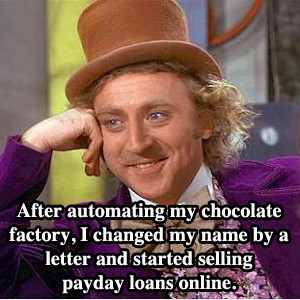
If in three years the average small business owner thinks Wonga is the last name of a guy that owns a chocolate factory, we promise to write a jingle that admits we were wrong about them. But On Deck Capital has been around the block and knows the business. They would allow Wonga to skip the learning curve and together could quite possibly nail lending down to a science.
Oompa Loompa do-ba-dee-doo, I’ve got another algorithm for you.
– Merchant Processing Resource
../../
There is great feedback to this article in a LinkedIn Group HERE
Credit Card for Business Owners? Forget it!
August 23, 2011Posted on April 4, 2011 at 9:59 PM
“Anyone that owns a small business is automatically declined,” revealed an inside source at a major credit card issuing bank. A friend of ours that we’ll call Dave (name changed), is an underwriter in charge of approving credit card applications. We were discussing tighter credit standards for consumers, an issue we felt to be of little relevance to business credit, until it got interesting.
According to Dave, and the bank doesn’t make this information public, small business owners and the self-employed are issued automatic declines for cards. “Just to get a simple credit card?”, we asked. Dave explained that their data indicates consumers are less risky than the self-employed. We dug deeper and were told his:
- Employed consumers are more likely to have a fixed budget and steady income.
- Business owners experience continuous ups and downs. During a down, they are more likely to supply their employees with their steady paychecks and skip out on the credit card payment until cash flow improves. If they did it the other way around, they would lose their employees and the business wouldn’t last.
- Employed consumers are better equipped to prove their income since they have verifiable documents such as W-2s or paystubs.
- Business owners are less able to verify their income, more likely to show losses on their tax returns, and less willing disclose their true financial status. Though this may serve them well come tax time, it works against them on credit applications.
But that shouldn’t discourage small business owners from applying. Dave concedes they’ll consider extending credit to businesses open longer than 20 years so long as the applicant has above 720 credit. Ouch!
The Ugly Face of Business Credit Cards
So if you don’t make the cut, or even if you do, credit cards aren’t so attractive these days anyway. The Credit Card Act of 2009 made major changes for consumers but NONE for businesses. In an article by creditcards.com, titled “10 ways business credit cards are different“, is a list of many dangers to look out for. If you’re a business owner, these are the pitfalls:
- A teaser rate can be as short as 6 months, 3 months, or even 1 day. That attractive 2% rate can be increased on a whim as soon as you sign up or start using the card.
- There is no minimum amount of time to notify you of a payment due. Consumers are required to receive their bill at least 21 days in advance of the payment due date. For business owners, you might not get the bill until the day before!
- Your due date can change every month. Don’t get too comfortable paying on the 30th every month, your card company can switch it up to throw you off and entrap you with late fees.
- There are no late fee penalty limits.
- Payments are applied to the balance with the lowest interest rate first, instead of to the highest interest rate like consumer cards.
- The business owners are usually personally liable for the business card’s debt.
What’s the Alternative?
It’s bad news galore but there’s light at the end of the tunnel. A unique financial product known as a Merchant Cash Advance (MCA) offers all the positive features of a credit card and spits out the negative. Any business that accepts credit/debit card payments from their customers is eligible. Different than a loan, a MCA provider purchases the future card revenues of the business in exchange for a lump sum of cash today. The benefits and differences are truly astounding.
- Good credit is not necessary.
- Funds can be received in under a week. (You can barely get a credit card that quick)
- A business can qualify with as little as 3 months in business.
- The “rate” or the cost of the funds can’t change. Once the cost of funds has been established and executed, it remains the same. The balance does not increase with time nor is there any element of interest.
- Because the balance is only reduced by withholding a percentage of card sales, less funds are withheld in slow periods, and more in strong periods. This tackles the issue of business ups and downs.
- There are usually no personal guarantees.
- Additional funds can be made available before the balance has been reduced to zero.
- Personal income does not need to be verified, just the monthly credit/debit card sales volume.
- Your credit can’t be negatively affected since it is not a loan.
Becoming a First Choice Option
A Merchant Cash Advance is not a last resort method of financing and is quickly becoming a first choice pick in the business world. Certainly better than business credit cards, they also rank better than SBA Loans. [SBA Loan vs. Merchant Cash Advance]
Before you fill out that credit card application, just remember what our friend Dave said. “You’re automatically declined.” Say goodbye to the card issuing naysayers and SBA Loan ploys. The lending system is too far broken to be aggravated about it anymore. If your business needs capital, you can simply sell your future card sales in exchange for cash today. Check out the true direct funding sources in our directory and walk away with flexible financing your business can depend on.
– The Merchant Cash Advance Resource
Does Your Merchant Cash Advance Company Pass The Scrutiny Test?
April 29, 2019
The merchant cash advance business has come under repeated fire of late from regulators, legislators and customers. “Every aspect of the industry is under scrutiny right now. Syndication agreements, underwriting, and collections are the subject of bills in Congress and across multiple states,” says Steven Zakharyayev, managing attorney for Empire Recovery Services in Manhattan, which offers debt recovery services to financial companies. So how should funders respond amid these obstacles? Here are a few pointers to help funders succeed despite ongoing challenges from a legal, regulatory, business and public relations perspective:
DIFFERENTIATE BETWEEN CASH ADVANCES AND LOANS AND MODEL BUSINESS DEALINGS ACCORDINGLY

In the eyes of the law, merchant cash advances and loans are very different. With a cash advance, a funder advances the merchant cash in exchange for a percentage of future sales, plus a fee. A loan, on the other hand, is a lump sum of cash in exchange for monthly payments over a set time period at an interest rate that can be fixed or variable. While the two types of funding options have certain similarities, funders have to be extremely careful to make appropriate distinctions in their business practices; otherwise legal trouble can easily ensue, experts say.
Most funders know that they are supposed to draw a bright line between merchant cash advance and lending, but it’s critical they put this knowledge into practice. Funders have to ensure the distinction is evident in their business lexicon, says Gregory J. Nowak, a partner in the Philadelphia office of law firm Pepper Hamilton LLP who focuses on securities law.
 For example, it’s extraordinarily important that funders don’t refer to merchant cash advances as loans in their business dealings. Business records, emails and other documents can be requested in litigation for discovery purposes. If the funder’s internal documentation refers to cash advances as loans, it’s going to be hard for the company to argue that they aren’t, in reality, loans.
“Most judges want to see consistency of treatment and that includes your vocabulary,” Nowak says. “The word ‘loan’ should be banned from their email and Word files.”
There’s a fair amount of litigation surrounding what is and what isn’t a cash advance. This can be helpful guidance for funders in setting out the criteria they need to follow to be able to defend their activities as cash advances. Even so, the line is somewhat of a moving target and funders need to be stalwart in these efforts given heightened regulatory scrutiny, experts say.
“If it looks like a loan, the law will treat it as a loan—and all the consequences that follow such a determination,” says Christopher K. Odinet, an associate professor of law at the University of Oklahoma College of Law.
BE CAREFUL ABOUT YOUR COLLECTION POLICIES
Obviously companies want to collect their payments. But some funders are too quick to file lawsuits, which could lead to unwanted trouble, says Paul A. Rianda, who heads a law firm in Irvine, Calif.
“The business model of sue first, ask questions later can be a problem,” says Rianda, whose clients include merchant cash advance companies.
The concern is that when funders sue, merchants start talking to attorneys and that could open the MCA firm to other types of lawsuits. The more a funder sues, the more it increases media attention and invites examination by state regulators and others. “You invite class action lawsuits and regulatory scrutiny that you really don’t want. It’s a boomerang thing,” he says.
The issue is especially pertinent now as legislators grapple with how to handle the thorny issue of confessions of judgement, more popularly known as COJs. For instance, since the start of the year, New York courts and county clerks have become much more rigid in processing confessions of judgments.
Certainly, not all funders use COJs. Just recently, for instance, Greenbox Capital suspended the use of COJs indefinitely, in response to the heightened industrywide debate over their use. While there’s no all-encompassing directive to stop using COJs, experts say it is incumbent upon funders to ensure they are used in a responsible and proper manner, especially amid political and regulatory uncertainty.

For instance, it would be irresponsible and potentially actionable to execute on a COJ simply because the merchant doesn’t remit receivables the merchant cash advance company purchased because he didn’t generate receivables, says Catherine M. Brennan, a partner at the law firm Hudson Cook LLP in Hanover, Maryland.
To be lawful, the COJ has to be based on a breach of performance under the agreement. Fraud, for instance, is actionable. But simple failure to remit receivables because the business has failed is not, she says.
“Conflating those two things—breaches of repayment versus performance—leads to a world of hurt,” she says. “MCA transactions do not have repayment as a concept.”
In places like New York, where COJs are more controversial, funders have to be especially careful about using them properly, experts say. Even though COJs are still enforceable under New York law for the time being, funders should understand every county processes them a bit differently, says Zakharyayev of Empire Recovery Services. “If they have a preferred county for filing, they should ensure their COJs are not only compliant with state law, but also complies with local rules,” he says.
What’s more, funders should ensure their COJs are properly notarized under New York law, ensure party names and the amount confessed is accurate, and avoid blanket statements such as naming each and every county in New York as a possible venue for filing, he says.
While some funders have suggested changing their venue provisions to a COJ-friendly state if New York outlaws COJs, Zakharyayev says he recommend New York funders keep their venue in New York regardless since it would still be one of the most efficient states to enforce a judgment. “I’ve filed COJs outside of New York and, even without a COJ, New York is much more efficient in judgment enforcement as New York courts are less restrictive in allowing the judgment creditor to pursue the debtor’s assets,” he says.
BE CAREFUL WHEN RAISING THIRD-PARTY MONEY
Aside from their dealings with merchants, funders also have to be cautious when it comes to interactions with potential investors.
Some companies have ample balance sheets and don’t need money from third parties to fund their operations. But funders that decide for business purposes to solicit money from investors, have to be careful not to run afoul of SEC rules, says Nowak, the attorney with Pepper Hamilton.
He recommends funders treat these fundraising efforts as if they are issuing securities and follow the rules accordingly. Otherwise they risk being the subject of an enforcement action where the SEC alleges they are raising money using unregulated securities. “You need to be very careful here because these rules are unforgiving. You can’t ignore them,” Nowak says.
TACKLE ACCOUNTING CHALLENGES
Accounting is another business challenge many funders face. Some have fancy customer relationship management systems, but the systems aren’t always set up to provide the detailed information the accounting department’s needs to effectively reconcile the firm’s books, says Yoel Wagschal, a certified public accountant in Monroe, New York, who represents a number of funders and serves as chief financial officer at Last Chance Funding, a merchant cash advance provider.
Ideally, a funder’s CRM and accounting systems should be integrated so both sales and accounting receive the relevant data without the need for either department to input duplicate data. The two systems need a way to get information from each other, without someone manually entering the data in both systems, which is inefficient and prone to error, Wagschal says.
DON’T SKIMP ON LEGAL SERVICES

There’s no set standard for funders to follow when it comes to legal advice. Some funders have in-house counsel, some contract with external law firms and some don’t have attorneys at all, which, of course, can be a risky proposition.
Some funders use contracts they’ve poached from a reputable funder online or from a friend in the industry, says Kimberly M. Raphaeli, vice president of legal operations at Accord Business Funding in Houston, Texas. The trouble is what flies in one state may not be legal in another, she says.
Many contracts include things such as jury waivers and class-action waivers or COJs and depending on the state, the rules surrounding the enforcement of these types of clauses may be different. So it’s really important to know the nuances of the state you’re doing business in and even potentially the states where your merchants are located, she says.
Having dedicated legal staff is arguably better. But at the very least, funders should have an attorney on speed dial who can provide advice on contracts, compliance and other areas of their business. Even when a funder has in-house attorneys, Raphaeli says it’s a good idea to tap external counsel to review documents in situations where potential liability exists. Not only does this offer a second set of eyes, it can provide added peace of mind. “A funder should never shy away from paying a little bit of money for long-term business security,” Raphaeli says.
FOLLOW BEST PRACTICES
 The Small Business Finance Association, an advocacy group for the non-bank alternative financing industry, has developed a list of best practices for industry participants to follow. These encompass principles of transparency, responsibility, fairness and security.
“It’s a very competitive market and companies are trying to differentiate themselves. I think it’s important to make sure you’re following industry standards,” says Steve Denis, executive director of the association whose members include funders and lenders.
Funders also need to be mindful that best practices can change based on business and competitive realities, so it’s important for funders to review procedures periodically, says Raphaeli, of Accord Business Funding. Because the industry is fast-moving, a good rule of thumb might be for a funder to review the entire set of policies and procedures every 18 months. But more frequent review could be necessary if outside factors such as new case law or regulation demand it, she says.
“Periodically taking a look at your collections techniques, your default procedures, even your funding process down to your funding call – these are all critical components of having a successful MCA funder,” she says.
TAKE PAINS TO AVOID INDUCTION INTO THE PUBLIC HALL OF SHAME
While there is no shortage of unseemly news stories involving MCA, funders need to do their best to avoid negative press. This means being extra careful about the way they present themselves to businesses, at public speaking engagements, at conferences, industry trade shows, brokers and others, says Denis of the Small Business Finance Association.

Denis, a long-time Washington, D.C., resident, recommends funders invoke what he calls the “The Washington Post test,” though it applies broadly to any news outlet. Before sending an email, leaving a voicemail or saying anything publicly, funding company employees need to ask themselves: Am I comfortable with that information being on the front page of the paper? “I think our industry has a big problem with public relations right now,” he says. “The stigma is only as true as our industry allows it to be.”
The Art of Moving The Deal – When it becomes too high risk for you
February 27, 2019 OakNorth, a small and medium sized business lender and online bank, has mastered a strategy to avoid merchants from defaulting 100% of the time, according to a story published in Quartz. The strategy: tell the merchants at risk of defaulting to refinance their loans at a competitor.
“We’ve said [to merchants], ‘Go renegotiate with another bank and refinance,’” OakNorth co-founder Joel Perlman said at the Finovate Europe conference in London on February 14, according to the Quartz story. “And they’ve gone and refinanced and then a few months later they’ve gone into default.”
Perlman’s phrasing may sound a little harsh, but the practice of moving at-risk merchants to another funder is really not uncommon. In fact, it seems like a fairly common and well-understood concept.
CEO of Accord Business Funding Adam Beebe said that brokers will contact Accord when their merchant is up for renewal. And if Accord knows it can’t continue to fund the merchant – either because it has missed payments or because it has become overburdened with other debt – the broker will shop that undesirable merchant elsewhere.
The merchant goes to a new funder and Accord is pleased to be rid of the merchant and not have it default on Accord’s balance sheet. Beebe notes, however, that the new funder is made aware of the merchant’s financial situation and is able to handle the higher risk. Transparency, he says, is important, particularly in a scenario like this.
Similarly, Heather Francis, CEO of Elevate Funding, said that she is more than happy for an ISO to move a stacking and defaulting merchant away from Elevate, as long as Elevate gets paid. Elevate only funds first position and Francis said they make it very clear to merchants that stacking (taking on additional funding from other sources before satisfying an existing contract) is not allowed.
“If a merchant is stacking, that’s not someone we want to work with,” Francis said. “And if the [new] funder understands the high risk, then is fine.”
As long as nothing is being hidden from the new funder, then it seems this practice is just an element of how funding works.
From the broker side, Rob Addison, Managing Member of Sentra Funding, an ISO, said that when a funder knows it will not be renewing one of his merchants, they will ask him to take the merchant away.
Addison said that some funders are so eager to get rid of defaulting merchants that they will offer deals like reducing the merchant’s balance just to get the merchant away from them.
It may not sound nice to jettison a defaulting merchant, but if a funder can avoid a merchant defaulting on its dime, then in many cases, it will.
“We try to move a financially distressed merchant from from, say, an MCA to a longer term loan,” Addison said. “If they haven’t been stacked, they have options. If they have, it’s harder. But if they have something, like commercial property or equipment, there’s usually a [a funder] willing to step in.”
Deal Flow in the Heartland — From Mississippi and Beyond
February 23, 2019
 The political, cultural and economic abyss that separates the heartland from the coasts seems to grow deeper and wider with each passing day, and trying to reconcile the disparities can feel nearly hopeless. But differences among geographic locations aren’t nearly so well-defined or as troubling in the alternative small-business funding industry. What’s more, business opportunities can arise when localities differ.
First the lay of the land: Members of the alt finance community agree that funders and brokers are concentrated in just a few geographic locales—Greater New York City, Southern California and South Florida. Those three areas probably generate more than 75 percent of the industry’s volume, according to Jared Weitz, CEO of United Capital Source and one of three co-chairs of the broker council recently formed by the Small Business Finance Association (SBFA).
Sorting out how the industry differs in various regions can prove challenging. The Internet is erasing regional quirks and alleviating the need for physical proximity, says Steve Denis, SBFA executive director. What’s more, every ISO and funder develops a slightly different way of doing business regardless of location, he notes.
However, to a great degree it’s a matter of tweaking a single general outline for navigating the industry no matter where the office or client is based. That’s partially because many members of the industry conduct business in every state or nearly every state.

That said, old-fashioned, small-town ethics can sometimes seem closer to the surface in shops operating far from the coasts. “We’re focused on the values of our organization—like doing what we say we’re going to do, maintains Tim Mages, chief financial officer at Expansion Capital Group, a funder and broker based in Sioux Falls, S.D. “Some of that maybe comes from the Midwest culture or upbringing.”
Outside the major population centers, the industry occasionally seems a little more “laid-back.” In a light-hearted example of a relaxed heartland approach to the alt funding business, Lance Stevens, an attorney who’s a co-founder of Brandon, Miss.-based TransMark Funding, claims he can underwrite a deal while driving his golf cart and listening to Bon Jovi—all while maintaining his under 5 handicap.
Everything can seem a little more slow in the heartland, where people have time to stop and say hello to strangers, says Weitz. “Some folks are like, ‘Hey, my mailbox is three miles from my house, I check my mail once a week. I do not email. I do not fax,’ ” he observes. “It’s a nice change.”
Interactions are often more informal between the coasts. “Being in the Midwest we don’t use a lot of the lingo and terminology from this space, such as ‘stacking,’” says Austin Moss, a managing partner at Strategic Capital in Overland Park, Kan. That lack of jargon may be good or bad, he admits, but instead the staff speaks in a more general, even “holistic,” financial language.
Then there’s the occasional need for the human touch in the heartland. Deals there are sometimes sealed in person, with an office-park conference room substituting for the community bank building on the town square where merchant used to take out loans. “It’s not a widespread trend, but a handful of the ISOs we do business with actually do face-to-face solicitation,” says Mike Ballases, CEO of Houston-based Accord Business Funding.
In line with that mini-trend, an ISO based in Southern California operates a Texas office that specializes in face-to-face encounters, according to Aldo Castro, Accord’s former vice president of sales and marketing. “It’s rather meaningful here,” he says of using the practice in Texas. “You get on the road and shake a hand. They put a face to a name.”

The process can work in reverse, too. A few of the larger local companies seeking funding from Strategic Capital make the journey to the broker-funder’s Overland Park, Kan., offices, Moss says. Bankers who serve as referral partners also like the opportunity to meet in person, he observes.
The personal encounters often strike Moss as “refreshing,” he admits. That’s because the vast majority of the company’s deals occur online and by phone and fax—all without ever seeing the client in person.
Although the desire for personal contact arises from time to time, most heartland deals don’t hinge upon it. “It’s not a big number, but we see it,” Ballases says of face-to-face meetings. “Could it be the wave of the future? Absolutely not.”
Moreover, for some in the industry, the need for face-to-face discussions barely registers. It’s just not about meeting in person, according to Mages. Instead, he cites the importance of other factors. “Speed, convenience and service are the key differentiators, and that’s all driven by data and analytics,” he declares. Partnerships also drive the company’s business, he notes.
Luck outweighs geography, too, in Mages’ view. “It’s more an issue of right place, right time,” he contends. Deals occur primarily when funders manage to attract business owners’ attention at exactly the time when capital’s needed, he contends.
 Besides, lots of people tend to think in wide-ranging ways these days instead of in narrow, provincial modes, Mages continues. At Expansion Capital Group, he notes, executives have differing points of view because they come from commercial banking, investment banking, the Small Business Administration lending program and the credit card industry.
At the same time, people tend to take an increasingly cosmopolitan approach to their jobs, according to Mages. He notes that executives at his company maintain contacts across the continent, often forged in earlier chapters of their careers.
Meanwhile, well-trained employees can use a phone call to gather the details they need and establish a consultative relationship without a thought for geography or the need for face-to-face meetings, Mages says.
However, geography can indeed play a role at least once in a while. In a few cases merchants prefer a funder with an address across town or at least in the home state. Sometimes business owners and referral partners choose local brokers or funders simply because their names sound familiar.
Strategic Capital, for example, does more business at home than anywhere else, Moss says. The company’s headquarters is in the portion of greater Kansas City that spills over from Missouri into the state of Kansas, making the location convenient to a major population center.
But despite the massive size of greater Kansas City, Strategic Capital remains the only alternative small-business funding option in the area—there just aren’t any other local providers, Moss says. It’s not like New York, where banks and merchants can choose from among many brokers and funders, he says.
That trend toward being the only game in town or one of just a few can hold true for most companies in the heartland, Moss maintains. A broker or funder based in Denver, for example, would probably have higher volume there than anywhere else, he notes.
Several reasons explain that geographic bias, Moss continues. “The employees live there and have contacts, and we’re part of the local associations and chambers,” he notes. “We work with just about all the banks in the area, and everyone knows who we are.” The company also handles local government bonds and local construction projects, he says.
Mages offers a different perspective. Only a few small-business owners in South Dakota choose Expansion Capital Group because they prefer dealing with a Midwestern company or because they’ve seen local press coverage or heard Expansion’s recruiting ads on the radio, he maintains.

Hometown, home state or regional preferences aside, executives at Accord emphasize the importance of the small-town approach of knowing their customers as well possible. For Ballases—the Accord chairman who started the company with Adam Beebe, who now serves as CEO—that means combining personal and impersonal approaches to underwriting.
Ballases views funders and brokers as falling into three categories. Some choose a personal, hands-on approach and don’t rely upon algorithms. A second category emphasizes automation. A third blends the personal and the automated. His organization falls into the latter, he says
For Accord, the personal comes into play because of what Ballases has learned in his decades in the banking business. He knows margins and growth rates in his applicants’ industries, and those factors aren’t often incorporated into algorithms, he says.
In fact, commercial banks have failed to learn to evaluate small businesses on their true merits, Ballases continues. Banks tend to underwrite small businesses, which he defines as those in need of $100,000 or less, by using a “skinnyed-down” version of how they underwrite big companies, which they base on general financial information. Instead, he counts on discipline, data and his 50 years of experience in commercial banking to evaluate a merchant on an individual basis.

At another company, TransMark Funding, Stevens and his partner draw upon legal and small-business experience to evaluate potential customers’ creditworthiness. “That causes us to focus on an applicant’s business model and their sustainability, which may boil down to personalities,” Stevens says. Transmark combines those factors with “a little bit of credit metrics” to come to decisions on applications.
The company’s mix of objective and subjective reasoning differs starkly from the thought process at most coastal funders, Stevens says. While his company gives most of the weight to the subjective and just a bit to the objective, big-city competitors tend to do the exact opposite, he says.
Of the last five MCA deals that Transmark funded, the merchants averaged 12 checks returned for insufficient funds per month, Stevens says, noting that he can make that statement “with a straight face.” Sometimes it’s been as high as 35 NSF checks per month for successful applicants. “Those people would not even get into the parking lot of a bank and would not get through the door of any MCA funder who’s using any sort of reasonable metrics,” he adds.
An anecdote helps explain the thinking. Suppose a restaurant has been operating for several years in a town of 50,000 and has amassed 2,200 “likes” on its Facebook page, Stevens suggests. “I’m in,” he exclaims, noting that it would take compellingly negative numbers to convince him that the business won’t survive if he helps it obtains capital to improve its positioning in its market.
The vignette illustrates that a business can do well in the community despite the merchant’s financial difficulties, Stevens says. However, the story doesn’t mean Facebook becomes the only determining factor, he continues. Positive factors for success include good location and marketing, he notes.
The principals at many companies funded by TransMark have credit scores in the low 500’s, Stevens continues. “That’s tough,” he says, “because they’re going to have a lot of history of not living up to their financial obligations.” But if someone with that credit score has personally guaranteed a lease on a storefront for the next two years, they may be unlikely to abandon the business. A big bank might look upon that merchant as insufficiently nimble because of the lease, but TransMark takes the opposite view, he says.
Even if a store, restaurant or contractor is “circling the drain” and about to shut down, TransMark may simply believe the owner has the character to make the business work. “Given our minute default rate, we’re right most of the time,” Stevens maintains, adding that banks see applicants as customers, and TransMark sees them as partners.
The business model requires peering into the future to see how the merchants will look after using perhaps $25,000 in capital to make improvements and while dealing with 18 percent holdback for the next six months, Stevens observes. “If they look strong, I need to fund them,” he says of the company’s prognostications.
To find ISOs who appreciate the TransMark model, the company seeks out purveyors of credit card merchant services, Stevens says. They encounter those merchant-services providers at trade shows and through “some general poking around,” he notes.
The merchant-services people often have long-standing relationships with merchants and thus can feed information into the TransMark way of viewing deals. “Tell me what it looks like when you walk into their store at 11 a.m.,” Stevens says to illustrate the kind of conversation he has with ISOs. “How is their signage?”
Besides understanding clients, it also pays to understand markets, and proximity can help with the latter, according to Ballases and Castro in Houston. “We have an affinity for Texas,” Castro says.
Many of the businesses based in Texas are vendors to people—like mechanics who fix cars or restaurants that feed people—not vendors to businesses, Ballases notes. Vendors who cater to people are better candidates for merchant cash advances than business-to-business companies are, he maintains.

“It’s just a huge state,” Castro declares. “We’ve got a thousand new residents moving to Texas every day.” Nearly 10 percent of the nation’s small businesses operate in The Lone Star State, he notes.
“There’s a convergence of the population growth, a low tax rate, low regulations, low cost of running a small business relative to national levels, and a great small-business environment,” Castro says of the Texas scene. “In addition, the healthcare industry is exploding here, and there are the ancillary businesses to healthcare.”
Meanwhile, the state’s Hispanic entrepreneurs remain under-served by alt funding ISOs, which presents a great untapped opportunity, Castro maintains. Funders who cater to those Hispanic merchants will find them loyal, he predicts. In Texas alone, Hispanic consumers spend half a billion dollars annually, he says.
To capitalize on that burgeoning market, Accord has assembled a team that can help Anglo ISOs bridge the cultural and linguistic gap, Castro says. “We do that every day,” he maintains. “We’re jumping on the phone with merchants and helping them get the funding they need to support the growth of their operations.” Those conversations with merchants do not put Accord in competition with ISOs, Castro notes. Accord does not maintain an inside sales staff and does all of its business through ISOs, he says.
Only a few of those ISOs are based in Texas, according to Ballases. Most of Accord’s ISOs operate from offices in the Northeast, with many in the other common geographic spots of South Florida and Southern California, he says. So that makes Accord a national company despite its emphasis on Texas, Ballases says.
Accord’s experience at home, combined with nationwide contacts in the industry, have convinced the company’s leadership that too many brokers remain unaware of the opportunities in Texas.
That’s why Accord is producing ads, videos, infographics, blogs and social media posts to alert those coastal ISOs to opportunities in Texas. The company even offers a tab called “FundTEX” on its website. “We’re getting the word out,” Castro says of the company’s effort to publicize his state.
Besides operating in areas sometimes overlooked on the coasts, heartland brokers and funders sometimes have to reinvent the industry almost from scratch. Brokers can find themselves teaching the business to potential investors outside the Big Three geographic locations, Moss says. In New York, investors already know the industry and use that familiarity to evaluate brokers, he says.
Brokers and funders also have to deal with the heartland’s lack of workers with industry experience. As the lone company in the market, Strategic Capital, for example, can’t find many prospective employees with previous jobs in the business, Moss notes. “There is no OnDeck or Yellowstone or RapidAdvance down the street to provide a talent pool for hiring,” he says.
That’s good and bad, Moss maintains. New hires don’t require re-training to lose habits that don’t fit the Strategic Capital way of working. But it’s difficult to find underwriters, accountants and other prospective employees with the right background. It doesn’t work to put new salespeople on straight commission because the “ramp-up” period takes longer with employees unfamiliar with the industry, he says.
The lack of local experience sometimes prompts brokers in the heartland to tap the Big Three areas for talent. Expansion Capital Group, for example, has a business development director in New York who came from another ISO, Mages says. Besides cultivating relationships in NYC, the business development expert makes frequent trips to Southern California and South Florida.
Meanwhile, members of the industry who tire of the rapid pace on the coasts might want to consider moving inland to fill the vacant jobs, sources suggest. After all, the heartland has its advantages, according to Moss. “Most people here have houses, and the cost of living is lower than in places like New York,” he says. A spacious five-bedroom house in Kansas City might cost less than a cramped apartment in New York, he notes.
To commute to the company’s suburban office, his typical employee jumps into a car in a climate controlled attached garage, cruises for half an hour or so on roads relatively free of traffic and parks in the lot a few steps outside his office building. It’s less stressful than crowding into a subway car, he notes.
The hinterland’s not as culturally barren as some might believe, Moss continues. The public hears “Kansas City” and they think of tornadoes, cows and the Wizard of Oz, he says. But the reality includes a downtown replete with skyscrapers and pro sports, not to mention lots of tech, healthcare and aerospace companies. “It’s like a mini-Chicago,” he notes.
But a retreat from the coasts may not be in the offing. Ballases expects that the majority of ISOs will continue to concentrate on the East Coast and West Coast because that’s where population growth remains strongest and thus provides the most opportunities. “It’s a numbers game,” he observes.
QuickBooks Capital Continues to Grow
June 8, 2025Intuit’s small business loan program, QuickBooks Capital, is continuing to grow. It generated $35M more revenue in FY Q3 2025 than it did over the same period last year, according to the company’s latest earnings report. Considering Intuit’s total quarterly revenue was $7.8B, its funding business, a small percentage of the total in comparison, is only mentioned in detailed on occasion.
QuickBooks Capital benefits from having a funding button in the widely used QuickBooks Capital software, a feature so effective that they were effectively the sixth largest online small business lender that AltFinanceDaily tracked in 2024. Its two main products are a term loan and a line of credit.
North Dakota Law Regulates “Alternative Financing” as a “Loan”
May 30, 2025The state legislature in North Dakota recently passed House Bill 1127. This bill made a simple amendment to a 1970s-era law called the Money Brokers Act (“MBA”).
Despite its name, the MBA is not limited to brokers. It is the primary law regulating consumer and commercial lending in North Dakota. It applies to any person engaged in the act of arranging or providing loans. Such persons are called “money brokers” in the MBA.
This amendment adds a two-sentence definition of the word “loan”. When this amendment takes effect, the MBA will define “loan” as follows:
“Loan” means a contract by which one delivers a sum of money to another and the latter agrees to return at a future time a sum equivalent to that which the person borrowed. This includes alternative financing products as identified by the commissioner through the issuance of an order.
Is this is a big deal? Yes. Here’s why.
Until now, the MBA has always defined the term “money brokering” to include the act of providing “loans” but has never defined the term “loan”. As a result, forms of business financing that are not typically considered loans – such as factoring or revenue-based financing (also sometimes called “merchant cash advance”) would not be subject to the MBA. Adding this new definition of “loan” to the MBA creates significant risk that alternative forms of business financing will become subject to the regulatory burdens impose by MBA.
 Those burdens are significant. The MBA requires money brokers to obtain a license from the North Dakota Department of Financial Institutions (“DFI”). The MBA also caps the maximum amount of fees and charges that can be impose by a money broker at a rate of 36% per year.
With this new definition, the North Dakota Department of Financial Institutions (“DFI”) can now issue an order designating any financing product as a loan subject to the MBA. Does the DFI intend to regulate revenue-based financing? That’s unknown at this time. The Commissioner of Financial Institutions provided a memorandum to the legislature stating that the new definition would allow DFI to ensure that North Dakota’s citizens “will have access to new lending products, without sacrificing safeguards”. It is possible that the Commissioner is intending to focus on consumer financing products and not commercial financing. Even if that’s the case, that’s small comfort.
There is still a problem with this law because the first sentence of the definition is simply too broad. It states that a “loan” includes a transaction with the following two features:
1. There is a contract by which a sum of money is delivered to another.
- A typical revenue-based financing is structured as a purchase of a merchant’s future revenue at a discounted purchase price. The purchase price is a sum of money delivered to the merchant.
- Invoice factoring transactions also involve a delivery of funds in the amount of the face value of the invoice minus a discount and/or a reserve.
2. At a future time, the person receiving that money agrees to return an “equivalent” sum.
- In revenue-based financing, the merchant agrees to deliver the purchased amount based on an agreed-upon percentage of the merchant’s revenue stream. Arguably this is a “sum of money” equivalent to the purchase price advanced to the merchant.
- Factoring is a bit more complicated. In recourse factoring, a factoring client sometimes is required to repurchase an invoice from the factor if the invoice is not paid on time. The repurchase price is based on the face value of the invoice. Arguably this is a “sum of money” equivalent to the face value of the invoice minus a discount and/or a reserve.
Even if the DFI does not order that revenue-based financing or factoring are loans, a North Dakota court could take the position that the definition of “loan” is now so broad that these products are already loans under the revised MBA. No DFI order is needed.
If a North Dakota court concludes these products are now subject to regulation under the MBA, including its 36% rate cap, then this opens the door for North Dakota businesses that obtain financing to sue any provider that imposes charges that effectively exceed that rate cap.
It’s not clear whether the North Dakota legislature understands what it just did. This amendment was part of a legislative package that was primarily focused on data security. The addition of the “loan” definition would be difficult to find if you weren’t looking for it. House Bill 1127 passed with almost unanimous support. Did all those legislators understand that this law could drive away products that offer working capital to businesses that badly need liquidity and don’t have access to a bank line of credit? I doubt it.
Does this mean that providers of alternative financing should stop funding in North Dakota? That’s a business decision. We’ll certainly be watching to see if the DFI provides any guidance on any kind of “alternative financing” product it considers to be a loan. But providers of revenue-based financing and factoring should start thinking about whether they might need an MBA license North Dakota and whether they can live with the MBA’s 36% rate cap.
According to the North Dakota legislature’s website, this change in the MBA is likely to take effect on August 1, 2025. That gives you some time to think about whether North Dakota is still a viable market for your financial products.