
The Fork in the Merchant Cash Advance Road
August 23, 2011Originally Posted on April 25, 2011 at 10:48 PM
The Merchant Cash Advance (MCA) industry is growing, albeit slower than some may have you believe. But it’s moving in two opposing directions, a condition that’s making it tougher to describe the financial product itself in general terms. MCAs are becoming more expensive and a lot cheaper at the same time. HUH? You read that right.
Originally aimed at business owners with poor credit, the risk of default or delinquency was overcome by withholding a percentage of sales revenue directly. As the credit crisis and Great Recession took hold, it attracted businesses of all credit backgrounds and today it’s widely accepted as a lending alternative, rather than a solution to poor credit.
As MCAs pushed forward to compete for customers normally accustomed to bank credit lines, the cost was stiffly resisted. These businesses had a tough time envisioning their financing terms to be anything outside of some percentage over the Prime Rate. Since a MCA is supposed to be structured as a sale, there is no APR equivalent, no timeframe, no amortization, nor any real familiarities of a loan. As the past couple years have passed, the product is more publicly understood, but for it to actually catch on, the costs had to come down. Many funding providers now refer to such high credit, low cost accounts as premium, platinum, preferred, gold, etc.
While the margins earned on high credit accounts shrank, funding providers were dealing with another challenge simultaneously, defaults. Whether the business owner intentionally interfered with their credit card processing or the store went out of business altogether, bad debt in the MCA world was mounting…FAST!
No matter which company ran the figures or how secret these portfolio statistics were, every funding provider came to the same realization. The lower the credit score of the business owner, the greater the chance of a problem. Why this came as any surprise, is a surprise in that of itself. The Fair Isaac Corporation (FICO) will have you know that any individual with a score below 499 has an 87 percent chance of being delinquent on a credit payment within the next 2 years. Delinquent, is defined as a payment of 90 days or more past due.
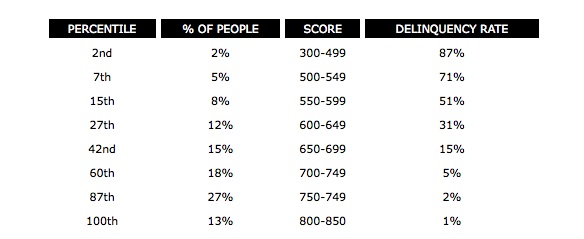
But wait… if a MCA is not a loan, nor does it depend on the business owner to make payments, then how can there be a risk of delinquency? Intentional manipulation of the revenue flow back to the funding provider can be relatively easy to do. A business owner could use spare POS equipment to accept card payments for which the funding provider is not aware of and therefore prevent the collection of funds. That’s a method known as splitting, and serious consequences can result when discovered. (Read more on what happens in the case of default or deliquency on a MCA in a previous article)
But outside the scope of malice, there’s the traditional reason, the inability to make payments. If the suppliers and wholesales aren’t being paid, then the business isn’t going to have inventory on hand to sell. If the rent isn’t being paid, then there’s not going to be any location to generate these sales. Essentially, the funding provider has a mutual interest in the business being able to satisfy ALL of their obligations, not just the MCA itself.
If there is an 87% chance that suppliers, landlords, or other essential creditors will not be paid on time in the next 2 years, then there’s an excellent probability that the business will be unable to operate at the same level. With no collateral as protection, the MCA industry has adapted to the challenge by raising the cost. Business owners with poor credit can expect funds to be expensive and the terms to be more restrictive. Lower funding amounts, higher withholding percentages, and the sacrifice of any negotiation is the price the MCA industry has set to make funding to the maximum risk group possible. These programs, which are now often referred to as starter advances, don’t work for everyone so the pros and cons should be weighed prior to executing a contract.
Both the premium advances and starter advances have experienced extraordinary growth to the point where they have become niches of their own. There are now starter advance companies and premium advance companies. Funding providers like Strategic Funding Source have taken the product a step further and reportedly did a MCA for an exhibit at the Tropicana Hotel in Las Vegas for $4 Million. Contrast that with deals that are struck for as little as $750. And we can’t fail to mention that some have taken it back to the basics, a loan. ForwardLine in Woodland Hills, CA lends money to businesses which are then repaid in accordance with a predetermined, fixed pace through the card sales. They have reintroduced concepts like APR back to the finance world.
If we continue at the current pace, MCAs will become less expensive, more costly, a lot bigger, and markedly smaller. We’ve come to the fork in the road for what the Merchant Cash Advance industry seeks to brand itself as. Loan alternative? First choice? Backup plan? Is it for smaller businesses or larger ones? Should it go the way of lending or continue to remain a structured purchase of future card sales? Is industry cohesion really necessary or will increased decentralization lead to greater acceptance of this financial product a whole? Will there come a time when America’s big banks swallow the industry up, buy out the existing portfolios, and add this product to their financing arsenals?
These are tough questions. Merchant Cash Advance is evolving, growing, and no longer moving in one direction. While we contemplate our next step, one thing is for certain, there’s no turning back.
– AltFinanceDaily
www.merchantprocessingresource.com
Merchant Cash Advance and Startup Businesses
October 20, 2010 Kudos to the entrepreneurs taking a chance in the worst economic period of modern times. Starting a business is already a truly challenging task in itself but before we shower you with praise for being the ultimate warrior of capitalism, let’s put everything into perspective.
Risk takers are a minority in today’s startup community. A persistently high rate of unemployment is breeding a culture of survivalists; Individuals that have been pushed to the limit via pay cuts, layoffs, and robo-signing foreclosing bankers. It’s resumé rejection, employer double talk, and anger at how Wall Street bankers continue to live. The new entrepreneurs are a resounding chorus of “If I can’t get a job, I’ll make my own job!” These people are going for it on 4th Down and Long and running it up the middle for a touchdown. It’s as if Charles Darwin spiked their Corn Flakes.
Startup survivalists are just as inspiring as their risk taking counterparts. Both groups have the drive and that’s essential. But you can’t forego some basic tools. Financing is a must. No capital, no business. Unless you are fortunate to start with deep pockets, you need access to cash.
New businesses are not likely to be offered credit terms by vendors, nor can you push back overhead expenses such as rent, until you’re generating revenue. If unforeseen demand overwhelms your capacity, a cash shortage can do irreparable damage to your success.
Rather than spew rhetoric about the importance of funds, and shortchange you with a bullet point list of vague sources whom in reality are so illiquid, they’re not actually viable, we’ll offer our real 2 cents.
Banks. For a startup? Not happening. Angel Investors and Venture Capitalists? Slim to no chance. Unless these private investors live in your community, they’re not going to invest in your business. More than 90% of startups fail. For an investor to take that much risk, they’re going to do some hands on management or want to follow you around and critique how you’re spending their money. That’s not necessarily a bad thing. It just means that one can’t reasonably expect a return on their investment without intimate knowledge of the demographics and community the business is situated in.
Looking for private investors over the internet? Don’t. Your pro forma financial statements, data research, and business plan won’t help. Do you know how many businesses fail to open even after they incorporate, sign a lease, purchase inventory, advertise, and make preliminary hires? An astounding number are eclipsed by failed health inspections, license/permit rejections, and building code violations. This reasserts that unless an investor is personally intimate with your progress, the odds are stacked against them.
Lastly, you need not pay to get approved for capital. We’ve spoken with many start ups over the last year and are flabbergasted by the amount of new businesses that are convinced they have to pay a $3,000 upfront fee to get approved for a loan. The ones that actually pay are quick to learn what town the lender is based in; It’s called Scam City.
Real Option? Merchant Cash Advance. A Merchant Cash Advance offers a business with a lump sum of capital upfront. In return, a piece of every sale the business makes will go towards paying it back plus a predetermined fee. There is no due date or set term for repayment. That means if sales are slow to get off the ground, then funds will be repaid slower and with no penalty.
A Merchant Cash Advance provider entrusts you with their capital because of the unique security the repayment method offers. The business itself must accept credit cards as a form of payment. The credit card processing company will automatically deduct the agreed percentage piece of each sale transacted and forward it to the Merchant Cash Advance provider on your behalf for repayment.
A startup can qualify with as little as 1 week in business. As long as you open, you can get funding. Credit can play a limited factor and the cost can be hefty, but the access to capital is unmatched. From the date you apply, funds can be received in as little as 5 days.
Purchase inventory, pay the rent, advertise, hire, or seize an opportunity. Whichever shortcoming you face, it can be overcome with a Merchant Cash Advance. Industry experts project that funding is on pace to reach over $600 Million for 2010 alone. With advances ranging from as small as $1,000 to as high as $500,000, there is proof that numerous deals are being made every day.
We’ve seen the same books, guides, and expert advice columns that you’ve seen and all of them seem to be a reprint of useless suggestions like the SBA and searching for angel investors online. These people earn a living writing. Whether or not the money expert column in your newspaper actually helps you, makes no difference to them. We have many years experience in the Merchant Cash Advance industry and we make careers out of funding you, not telling you about funding.
We try not to promote any one company over another. There is no harm in enlisting the service of a middleman or reseller for one of the direct funding sources. It may actually benefit you. If you are open for business, you can obtain a Merchant Cash Advance. If you have been in business for a long time, a Merchant Cash Advance is still a fantastic option.
It’s 4th Down and Long. You’re ambitious, focused, and ready. You are the ultimate warrior of capitalism. A Merchant Cash Advance will supply the cash. Grow, take risks, survive, and don’t be surprised if your Corn Flakes taste funny.