
‘We Cannot Have Opaque Black Boxes Running Our Economy,’ Says Director of US PIRG
June 9, 2016
During a marketplace lending event hosted by the FTC, one panelist said he was not impressed by the reliance that some consumer lenders have on proprietary algorithms and secret sauces to determine who gets approved for a loan. Ed Mierzwinski, Consumer Program Director for U.S. PIRG, a nonprofit consumer interest group, expressed that regulators should investigate these methodologies. “We cannot have opaque black boxes running our economy,” he said. “That may be something that excites the investors” but credit fairness has to come first, he added.
Meanwhile, Jessica Milano, a Deputy Assistant Secretary for the U.S. Treasury, explained that underwriting methodologies used by consumer marketplace lenders still produce results that are highly correlated with FICO. The Treasury published a much-talked-about report on marketplace lending just last month.
Peter Renton, who founded the LendAcademy blog and LendIt conference, countered Mierzwinski by explaining that alternative data sources are not so much about assessing credit-worthiness, but rather about verifying the identity of the applicant.
Milano and Renton both conceded that things were different on the business lending side of the industry.
This was an educational event, not an inquiry or hearing so nobody was officially being scrutinized. FTC Commissioner Edith Ramirez said in her introductory speech that “most observers agree that, given the advantages it offers both lenders and borrowers, marketplace lending is here to stay.”
You can watch a recap of the 3-hour event below. It starts at about 1 hour in to the recording.
Are You Ready to deBank Again?
June 8, 2016As the newest issue of AltFinanceDaily magazine prints, the question remains, are you subscribed to receive it?
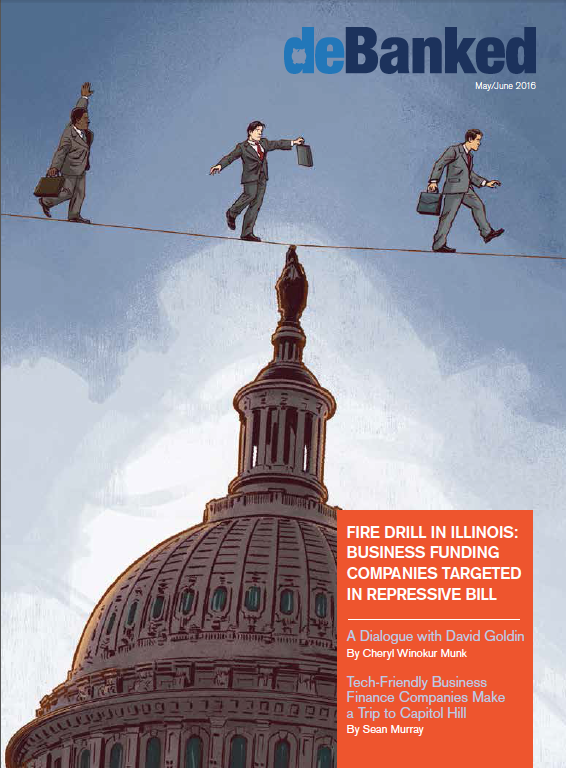
The May/June issue delves deeper into the legislative events taking place in Illinois, a summary of industry trips to Washington DC, an interview with Capify’s David Goldin, a recap of LendIt and more.
Subscriptions are FREE and yes, it’s a physical publication.

Prosper Might Want to Sell. But Who Wants to Buy?
May 25, 2016
Keynote Presentation by Ron Suber of Prosper at the LendIt USA 2016 conference in San Francisco, California, USA on April 11, 2016. (photo by Gabe Palacio)Has the atmosphere for the industry changed enough for Prosper to consider selling? It might be.
The beleaguered online lender is in talks with JP Morgan Chase and Financial Technology Partners to explore “strategic options,” implying a stake sale, according to Reuters.
The company is in pursuit of capital to fund its loans while trying to keep its investors happy. For that purpose, Prosper increased rates on its riskier borrowers by 0.29 percentage points this week. A move the company suggests is “appropriate and makes the risk-reward tradeoff of investing in newly originated loans at least as attractive as purchasing ABS products backed by loans through Prosper in the secondary market.” In February, Prosper raised rates by 1.4 percentage points, the same time it increased its loss estimates for investors.
This second increase, according to its new chief risk officer, Brad Pennington is a “direct result of forward looking credit market” and with the possible Fed rate hike already priced in. This move from the San Francisco-based lender follows a 28 percent cut in its taskforce, shutting down its Utah office and letting go of former risk officer and CEO Aaron Vamut foregoing a year’s salary.
The lender also lost a securitization deal with Citi in April as investors started demanding more yield from Prosper bonds. “When we don’t have alignment with our investors, when groups sell our loans into the market no matter what, if the market’s not ready, it’s not good,” Prosper’s president Ron Suber said at LendIt.
With great prosperity comes….?
Moodys, New Securitization Deals Absolve New Age Lenders
May 21, 2016
You can’t keep a good industry down. Despite the turbulence caused by Lending Club on “marketplace lenders,” ratings agency Moodys rated SoFi’s latest $380 Million bond offering AAA, equivalent to the safety and soundness of the United States Government. That feat is all the more incredible considering that the full faith and credit of the good ‘ol USA doesn’t even enjoy a rating that high with Moodys’ competitor Standard & Poor’s.
Not that the rating should come as any surprise since SoFi borrowers tend to be super-prime credit risks with six-figure incomes and postgraduate level educations. It’s a group that one might call America’s elite, a characterization that SoFi has even gotten in trouble with for capitalizing on. In February, they ran a Super Bowl ad that seemed to taunt viewers that they were “probably not” great enough to borrow from them.
Still, a AAA-rating, whether warranted or not, will be a welcome antithetical headline to the lenders who are being forced to play defense amidst news of layoffs and scandals elsewhere.
OnDeck too, just announced the closing of a $250 Million securitization. DBRS, another ratings agency which has long played a role with new age lenders, rated OnDeck’s Class A notes in this transaction a Single-A, two levels below the highest. The Class B notes scored a Triple-B. (You can view a list of some of DBRS’s ratings history with OnDeck and others here.)
DBRS states that the personal guarantors of the loans pooled in OnDeck’s notes could have FICO scores as low as 500, but that overall they have an average FICO score of 676. OnDeck’s borrowers are therefore worlds apart from the ones SoFi caters to. But the distinction is greater still when considering that SoFi is mainly in the student lending business and OnDeck in the commercial lending business.
The positive marks bestowed upon each during a tumultuous time however, is evidence that confidence exists across the spectrum of today’s new age lenders.
Fora Financial for example, another business lender, announced days ago that they had secured a $53 million credit facility to facilitate continued growth.
On Friday, Lending Club closed at $3.99, still down more than 70% from its IPO price. OnDeck closed at $4.69, down more than 75% from its IPO price.
Has the market gone too far in punishing them?
After Prosper, Avant Lays off 60 Employees, Stalls Expansion Plans
May 20, 2016
Lending Club tumbled, Prosper laid off 171 employees, OnDeck lost $12 million in Q1. Who’s next? Avant.
The Chicago-based lender, popular among subprime borrowers, is laying off 60 employees and putting some of its plans on the back burner, raising more alarms for the industry, the American Banker reported.
Avant’s loan volume dropped 27 percent in the first quarter and the number of loan offers fell 63 percent between December 2015 to February this year. The company plans to delay the launch of its auto loan refinancing program announced in March this year, the same month it crossed $3 billion in personal loan funding. It announced plans to refinance auto loans ranging between $4,000 and $35,000 with APRs between 10.11 percent and 25 percent ranging over 2-5 years.
The news comes in light of rising auto loan balances. Vehicle loans and leases held by subprime consumers increased by 11 percent in Q1 this year and for the first time since the recession, balances on auto loans hit the $1 trillion mark, up from $905 billion last year.
SoFi Hires Ashish Jain, Trader Sacked by Deutsche Bank Last Year
May 19, 2016
If you get fired from a top investment bank pending a compliance probe, don’t worry. Things might still turn around, as it did for Ashish Jain, the former Deutsche Bank trader hired by SoFi.
SoFi hired Jain to bundle loans into bonds and sell them to investors. Deutsche Bank’s former CEO Anshu Jain is already an advisor to SoFi. Speaking of Ashish Jain’s appointment, Bloomberg quoted SoFi CEO Mike Cagney as saying,
“We are comfortable with Ashish’s character and integrity..we spent a lot of time talking with folks in the industry and concluded that he is a good actor.”
Jain was terminated as the former head of securitized product sales for Deutsche Bank in America after the bank found that he failed to comply with the bank’s policies after the bank fired junior traders for lying to clients on the pricing of commercial mortgage bonds.
Separately, the San Francisco-based lender closed a $380 million securitization deal. And earlier this month, the company’s subsidiary SoFi Lending Corp became an approved Fannie Mae seller and servicer.
Lending Club Faces Another Subpoena, This Time It’s NY Regulators
May 18, 2016
Adding to its list of woes, New York financial regulators have subpoenaed the lender on its interest rates charged to borrowers in New York. CNBC reports that this matter is unrelated to Laplanche’s exit.
From its CEO resigning on May 9th to being slapped with a Justice department notice the same week, the lender’s reputation has been through a lot of trauma. Its stock tanked more than 8 percent on Tuesday and opened under $4 on Wednesday.
And to add to the heap of bad news, the company evaluated its staffing needs and cancelled its 10-week summer internship program.
Lending Club received a Department of Justice grand jury subpoena on May 9th, according to the company’s quarterly earnings report, the same day that the resignation of their iconic CEO was announced. Grand juries are selected to decide if a criminal indictment should be brought against a party. The timing of the subpoena is suspicious because it leads one to suppose that a federal prosecutor had listened in on the May 9th earnings call, read news reports, decided there might be criminal activity, summoned jurors and issued a subpoena all within hours of the original announcement.
The WSJ, which did a great job reporting the details of the events leading up to Laplanche’s ouster, was not able to pin down the smoking gun that “convinced directors that more drastic action was needed,” just that the board had been “presented with evidence” that Laplanche knew many details of the $22 million loan sale.
A highly likely possibility (and this is just my theory) is that someone at Jefferies, the investment bank that Lending Club fudged the numbers on and ultimately bought $22 million worth of loans back from, tipped off federal authorities as to what took place with the loan sale.
Contrary to what people think about Wall Street, many bankers are scared to death about having knowledge of something that could lead to investors being harmed. Someone at Jefferies (and again just my theory) very well could have been so bothered by what Lending Club did, that they made sure the authorities knew what transpired. In doing so, they would probably have been viewed positively for blowing the whistle on bad behavior.
 Cue a prosecutor’s interest, a grand jury, and likely a subpoena to individuals who would’ve had direct knowledge of the transaction. In my opinion, nothing would convince a board of directors more to give their famous CEO 24 hours to resign or be fired than having acquired knowledge of a grand jury investigation.
According to the WSJ, by Thursday, May 5th, Laplanche was removed as board chairman. On May 6th, he resigned. Over the weekend, he emailed friends from a new personal address, and on May 9th it was announced that he had resigned. That same day, Lending Club (the company), received a grand jury subpoena, of what I theorize was probably part of an investigation that was already in progress.
We may never know the full truth, but a seemingly innocent chain of events has clearly spiraled out of control to the point where over the course of a single week, Lending Club’s business model is seemingly coming undone. If nobody wants to buy loans or notes from their marketplace, then they are essentially out of business.
The dearth of interest in buying the loans they originate given the recent news has forced the company to disclose that it might actually have to use its own money to fund loans. No buyers, no business. So what else can they do? For one, they admit that they may need to reduce the volume of loans they originate, and that in doing so, it would likely have material adverse impact on their business.
These consequences have been predicted for years. What happens when investors just don’t want to buy the loans? How could a company where 90% of the income comes from loan origination fees provide continuous value to shareholders in an environment where there are no longer buyers?
Notably, veteran banker Todd Baker has been one of the most vocal on this issue. Six months ago, he publicly challenged SoFi CEO Mike Cagney about the viability of the marketplace model. Cagney had previously addressed Baker in an American Banker article by writing, “It is true that an MPL [Marketplace Lender] needs a buyer to originate loans — without one, the marketplace needs to raise rates until a buyer emerges. If there is no buyer, MPLs simply stop lending — they won’t start originating underwater loans.”
Stop lending?
Seemingly willing to undermine his own assertions, Cagney told the WSJ less than a year later a different story. “In normal environments, we wouldn’t have brought a deal into the market, but we have to lend. This is the problem with our space.” The environment of which he spoke then of course, was one where loan buyer interest was simply not as high as they would’ve liked, and thus it was becoming a “problem.”
Cagney’s reversal played right into Baker’s point, that a marketplace lender has to keep issuing loans to survive. When those loans don’t have organic buyers, at least in SoFi’s case, the weird idea of launching a hedge fund to potentially artificially keep up loan originations was proposed.
For Lending Club, their Plan B to keep things going is to simply buy their own loans if no buyers are available. Lending Club has a strong balance sheet and could potentially have success with this, for a time of course. The problem is that it would be taking on the credit risk of those loans as a result and put its retail note buyers at risk in the process.
Here’s why: When investors use the Lending Club platform, they are lending money to Lending Club and Lending Club is using that money to lend to borrowers. Investor yield might be tied to the performance of the notes they acquire but the credit risk is ultimately Lending Club itself. If Lending Club goes kaput, note holders would have a major problem, one that hasn’t really been a possibility until now because Lending Club hasn’t kept much risk on its balance sheet. That might soon change, according to their recent quarterly earnings report, where they say they might have to balance sheet some loans. Investors then wouldn’t really be participating in some disruptive peer-to-peer sharing economy revolution, but rather become very much like bondholders in an unregulated non-depository financial institution. And that smells horrifyingly risky. Throw in the fact that Lending Club is facing class action lawsuits, one of which alleges them to be a Racketeer Influenced Corrupt Organization. Does this sound like the kind of bond you want to invest in if you’re an unaccredited retail investor?

What Laplanche actually did or what a grand jury finds are unimportant in the grand scheme of what’s already been revealed. The only thing that matters is that when buyers dry up (whether for rational or irrational reasons), the entire system’s foundation shakes. The marketplace as it was supposed to be anyway, certainly can’t forever operate as a marketplace when it has shareholders who expect ever-increasing revenues and profits. According to Cagney’s original libertarian fantasy, nothing should theoretically be going on balance sheet. Lending Club should just be lending less, and if there are ultimately no buyers, the company should shut down until such a day that buyers return. One could only imagine that conversation with shareholders.
At the LendIt Conference last month, Renaud Laplanche joked with the crowd about cutting off the sleeves of his Lending Club jacket to make the Lending Club vest he sported on stage during his keynote speech. But was it just the sleeves that were missing? Speaking so confidently, Laplanche projected the authority of an emperor, perhaps one we’ve all been introduced to before.
“Was it really just the sleeves that have been cut away?” You may have thought to yourself for a split second. Or is it possible that the emperor of the marketplace, unbeknownst to the crowd, was simply wearing no clothes at all?
GAME OVER: Is The Marketplace Lending Model Dead?
May 17, 2016
Lending Club received a Department of Justice grand jury subpoena on May 9th, according to the company’s quarterly earnings report, the same day that the resignation of their iconic CEO was announced. Grand juries are selected to decide if a criminal indictment should be brought against a party. The timing of the subpoena is suspicious because it leads one to suppose that a federal prosecutor had listened in on the May 9th earnings call, read news reports, decided there might be criminal activity, summoned jurors and issued a subpoena all within hours of the original announcement.
The WSJ, which did a great job reporting the details of the events leading up to Laplanche’s ouster, was not able to pin down the smoking gun that “convinced directors that more drastic action was needed,” just that the board had been “presented with evidence” that Laplanche knew many details of the $22 million loan sale.
A highly likely possibility (and this is just my theory) is that someone at Jefferies, the investment bank that Lending Club fudged the numbers on and ultimately bought $22 million worth of loans back from, tipped off federal authorities as to what took place with the loan sale.
Contrary to what people think about Wall Street, many bankers are scared to death about having knowledge of something that could lead to investors being harmed. Someone at Jefferies (and again just my theory) very well could have been so bothered by what Lending Club did, that they made sure the authorities knew what transpired. In doing so, they would probably have been viewed positively for blowing the whistle on bad behavior.
Cue a prosecutor’s interest, a grand jury, and likely a subpoena to individuals who would’ve had direct knowledge of the transaction. In my opinion, nothing would convince a board of directors more to give their famous CEO 24 hours to resign or be fired than having acquired knowledge of a grand jury investigation.
According to the WSJ, by Thursday, May 5th, Laplanche was removed as board chairman. On May 6th, he resigned. Over the weekend, he emailed friends from a new personal address, and on May 9th it was announced that he had resigned. That same day, Lending Club (the company), received a grand jury subpoena, of what I theorize was probably part of an investigation that was already in progress.
We may never know the full truth, but a seemingly innocent chain of events has clearly spiraled out of control to the point where over the course of a single week, Lending Club’s business model is seemingly coming undone. If nobody wants to buy loans or notes from their marketplace, then they are essentially out of business.
The dearth of interest in buying the loans they originate given the recent news has forced the company to disclose that it might actually have to use its own money to fund loans. No buyers, no business. So what else can they do? For one, they admit that they may need to reduce the volume of loans they originate, and that in doing so, it would likely have material adverse impact on their business.
These consequences have been predicted for years. What happens when investors just don’t want to buy the loans? How could a company where 90% of the income comes from loan origination fees provide continuous value to shareholders in an environment where there are no longer buyers?
Notably, veteran banker Todd Baker has been one of the most vocal on this issue. Six months ago, he publicly challenged SoFi CEO Mike Cagney about the viability of the marketplace model. Cagney had previously addressed Baker in an American Banker article by writing, “It is true that an MPL [Marketplace Lender] needs a buyer to originate loans — without one, the marketplace needs to raise rates until a buyer emerges. If there is no buyer, MPLs simply stop lending — they won’t start originating underwater loans.”
Stop lending?
Seemingly willing to undermine his own assertions, Cagney told the WSJ less than a year later a different story. “In normal environments, we wouldn’t have brought a deal into the market, but we have to lend. This is the problem with our space.” The environment of which he spoke then of course, was one where loan buyer interest was simply not as high as they would’ve liked, and thus it was becoming a “problem.”
Cagney’s reversal played right into Baker’s point, that a marketplace lender has to keep issuing loans to survive. When those loans don’t have organic buyers, at least in SoFi’s case, the weird idea of launching a hedge fund to potentially artificially keep up loan originations was proposed.
For Lending Club, their Plan B to keep things going is to simply buy their own loans if no buyers are available. Lending Club has a strong balance sheet and could potentially have success with this, for a time of course. The problem is that it would be taking on the credit risk of those loans as a result and put its retail note buyers at risk in the process.
Here’s why: When investors use the Lending Club platform, they are lending money to Lending Club and Lending Club is using that money to lend to borrowers. Investor yield might be tied to the performance of the notes they acquire but the credit risk is ultimately Lending Club itself. If Lending Club goes kaput, note holders would have a major problem, one that hasn’t really been a possibility until now because Lending Club hasn’t kept much risk on its balance sheet. That might soon change, according to their recent quarterly earnings report, where they say they might have to balance sheet some loans. Investors then wouldn’t really be participating in some disruptive peer-to-peer sharing economy revolution, but rather become very much like bondholders in an unregulated non-depository financial institution. And that smells horrifyingly risky. Throw in the fact that Lending Club is facing class action lawsuits, one of which alleges them to be a Racketeer Influenced Corrupt Organization. Does this sound like the kind of bond you want to invest in if you’re an unaccredited retail investor?
What Laplanche actually did or what a grand jury finds are unimportant in the grand scheme of what’s already been revealed. The only thing that matters is that when buyers dry up (whether for rational or irrational reasons), the entire system’s foundation shakes. The marketplace as it was supposed to be anyway, certainly can’t forever operate as a marketplace when it has shareholders who expect ever-increasing revenues and profits. According to Cagney’s original libertarian fantasy, nothing should theoretically be going on balance sheet. Lending Club should just be lending less, and if there are ultimately no buyers, the company should shut down until such a day that buyers return. One could only imagine that conversation with shareholders.
At the LendIt Conference last month, Renaud Laplanche joked with the crowd about cutting off the sleeves of his Lending Club jacket to make the Lending Club vest he sported on stage during his keynote speech. But was it just the sleeves that were missing? Speaking so confidently, Laplanche projected the authority of an emperor, perhaps one we’ve all been introduced to before.
“Was it really just the sleeves that have been cut away?” You may have thought to yourself for a split second. Or is it possible that the emperor of the marketplace, unbeknownst to the crowd, was simply wearing no clothes at all?