
Updates On Several Industry Court Cases
October 4, 2017Curious to know the status of industry court cases we’ve reported on? Here’s an update on several:
| Case | When filed | Where pending | Status |
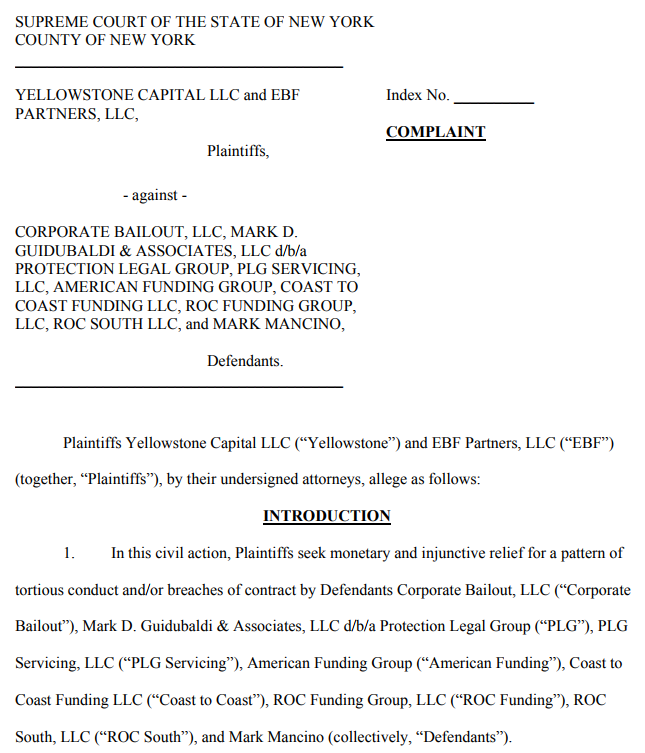
| Yellowstone Capital LLC and EBF Partners, LLC v. Corporate Bailout, LLC, Mark D. Guidubaldi & Associates, LLC dba Protection Legal Group, PLG Servicing, LLC, American Funding Group, Coast to Coast Funding, LLC, ROC Funding Group, LLC, ROC South LLC, and Mark Mancino. | 9/27/17 | New York State Supreme Court | Complaint filed. No anwswer filed yet |
| Sean Pullen, Christina Cane, Michael Cane, Michael Carrera, Matthew Taylor, and Yulia Zamaora v Social Finance, Inc. and Does 1-50 | 8/14/17 | Superior Court of California | SoFi filed an answer to the complaint on 9/15 |
| Craig Cunningham v. Mark D. Guidubaldi & Associates, LLC dba Protection Legal Group, and Corporate Bailout, LLC, Sanford J. Feder Esq, Mark D. Guidubaldi, Esq, Cashflow Care, LLC | 5/10/17 | Northern District of Texas | Motion for default judgment filed against Corporate Bailout on 9/12/17. Defendant never responded |
| Natures Market Corp v. Creditors Relief | 4/28/17 | New York State Supreme Court | Creditors Relief’s motion to dismiss and sanctions are still pending |
| Pearl Gamma Funding, LLC and Pearl Beta Funding, LLC v. Creditors Relief, LLC | 11/16/16 | New York State Supreme Court | Pearl has moved to dismiss Creditors Relief’s counterclaims |
| United States v. Sergiy Bezrukov | 10/26/16 | Western District of New York | The criminal indictment was amended on 8/3/17 to add more charges. Bezrukov is facing up to 30 years in prison |
| Ronald Bethune, on behalf of himself and all others similarly situated v. Lendingclub Corporation;WebBank, Steel Partners Holdings, L.P.; The Lending Club Members Trust; and does 1 through 10, inclusive | 4/6/16 | Southern District of New York | The judge granted the defendants motion to compel arbitration on Jan 30, 2017 |
| Kalamata Capital LLC v. Biz2Credit, Inc. and Itria Ventures, LLC | 12/8/14 | New York State Supreme Court | Kalamata plans to amend the complaint and the Court is scheduled to decide on the debate over whether certain documents should be sealed from public view |
| Federal Trade Commission v. AMG Services, Inc., et al. | 4/2/12 | District of Nevada | $1.3 billion judgment entered. Company owner Scott Tucker is also currently being tried criminally in the Southern District of New York for ill-gotten profits related to his payday lending empire. The jury is expected to decide the outcome this month |
ISOs Alleged to Be Partners in Debt Settlement “Scam” in Explosive Lawsuit
September 28, 2017 ISOs and brokers referring deals to debt settlement companies should pay attention to a lawsuit that was filed in the New York Supreme Court on Wednesday. In it, plaintiffs Yellowstone Capital and EBF Partners (“Everest Business Funding”) allege that certain ISOs are culpable partners in a scam that nefarious debt settlement companies are perpetrating on small businesses.
The debt settlement companies “mislead the merchants as to the services they will perform and the cost to the merchant, and they also conceal their relationships with the ISO Defendants and the fact that they or their affiliates are introducing these same merchants to merchant cash advance providers like Plaintiffs only to later induce those merchants to breach their agreements with their cash advance providers,” the complaint states.
Among the named defendants are:
- Corporate Bailout, LLC
- Mark D. Guidubaldi & Associates, LLC dba Protection Legal Group
- PLG Servicing LLC
- American Funding Group
- Coast to Coast Funding, LLC
- ROC South, LLC
- Mark Mancino
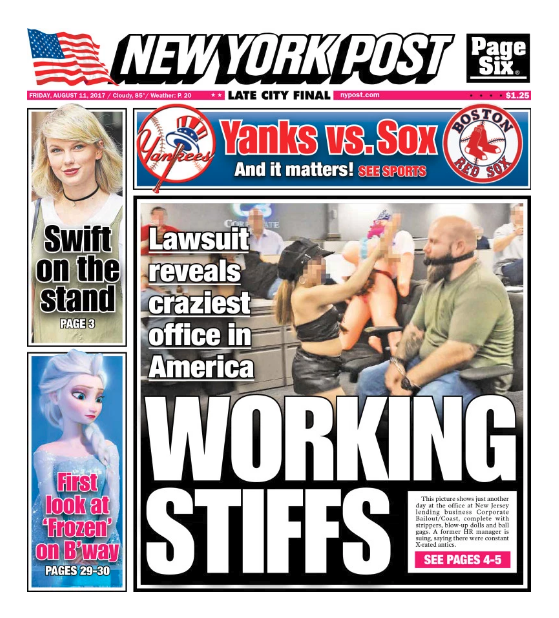
Several defendants are already best known for running an office “so sexually aggressive, morally repulsive, and unlawfully hostile that it is rivaled only by the businesses portrayed in the films ‘Boiler Room’ and ‘The Wolf of Wall Street,’” according to a salacious story that graced the back cover of the New York Post last month.
One paragraph of the complaint summarizes the allegedly collaborative scheme like this:
American Funding, Coast to Coast, […] (the “ISO Defendants”) are independent sales organizations (“ISOs”), companies that ostensibly support the merchant cash advance industry by brokering merchant agreements for companies like Plaintiffs. The ISO Defendants are anything but the proverbial “honest brokers.” As alleged below, they have partnered with companies that purport to offer debt relief services to merchants who have agreements with merchant cash advance companies like Plaintiffs. In practice, for these companies, “debt relief” is a code word for deceiving merchants to breach their existing agreements with Plaintiffs and to instead pay fees to these debt relief entities. In short, they scam merchants into believing that they can save them money when, in fact, they leave these merchants in financial shambles, while causing Plaintiffs to suffer millions of dollars in losses and future los[t] profits.
“’DEBT RELIEF’ IS A CODE WORD FOR DECEIVING MERCHANTS TO BREACH THEIR EXISTING AGREEMENTS”
Central to the plaintiffs’ claim is that they have ISO agreements with the defendants and that the defendants’ conduct is a breach of those agreements. The three causes of action alleged are tortious interference with contract, conversion, and breach of contract. Plaintiffs claim that 100 merchants with more than $3 million in outstanding balances are in breach of their contracts because of the defendants’ conduct.
The complaint was prepared and filed by attorneys at Proskauer, a 142-year old law firm founded in New York City.
Debt Relief Under Fire
The small business debt relief industry has been marred by scandal in recent years. In an unrelated criminal matter being handled in the Western District of New York, the owner of Corporate Restructure Inc. (no ties to Corporate Bailout) is currently residing in the Niagara County Jail awaiting trial on charges of conspiracy to commit mail fraud, wire fraud, bank fraud and money laundering for failing to deliver the debt relief services it charged for. In that case, United States vs. Sergiy Bezrukov, Bezrukov advertised that he could reduce a merchant’s short term debt by up to 75%. He is facing up to 30 years in prison. He was also previously a merchant cash advance ISO.
Two other MCA funding companies, Pearl Gamma Funding and Pearl Beta Funding, filed a lawsuit last November against another debt relief company that calls itself Creditors Relief. The complaint in that case also alleges tortious interference with contract and is still pending.
Meanwhile, a lawsuit filed in May by famous TCPA litigant Craig Cunningham against Corporate Bailout and Mark D Guidubaldi & Associates LLC went unanswered, according to court records. Cunningham, who alleged violations of telemarketing laws, filed for a default judgment against Corporate Bailout on September 12th.
Taking Advantage
Both Yellowstone Capital and Everest would not comment on the lawsuit they filed, citing pending litigation. Sources close to them, however, contend that both companies take matters that involve merchants being taken advantage of very seriously.
“When our own ISOs work directly in concert with companies that induce merchants to breach our contracts, that’s a problem,” said one source who did not wish to be named and was speaking generally about the recent introduction of debt relief service companies to the industry. “They’re taking advantage of businesses that can’t afford to be taken advantage of.”
An email sent by AltFinanceDaily to Mark Mancino early Thursday afternoon, an individually-named defendant alleged to be affiliated with the other defendants, has not yet received a response. This story may be updated if a reply is received.
A COPY OF THE COMPLAINT CAN BE VIEWED HERE.
Tech Banks: Will Fintech Dethrone Traditional Banking?
August 20, 2017On Halloween, 2014, a largely unknown, Boston-based financial institution, First Trade Union Bank, embraced high-technology, went paperless, and officially adopted a new name: Radius Bank.
 In reinventing itself, Radius did more than dump its dowdy moniker. It shuttered five of its six branches, re-staffed its operations with a tech-savvy team, instituted “anytime/anywhere” banking services, and offered customers free access to cash via a nationwide ATM network. And it teamed up with a fistful of financial technology companies to offer an impressive array of online lending and investment products.
Today, the bank’s management boasts that, using their personal mobile phones, some 2,700 people per week are opening up checking accounts, funneling $3 million in consumer deposits into the bank’s virtual vault. That’s a stark contrast from a decade ago when the financial institution was being rocked by the financial crisis and “we couldn’t get anybody to walk into our branches,” says Radius’s chief executive, Mike Butler.
“We tried to leave that old bank behind,” he says. “We’re a virtual retail bank now, an efficiently run organization that offers high levels of customer service and Amazon-like solutions.”
Radius Bank is not alone. At a moment when there is much discussion — and hand-wringing — over the future of seemingly outmoded, highly regulated community banks, a coterie of small but nimble banks is exploiting technology and punching above its weight. Almost overnight, this cohort is combining the skill and hard-won experience of veteran bankers with the lightning-fast, extraordinary power afforded by the Internet and technological advances. As a result, these small and modest-sized institutions are redefining how banking is done.
In addition to Radius Bank, independent banks winning recognition for their bold, innovative – and profitable — exploitation of technology, include: Live Oak Bank in Wilmington, N.C., which adroitly parlays technology to become the No. 2 lender to business and agricultural borrowers backed by the U.S. Small Business Administration; Darien Rowayton Bank in Darien, Conn., which is making a name for itself with coast-to-coast, online refinancing of student loans; and Cross River Bank in Fort Lee, N.J., which does back-end work for a passel of fintech marketplace lenders.
Interestingly, there’s not much overlap. Each of the banks goes its own way. But what all the banks have in common is that each has struck out on its own, each hitting upon a technological formula for success, each experiencing superior growth.
“These are companies that understand the value of a bank charter,” says Charles Wendel, president of Financial Institutions Consulting in Miami. “They have to work under the watchful eyes of state and federal regulators. But their cost of funds is low and they can offer more attractive rates. Because they’re less likely (than nonbank fintechs) to disappear, run out of money, or get sold,” the bank expert adds, “they also have the image of stability with customers.”
These modest-sized banks are emerging as not only pacesetters for the banking industry. Along with making common cause with the fintechs — which had promised to disrupt the banking industry – they’re even beating the fintechs at their own game.

“Classically, community banks have looked to technology partners to provide technological innovation,” says Cary Whaley, first vice-president for payment and technology policy at the Independent Community Bankers of America, a Washington, D.C.-based trade group representing a broad swath of the country’s 5,800 Main Street banks. “They still do. You’re seeing more partnerships. But now you also see community banks building innovative products and services outside of that relationship. You see forward-thinking banks developing their own technology to support big ideas like marketplace lending, distributed ledger technology, and emerging payments technology.”
With its extraordinary skill at exploiting technology, Live Oak Bank – which trades on the Nasdaq and is the only public company encountered in the cohort — has become a Wall Street darling. “While several banks have adopted an online-only model, and nearly all banks are shifting more and more delivery through online channels, Live Oak was built from the ground up as a technology-based bank,” Aaron Deer, a San Francisco-based research analyst at Sandler O’Neill Partners, wrote in a recent investment note.
Driving the success of Live Oak, which operates out of a single branch in the North Carolina seacoast town and has only been in business for a decade, is the explosive growth in its SBA lending, the bank’s “core strategy,” Deer notes. Last year, Live Oak lent out $709.5 million in SBA loans in increments of up to $5 million, the federal agency reports, making it the country’s No. 2 SBA lender. It trailed only megabank Wells Fargo Bank, the third largest bank in the U.S. with $1.5 trillion in assets, which made $838.93 million in SBA-backed loans last year.
As its SBA lending has taken off, Live Oak, which qualifies as a “preferred lender” with the federal agency, boasts assets that have nearly tripled to $1.4 billion in 2016, up from $567 million two years earlier. Those are flabbergastingly fantastic growth numbers. But just as incongruously — by nipping at the heels of Wells Fargo — Live Oak has been challenging a bank more than a thousand times its asset size for dominance in SBA lending.
And, interestingly, the bank is able to book those outsized amounts of SBA loans while lending to only 15 industries out of 1,100 approved by the government agency, slightly more than 1% of the universe. That’s up from 13 industries in 2015, and Live Oak is adding two to four additional industries yearly for its SBA loan portfolio, Deer reports. Included among the industries to which the bank made an average SBA loan of $1.29 million last year: Agriculture and poultry, family entertainment, funeral services, medical and dental, self-storage, veterinary, and wine and craft-beverage.
The bank has a team of financing specialists dedicated to each of the designated industries. Among Live Oak’s current SBA borrowers are Martin Self Storage in Summerville, S.C.; Utah Turkey Farms in Circleville, Utah; Pinballz Arcade, Austin, Tex.; and Council Brewery Company in San Diego. Steve Smits, chief credit officer at the bank, told NerdWallet: “When you specialize in something, you become efficient. Because we do it every day and we have professionals and specialists, we tend to be more responsive and quicker.”
The heady combination of technological sophistication and banking expertise has allowed the lender to slash its loan-origination time to 45 days, about half the three-month industry average for SBA loans. To speed up loan sourcing and generation, the bank developed its own in-house technology, which led to the formation of the Wilmington-based technology company nCino, which was spun off to shareholders in 2014.
Live Oak did not return calls to discuss its lending strategies, but in SEC filings bank management declared: “The technology-based platform that is pivotal to our success is dependent on the use of the nCino bank operating system” which relies on Force.com’s cloud-computing infrastructure platform, a product of Salesforce.com.
Natalia Moose, a public relations manager at nCino told AltFinanceDaily in an e-mail interview: “We work with Live Oak Bank, in addition to more than 150 other financial institutions in multiple countries with assets ranging from $200 million to $2 trillion, including nine of the top 30 U.S. banks. nCino was started by bankers at Live Oak Bank who found the logistics of shuffling paperwork among loan stakeholders to be unwieldy, inefficient and time-consuming.
“nCino’s bank operating system,” Moose adds, “leverages the power and security of the Salesforce platform to deliver an end-to-end banking solution. The bank operating system empowers bank employees and leaders with true insight into the bank, combining CRM (customer relationship management), deposit account opening, loan origination, workflow, enterprise content management, digital engagement portal, and instant, real-time reporting on a single secure, cloud-based platform.”
Live Oak, meanwhile, is not resting on its technological laurels. According to Deer’s report, the bank’s parent company, Live Oak Bancshares, has formed a subsidiary to inject venture capital into fintech companies. It’s already taken a small equity stake in Payrails and Finxact, “the latter of which is developing a completely new core processor to compete against the old legacy systems used by most banks,” the Sandler O’Neill analyst writes. “Quite simply,” he asserts elsewhere in his report, “the company is far beyond any other bank we cover in its technical capabilities and the growth outlook remains outstanding.”
 Five hundred and thirty-three miles due north along the Atlantic coast in southeastern Connecticut, Darien Rowayton Bank is also experiencing tremendous success as a lender using a home-grown technology platform. State-chartered by the Connecticut Department of Banking and regulated as well by the Federal Deposit Insurance Corp., the $600 million-asset bank is winning attention in banking circles for its online student-loan refinancing.
A few years ago, DRB, as it is known, was looking to go beyond mortgage and commercial lending — “the bread and butter for most community banks,” bank president Robert Kettenmann explained to AltFinanceDaily in a telephone interview – and was somewhat at a loss. The bank considered but then rejected the credit card business. Finally, DRB struck paydirt refinancing student loans. “Our chairman really seized on the opportunity,” Kettenmann says, adding: “It’s a $35 billion market.”
Thanks to the National Bank Act, it’s able to operate in all 50 states. As a regulated commercial bank with a strong deposit base, DRB can also offer low rates well below any state’s usury prohibitions.
What is most striking about DRB’s program is its nationwide targeting of upwardly mobile, affluent young professionals. According to a PowerPoint presentation obtained by AltFinanceDaily, all of the bank’s super-prime borrowers, who are mainly in the 28-34 age bracket, have a college degree and a whopping 93% have graduate degrees. Average income is $194,000.
 Forty-eight percent of those refinancing student loans with DRB are doctors or dentists and another 22 percent are pharmacists, nurses or medical employees; only about 20% are paying off their law degrees or MBAs. The heavy concentration of refinancing in the medical field reduces economic risk in an economic downturn. Forty-three percent of the borrowers are home-owners, the rest are renters – and prime candidates for an online, DRB-financed mortgage.
(Once known as “yuppies” today this cohort is “known by the acronym ‘HENRY,’” remarks Cornelius Hurley, a Boston University banking professor and executive director of the Online Lending Institute, explaining the initials stand for “High Earners Not Rich Yet.”)
The Connecticut bank partnered with a third-party on-line vendor, Campus Door, when it commenced making student loans in 2013. In the fall of 2016, however, DRB built out its own, proprietary loan-origination system, Kettenmann reports, emphasizing that CampusDoor had been an excellent partner but that the bank wanted to exercise end-to-end control over the process. DRB employs a seven-pronged, “omni-channel” marketing approach that includes interactive marketing, affinity partnerships, digital/online advertising, direct mail, mass-media advertising, and public relations/brand awareness campaigns.
DRB’s online enrollment provides “pre-approved rates” in less than two minutes with final approval on rates in 24-48 hours. Refinancers can complete the online application at their own speed. Through May, 2017, DRB had made $2.48 billion in refinancing to 20,000 student-loan borrowers, with only ten defaults, five of which were attributed to deaths or “terminal illness.”
On Yelp! the bank has received a batch of reviews ranging from very favorable, five-star (“I had a truly wonderful experience”) to one-star (“awful” and “truly a nightmare”). Many fault the application process as laborious, describing it as “time-consuming.” But for those who have succeeded, like the reviewer who counseled “patience,” the result can be “the lowest rate with DRB…my loan payments went down $100 a month.”
 Just about an hour’s drive south and taking its name from its proximity to New York city just over the George Washington Bridge is New Jersey-based, state-chartered Cross River Bank, which has a reputation as a partner-in-arms to fintech companies. “We’re both users and producers of technology,” declares Gilles Gade, the bank’s chief executive.
The bank provides “back-end” and infrastructure support to 17 marketplace lenders that offer a suite of lending products including personal loans, mortgages and home-equity loans. Following loan origination by a fintech company – Marlette Funding, Affirm, Upstart, loanDepot, SoFi, and Quicken Loan, among other partners — Cross River does the actual underwriting. Last year, Gade reports, the bank underwrote 1.9 million loans valued at $4-4.5 billion, about 10% of which Cross River kept on its books. The bulk of the loans are sold “back to the marketplace lenders” or to a third party. “We’ve created a high-velocity automated system,” he says.
Gade is manifestly unapologetic about the bank’s role in assisting fintechs in their competition with the banking establishment. “We’re a banking infrastructure services provider for those who want to disrupt the banking system,” he says. “Consumers expect a lot better than they’ve been getting from traditional banking services.”
 Back in Boston, Radius Bank’s chief executive reports that forging partnerships with fintechs to provide the full panoply of online banking services was no easy proposition. In its mating ritual, Radius not only had to determine that a fintech company’s offerings were sound and that it had the right characteristics – most especially “a long-term, sustainable business model” – but that its corporate culture meshed comfortably with Radius’s.
After meeting with as many as 500 fintechs and after a fair amount of trial and error, Radius formed partnerships with LevelUp, which enables customers to make mobile payments; with online lender Prosper, for refinancing consumer debt and “credit rehabilitation”; with SmarterBucks, for refinancing student loans; and with online investment firm Aspiration Partners – which allows investors to name their own fees and markets itself to a predominately middle-class audience as the firm “with a conscience.”
Radius employs advertising on social media websites and employs “psychographics” to appeal to “anyone who is zealous about using technology, not necessarily millennials,” Butler says. The data show that 65% of adults in the U.S. would prefer to use a traditional bank and have face-to-face interactions with a teller, he notes, leaving the remaining 35% as Radius’s target audience.
Christopher Tremont, executive vice-president for virtual banking, told AltFinanceDaily that a typical Radius customer is 42 years old, lives in Boston, New York, Chicago “or one of the bigger cities in the West,” is a “technophile,” earns $75,000 a year, and has $100,000 in personal assets.
Radius’s performance since it went paperless has been stellar. The bank has seen a rapid rise in deposits, spurting to $782 million through the first quarter of 2017, up from $565 million at year-end 2014. With little fee income but ample deposits and low-cost funds, Radius realizes the bulk of its revenues – and profits — on the interest-rate spread generated from its loan portfolio.
The bank booked $43.5 million in SBA loans last year, ranking it in the top 50 banks on the SBA’s league tables, while carrying another $105 million in its commercial leasing business at the end of the first quarter this year. Loan generation is driving asset growth, which are currently at $973 billion, up more a third from $726 million in 2014, and Butler expects the bank’s assets to top $1 billion sometime this year.
“Community banks love that part of the business—lending money,” Butler says.
Recent Court Decisions Impacting Merchant Cash Advances – Still Not a Loan
June 22, 2017In the United States District Court, Southern District of New York, a judge expounded on his decision as to why the Purchase and Sale of Future Receivables contract between TVT Capital and Epazz, Inc. was not a loan.
In this case, the “receipts purchased amounts” are not payable absolutely. Payment depends upon a crucial contingency: the continued collection of receipts by Epazz from its customers. TVT [TVT Capital] is only entitled to recover 15% of Epazz’s daily receipts, and if Epazz’s sales decline or cease the receipts purchased amounts might never be paid in full. See counter- claims, Exhs. A-C at 1. The agreements specifi cally provide that “Payments made to FUNDER in respect to the full amount of the Receipts shall be conditioned upon Merchant’s sale of products and services and the payment therefore by Merchant’s customers in the manner provided in Section 1.1.” Id. at 3 § 1.9.
Defendants’ argument that the actual daily payments ensure that TVT will be paid the full receipts purchased amounts within approximately 61 to 180 business days, id. ¶¶ 33-47, is contradicted by the reconciliation provisions which provide if the daily payments are greater than 15% of Epazz’s daily receipts, TVT must credit the difference to Epazz, thus limiting Epazz’s obligation to 15% of daily receipts. No allegation is made that TVT ever denied Epazz’s request to reconcile the daily payments. TVT’s right to collect the receipts purchased amounts from Epazz is in fact contingent on Epazz’s continued collection of receipts. See Kardovich v. Pfizer, Inc., 97 F. Supp. 3d 131, 140 (E.D.N.Y. 2015), quoting Amidax Trading Grp. v. S.W.I.F.T. SCRL, 671 F.3d 140, 147 (2d Cir. 2011) (“Where a conclusory allegation in the complaint is contradicted by a document attached to the complaint, the document controls and the allegation is
not accepted as true”).None of the defendants’ arguments, Counterclaims ¶¶ 51-109, change the fact that whether the receipts purchased amounts will be paid in full, or when they will be paid, cannot be known because payment is contingent on Epazz generating suffi cient receipts from its customers; and Epazz, rather than TVT, controls whether daily payments will be reconciled.
The judge relied heavily on the reconciliation clause common to merchant cash advance agreements, whereby merchants can adjust their daily ACH amount to correlate with their actual sales activity. The case # is: 1:16-cv-05948-LLS. The full decision can be downloaded through a link contained at: http://dbnk.news/7
MISREPRESENTATIONS? WHAT MISREPRESENTATIONS?
In the New York Supreme Court, a judge addressed a business owner’s allegations that they had been misled into entering into purchase agreements when they actually wanted loans. In the decision excerpt below, Passley is Shaun Passley, one of the plaintiffs in the case.
[The plaintiffs] state that they would not have knowingly entered into merchant agreements, because what they really wanted were loans. Indeed, plaintiffs allege that “the word ‘purchase’ or ‘sale’ would have caused Passley to decline a transaction with [defendants] because a loan – the product Passley wanted to obtain – is not a purchase or sale.”
A review of the contracts in this action shows that not only do they all clearly state that they involve purchases or sales, but they all expressly state they are not loans. Even if someone were confused by the contracts, or did not understand the obligation or the process, by reading the documents, one would grasp immediately that they certainly were not straightforward loans. The very fi rst heading on the page was “Merchant Agreement,” and the second heading says “Purchase and Sale of Future Receivables.”
[…] For plaintiffs to state that they would not have entered into a purchase or sale if they had known that that is what they were doing is utterly undermined by the documents themselves. As the Second Department has held, in Karsanow v. Kuehlewein, 232 A.D.2d 458, 459, 648 NY.S.2d 465, 466 (2d Dept. 1996), “the subject provision was clearly set out in the … agreements, and where a party has the means available to him of knowing by the exercise of ordinary intelligence the truth or real quality of the subject of the representation, he must make use of those means or he will not be heard to complain that he was induced to enter into the transaction by misrepresentations.” So too here, plaintiffs had the means to understand that the agreements set forth that they were not loans. As it has long been settled that a party is bound by that which it signs, the Court finds that the ninth cause of action, for recission based on misrepresentation or mistake, and the tenth cause of action, for fraudulent inducement based on misrepresentation, must be dismissed as a matter of law. Pimpinello v. Swift & Co., 253 N.Y. 159, 162-63 (1930) (“the signer of a deed or other instrument, expressive of a jural act, is conclusively bound thereby. That his mind never gave asset to the terms expressed is not material. If the signer could read the instrument, not to have read it was gross negligence; if he could not have read it, not to procure it to be read was equally negligent; in either case the writing binds him.”).
The case # is 54755/2016 in the County of Westchester in the New York Supreme Court. The full decision can be downloaded through a link contained at: http://dbnk.news/8
The ‘Loan’ Star State – Texas is an alternative finance nexus
June 15, 2017
We’re at Able Lending in Austin, Texas, a financial technology company occupying three floors deep in the heart of the Seaholm power plant overlooking Lady Bird Lake. The fortress-like building anchors an inner-city complex of offices and residences, chic restaurants, boutique shops, and a Trader Joe’s.
Once the main source of electricity for Texas’s capital city, the natural gas-fired boilers have given way to a warren of glassed-in offices and meeting rooms connected by angular metallic stairways and a carpeted mezzanine.
It is here, in a tiny conference room, that Will Davis, a slim man of 35 and an alumnus of Harvard Business School, is drawing a bell curve on a whiteboard. Dressed for the balmy Texas weather in tan Bermuda shorts, a black tee-shirt and Nike running shoes, the company’s chief executive and co-founder is explaining how Able’s friends-and-family lending formula “widens” the risk curve.
“We all compete here in this box on price,” Davis says, drawing a square at the topmost point of the bell curve, indicating where the near-prime borrowers abide and where lenders are crowded in pursuit. But when loans from friends and family form 10%-15% of the total loan, he says, drawing squiggly lines just to the left of the box, a cohort with less-than-stellar credits now becomes credit-worthy.
Because of the “peer pressure” and “behavioral change” exerted by the involvement of family and friends, the formula produces a “positive-selection effect on the loan portfolio” Davis says, declaring: “We can serve more of the market.”
It all sounds very business-schoolish. But here’s the bottom line: Able’s lending model sharply reduces both risk and borrowing costs, allowing it to go head-to-head with national rivals like Funding Circle, Bond Street, OnDeck and StreetShares. Thanks in large part to its reduced risk, asserts Able’s director of development, 30-year-old Matt Irving, the Austin fintech can lend twice as much money as its competitors at half the interest rate.
Since opening its doors and firing up its computers in the fourth quarter of 2014, Able’s average loan size has climbed to $231,200 from $100,000. Of that, an average of 3.2 “backers” have accounted for $40,691, or 17.6% of the average total loan amount. The average “blended” annual percentage rate is 16.41%.

Meanwhile, Able, which has made some $48 million in loans to entrepreneurs through the end of April, 2017, reports CEO Davis, is itself on sound financial footing. According to the data-services firm Crunchbase, Able has raised $12.5 million in three rounds of venture capital financing from 21 investors. Principal equity financiers are Peter Thiel’s Founders Fund, Peterson Ventures, RPM Ventures, and Blumberg Capital. On Sept. 27, 2016, moreover, Able added another $100 million to its arsenal in debt financing from Community Investment Management, a San Francisco investment firm. Borrowers include owners of food trucks and apparel shops; professionals including doctors, dentists, veterinarians, and accountants; “creatives” like public relations and advertising firms; and construction companies. Since its inception, Davis says, just one borrower has defaulted, resulting in an $85,000 charge-off.
So far in 2017, the company has lent out nearly $15 million in the first quarter, but it’s on track to make $80 million this year. “We’re ramping up,” Davis declares.
Welcome to fintech in the Lone Star State. While everything may be bigger in Texas, as the saying goes, that’s not quite true of financial technology. The geographic contours of fintech operations are roughly 60% in California (especially Silicon Valley/San Francisco), 30% New York, and 10% scattered about the rest of the country, says 40-year-old Mihir Korke, the San Francisco-based chief marketing officer at Able.
Nonetheless, Texas offers fertile ground for the burgeoning fintech industry. The vaunted Texas business climate promises a relaxed regulatory regime, the absence of either a personal or corporate income tax, and a lower cost of living. All of which were cited by Able Lending, as well as an additional pair of fintech companies that specialize in factoring and merchant cash advances: Jet Capital, located in North Richland Hills in the Dallas-Fort Worth “metroplex”; and Ironwood Finance in Corpus Christi, a port city on the Gulf of Mexico.
“What’s interesting about fintech companies is that they can choose to locate where they want to do business,” says Erin Fonte, an attorney at Dykema Cox Smith in Austin whose legal practice includes mobile payments, mobile wallets and financial technology. “They don’t necessarily get a regulatory advantage because much of what they do is based on their customers’ location,” says Fonte, who is currently serving as a member of the Federal Reserve’s Faster Payments Taskforce. “That said,” she adds, “some companies have chosen to locate in Texas because of the labor and talent pool, because it’s a good source of venture capital, and it’s more affordable.”

Jet Capital’s 42-year-old chief executive, Kenneth Wardle, confirms many of Fonte’s observations. “So far, Texas has been friendly to MCA companies,” he says, using the initials for “merchant cash advance.” Especially favorable to his industry is the fact that “Texas regulators do not define an MCA as a loan,” he adds.
Prior to co-founding Jet Capital with chief operating officer Allan Thompson, 49, Wardle served as a portfolio manager at Exeter Finance Corp, a $3 billion company in nearby Irving which specializes in subprime auto financing. Wardle has also held leadership positions at AmeriCredit Corp., now GM Financial, and Drive Financial, now Santander Consumer USA.
His 20-year background has included the gritty work of repossessing cars when owners fell into arrears on their auto loans. “Most of my career in auto finance was in risk management and I’ve driven a repo truck,” he says. “You take off with the car right away and then chain it down after you’ve gone a couple of blocks so you don’t lose it out on the highway.”
Backed by more than $5 million in equity financing from a family office in Puerto Rico, Jet Capital makes cash advances of $25,000-$30,000, on average, for working capital.
The sweet spot for Jet’s financings are retail establishments, trucking companies, hair-and-nail spas, and medical doctors. Doctors in particular are prime candidates for a Jet cash advance. “They have a pretty good gap between when they perform services and when they get paid by insurance companies” during which they have to cover payroll expenses and overhead, Wardle notes. Prospecting for customers is done largely through independent sales offices, direct mail, and pay-per-click services offered by Google, among additional online channels.
“Our defaults are relatively in line with expectations” and were largely confined to the first year of business, Wardle says. “We made some underwriting and verification changes last September and October,” he adds, “and we changed our minimum credit scores. Since then we’ve seen defaults migrate in the right direction.”
 Since Wardle and Thompson took occupancy of an empty office outside Fort Worth in October, 2015, Jet has grown to 12 employees who today have “a variety of roles” says Thompson, citing sales, underwriting, customer service, collections, analytics, and information technology. “They wear a lot of hats and there’s a lot of cross pollination,” he says.
Looking ahead, Wardle foresees Jet expanding its product line beyond merchant cash advances to offer lines of credit and installment loans. “Our goal is to be a one-stop, nonbank financing solution,” Wardle says.
Kevin Donahue, 37, owner of Ironwood bootstrapped the South Texas company, which opened in 2013 using personal savings of $1.5 million remaining from the sale of mobile home parks in South Dakota and Texas. He also plowed earnings into Ironwood from a subsequent job as a commercial loan broker.
Donahue, who grew up in a family of fishermen on the Oregon and California coasts and is a 2006 graduate of California Polytechnic State University at San Luis Obispo, says that he turn up in Corpus Christi somewhat by accident. While operating the mobile home park in nearby Kingsville, he got married, started a family, and put down roots.
With 20 employees, Ironwood focuses on providing merchants cash advances in the $5,000 – $50,000 range, Donahue says, “but we can go up to $1 million.” The average cash advance – usually $10,000-$15,000 – is put to use as working capital by what he dubs “Main Street” businesses: restaurants, boutiques, trucking and transportation companies, professionals, and contractors. Ironwood charges clients factoring fees that are collected via ACH.
“Many times (these businesses) don’t qualify for bank loans,” Donahue says. And even when they do qualify, he notes, “banks take forever – up to three months – while we’re using our own money and can do it in three days. We’re very low on requiring a lot of documents.”
For his part, Donahue wants to see a customer’s bank statements, a photo I.D., voided checks, and a financial report. But, he says: “Cash flow is much more important than financials.”
Clients typically find their way to Ironwood through the website, although they often arrive through referrals from brokers and real estate agents, attorneys, accountants and “anyone doing commercial lending,” he says. Donahue says he closed down a call center. “The way to get leads is more through relationships than marketing,” he says.
Trucking companies are important customers. “They work on thinner margins, the barriers to entry are lower, sometimes their customers don’t pay their bills,” Donahue says of the industry’s economics. “They have huge expenses for fuel, payroll, insurance – and they might not get paid (by their customers) for 30 days or more.”
Ironwood’s advance for a million dollars, cited earlier, was made to a trucking company in Midland, Texas, which hauled both general freight and oilfield equipment. The money was put to use both to smooth out cash flow and as growth capital. The trucking concern “used part of that for expansion, making down-payments with Volvo or Peterbilt,” Donahue recalls.

Backstopped by the titles for 18 trucks valued at roughly $1.5 million, the deal was structured as a three-year, sale-leaseback agreement with “no interest” but rather a fee, Donahue says. Payments were $32,000 monthly, he says, amounting to $152,000 above the advance.
Donahue has no trouble justifying the steep fee schedules. Not only does he release money quickly but in many instances Ironwood has stepped in to bail out businesses that could have gone belly-up. He cites a trucker in the Midwest who had a “very lucrative” business hauling Boeing jet engines worth $30 million to Seattle where they could be worked on and returned to the planes for installment. In order to fulfill the contracts – which earned the hauler $25,000 monthly — the trucking company’s owner needed to purchase pricey insurance.
The owner, however, “had horrible credit,” Donahue says, largely the result of cash flow problems after investing in a special trailer for the jet engines, compounded by a messy divorce. To secure the $10,000 for the special insurance, the trucker sold Ironwood $14,000 of their future receivables. “For his investment of $4,000 he’s making $25,000-a-month forever,” Donahue explains.
Back in Austin, Able is gearing up for another round of capital-raising to bulk up staff and, according to Korke, win licensing to do business in California. At the same time, its friends-and-family credit structure is winning kudos for reaching what researcher David O’Connell calls “the unloaned.”
 A senior analyst at Aite Group, a Boston-based consulting firm, O’Connell recently completed a study disclosing that 35% of small and medium-sized businesses in the U.S were unable to obtain credit over a recent two-year period. Able’s lending model is “a good example of using covenants to structure a deal that brings down borrowing risk,” the Bostonian says. “It’s terrific.”
Able’s staff doesn’t have to travel far to witness the fruits of their efforts. On Congress Avenue, in the heart of downtown Austin, is Jae Kim’s food truck offering Korean barbecue thanks to a $100,000-plus loan from the fintech lender. Kim, the founder and chief executive at food vendor Chi’lantro, enlisted his mother to pitch in $10,000. All told, family and friends ponied up 30% of the total loan.
In the three years since he hooked up with Able, Kim has gone on to bigger things, including a television appearance last November on Shark Tank that netted him $600,000 from celebrity investor Barbara Corcoran.
Chi’lantro is now operating five restaurants and four food trucks and as Kim disclosed on Shark Tank, annual sales topped $4.7 million last year.
Able Funds Chi'Lantro from Able Lending on Vimeo.
In an interview, he told AltFinanceDaily that he counts himself fortunate to have gotten the Able “micro-loan.” It played a key role in generating the cash flow that qualified his company for a $200,000 bank loan backed by the Small Business Administration. “It was one of many opportunities, and now we have good relationships with banks,” he says.
And then, a little farther south, there’s Stephanie Beard’s “esby apparel,” a women’s clothing boutique named for her initials. Beard, 35, came to Austin in 2013 after a decade in New York designing men’s clothing at Tommy Hilfiger and Converse. Originally from North Carolina and a graduate of Appalachian State University, she had zero connections in Texas and only a little money.
But she had a big vision: She would open a store and design and sell top-quality, flattering clothes for women that had “a menswear mentality.” Men, she had discovered, buy fewer clothes than women. But men tend to buy clothes that are durable, clothes that they can wear again-and-again over many years. After she sold $65,000 worth of her casual clothing line on the website Kickstarter, Beard developed a fan base and was put in touch with Able. “Actually, they contacted me,” she says.
To qualify as an Able borrower, Beard assembled $20,000 from friends and family, she reports, including $2,500 from her future mother-in-law, another $2,500 from the proprietor of a dress shop that “wholesaled” her collection, and the rest from aficionados of her wares. Once that money was gathered, Able lent her $100,000 at a 10% APR in October, 2014, which enabled her to open her shop. The combined interest rate was 9.8%. Monthly payments have automatically been withdrawn from her business’s checking account.
She’s scheduled to repay both Able and her backers in full by this October. Total sales for the shop have cleared $1 million and Beard expects annual revenues for 2017 to hit $900,000. “A lawyer friend who helped me out with the paperwork pro bono told me that Able was practically giving money away,” she says. “I definitely was lucky.”
District Court Offers Guidance on Merchant Cash Advances in Precedent-Setting Decision
June 6, 2017On May 9, in Colonial Funding Network, Inc. v. Epazz, Inc., the U.S. District Court for the Southern District of New York dismissed counterclaims alleging the overcharging of interest and the affirmative of usury. The decision is the first federal case to recognize that a contractual relationship establishing a bona fide merchant cash advance (MCA) does not create a loan. Beyond that, the decision offers helpful guidance on how to structure a legally enforceable MCA agreement.
In Colonial Funding, the parties’ MCA agreement required the subject cash advance to be repaid in daily payments equal to 15 percent of defendant Epazz’s daily collected receivables. To this end, the agreement authorized plaintiff TVT Capital to make daily withdrawals in agreed-upon, set amounts from a designated bank account into which Epazz was required to deposit sums it collected. In addition, TVT was required to reconcile its withdrawals on a monthly basis against the bank statement for the designated deposit account. If TVT’s withdrawal on a given day was higher or lower than 15 percent of the receivables Epazz had collected on that day, TVT was required to debit or credit the deposit account for the difference. If, however, Epazz failed to provide TVT with the bank statement needed to make reconciliations, “TVT [was] not required to reconcile future payments.” The parties’ dispute arose when Epazz stopped making deposits into the account. Colonial, as servicing provider for TVT, responded by filing a lawsuit in New York Supreme Court, which was removed to federal court.
Epazz counterclaimed, alleging that the parties’ MCA agreement actually created a usurious loan. In considering this argument, the district court noted that, under New York law, “there can be no usury unless the principal sum advanced is repayable absolutely.”
Applying this standard to the MCA agreement in question, one could argue that the nature of the parties’ relationship would convert to a loan if Epazz ceased delivering bank statements to TVT; i.e., from that point forward, TVT would be entitled to collect daily payments in specified uniform amounts, with no obligation to reconcile, until the advance was repaid in full. In the district court’s view, however, if this contingency were to occur, Epazz’s obligation to repay would remain tethered to 15 percent of its daily collected receivables, and, in the absence of reconciliation, TVT’s daily withdrawals would be presumed to have been made in appropriate amounts. In this regard, the district court’s opinion stressed that “Epazz, rather than [Colonial] controls whether daily payments will be reconciled.” Moreover, “[n]o allegation is made that TVT ever denied Epazz’s request to reconcile the daily payments.”
After reviewing the structure of the parties’ MCA relationship, the district court noted that Epazz’s argument that the relationship constituted a loan rested on three specific cases. With respect to the first of those cases, Merchant Cash & Capital LLC v. Edgewood Group, LLC, 2015 U.S. Dist. LEXIS 94018, 2015 WL 4451057 (S.D.N.Y. July 20, 2015), the district court stated that “[w]hether the arrangement was a loan was not briefed and was not determinative to the outcome [of the case.]” The Colonial Funding court then noted that the judge in Merchant Cash reviewed a supplemental filing made by the plaintiff MCA provider and concluded that the parties’ relationship “appear[ed] to be structured not as a loan but as the sale of accounts receivable” because the MCA agreement required weekly reconciliations of payments made against collected receivables.
In regard to the second case cited by Epazz (Clever Ideas, Inc. v. Rest. Corp., 2007 N.Y. Misc. LEXIS 9248 (N.Y. Sup. Ct. Oct. 12, 2007)), the district court noted that the contract at issue had “included neither a reconciliation provision, nor payment contingent on the amount of receipts generated.” Hence, the court opined that “the clear facts [of Clever Ideas] differ from those in this case.”
The district court next determined that Platinum Rapid Funding Group Ltd. v. VIP Limousine Services, Inc., 2016 N.Y. Misc. LEXIS 4131 (N.Y. Sup. Ct. Oct. 27 2016), the third case cited by Epazz, presented facts that more closely resembled the dispute at hand. In Platinum, the New York Supreme Court held that the respective repayment obligations of the merchant and its co-defendant principal owner were not unconditional and the “deposited receipts from future transactions” constituted the sole source of repayment of the subject MCA. In this regard, the court concluded that the personal guaranty of the merchant’s principal owner did not give rise to a loan because the “personal guaranty [was] no broader than the [merchant’s] obligations under the Agreement, and the requirement of payment by the Guarantor [was] no greater than that of the Merchant.”
Finally, in addition to the above cases, the Colonial Funding court considered the parties’ dispute in light of Merchant Cash & Capital, LLC v. Transfer International Inc., 2016 N.Y. Misc. LEXIS 4515 (N.Y. Sup. Ct. Nov. 2, 2016). In that case, the amount of the merchant’s daily payment “could be adjusted downward in the event that the average daily receipts were less than anticipated, and adjusted upward in the event that the average daily receipts were greater than anticipated.” According to the defendant, these adjustments made the subject MCA arrangement a usurious loan. The New York Supreme Court disagreed on the basis that the “plaintiff assumed the risk that, if the receipts were less than anticipated, the period of repayment would be correspondingly longer, and the investment would yield a correspondingly lower annual return.”
Based on its review of the parties’ relationship in Colonial Funding, the district court concluded that Epazz’s obligation to repay was not absolute and did not constitute a loan under applicable law. Rather, the court found that “[p]ayment depends upon a crucial contingency; the continued collection of receipts by Epazz from its customers.” That condition, the court noted, was stated explicitly in the parties’ agreement: “Payments made to FUNDER in respect to the full amount of the Receipts shall be conditioned upon Merchant’s sale of products and services and the payment therefore by Merchant’s customers in the manner provided in Section 1.1.”
Furthermore, Epazz’s contention that the agreement amounted to a loan because it required specified daily payments was “contradicted by the reconciliation provisions which provide that if daily payments are greater than 15% of Epazz’s daily receipts, TVT must credit the difference to Epazz, thus limiting Epazz’s obligation to 15% of daily receipts.” Accordingly, the court dismissed Epazz’s counterclaim for the overcharge of interest and affirmative defense of usury.
Takeaways
- Colonial Funding reinforces that, in order to avoid an MCA being deemed a usurious loan, (i) the provider’s acquired interest in the merchant’s accounts receivable must constitute the sole source of repayment and (ii) the contract must include a mechanism for reconciling required contract payments against the financial performance of the purchased receivables.
- Colonial Funding also illustrates that the line between an MCA and a loan may be a fine one. Without effective contract drafting, a court could consider a default provision requiring fixed payments with no reconciliation requirement as giving rise to a loan. In Colonial Funding, the court noted that the right to require reconciliations rested solely with the defendant merchant, and, if the merchant chose to forgo that right by failing to provide a bank statement to the MCA provider, the provider could presume that its daily withdrawals corresponded to 15 percent of the merchant’s daily collected receivables.
- Requiring the merchant’s principal owner(s) to give a personal guaranty will not render an otherwise bona fide MCA a usurious loan so long as the terms of the guaranty mirror the obligations of the merchant. For example, in Colonial Funding, the guarantor was obligated, along with the merchant, to deposit each day’s collected receivables into a designated account. The guarantor was not, however, obligated to make up any deficiencies in the amounts deposited out of his pocket, which would have constituted a loan.
Bitcoin: The Sky’s the Limit?
May 26, 2017 Investors, merchants and miners all watched as bitcoin’s price ran up knocking on the door of the $2,800 level. The digital currency has climbed nearly 50 percent in the past week and by triple digits in 2017, evoking emotions ranging from euphoria to fear that a bubble is among us.
And while the price has pulled back some, underscoring the volatility that’s attached to the digital currency, bitcoin continues to attract the spotlight.
“The sense I’m getting generally is excitement, the sky’s the limit kind of feeling. I think there’s also some nervousness. Personally, this looks like a bubble. Whenever you see something go up this quickly, the fear is that what goes up must come down,” said Joshua Rosenblatt, an attorney at Frost Brown Todd.
The stratospheric rise in the bitcoin price has been attributed to several factors, not the least of which includes increased demand from a wider audience.
“I think people are starting to realize that these digital assets like bitcoin are good for several different purposes, they’re versatile. There’s a whole industry built on top of them and to gain access to the industry you need to have access to cryptocurrencies like bitcoin,” said Rosenblatt, who also personally invests in cryptocurrency.
Meanwhile DoubleLine Capital chief executive Jeffrey Gundlach hints toward a flight to safety in Asia as the catalyst for the spike in bitcoin. He recently tweeted:
“Bitcoin up 100% in under 2 months. Shanghai down almost 10% same timeframe, compared to most global stocks up. Probably not a coincidence!” – Jeffrey Gundlach on Twitter.
Indeed Rosenblatt agrees that in markets where access to capital or movement of capital is difficult, cryptocurrencies are a great alternative.
 “A lot of people who missed the 2013 bitcoin bubble want in on this one. Also there is a lot of institutional money moving in for the first time. Interest in cryptocurrencies as an alternative to government issued currencies is [advancing] especially in Asia, South America and Africa, places where banking is hard or government intervention is high. Bitcoin at its core is excellent for the unbanked,” Rosenblatt told AltFinanceDaily.
Rosenblatt’s clients are comprised of startups with products in the cryptocurrency space and funds that invest in this segment. He and the firm’s 15-person cryptocurrency team are devoting an increasing amount of time to clients in this space. “It’s most of what I do at this point,” he said.
Meanwhile, Frost Brown Todd, the firm at which Rosenblatt is employed, is similarly lifting its profile in the cryptocurrency space, evidenced by the firm’s recent launch of a smart-contract app for software escrow agreements.
“We believe smart contracts are going to change the way the law is practiced and we want to be on the bleeding edge of that. In our part of America there are not a lot of people focusing on it. We’re in a unique spot,” said Rosenblatt of the Midwestern-based law firm.
What Next?
The question on everybody’s minds is the same – where does bitcoin go from here? The expectations appear different depending on who you ask.
Kevin O’Leary, O’Shares ETF chairman, recently told CNBC he wished the SEC had approved a bitcoin ETF so he could take a short position in the fund.
And while Rosenblatt acknowledges signs of a bubble forming, he’s not going anywhere. “I’m still very excited about what the space has to offer over the medium and long term. The way I look at it, I’m in it for the long run,” he said, he said, adding that he is hopeful in the next year there will be companies starting to mature into revenue generating businesses with scale.
Federal Court Agrees, Merchant Cash Advances Not Loans or Usurious
May 13, 2017 By now, numerous judges in the New York Supreme Court have concurred that purchases of future receivables are not loans nor usurious, yet challenges to these contracts continue. In the latest landmark ruling, defendants/counterclaim plaintiffs Epazz, Inc., Cynergy Corporation, and Shaun Passley a/k/a Shaun A. Passley, moved to have the original action involving their merchant cash advance dispute transferred from state court to federal court, perhaps hoping for a different opinion on whether such agreements are usurious.
The law was not on their side. In the Southern District of New York, a federal court, the Honorable Louis L. Stanton echoed on May 9th, 2017, what state judges have been saying all along, that a purchase is not a loan because the purchased receipts are not payable absolutely.
In this case, the “receipts purchased amounts” are not payable absolutely. Payment depends upon a crucial contingency: the continued collection of receipts by Epazz from its customers. TVT [TVT Capital] is only entitled to recover 15% of Epazz’s daily receipts, and if Epazz’s sales decline or cease the receipts purchased amounts might never be paid in full. See counterclaims, Exhs. A-C at 1. The agreements specifically provide that “Payments made to FUNDER in respect to the full amount of the Receipts shall be conditioned upon Merchant’s sale of products and services and the payment therefore by Merchant’s customers in the manner provided in Section 1.1.” Id. at 3 § 1.9.
Defendants’ argument that the actual daily payments ensure that TVT will be paid the full receipts purchased amounts within approximately 61 to 180 business days, id. ¶¶ 33-47, is contradicted by the reconciliation provisions which provide if the daily payments are greater than 15% of Epazz’s daily receipts, TVT must credit the difference to Epazz, thus limiting Epazz’s obligation to 15% of daily receipts. No allegation is made that TVT ever denied Epazz’s request to reconcile the daily payments. TVT’s right to collect the receipts purchased amounts from Epazz is in fact contingent on Epazz’s continued collection of receipts. See Kardovich v. Pfizer, Inc., 97 F. Supp. 3d 131, 140 (E.D.N.Y. 2015), quoting Amidax Trading Grp. v. S.W.I.F.T. SCRL, 671 F.3d 140, 147 (2d Cir. 2011) (“Where a conclusory allegation in the complaint is contradicted by a document attached to the complaint, the document controls and the allegation is not accepted as true”).
None of the defendants’ arguments, Counterclaims ¶¶ 51-109, change the fact that whether the receipts purchased amounts will be paid in full, or when they will be paid, cannot be known because payment is contingent on Epazz generating sufficient receipts from its customers; and Epazz, rather than TVT, controls whether daily payments will be reconciled.
The decision relies heavily on the reconciliation clause common to merchant cash advance agreements, whereby merchants can adjust their daily ACH amounts to correlate with their actual sales activity. This concept is explained at length in the Merchant Cash Advance Basics training course.
Furthermore, the court was incredulous over the defendants’ claim that they actually wanted loans but were instead fraudulently induced into purchase agreements.
Defendants do not claim that they were misled with regard to the amount of their payment obligation, only that they were misled into believing that their repayment obligation would be absolute when it actually is contingent. Their injury from that is unclear.
In short, the judge suggests that entering into a loan would’ve been worse because it was absolutely repayable, whereas the purchase agreement was not. So how could they have been damaged?
The entire decision surrounding all the claims can be downloaded here.
The case is Colonial Funding Network, Inc. as servicing provider for TVT Capital, LLC v. Epazz, Inc. Cynergy Corporation, and Shaun Passley a/k/a Shaun A. Passley in the United States District Court’s Southern District of New York. Case: 1:16-cv-05948-LLS.
Defendants Shaun Passley and Epazz also lost challenges in another merchant cash advance case in the New York Supreme Court.